
A lexandroff spaces, first introduced by Pavel Alexandroff in 1937 [1], represent a class of topological spaces where arbitrary intersections of open sets remain open. This property renders them equivalent to preorders under the specialization order, making them valuable in areas such as digital topology, computer science, and dynamical systems [2]. Functional Alexandroff spaces form a specialized subclass, induced by a self-map that satisfies additional structural axioms, ensuring a chain-like preorder with finite heights between comparable elements [2].
In dynamical systems, chaos encapsulates the notion of unpredictable, complex behavior arising from deterministic rules. Devaney chaos [3], characterized by topological transitivity, dense periodic points, and sensitive dependence on initial conditions, provides a robust framework for chaos in compact metric spaces. Li–Yorke chaos [4], on the other hand, focuses on the existence of uncountable scrambled sets where pairs of points exhibit proximal but non-asymptotic orbits, offering a measure of irregularity that is often implied by Devaney chaos in certain settings [5].
This work examines generalized shift maps on functional Alexandroff spaces, which generalize classical symbolic shifts over infinite alphabets or graphs [6, 7]. Building on recent advancements in entropy theory and transitivity in closed-relation systems [8, 9], we characterize when these systems exhibit Devaney and Li–Yorke chaos. Our analysis reveals that Devaney chaos occurs if and only if the inducing map is injective and has no periodic points, while Li–Yorke chaos hinges on the presence of at least one infinite orbit.
The results presented here are adaptations of the characterizations in [6] and [7] to the setting of functional Alexandroff spaces. The proofs are new, leveraging the disjoint chain decomposition unique to functional Alexandroff spaces, and incorporate additional hypotheses such as countability of the index set for metrizability. While the core conditions for chaos align with those in the general case, the functional structure allows for simplified arguments and explicit computations in examples.
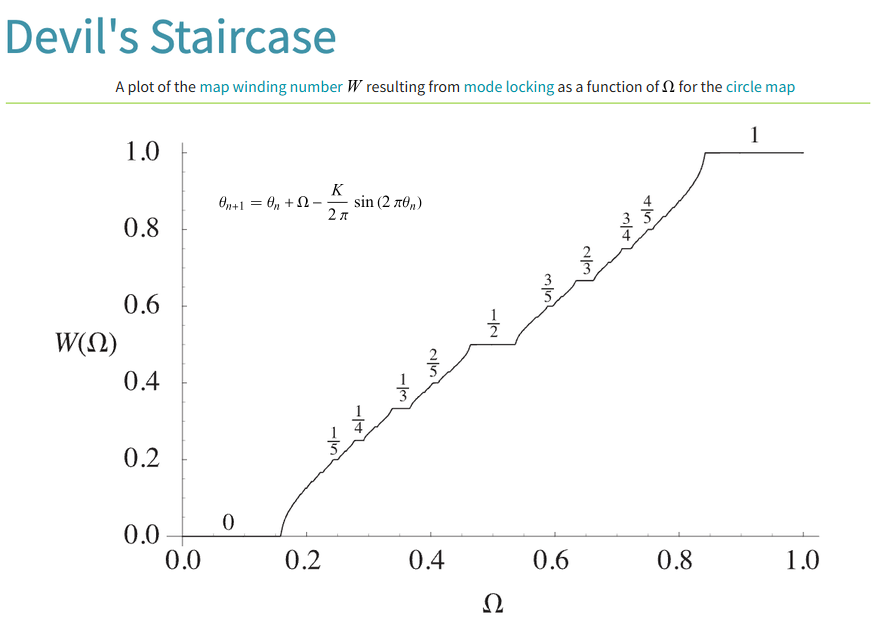
Furthermore, we discuss parallels to fractal phenomena in chaos theory, particularly the devil’s staircase (also known as the Cantor function). The devil’s staircase is a non-decreasing function from [0,1] to [0,1] that is constant on intervals complementary to a Cantor set and increases only on the Cantor set itself, resulting in a structure with plateaus separated by jumps [10]. In dynamical systems, it manifests in various contexts, such as the rotation number as a function of the parameter in circle maps at the onset of chaos [11], where mode-locking intervals (plateaus) correspond to rational rotation numbers, and the Cantor set supports irrational windings leading to chaotic behavior. Similar structures appear in forced oscillators [12], Josephson junctions [13], chaotic scattering [14], and phase diagrams of Ising models [15] or renormalization group flows [16].
In our setting, the decomposition of the functional Alexandroff space into disjoint chains offers an analogy to this staircase: finite chains akin to plateaus yield periodic or quasi-periodic dynamics (non-chaotic), while infinite chains, like the Cantor set, provide the support for scrambled sets and sensitivity. For Li–Yorke chaos, a single infinite chain suffices to embed a chaotic subsystem, analogous to a jump in the staircase where entropy increases. For Devaney chaos, the presence of at least one infinite chain (implied by the injectivity and acyclicity conditions on an infinite space) suffices, evoking aspects of the fractal nature in continuous systems. This analogy underscores how structural discreteness in topology can replicate parameter-space fractality in continuous systems, though it is presented as heuristic motivation rather than rigorous evidence.
The paper is organized as follows: §2 reviews essential definitions and preliminaries. §3 presents the main results, decomposed into lemmas and propositions for clarity, with complete proofs. §4 provides illustrative examples. §5 concludes with a summary and directions for future research.
Throughout this paper, we assume that the index set \(X\) is countable. This ensures that the space \(K^X\) is compact and metrizable when \(K\) is finite and discrete.
Definition 1. A topological space \((X, \tau)\) is an Alexandroff space if the intersection of any family of open sets is open. Equivalently, every point \(x \in X\) has a minimal open neighborhood \(V(x)\).
Definition 2(Functional Alexandroff Space).Let \(\lambda : X \to X\) be a self-map. The topology \(\tau_\lambda\) is generated by the basis \(\{V(x) : x \in X\}\), where \(V(x) = \bigcup_{n \ge 0} \lambda^{-n}(\{x\})\). The space \((X, \tau_\lambda)\) is a functional Alexandroff space if it satisfies:
For all \(x, y \in X\), either \(V(x) \subseteq V(y)\), \(V(y) \subseteq V(x)\), or \(V(x) \cap V(y) = \emptyset\).
If \(V(x) \subseteq V(y)\), then for all \(z \neq x\), \(V(x) \neq V(z)\).
For all \(x, y \in X\), the set \(\{z \in X : V(x) \subseteq V(z) \subseteq V(y)\}\) is finite.
Definition 3(Generalized Shift Dynamical System).Let \(K\) be a finite discrete space with \(|K| \ge 2\), and \((X, \tau_\lambda)\) a functional Alexandroff space. The space \(K^X\) is equipped with the product topology, which is compact and metrizable (since \(X\) is countable). A compatible metric is given by \(d(z, w) = \sum\limits_{n=1}^\infty 2^{-n} \delta(z_{x_n}, w_{x_n})\), where \(\{x_n\}\) enumerates \(X\) and \(\delta(a,b) = 0\) if \(a=b\), \(1\) otherwise. The generalized shift is the map \(\sigma_\lambda : K^X \to K^X\) defined by \(\sigma_\lambda((z_t)_{t\in X}) = (z_{\lambda(t)})_{t\in X}\).
Definition 4(Devaney Chaos).A continuous map \(f : Y \to Y\) on a compact metric space \((Y, d)\) is Devaney chaotic if:
\(f\) is topologically transitive: for any nonempty open sets \(U, V \subseteq Y\), there exists \(n \ge 1\) such that \(f^n(U) \cap V \neq \emptyset\).
The set of periodic points of \(f\) is dense in \(Y\).
\(f\) has sensitive dependence on initial conditions: there exists \(\delta > 0\) such that for every \(x \in Y\) and every \(\epsilon > 0\), there exist \(y \in Y\) with \(d(x,y) < \epsilon\) and \(n \ge 1\) with \(d(f^n(x), f^n(y)) > \delta\).
Definition 5(Cellularity).The cellularity \(c^*(X, \tau) = \sup\{|A| : A\) is a collection of pairwise disjoint nonempty open sets in \((X, \tau)\}\). If the supremum is infinite, \(c^*(X, \tau) = \infty\).
Definition 6(Li-Yorke Chaos).A continuous map \(f : Y \to Y\) on a compact metric space \((Y, d)\) is Li–Yorke chaotic if there exists an uncountable set \(S \subseteq Y\) such that for any distinct \(x, y \in S\):
\(\liminf_{n\to\infty} d(f^n(x), f^n(y)) = 0\) (proximal),
\(\limsup_{n\to\infty} d(f^n(x), f^n(y)) > 0\) (distal).
We characterize Devaney and Li–Yorke chaos for the generalized shift \(\sigma_\lambda\) on functional Alexandroff spaces. The functional structure allows decomposition of \(X\) into disjoint chains (backward orbits under \(\lambda\)), on each of which \(\sigma_\lambda\) acts independently. The cellularity \(c^*(X, \tau_\lambda)\) equals the number of such chains.
Lemma 1(Transitivity).Let \((X, \tau_\lambda)\) be a functional Alexandroff space with \(X\) infinite and countable, \(K\) finite with \(|K| \ge 2\), and \(\sigma_\lambda : K^X \to K^X\) the generalized shift. Then \(\sigma_\lambda\) is topologically transitive if and only if \(\lambda\) is injective and has no periodic points.
Proof. \((\Rightarrow)\) Suppose \(\sigma_\lambda\) is transitive. First, show \(\lambda\) is injective. Suppose not; there exist distinct \(t_1, t_2 \in X\) with \(\lambda(t_1) = \lambda(t_2) = s\). Consider a configuration \(w \in K^X\) with \(w_{t_1} \neq w_{t_2}\) and arbitrary elsewhere. If there existed \(z \in K^X\) such that \(\sigma_\lambda(z) = w\), then \(z_s = w_{t_1}\) (since \(\sigma_\lambda(z)_{t_1} = z_s\)) and \(z_s = w_{t_2}\) (since \(\sigma_\lambda(z)_{t_2} = z_s\)), a contradiction since \(w_{t_1} \neq w_{t_2}\). Thus, \(\sigma_\lambda\) is not surjective, hence not transitive (as surjectivity is necessary for transitivity in compact spaces [3]). Next, show \(\lambda\) has no periodic points. Suppose \(\lambda\) has a periodic point \(p\) of period \(k \ge 1\), so \(\lambda^k(p) = p\) and \(k\) minimal. The cycle \(C = \{p, \lambda(p), \dots, \lambda^{k-1}(p)\}\) is invariant under \(\lambda\). The restriction \(\sigma_\lambda|_{K^C}\) is the cyclic shift on \(K^k\), which is not transitive for \(k \ge 2\) and \(|K| \ge 2\) (e.g., constant configurations do not mix with alternating ones). Since \(K^X = K^C \times K^{X \setminus C}\) and \(\sigma_\lambda = \sigma_C \times \sigma_{X \setminus C}\), the non-transitivity of \(\sigma_C\) implies non-transitivity of \(\sigma_\lambda\) (take cylinders \(U, V\) differing only on \(C\) in non-mixing ways). \((\Leftarrow)\) Assume \(\lambda\) is injective and has no periodic points. Then the graph of \(\lambda\) consists of disjoint infinite paths (either \(\mathbb{Z}\)-type or \(\mathbb{N}\)-type rays), as injectivity ensures in-degree \(\le 1\), totality ensures out-degree \(1\), and acyclicity prevents cycles or finite paths. The functional conditions ensure these are linear chains without branches. Thus, \(X = \bigsqcup_{j \in J} C_j\) where each \(C_j\) is an infinite chain, and \(K^X = \prod_{j \in J} K^{C_j}\) with \(\sigma_\lambda = \prod_{j \in J} \sigma_{C_j}\), where each \(\sigma_{C_j}\) is a one-sided or two-sided full shift on \(K^{C_j}\), which is transitive [3]. The product of transitive maps is transitive [11]. ◻
Lemma 2(Sensitive Dependence).Under the assumptions of Lemma 1 with \(\lambda\) injective and no periodic points, \(\sigma_\lambda\) has sensitive dependence on initial conditions.
Proof. Since \(\lambda\) is injective with no periodic points and \(X\) infinite, there is at least one infinite chain \(C\), so the subsystem \((K^C, \sigma_C)\) has topological entropy \(h_{\mathrm{top}}(\sigma_C) = \log |K| > 0\) [3]. Thus, \(h_{\mathrm{top}}(\sigma_\lambda) \ge \log |K| > 0\). By Lemma 1, \(\sigma_\lambda\) is transitive. In a transitive continuous dynamical system on a compact metric space, positive topological entropy implies sensitive dependence on initial conditions [17]. ◻
Lemma 3(Density of Periodic Points).Under the assumptions of Lemma 1 with \(\lambda\) injective and no periodic points, the periodic points of \(\sigma_\lambda\) are dense in \(K^X\).
Proof. Basic open sets in \(K^X\) are cylinders: for finite \(S \subset X\) and assignment \(a: S \to K\), the cylinder \([a]_S = \{z \in K^X : z|_S = a\}\). To show density, for any cylinder \([a]_S\), find a periodic point \(p\) in any given smaller cylinder around a point in \([a]_S\); since cylinders form a basis, it suffices to approximate arbitrary cylinders with periodic points. Decompose \(X = \bigsqcup C_j\) into chains. \(S\) intersects finitely many chains, say \(C_1, \dots, C_m\). On each \(C_i\), the support \(S_i = S \cap C_i\) is finite. Since each \(C_i\) is infinite (no periodic points), choose \(k\) large enough so that on each \(C_i\), the sets \(\{\lambda^{l k}(S_i) : l \in \mathbb{Z}\}\) (or \(\mathbb{N}\) for rays) are disjoint for \(|l| < M\) for large \(M\). Construct \(p\) periodic of period \(k\): on each chain \(C_i\) intersecting \(S\), assign values on the orbit segments consistent with \(a\) on \(S_i\) and repeating every \(k\) steps. Extend periodically along the infinite chain. On chains not intersecting \(S\), assign arbitrary constant values (periodic). The product topology ensures \(p\) agrees with \(a\) on \(S\), hence dense. ◻
Theorem 1. Let \((X, \tau_\lambda)\) be a functional Alexandroff space with \(X\) infinite and countable, \(K\) finite with \(|K| \ge 2\), and \(\sigma_\lambda : K^X \to K^X\) the generalized shift. Then \((K^X, \sigma_\lambda)\) is Devaney chaotic if and only if \(\lambda\) is injective and has no periodic points.
Proof. If Devaney chaotic, then transitive, so by Lemma 1, \(\lambda\) injective with no periodic points. If \(\lambda\) injective with no periodic points, then transitive by Lemma 1, sensitive by Lemma 2, dense periodic points by Lemma 3. ◻
Corollary 1. If \((X, \tau_\lambda)\) is finite, then \(\sigma_\lambda\) is not Devaney chaotic.
Proof. Finite \(X\) implies existence of periodic points or non-injectivity for \(\lambda\), contradicting Theorem 1. ◻
Proposition 1(Necessity for Li–Yorke Chaos).If all forward orbits under \(\lambda\) are finite, then \(\sigma_\lambda\) is not Li–Yorke chaotic.
Proof. Finite orbits mean every point is eventually periodic under \(\lambda\). The space decomposes into finite chains leading to cycles. Configurations on cycles are eventually periodic, and the dynamics is quasi-periodic. For distinct \(x, y \in K^X\), if they agree on tails of chains, orbits become asymptotic (\(\lim d(\sigma_\lambda^n(x), \sigma_\lambda^n(y)) = 0\)); if not, they may be proximal periodically but lack an uncountable set with both proximal and distal properties simultaneously, as the cardinality of variations is bounded by finite supports. Thus, no uncountable scrambled set exists [7]. ◻
Proposition 2(Sufficiency for Li–Yorke Chaos).If there exists at least one point \(t \in X\) with infinite forward orbit under \(\lambda\), then \(\sigma_\lambda\) is Li–Yorke chaotic.
Proof. The infinite orbit \(O = \{\lambda^n(t) : n \ge 0\}\) forms an infinite ray \(C \cong \mathbb{N}\). The restriction \(\sigma_\lambda|_{K^C}\) is the one-sided full shift, which is Li–Yorke chaotic with an uncountable scrambled set \(S_C\) constructed via alternating blocks of agreement and disagreement [4, 5]. Extend to \(S \subset K^X\) by setting constant symbols (say fixed \(k_0 \in K\)) outside \(C\). For \(x, y \in S\) corresponding to \(x_C, y_C \in S_C\), \(d(x,y) = d_C(x_C, y_C)\) (where \(d_C\) is the metric restricted to \(C\)), preserving proximality and distality in the product metric. ◻
Theorem 2. Let \((X, \tau_\lambda)\) be a functional Alexandroff space with \(X\) countable, \(K\) finite with \(|K| \ge 2\), and \(\sigma_\lambda : K^X \to K^X\) the generalized shift. Then \((K^X, \sigma_\lambda)\) is Li–Yorke chaotic if and only if there exists at least one point \(t \in X\) whose forward orbit under \(\lambda\) is infinite.
Proof. Follows directly from Propositions 1 and 2. ◻
Remark 1. Devaney chaos implies Li–Yorke chaos, as injectivity and absence of periodic points on infinite \(X\) imply infinite orbits.
To illustrate the theoretical results presented in Section 3, we provide a series of examples that validate the characterizations of Devaney and Li–Yorke chaos in generalized shift systems on functional Alexandroff spaces. Each example includes explicit computations of the topology \(\tau_\lambda\), the chain decomposition, the cellularity \(c^*(X, \tau_\lambda)\), and verifications of the conditions for chaos, with references to the relevant theorems and lemmas.
Example 1 (Finite Chain with Fixed Point: Absence of Chaos).Consider \(X = \{1,2,3\}\) with \(\lambda(1)=1\), \(\lambda(2)=1\), \(\lambda(3)=2\). The minimal neighborhoods are: \[V(1) = \bigcup_{n=0}^\infty \lambda^{-n}(\{1\}) = \{1\} \cup \{1,2\} \cup \{1,2,3\} = \{1,2,3\},\] since \(\lambda^{-1}(\{1\}) = \{1,2\}\), \(\lambda^{-2}(\{1\}) = \lambda^{-1}(\{1,2\}) = \{1,2,3\}\) (as \(\lambda^{-1}(\{2\}) = \{3\}\)), and higher preimages stabilize. Similarly, \[V(2) = \{2\} \cup \{3\} = \{2,3\}, \quad V(3) = \{3\}.\]
The inclusion relations \(V(3) \subset V(2) \subset V(1)\) satisfy the functional Alexandroff conditions: chains are linear and finite, with distinct neighborhoods for distinct points. The space decomposes into a single chain \(C = \{3 \to 2 \to 1\}\), yielding \(c^*(X, \tau_\lambda) = 1\). The map \(\lambda\) has a periodic point (1, period 1) and is not injective (\(\lambda(1) = \lambda(2)\)). By Lemma 1, \((\sigma_\lambda, K^X)\) is not transitive, hence not Devaney chaotic (Theorem 1). All forward orbits are finite: \(orb(1) = \{1\}\), \(orb(2) = \{1,2\}\), \(orb(3) = \{1,2,3\}\), so not Li–Yorke chaotic (Theorem 2).
Example 2(Countable Union of Fixed Points: Absence of Li–Yorke Chaos).Let \(X = \{p_m : m \in \mathbb{N}\}\) with \(\lambda(p_m) = p_m\) for all \(m\). Each \(V(p_m) = \{p_m\}\), forming disjoint singletons. The decomposition is into infinitely many finite chains (length 1), so \(c^*(X, \tau_\lambda) = \infty\). All orbits are finite (period 1). The system \((\sigma_\lambda, K^X)\) is a product of constant maps on singletons, yielding periodic dynamics with no sensitivity or scrambled sets. Thus, not Li–Yorke chaotic by Theorem 2.
Example 3(Two Fixed Points: Absence of Transitivity).Let \(X = \{a, b\}\) with \(\lambda(a) = a\), \(\lambda(b) = b\). Then \(V(a) = \{a\}\), \(V(b) = \{b\}\), disjoint chains, \(c^*(X, \tau_\lambda) = 2\). Although \(\lambda\) is injective, orbits are finite. The shift \(\sigma_\lambda\) acts independently on \(K^{\{a\}} \times K^{\{b\}}\), preserving components, so not transitive (Lemma 1).
Example 4(One-Sided Infinite Shift: Presence of Devaney and Li–Yorke Chaos). Let \(X = \mathbb{N} = \{1,2,3,\dots\}\) with \(\lambda(n) = n+1\). The neighborhoods are \(V(n) = \{n, n+1, n+2, \dots\}\), forming a single infinite chain \(C = \mathbb{N}\) (backward ray), \(c^*(X, \tau_\lambda) = 1\). The map \(\lambda\) is injective with no periodic points, and forward orbits are infinite (e.g., \(orb(1) = \mathbb{N}\)). This induces the one-sided full shift \((\sigma_\lambda, K^\mathbb{N})\), which is Devaney chaotic [3] (Theorem 1) and Li–Yorke chaotic (Theorem 2).
Example 5(Two-Sided Infinite Shift: Presence of Devaney and Li–Yorke Chaos).Let \(X = \mathbb{Z}\) with \(\lambda(n) = n+1\). The neighborhoods \(V(n) = \{\dots, n-1, n\}\) (left ray to \(n\)). Inclusions \(V(n) \subset V(m)\) for \(n \le m\), with finite intermediates \(\{z : n \le z \le m\}\), satisfy functional conditions. Single infinite chain \(\mathbb{Z}\), \(c^*(X, \tau_\lambda) = 1\). Injective, acyclic \(\lambda\) yields the two-sided full shift, Devaney chaotic [3] (Theorem 1).
Example 6(Finite Index Set: Absence of Chaos).For finite \(X\), any \(\lambda: X \to X\) has periodic points by the pigeonhole principle (or non-injectivity if not surjective). Thus, not Devaney chaotic (Corollary 3.5). Finite orbits imply no Li–Yorke chaos (Theorem 2).
Example 7(Disjoint Finite Cycles: Absence of Li–Yorke Chaos).Let \(X = \{1_a, 2_a\} \sqcup \{1_b, 2_b\}\) with cycles \(\lambda(1_a)=2_a\), \(\lambda(2_a)=1_a\), similarly for \(b\). Two disjoint chains (cycles), \(c^*(X, \tau_\lambda)=2\). Finite periodic orbits yield product of cyclic shifts on finite sets, periodic dynamics without scrambled sets, hence not Li–Yorke chaotic (Theorem 2).
Example 8(Countable Union of Infinite Chains: Presence of Devaney Chaos).Let \(X = \bigsqcup_{m \in \mathbb{N}} \mathbb{N}_m\) with \(\lambda(n_m) = (n+1)_m\). Each \(\mathbb{N}_m\) is an infinite ray, disjoint, \(c^*(X, \tau_\lambda) = \infty\). The map \(\lambda\) is injective and acyclic. The system is a product of one-sided shifts, transitive (product of transitive maps [11]), with positive entropy and dense periodic points, hence Devaney chaotic (Theorem 1).
We have characterized Devaney and Li–Yorke chaos in generalized shifts on functional Alexandroff spaces, with complete proofs utilizing the chain decomposition. The conditions highlight topological structures fostering chaos, with analogies to the devil’s staircase providing intuition for how discrete chains parallel fractal routes to chaos. Future work could investigate distributional chaos [18], exact entropy computations [19], or applications in computational topology [20].