
This paper presents a formal mathematical analysis of the structural logic underlying musical scales, focusing on the theoretical tension between Pythagorean tuning and Equal Temperament. Moving beyond a purely historical survey, the study adopts a mathematical-deductive framework to demonstrate how musical pitch systems emerge from fundamental arithmetic principles and the recursive generation of intervals.
Taking a deeper perspective, we must determine whether these “musical numbers” emerge from a coherent underlying algorithm or if they constitute merely an arbitrary list without internal mechanisms. If a scale is to be more than a collection of frequencies, it must possess an intrinsic structure.
We will introduce mathematical algorithms designed to generate a musically coherent harmonic system and examine how specific recursive processes define the internal geometry of a scale, moving from a simple inventory of pitches to a rigorous study of structural properties.
While the core subjects addressed here are well-established and part of a long historical tradition, this study places significant emphasis on their formal presentation. We believe that an innovative perspective on the two most prominent sound systems – Pythagorean and equal-tempered – can reveal deeper insights into their internal logic.
The history of music theory is characterized by a vast and heterogeneous landscape of tuning systems, reflecting a diverse array of cultural, geographical, and aesthetic priorities. From the complex microtonal divisions of Arabic maqam1 to the shifting temperaments of the European Renaissance, the search for a definitive organization of pitch has produced countless solutions. However, in the present study, we focus on the two systems that most transparently emerge from mathematical first principles: Pythagorean Tuning and Equal Temperament. These two models represent the polarities of musical thought – rational purity versus geometric symmetry – and provide the essential theoretical keys to framing the broader evolution of musical scales.
The mathematical framing of the “Octave Principle” finds its historical root in the Pythagorean tetraktys – the arithmetic progression of the first four natural numbers (\(1, 2, 3, 4\)). In the Pythagorean tradition, these numbers represented the mathematical perfection of the cosmos. When applied to acoustics, the ratios between them define the perfect consonances: the \(2:1\) (diapason), the \(3:2\) (diapente), and the \(4:3\) (diatessaron).
The term “fifth” derives from the ancient Greek dia pente (literally “through five”). This name reflects the internal structure of the diatonic scale: the interval from C to G, for instance, encompasses five notes (C-D-E-F-G). For millennia, following the legacy of Boethius’s De Institutione Musica (c. 510 AD) [1], Western theory maintained that only these simple integer ratios reflected the divine order of the “Music of the Spheres.”
The transition from the rational ratios of the Greeks to the formal mathematical definition of Equal Temperament represents one of the most significant paradigm shifts in musicology. While various “well-tempered” approximations existed in practice to mitigate the acoustic discrepancies of keyboard instruments (as documented by Gioseffo Zarlino in his treatise [2]), the exact formulation using irrational numbers emerged only in the late 16th century.
Prince Zhu Zaiyu in China (1584) provided the first precise calculation of the 12th root of 2 (\(\sqrt[12]{2}\)), a feat mirrored in Europe by the mathematician Simon Stevin [3] and later formalized by Marin Mersenne in his monumental work [4].
The centuries-long delay in adopting this model was due to two both a computational hurdle and a philosophical barrier:
before John Napier’s invention of logarithms in 1614, calculating \(\sqrt[12]{2}\) with high precision was an arduous task; without the logarithmic shortcut, extracting successive roots required complex manual algorithms, making a rigorous numerical definition nearly impossible for instrument makers.
In the Pythagorean worldview, an irrational number was unreasonable (“alogos”). To accept \(\sqrt[12]{2}\) meant deliberately “tempering” (distorting) the divine \(3:2\) ratio to close the circle of fifths.The eventual triumph of Equal Temperament marked the shift from a cosmological view of music to one of practical utility, granting the modulatory freedom that defines modern Western composition.
The tension between Pythagorean Tuning and Equal Temperament has been extensively documented. Fundamental analyses can be found in [5], where Helmholtz addressed the psychoacoustic implications of tuning discrepancies. The comparative study of these systems was significantly advanced by Alexander J. Ellis [6] who, in his 1885 translation of Helmholtz, introduced the cents system. This logarithmic scale provided the first standardized mathematical tool to precisely measure the discrepancies between equal-tempered intervals and their Pythagorean counterparts. More recently, a significant reference is [7]: although Partch dismisses Equal Temperament, his work provides an exhaustive analysis of the tension between the purity of rational numbers in just intonation and the compromises of tempered systems. Another fundamental text is [8], particularly regarding the application of continued fractions to 12, 31, and 53-tone systems, bridging the gap between historical temperaments and digital acoustics.
The concept of bracketing refers to the capacity of a tuning system to frame an equal-tempered pitch between two rational limits – typically Pythagorean or just ratios – effectively “anchoring” the irrational value within a defined harmonic boundary. Within technical literature, this phenomenon is often analyzed through the frameworks of continued fractions or microtonal approximation theory. A primary reference for this structural approach is [9], which illustrates how the 31-tone system effectively brackets natural major thirds within the boundaries defined by Pythagorean fifths, serving as a containment structure for intervals that would otherwise diverge. Similarly, in his influential dissertation [10], J. Mandelbaum examines how 31- and 53-tone systems organize harmonic resources. He highlights how the grid of the Mercator system (53-TET)2 is sufficiently dense to allow a single equal-tempered pitch to serve as a viable approximation for multiple adjacent Pythagorean ratios through this interlocking bracketing effect.
This structural density is further defended by M. Vogel in [11], who describes the 53-tone system’s capacity to capture nearly every interval of the harmonic series. Vogel interprets the equal-tempered framework as a tool for bringing Pythagorean pitches within a manageable and theoretically coherent configuration. Finally, the studies by Rasch [12] regarding the transition from Pythagorean systems to multiple Equal Temperaments provide the necessary mathematical rigor to define the boundaries within which an equal-tempered tone acts as an effective approximation of a pure interval. This consolidates the idea of the tempered system not merely as a compromise, but as a functional “harmonic envelope” that stabilizes the complexity of natural ratios. Sethares [13] offers a modern computational perspective on how tempered intervals approximate pure ratios. By analyzing the “sensory dissonance” curves, he justifies the use of 12-TET and other equal divisions as optimal structures that minimize dissonance while maximizing harmonic possibilities, a concept that aligns with the structural density of the systems discussed by Vogel and Mandelbaum.
The present study is organized as follows. We begin in §2 by establishing the foundational musical concepts necessary to provide a clearer insight into the subsequent analysis. These premises will certainly be familiar to those with a musical background and helpful for those with less experience. Our formal effort (which may be unusual) is intended to demonstrate that the primary concepts stem directly from the Octave Principle. This principle clarifies why the appropriate metric for musical distance is the ratio rather than linear difference.
In §3, we shift to the mathematical modeling of pitch systems. Diverging from the chronological order of history, we first present Equal Temperament, as it offers the most transparent and systematic axiomatic structure. Subsequently, we introduce the mathematics underlying the Pythagorean system, which is profoundly compelling from a conceptual standpoint yet presents significant practical challenges in its concrete musical implementation. For both systems, we provide a musical interpretation of their characterizing mathematical properties. The final part of §3 is dedicated to recalling the method of continued fractions and convergents to address the classical problem of approximating a given number of octaves with cycles of fifths. The formal framework we have adopted – which is, in our view, straightforward and efficient – is based on the alternating property of under – and over-approximations within the sequence of convergents. The topics discussed in this Section are certainly well-known and widely documented in the literature. The strength and slight innovation we claim lie in a presentation that privileges a mathematical perspective, developing concepts deductively and gathering the algebraic properties of both the Equal-tempered and Pythagorean systems (while commenting on their musical implications). To ensure the presentation is both self-contained and compelling, we found it useful to provide proofs for the various properties, nearly all of which are based on standard arguments from number theory.
In §4 we present our most significant findings by mapping the 12 equal-tempered tones against a bidirectional sequence of Pythagorean fifths. This analysis reveals not only a striking geometric symmetry and a compensatory relationship between pitch approximations but also a unique bracketing structure. This configuration offers an additional perspective on the mathematical robustness of the 12-tone scale, reinforcing the rationale behind its historical selection.
Finally, §5 provides concluding remarks and addresses a more general problem concerning the interaction between the Equal-tempered and Pythagorean systems, specifically regarding the “bracketing” of Pythagorean pairs around an Equal-tempered pitch.
The present section provides a concise presentation of the key musical principles and terminology that form the basis of our analysis.
At the heart of Jean-Philippe Rameau’s Traité de l’harmonie [14] lies the principle of the identity of octaves (identité des octaves). Rameau posits that the octave is a “replica3” of the fundamental unit, asserting that any pitch with a frequency4 \(f\) is essentially identical in nature to its multiples \(2^k f\), where \(k \in \mathbb{Z}\).
For Rameau these sounds are not merely similar; they are the same sonorous entity manifested across different registers. The ear perceives them as nearly indistinguishable, and a pitch outside one’s vocal or audible range is instinctively “replaced” by its octave equivalent.
This Principle is supported by two primary arguments:
Mathematical Simplicity: halving a vibrating string or pipe – the simplest possible physical division – doubles its frequency5. This reflects the Pythagorean view of a universe regulated by Number, where music is an exact science and a simple \(1:2\) ratio inevitably yields a “perfect” musical effect.
Physical Resonance: the first harmonic of any complex tone is its double frequency. The vibrational mode with a node at the string’s midpoint – vibrating at \(2f\) – is the first permitted mode after the fundamental. Thus, the octave is naturally embedded within the fundamental sound itself.
The universality of this Principle is evidenced by the convention of assigning the same name to equivalent pitches. For instance, a piano features eight “A” notes ranging from \(27.5\) Hz to \(3520\) Hz, all perceived as functionally identical. The term octave derives from the fact that, in the diatonic succession of seven sounds- C, D, E, F, G, A, B – the starting pitch recurs as the eighth note (C). This eighth position, often denoted as [C] to signify the completion of the cycle, possesses exactly double the frequency of the initial tone. This concept is a cross-cultural musical universal; even in Ancient Greece, the interval was termed dia pason (“through all”), signifying the completion of a cycle before encountering the starting pitch’s identity.
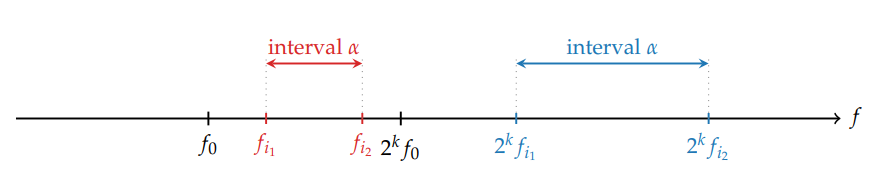
To establish a formal scale, we conceptualize the frequency spectrum as a continuous line. Given a reference frequency \(f_0\), we identify the sounds \(2^k f_0\) (where \(k \in \mathbb{Z}\)) as its octaves above and below:

As shown above, frequency intervals perceived as “equal” from a musical standpoint do not correspond to equal Euclidean lengths \(L\). The linear distance between \(2^k f_0\) and \(2^{k+1} f_0\) is \(2^k f_0\), which doubles at every octave. To treat these segments as equivalent, we must evaluate the ratio between boundary frequencies rather than their linear difference: \[\frac{2^{k+1} f_0}{2^k f_0} = 2 \quad \forall k \in \mathbb{Z}.\]
This principle extends to all intermediate frequencies. If \(f_{i_1}\) and \(f_{i_2}\) are two frequencies within the reference octave \([f_0, 2f_0]\), their counterparts in any other octave \([2^k f_0, 2^{k+1} f_0]\) will be \(2^k f_{i_1}\) and \(2^k f_{i_2}\). Since these pairs fulfill the same functional role within their respective scales, they must represent the same “distance.” This is realized by measuring the ratio, as: \[\frac{2^k f_{i_1}}{2^k f_{i_2}} = \frac{f_{i_1}}{f_{i_2}} \quad \text{for any} \; k \in \mathbb{Z}.\]
Graphically, the validity of the Principle of the Octave implies the equality of the segments highlighted below:
In the frequency domain, the significant metric for measuring distance is the ratio. We define the musical interval \(I\) between two frequencies \(f_{i_1}\) and \(f_{i_2}\) (where \(f_{i_2} \geq f_{i_1}\)) as: \[\label{interv} I(f_{i_1}, f_{i_2}) = \dfrac{f_{i_2}}{f_{i_1}}.\]
This definition ensures that \(I(2^k f_{i_1}, 2^k f_{i_2}) = I(f_{i_1}, f_{i_2})\), preserving the identity of intervals across different registers. Common examples include the unison (\(I = 1\)) and the octave (\(I = 2\)).
Remark 1. The recognition of a musical melody depends strictly on these ratios rather than absolute frequencies. Thus, the interval possesses greater structural and cognitive significance than the absolute pitch. This explains why the human perception of pitch is logarithmic: equal musical intervals correspond to equal differences in the logarithms of their frequencies.
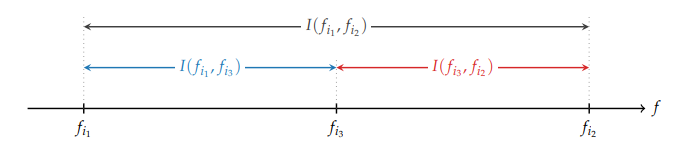
Defining the interval as a ratio (1) leads to a fundamental property of interval composition: the “sum” of two adjacent musical intervals corresponds to the mathematical product of their ratios. If an interval \(I(f_{i_1}, f_{i_2})\) includes an intermediate frequency \(f_{i_3}\) (where \(f_{i_1} \leq f_{i_3} \leq f_{i_2}\)), then: \[\label{sommainterv} I(f_{i_1}, f_{i_2}) = I(f_{i_1}, f_{i_3}) \cdot I(f_{i_3}, f_{i_2}) = \frac{f_{i_3}}{f_{i_1}} \cdot \frac{f_{i_2}}{f_{i_3}} = \frac{f_{i_2}}{f_{i_1}}. \tag{2}\]
When representing intervals graphically, it becomes clear that a segment formed by the juxtaposition of two adjacent musical distances has a total length equal to the product of its components:
This multiplicative property remains consistent even across multiple octaves. For example, combining an interval of two octaves (\(2^2\)) with one of three octaves (\(2^3\)) yields a total distance of five octaves: \[I(f_0, 4f_0) \cdot I(4f_0, 32f_0) = 4 \cdot 8 = 32 = 2^5.\]
Within the framework of a scale \([f_0, 2f_0]\), any interval \(I\) is bounded by the unison and the octave (\(1 \leq I \leq 2\)). Consequently, the tuning system of the scale can be fully defined in two equivalent ways:
By the \(N\) ratios between consecutive frequencies: \[\label{gradi} G_1 = \frac{f_1}{f_0}, \quad G_2 = \frac{f_2}{f_1}, \quad \dots, \quad G_N = \frac{2f_0}{f_{N-1}}, \tag{3}\] which represent the steps of the scale.
By the \(N-1\) intervals that each sound forms with the fundamental \(f_0\): \[\label{intervalliscala} S_1 = \frac{f_1}{f_0}, \quad S_2 = \frac{f_2}{f_0}, \quad \dots, \quad S_{N-1} = \frac{f_{N-1}}{f_0}, \tag{4}\] which represent the scale degrees or relative intervals.
Given \(f_0\) and the octave \(f_N = 2f_0\), only \(N-1\) intermediate values \(f_1, \dots, f_{N-1}\) are required to derive both the steps \(G_n\) and the degrees \(S_n\). This mathematical structure ensures that any transposed scale \([2^k f_0, 2^{k+1} f_0]\) is partitioned by identical ratios, maintaining an invariant internal geometry across all octaves for any \(k \in \mathbb{Z}\).
Based on the common foundation of the Octave Principle, the formation of a specific scale depends on the choice of \(N\) (the number of notes) and the definition of the steps \(G_n\) (3). These selections are generally guided by two distinct criteria:
(A) Cultural and Structural Context (\(N\)). The value of \(N\) is typically established by a musical culture or genre. Western music has predominantly standardized \(N=12\), meaning that after twelve steps from a starting frequency \(f_0\), one reaches the octave \(2f_0\). This is physically evident in the twelve keys (including chromatic tones) required to span an octave on a piano or the twelve frets on a guitar. While \(N=12\) defines the chromatic scale, other systems are equally viable: \(N=5\) produces the pentatonic scale, \(N=6\) the whole-tone scale, and \(N=7\) the diatonic and various modal or non-Western scales.
(B) Tuning and Mathematical Constraints (\(G_n\)). Within a chosen \(N\), fixing the steps \(G_1, \dots, G_N\) constitutes the act of tuning. Historically, this has moved between two paradigms: an arithmetic approach, where intermediate frequencies are derived from simple integer ratios based on \(f_0\), and a practical approach designed to resolve the mechanical and harmonic limitations of fixed-pitch instruments.
The choice of \(N\) is a cultural phenomenon; there are no spontaneous mathematical reasons that dictate a universal number of sounds. However, point (B) – the determination of specific pitch values – is intrinsically linked to mathematics. Historically, addressing this issue in purely arithmetic terms essentially involves a choice between rational and irrational numbers.
This section examines two significant scale constructions through a mathematical lens, highlighting the specific axioms and properties that define each system beyond the fundamental Octave Principle. In an overall view, the mathematical framework underlying the two musical systems, Equal Temperament and Pythagorean Tuning, can be outlined as follows:
Octave principle \(+\) equal scale partitioning: Equal Temperament,
Octave principle \(+\) inclusion of \(3^n f_0\) pitches: Pythagorean tuning.
From a mathematical perspective, the simplest way to establish a scale is to arrange the frequencies \(f_0\), \(f_1\), \(\dots\), \(f_N=2f_0\) equidistantly (in the sense of the distance defined in (1)) within the interval \([f_0, 2f_0]\). The case \(N=1\) is meaningless, hence we set \(N \geq 2\). Equidistance amounts to requiring that the steps \(G_1, \dots, G_N\) from (3) are all equal to a positive number \(r\): \[G_1=G_2=\dots=G_N=r \quad \text{or} \quad \frac{f_1}{f_0}=\frac{f_2}{f_1}=\dots = \frac{2f_0}{f_{N-1}}=r.\]
To calculate \(r\), one can write, for example \(2=\frac{2f_0}{f_0}=\frac{2f_0}{f_{N-1}} \frac{f_{N-1}}{f_{N-2}}\dots\frac{f_2}{f_1}\dfrac{f_1}{f_0}=r^N\) from which \(r=2^{1/N}\).
In order to obtain the values (4), we use the rule (2) starting from \(S_1=\dfrac{f_1}{f_0}=r=2^{1/N}\): \[S_2=\dfrac{f_2}{f_0}=\dfrac{f_2}{f_1}\dfrac{f_1}{f_0}=r^2 =2^{2/N}, \quad S_3=\dfrac{f_3}{f_0}=r^3=2^{3/N}, \quad \cdots\quad S_{N-1}=\dfrac{f_{N-1}}{f_0}=r^{N-1}=2^{(N-1)/N}, \tag{5}\] and finally, as a confirmation, \(S_N=\dfrac{2f_0}{f_0}=r^N=2\). In a compact form, we can write \[\label{ognifreq} f_k=2^{k/N} f_0, \qquad k=0,1,\dots, N.\]
To obtain the complete range of equal-tempered sounds generated by \(f_0\), according to the Octave Principle, the set (5) must be replicated across each octave by multiplying it by (positive and negative) powers of \(2\). Therefore, the set of equal-tempered sounds generated by the fundamental frequency \(f_0\) is defined as: \[\label{scalatemp} {\mathbb T}_N(f_0)=\left\{ f\in {\mathbb R}\,|\,f=f_{m,k}:=2^{m+k/N}f_0, \;k\in { 0, 1, \dots, N-1}, \; m \in {\mathbb Z} \right\}. \tag{6}\]
Notice that the value \(k=N\) is excluded to avoid redundancy, since \(f_{m,N} = 2^{m+N/N}f_0 = 2^{m+1}f_0 = f_{m+1,0}\). The frequency \(f_{m,k}\) is thus characterized by two discrete parameters:
\(m\): the octave index, determining the frequency range \([2^m f_0, 2^{m+1} f_0)\);
\(k\): the step index, representing the number of equal-tempered intervals (\(2^{1/N}\)) added to the \(m\)-th octave.
We emphasize the following mathematical properties of the set \({\mathbb T_N}(f_0)\).
Uniqueness. Each frequency \(f_{m,k} \in {\mathbb T}_N(f_0)\) is uniquely determined by the pair of indices \((m, k)\), where \(m \in \mathbb{Z}\) and \(k \in \{0, 1, \dots, N-1\}\).
Proof. Suppose \(f_{m_1,k_1} = f_{m_2,k_2}\). This implies \(2^{m_1 + k_1/N} = 2^{m_2 + k_2/N}\), which leads to \[m_1 – m_2 = \frac{k_2 – k_1}{N}.\]
The left-hand side is an integer, so the right-hand side must also be an integer. However, since both \(k_1\) and \(k_2\) are in the range \([0, N-1]\), their difference satisfies \(|k_2 – k_1| < N\). The only integer in the interval \((-1, 1)\) is zero; thus, we must have \(k_2 – k_1 = 0\), which implies \(k_1 = k_2\). Consequently, \(m_1 – m_2 = 0\), leading to \(m_1 = m_2\).
Irrationality. The normalized frequencies \(f_{m,k}/f_0=2^{m+k/N}\), with \(k \in \{1, \dots, N-1\}\) and \(m \in \mathbb{Z}\), are all irrational for any integer \(N \geq 2\).
Proof. Assume \(2^{m+k/N} = p/q\) for some \(p, q \in \mathbb{Z}^+\). Elevating both sides to the power of \(N\), we obtain \(2^{Nm+k} = p^N/q^N\), which implies \[q^N \cdot 2^{Nm+k} = p^N.\]
By the Fundamental Theorem of Arithmetic, the exponent of the prime factor 2 must be a multiple of \(N\) on both sides. Let \(v_2(n)\) be the 2-adic valuation (the exponent of the highest power of 2 in the prime factorization of \(n\)). On the right side, the exponent is \(v_2(p^N) = N \cdot v_2(p)\), which is a multiple of \(N\). On the left side, the exponent is \[v_2(q^N \cdot 2^{Nm+k}) = N \cdot v_2(q) + Nm + k.\]
Since \(1 \le k < N\), this sum cannot be a multiple of \(N\), leading to a contradiction. \(\square\)
Discreteness. The set (6) is a discrete subset of \(\mathbb{R}^+\). A subset \(S \subseteq \mathbb{R}\) is discrete if every point \(s \in S\) is an isolated point; that is, there exists a neighborhood \(U\) of \(s\) such that \(U \cap S = \{s\}\). In our case, for any \(f \in {\mathbb T}_N(f_0)\), the distance to the nearest neighbor is at least \[\Delta f \ge f \left( 2^{1/N} – 1 \right) > 0.\]
This ensures that no point of the set is an accumulation point.
Geometric sequence. When ordered, the elements of \({\mathbb T}_N(f_0)\) constitute a geometric progression with common ratio \(q = 2^{1/N}\). The natural ordering consists of arranging the elements \(f_{m,k}\) lexicographically by the index pair \((m, k)\). Specifically, for any two frequencies \(f_{m_1, k_1}\) and \(f_{m_2, k_2}\), we set \(f_{m_1, k_1} < f_{m_2, k_2}\) if \(m_1 < m_2\), or \(m_1 = m_2\) and \(k_1 < k_2\). Under this ordering, each element is obtained by multiplying the preceding one by \(2^{1/N}\), effectively mapping the discrete steps of the scale to a continuous exponential growth.
Partition of \(\mathbb{R}^+\) into equal-tempered sets. The following properties
\(f_1 \in {\mathbb T}_N(f_2) \iff f_2 \in {\mathbb T}_N(f_1)\),
If \({\mathbb T}_N(f_1) \cap {\mathbb T}_N(f_2) \neq \emptyset\), then \({\mathbb T}_N(f_1) = {\mathbb T}_N(f_2)\),
entail that the “membership in the same equal-tempered set” relation constitutes an equivalence relation over \(\mathbb{R}^+\). In algebraic terms, each set \({\mathbb T}_N(f_0)\) is an equivalence class of the multiplicative quotient group \(\mathbb{R}^+ / \langle 2^{1/N} \rangle\), where \(\langle 2^{1/N} \rangle\) is the cyclic subgroup generated by the \(N\)-th root of 2, defined as: \[\langle 2^{1/N} \rangle = \{ 2^{z/N} : z \in \mathbb{Z} \}.\]
This subgroup represents the set of all possible intervals (expressed as frequency ratios) that can be formed using the fundamental step of the \(N\)-tone Equal Temperament.
Transpositional invariance. Consider an arbitrary subset \(S \subset {\mathbb T}_N(f_0)\) and, for a fixed integer \(\tau \in \mathbb{Z}\), define the transposed set \[\label{trset}S_\tau = \left\{ r^\tau f \mid f \in S \right\}, \tag{7}\] generated by shifting each element of the original set forward (\(\tau > 0\)) or backward (\(\tau < 0\)) by \(|\tau|\) steps of the common ratio \(r = 2^{1/N}\). Then, the musical interval between any two elements \(f_1, f_2 \in S\) is preserved for the corresponding elements in \(S_\tau\): \[I(r^\tau f_1, r^\tau f_2) = \frac{r^\tau f_2}{r^\tau f_1} = \frac{f_2}{f_1} = I(f_1, f_2).\]
Remark 2. From an algebraic perspective, the transpositional invariance is a direct consequence of the multiplicative group structure of \((\mathbb{R}^+, \cdot)\). Since \({\mathbb T}_N(f_0)\) is a coset of the cyclic subgroup \(\langle r \rangle\), the transposition map \(T_\tau: f \mapsto r^\tau f\) is an automorphism (specifically, a translation in the group) that preserves the ratio between any two elements.
We examine the properties just listed from an acoustic-musical perspective.
Irrationality. Historically, the equal scale was criticized for using “unnatural” irrational numbers. Indeed, they do not align with the harmonic series or simple integer ratios traditionally used for obtaining consonant sounds. In plain terms, fitting \(N\) equal segments into the interval \([1,2]\) — where distance is defined as in (1) — provides a manageable finite set of sounds. However, these cannot be obtained through simple practical operations, such as integer string divisions, as they inherently involve irrational proportions.
Geometric sequence. The psychological foundation of the equal-tempered scale is rooted in its geometric progression. To achieve a uniform increase in perception, stimuli must follow a geometric progression, in accordance with Weber’s Law of psychophysics (see [15]). Although defined by irrational numbers, these intervals satisfy the human need for a linear, uniform progression in perceived pitch, mapping the logarithmic nature of our hearing onto an arithmetic-like grid.
Discreteness. This property is the mathematical prerequisite for the existence of distinct “notes” and musical notation. By ensuring that each element is an isolated point, the system provides the perceptual stability necessary for a musical language. The distance \(\Delta f\) guarantees that each pitch remains identifiable and distinct from its neighbors, preventing the sonic space from collapsing into a continuous, undifferentiated slide (glissando).
Partition of \(\mathbb{R}^+\) into equal-tempered sets. The “space of all possible sounds” is divided into infinitely many parallel equal-tempered systems. By choosing a reference frequency (e.g., \(A4 = 440\) Hz), we define the standard tempered system used in Western music. Any frequency not belonging to \(\mathbb{T}_{12}(440)\), such as \(441\) Hz, belongs to a different block of the partition — effectively a system that is either “out of tune” or shifted relative to the standard one.
Transpositional invariance. This property invites a fundamental observation. Let \(S\) be a finite set \(S\{ f_{i_1}, f_{i_2}, \dots, f_{i_\kappa}\}\): these sounds can represent a chord (if simultaneous), a melodic line (if sequential), a scale (if arranged in ascending order and governed by a specific rule), or the whole scale itself, if the increment is the constant interval \(r\).
Example 1.In the twelve-tone equal-tempered system (\(N=12\)), the following sets represent standard musical structures within a generic octave \(m \in \mathbb{Z}\): \[\begin{array}{ll} \{ f_{m,0}, f_{m,1}, \dots, f_{m,11}, f_{m+1,0}\} & \textrm{Chromatic scale}\\ \{ f_{m,0}, f_{m,2}, f_{m,4}, f_{m,5}, f_{m,7}, f_{m,9}, f_{m,11}, f_{m+1,0}\} & \textrm{Major diatonic scale}\\ \{ f_{m,0}, f_{m,2}, f_{m,3}, f_{m,5}, f_{m,7}, f_{m,8}, f_{m,10}, f_{m+1,0}\} & \textrm{Natural minor scale}\\ \{f_{m,0}, f_{m,4}, f_{m,7}\}, \;\{f_{m,0}, f_{m,3}, f_{m,7}\} & \textrm{Major chord, minor chord} \\ \{ f_{m,0}, f_{m,4}, f_{m,7}, f_{m,11}\}, \;\{ f_{m,0}, f_{m,3}, f_{m,6}, f_{m,9}\} & \textrm{Major 7th chord, diminished 7th chord}. \end{array}\]
Moreover, the first theme of Brahms’s Fourth Symphony can be described as a sequence of frequencies across octaves: \[\{f_{m,11}, f_{m,7}, f_{m,4}, f_{m+1,0}, f_{m,9}, f_{m,6}, f_{m,3}, f_{m,11}\}.\]
The use of the generic index \(m\) emphasizes that these musical structures are defined solely by the relative differences between the \(k\) indices, regardless of the absolute frequency range (the register) in which they are performed.
Each set of sounds is completely defined by the number of constant steps \(r\) between one frequency and the next; the transposition (7) applies the same succession of intervals starting from a different \(f_0\). Therefore, in the Equal Temperament system, up to a translation \(\tau\), there exists only one chromatic scale, only one major scale (leading to the common observation that “only one key exists”), only one major chord, and so forth.
The homogeneity of the equal-tempered scale ensures that scales and chords, when transposed to another key, do not change their distinctive internal relations. Similarly, from a melodic standpoint, a transposed melody traverses intervals of the same length; its structure remains unaltered, shifting only in pitch. A melody sounds identical regardless of the starting key.
In musical terms, this ensures that the internal structure of any melody or chord is invariant under shifting, making all \(N\) keys within the equal-tempered system functionally equivalent. The composer can therefore write in any key without facing constraints specific to any of them, and the performer can transpose sounds, melodies, and harmonies into the desired keys using simple arithmetic rules.
The atmosphere is now completely different: the structural practicality of equidistantly spacing the scale elements (in terms of ratio) is replaced by a Principle that essentially extends that of the octave. We embrace the presence, within the scale to be constructed, of the sound obtained by dividing the string into three equal parts or tripling its length. Starting from the fundamental frequency \(f_0\), we can employ the frequencies \(3f_0, 9f_0, 27f_0, \dots\) and \(\frac{1}{3}f_0, \frac{1}{9}f_0, \frac{1}{27}f_0, \dots\) or, more concisely: \[\label{3kf} 3^kf_0, \quad k\in {\Bbb Z}\;\textrm{integers}. \tag{8}\]
Eq. (8) may be referred to as the “Principle of the fifth” (see Introduction).
From the simultaneous validity of the octave and fifth principles, we deduce that the sound universe available from a fundamental frequency \(f_0\) is
\[\label{scalapit} {\mathbb P}(f_0) = \left\{f\in {\Bbb R}\,|\,f=p_{a,b}=2^a 3^b f_0, \; a,b \in \mathbb{Z}\right \}. \tag{9}\]
As with the equal-tempered set, we outline below the fundamental properties of \({\mathbb P}(f_0)\).
Uniqueness. Each frequency \(p_{a,b} \in {\mathbb P}(f_0)\) is uniquely determined by the pair of integers \((a, b)\).
Proof. Suppose there exist two pairs \((a_1, b_1)\) and \((a_2, b_2)\) such that \(p_{a_1, b_1} = p_{a_2, b_2}\). This implies:\[2^{a_1} 3^{b_1} f_0 = 2^{a_2} 3^{b_2} f_0 \implies 2^{a_1 – a_2} = 3^{b_2 – b_1}.\]By the Fundamental Theorem of Arithmetic, since 2 and 3 are distinct prime numbers, the only way for a power of 2 to equal a power of 3 is if both exponents are zero. Therefore, \(a_1 – a_2 = 0\) and \(b_2 – b_1 = 0\), which means \(a_1 = a_2\) and \(b_1 = b_2\). \(\;\square\)
Rationality. The normalized frequencies \(p_{a,b}/f_0 = 2^a 3^b\), with \(a, b \in \mathbb{Z}\), are all rational numbers. This property is an immediate consequence of the fact that the set \({\mathbb P}(f_0)\) is generated by integer bases. Since any integer power of 2 or 3 is an integer (for \(a, b \geq 0\)) or a unit fraction (for \(a, b < 0\)), their product necessarily belongs to the field of rational numbers \(\mathbb{Q}\).
Density. The set \({\mathbb P}(f_0)\) is a dense subset of \(\mathbb{R}^+\). This means that for any two frequencies \(f_1, f_2 \in \mathbb{R}^+\) with \(f_1 < f_2\), there exists at least one Pythagorean frequency \(p_{a,b}\) such that \(f_1 < p_{a,b} < f_2\).
Proof. To show that \({\mathbb P}(f_0)\) is dense in \(\mathbb{R}^+\), it suffices to show that the set of logarithms \(L = \{ \log_2(f/f_0) : f \in {\mathbb P}(f_0) \}\) is dense in \(\mathbb{R}\). For any \(f = 2^a 3^b f_0\), we have:\[\log_2(f/f_0) = a + b \log_2 3, \quad a,b \in \mathbb{Z}.\]We invoke Kronecker’s Theorem on Diophantine Approximation6 ([16], Theorem 439), which states that if \(\theta\) is an irrational number, then the set \(\{ a + b\theta : a,b \in \mathbb{Z} \}\) is dense in \(\mathbb{R}\). Since \(\log_2 3\) is irrational (as \(2^p = 3^q\) has no non-zero integer solutions by the Fundamental Theorem of Arithmetic), the set \(L = \{ a + b \log_2 3 : a,b \in \mathbb{Z} \}\) is dense in \(\mathbb{R}\). Because the mapping \(x \mapsto 2^x f_0\) is a homeomorphism from \(\mathbb{R}\) to \(\mathbb{R}^+\), it preserves density. Thus, \({\mathbb P}(f_0)\) is dense in \(\mathbb{R}^+\). \(\square\)
Partition of \(\mathbb{R}^+\) into equal-tempered sets. The same logic applies to the Pythagorean system. Specifically:
\(f_1 \in {\mathbb P}(f_2) \iff f_2 \in {\mathbb P}(f_1)\),
if two Pythagorean sets share a common frequency, they are identical: \(\mathbb{P}(f_1) \cap \mathbb{P}(f_2) \neq \emptyset \implies \mathbb{P}(f_1) \equiv \mathbb{P}(f_2)\).
Consequently, the relation “belonging to the same Pythagorean set” is an equivalence relation on \(\mathbb{R}^+\). In algebraic terms, \({\mathbb P}(f_0)\) is an equivalence class of the quotient group: \[\mathbb{R}^+ / \bigl\langle 2, 3 \bigr\rangle,\]where \(\langle 2, 3 \rangle\) is the multiplicative subgroup of \(\mathbb{R}^+\) generated by the primes 2 and 3: \[\langle 2, 3 \rangle = \{ 2^a 3^b : a, b \in \mathbb{Z} \}.\]
The family of all Pythagorean sets constitutes a partition of the frequency space \(\mathbb{R}^+\).
Non-closure. The set \({\mathbb P}(f_0)\) does not contain any frequency \(p_{a,b}\) that is an exact octave of \(f_0\), except for the trivial cases where \(b=0\). This is a direct consequence of the Fundamental Theorem of Arithmetic7: since \(2^a 3^b = 2^k\) implies \(3^b = 2^{k-a}\), the only integer solution is \(b=0\).
Transpositional invariance. Consider an arbitrary subset \(S \subset {\mathbb P}(f_0)\) and, for fixed integers \(\alpha, \beta \in \mathbb{Z}\), the transposed set: \[\label{trsetP}S_{\alpha,\beta} = \left\{ (2^\alpha 3^\beta) f \mid f \in S \right\},\] generated by shifting each element of the original set by \(\alpha\) octaves and \(\beta\) perfect fifths. Then, the distance (the interval ratio) between any two elements \(f_1, f_2 \in S\) is preserved for the corresponding elements in \(S_{\alpha,\beta}\): \[I(2^\alpha 3^\beta f_1, 2^\alpha 3^\beta f_2) = \frac{2^\alpha 3^\beta f_2}{2^\alpha 3^\beta f_1} = \frac{f_2}{f_1} = I(f_1, f_2).\]
Remark 3. Just as in the equal-tempered case, this property stems from the fact that \({\mathbb P}(f_0)\) is a coset of the multiplicative subgroup \(\langle 2, 3 \rangle\) within \((\mathbb{R}^+, \cdot)\). Any transposition \(T_{\alpha,\beta}: f \mapsto (2^\alpha 3^\beta)f\) is an automorphism of the group structure that preserves the relative ratios between elements.
The structural properties of the Pythagorean set \({\mathbb P}(f_0)\) lead to a musical landscape that is fundamentally different from the equal-tempered one, characterized by “pure” acoustic beauty but also by significant practical limitations. Broadly speaking, while the density of \(\mathbb{P}(f_0)\) offers infinite theoretical possibilities, it creates insurmountable practical hurdles.
Rationality and Natural Consonance. Unlike the irrational steps of Equal Temperament, the Pythagorean system is built on the ratio \(3/2\), which corresponds to the third harmonic of the natural harmonic series8. The simplicity of this integer ratio reflects the ancient Pythagorean ideal that harmony is rooted in the relationship between whole numbers. The perceived consonance between \(f_0\) and its multiples follows the simplicity of the ratio: the octave (\(2:1\)) and the fifth (\(3:2\)) represent the highest degrees of harmonic stability. This system ensures that perfect fifths are “pure” (beat-less).
Density and the Infinite Scale. The density of \({\mathbb P}(f_0)\) in \(\mathbb{R}^+\) implies that the Pythagorean system is, in principle, an infinite “open” system: musically, density implies that by continuing the cycle of fifths indefinitely, one can approximate any desired pitch with arbitrary precision. This means that a Pythagorean instrument would theoretically require an infinite number of strings or keys to maintain perfect intonation across all transpositions.
Non-closure. The mathematical fact that \(2^a 3^b \neq 2^k\) (for \(b \neq 0\)) implies that no sequence of perfect fifths will ever return exactly to an octave of the starting note. The following Paragraph details the mathematical intervention required to truncate the infinite chain of fifths into a finite practical scale.
Transpositional Invariance vs. Practical Modulation. While the infinite set \(\mathbb{P}(f_0)\) is strictly invariant under any transposition \(T_{\alpha,\beta}: f \mapsto (2^\alpha 3^\beta)f\), a fundamental conflict arises in finite applications. In the equal-tempered system \(\mathbb{T}_N\), the underlying algebraic structure is essentially a finite cyclic group \(\mathbb{Z}_N\). Here, transposition acts as a cyclic permutation that preserves the set; thus, all keys are functionally equivalent or congruent. In contrast, finite Pythagorean scales do not possess this property. If we select a finite subset \(\mathcal{S}_N \subset \mathbb{P}(f_0)\) and attempt to transpose a musical structure within it to a new base frequency \(\tilde{f}_0 \in \mathbb{P}(f_0)\), the resulting frequencies will inevitably drift outside the original selection. This failure of closure is a direct consequence of the uniqueness of prime factorization.
Example 2. Generating a 12-tone scale starting from \(f_0\) (C) requires indices \(k \in \{0, \dots, 11\}\). If we transpose a melody to \(\tilde{f}_0 = 2^{-6}3^4 f_0\) (E), an interval of 4 steps along the circle of fifths would lead to an exponent \(k=4+4=8\), which remains within the set. However, a note located 9 fifths above \(\tilde{f}_0\) would require the frequency \[\tilde{f}_{new} = (3/2)^9 \cdot \tilde{f}_0 = 2^{-9}3^9 \cdot (2^{-6}3^4 f_0) = 2^{-15}3^{13} f_0.\]
Although \(\tilde{f}_{new} \in \mathbb{P}(f_0)\), its index \(k=13\) lies beyond the standard 12-tone truncation9.
This distinction highlights the functional uniqueness of Equal Temperament: it restores, within a finite context, the transpositional invariance that is structurally broken in finite Pythagorean scales. Historically, this algebraic gap forced a choice between perfect intonation in a few home keys or significant dissonance in others. While this lack of congruence gave each key a unique affect or color, it limited the freedom of modulation, a constraint addressed by the transition to the cyclic symmetry of \(\mathbb{T}_N\).
Partition and the Standard Pitch. Similar to the equal-tempered case, the partition property implies that once a fundamental \(f_0\) is chosen, the entire grid of pure fifths and octaves is fixed. Any sound outside this grid (even by a few cents) belongs to a different Pythagorean world. However, due to the density of the set, the “boundaries” between different Pythagorean sets are perceptually much thinner than in the discrete equal-tempered case.
The fundamental distinction between the two systems lies in the nature of their ratios: rationality for the Pythagorean set \(\mathbb{P}(f_0)\) and algebraic irrationality for the equal-tempered set \(\mathbb{T}_N(f_0)\). These two infinite worlds intersect exclusively at pure octave intervals: \[\label{tpintersez} {\mathbb P}(f_0) \cap {\mathbb T}_N(f_0) = \{f_0 \cdot 2^m : m \in \mathbb{Z}\}. \tag{11}\]
Proof. Let \(f \in {\mathbb P}(f_0) \cap {\mathbb T}_N(f_0)\). By definition, there exist \(a, b, m \in \mathbb{Z}\) and \(k \in \{0, \dots, N-1\}\) such that \[f_0 \cdot 2^b 3^a = f_0 \cdot 2^{m+k/N}.\]
Dividing by \(f_0\) and rearranging the exponents, we obtain \[3^a = 2^{m-b+k/N},\] and raising both sides to the \(N\)-th power yields \[3^{Na} = 2^{N(m-b)+k}.\]
Since \(2\) and \(3\) are coprime, the Fundamental Theorem of Arithmetic implies that the only integer solution to \(3^X = 2^Y\) is \(X = Y = 0\). Thus \(Na = 0 \implies a = 0\)\(N(m-b) + k = 0\). Given that \(m, b \in \mathbb{Z}\) and \(0 \le k < N\), the second equation holds if and only if \(k = 0\) and \(m = b\). Substituting these values back into the expression for \(f\), we find \(f = f_0 \cdot 2^m\). It follows that the intersection consists precisely of the pure octaves \(\{f_0 \cdot 2^m : m \in \mathbb{Z}\}\). ◻
The standard algorithm for generating a Pythagorean scale relies on stacking perfect fifths and applying octave reduction to map each tone back into the reference interval \([f_0, 2f_0]\).
To formalize the construction of the Pythagorean set within a single reference octave, we follow a three-step process. First, the term10 \(3^a f_0\) generates a sequence of ascending perfect fifths for \(a > 0\) and descending perfect fifths for \(a < 0\). Second, to implement octave equivalence, we apply an octave reduction by dividing the resulting frequency by \(2^b\). The specific value of the exponent \(b\) is chosen to satisfy the condition \(f_0 \leq p_{a,b} < 2f_0\), effectively placing every generated tone within the fundamental interval \([f_0, 2f_0)\).Any Pythagorean tone \(p_{a,b}\) can thus be formally expressed by the following normalization: \[\label{pitnorm} p_{a,b} = \frac{3^a f_0}{2^b}, \quad \text{with} \quad b = \lfloor a \log_2(3) \rfloor, \quad a \in \mathbb{Z}, \tag{12}\] where the floor function \(\lfloor \cdot \rfloor\) determines the unique integer \(b\) such that the ratio \(3^a/2^b\) falls in the range \([1, 2)\). It is worth noting that for \(a < 0\), which corresponds to a sequence of descending fifths, \(b\) also takes negative values. In this case, the division by \(2^b\) (with \(b < 0\)) acts as an upward shift in pitch, consistently maintaining the frequency within the specified boundaries.
To better isolate the generative mechanics, the expression for \(p_{a,b}\) from (12) can be rewritten as: \[\label{fifthoctave} p_{a,b} = 2^{a-b} \left( \frac{3}{2} \right)^a f_0. \tag{13}\]
In this formulation, \((3/2)^a\) represents the stack of pure fifths, while the term \(2^{a-b}\) performs the necessary octave corrections to keep the resulting pitch within the reference octave \([f_0, 2f_0]\). Equivalently, this formula states that a sequence of \(a\) pure fifths is approximated by an interval of \(b-a\) octaves. Notably, the exponent \(a-b\) typically carries the opposite sign of \(a\), acting as a compensatory shift for ascending (\(a>0\)) or descending (\(a<0\)) sequences.
Remark 4. By recalling that \(b = \lfloor a \log_2(3) \rfloor\) (see (12)), it is straightforward to check that the term \(b-a\) simplifies to \[\label{b-a} b-a=\lfloor a \log_2(3/2) \rfloor. \tag{14}\]
This confirms that \(b-a\) represents the total number of full octaves spanned by a sequence of \(a\) pure fifths. The additional formula \(2^{a-b}(3/2)^a=2^{a \log_2(3)-\lfloor a \log_2(3)\rfloor}\) valid for any \(a\in \mathbb{Z}\) serves to verify that the ratios \(2^{a-b}(3/2)^a\) remain within the \([1, 2)\) range, thereby ensuring that the corresponding pitches are situated in the reference octave.
Broadly speaking, while the density of \(\mathbb{P}(f_0)\) allows for arbitrary pitch approximation, practical instrument design requires a stopping criterion to truncate the infinite cycle of fifths. The problem of closing the cycle can be formulated by searching suitable values \(a, m\in {\Bbb Z}\) such that \[\label{fifthapprox} 2^{-m} \left( \frac{3}{2} \right)^a f_0 \approx f_0. \tag{15}\]
This requirement reflects the fact that, after \(a\) steps in the sequence of fifths, one returns – except for octave shifts – to a pitch very close to the starting sound. Equivalently, this formula states that a sequence of \(a\) fifths provides a close approximation to \(m\) octaves.
Regarding the positioning of the sound \(2^{-m}(3/2)^a\) within the reference octave \([f_0, 2f_0]\) and its relationship with the representative formula (13), it should be specified that:
if \(2^{-m} \left( \frac{3}{2} \right)^a > 1\) (rounding up), then directly \(m = b – a\); that is, \(a\) fifths are rounded up by \(b – a\) octaves.
If \(2^{-m} \left( \frac{3}{2} \right)^a < 1\) (rounding down), then bringing the sound back into the reference octave yields \(2 \cdot 2^{-m} \left( \frac{3}{2} \right)^a = 2^{-m+1} \left( \frac{3}{2} \right)^a\); therefore, with respect to (13) we have \(m = b – a + 1\). In this case, \(a\) fifths are rounded down by \(b – a+1\) octaves.
The accuracy of the approximation (15) can be measured by the discrepancy between \(f_0\) and the approximating sound, defined by the ratio \[\label{discr} {\cal I} = \left\{ \begin{array}{ll} 2^{-m}(3/2)^a& \textrm{in case of rounding up,} \\ \\ \left( 2^{-m} (3/2)^a\right)^{-1} &\textrm{in case of rounding down.} \end{array} \right. \tag{16}\]
The closer this ratio is to unity, the higher the precision of the approximation.
Taking the base-2 logarithm of both sides in (15) and rearranging the expression, we obtain the problem \[\label{approxlog} \log_2\left(\frac{3}{2}\right) \approx \dfrac{m}{a}. \tag{17}\]
As \(a\) increases, this ratio converges to the irrational value \(\log_2(3/2)=0.5849625…\). This problem is a classic instance of Diophantine approximation, which deals with approximating real numbers using rational numbers (fractions). The most efficient tool for this purpose is the continued fraction expansion: any real number \(r\) can be represented as a sequence of nested fractions: \[r=q_0 + \frac{1}{q_1 + \frac{1}{q_2 + \frac{1}{q_3 + \dots}}}, \tag{18}\] and the coefficients \([q_0; q_1, q_2, \dots]\) are called partial quotients. By cutting off this infinite expansion at different stages, we obtain a sequence of fractions \(C_k = p_k/q_k\) called convergents. These convergents are the “best” approximations in a specific sense: no other fraction with a smaller denominator can provide a closer value to the irrational number.
The method of continued fraction expansion, when applied to \(\log_2(3/2)\), generates the partial quotients \[[0;1,1,2,2,3,1,5,2,…] \tag{19}\] to which correspond the convergents \[\label{convergents} \left\{ 0, 1, \frac{1}{2}, \frac{3}{5}, \frac{7}{12}, \frac{24}{41}, \frac{31}{53}, \dots \right\}, \tag{20}\] where we recall that the denominator \(a\) indicates the number of steps in the cycle of fifhts and the numerator \(m\) indicates the number of octaves spanned.
In order to correctly use formula (16) to measure accuracy, it is important to recall that the convergents \(C_k\) provide alternating lower and upper approximations of \(r\) (see [16] or [17]). The decimal representations \[\{0, 1, 0.5, 0.6, 0.58\overline{3}, 0.\overline{585365}, 0.\overline{584905….73}\},\] of the convergents (20) for \(\log_2(3/2) \approx 0.584962…\) clearly exhibit this property.
Due to this alternation, beginning with convergent \(1\) (we disregard the first convergent \(0/1\), as it is musically vacuous), the first row and the second row of (16) must be used alternately to measure an underestimate and an overestimate of the convergent, respectively11.
Let us review the various cases, seeking to provide a musical perspective as well:
\(1/1\): A single fifth is “equated” to one octave. The discrepancy (16) is expressed by the ratio \(2/(3/2)=4/3=1.\overline{3}\) which is a massive error, corresponding to the fourth interval. In musical terms, this represents a trivial system consisting of a single interval – the fifth – which is forced to function as the octave itself.
\(1/2\): Two fifths overstimate it is a two-tone system corresponding to a Pythagorean G (namely \(3/2f_0\), if the starting tonic \(f_0\) is \(C\)) and D (\(9/8f_0\)), where the closure discrepancy is clearly \(9/8=1.125\) (a major second).
\(3/5\): Five fifths fall short of three octaves, providing the mathematical basis for a pentatonic system. The system generates five distinct sounds (corresponding to the Pythagorean G, D, A, E, and B, respectively \(3/2 f_0\), \(9/8f_0\), \(27/16 f_0\), \(81/64 f_0\), \(243/128 f_0\)). The closure error necessitates the use of the second line in (16): \[{\cal I}=(2^{-3}(3/2)^5)^{-1},\] and we encounter an interval of great historical importance in music theory, known as the Pythagorean limma: \[\label{limma} \mathcal{I}_{\cal L} = \frac{2^8}{3^5} \approx 1.0535. \tag{21}\]
We also incidentally remark that, by excluding the note B, we obtain the pentatonic scale (\(G\), \(D\), \(E\), \(G\), \(A\)) widely used in Eastern music and adopted by Western Impressionist composers, most notably C. Debussy.
\(7/12\): Twelve fifths exceed seven octaves, forming the foundation of the chromatic scale12. The closure error calls for the first line in (16): \[{\cal I}=2^{-7}(3/2)^{12},\] giving the discrepancy from the originating sound \(f_0\) as \[\label{comma} \mathcal{I}_{\cal C}=\frac{3^{12}}{2^{19}}\approx 1.0136, \tag{22}\] known as the Pythagorean comma13. The twelve-tone system has provided the theoretical and practical foundation for Western musical culture for centuries. This structure, materialized in the twelve-step chromatic scale, will be the primary focus of the analysis throughout the remainder of this work.
\(24/41\): Forty-one fifths undershoot 24 octaves. The discrepancy is (second line in (16)) \[\left(2^{-24}(3/2)^{41}\right)^{-1} = \frac{2^{65}}{3^{41}} \approx 1.0115.\]
While the convergent \(\frac{24}{41}\) offers a mathematically superior approximation of Pythagorean Tuning compared to the 12-tone system (reducing the error to nearly imperceptible levels), it remains a theoretical curiosity. The discrepancy interval has not been assigned a specific designation.
\(31/53\): Fifty-three fifths exceed 31 octaves, known as Holder’s system [18], [19]. The accuracy is defined by (16), first line: \[{\cal I}=2^{-31}(3/2)^{53} = \frac{3^{53}}{2^{84}} \approx 1.0021.\]
This ratio, known as Mercator’s comma14, is remarkably close to \(1\) and represents a near-perfect theoretical solution where the error is practically negligible for the human ear. Although the \(31/53\) convergent introduces even greater practical constraints and requires superior human ear microtonal precision than the \(24/41\), it is more widely recognized in musical theory. This is due to its dual advantage: it provides an almost perfect Pythagorean fifth while simultaneously offering a superior approximation of the major third \(5/4\) according to the Just Intonation system15. Furthermore, it serves as the mathematical foundation for Ottoman/Turkish music theory [20], where the octave is traditionally divided into 53 commas.
A comprehensive mathematical analysis of the approximations by convergents approximations can be found in [21], who utilizes the continued fraction expansion of \(\log_2(3/2)\) to evaluate various tuning systems. Benson demonstrates that the 53-tone system is mathematically superior to both the 12-tone chromatic scale and the 41-tone system. While the \(31/53\) convergent is often regarded as a theoretical benchmark due to its extraordinary mathematical precision, its transition from theory to widespread practice faces significant hurdles. Unlike the 12-tone system, which offers superior ergonomic simplicity, a 53-tone layout requires specialized and highly complex instruments16
In the remainder of this work, we aim to provide an analytical comparation between the equal-tempered and the Pythagorean Tuning systems. The mathematics of continued fractions offers no guidance regarding the most appropriate choice of convergent; rather, it would favor an ever-increasing number of fifth cycles to more accurately approximate the closure of the fifths onto the octave. Nevertheless, various (and well-documented) reasons prompt us to investigate the twelve-tone system case:
From the Renaissance onwards, Western music theory has been centered on the notation of seven natural tones and five sharps or flats (twelve sounds). In modern practice, music employs \(N=12\) for the equal-tempered scale: starting from \(C\) as \(f_0\), the twelfe steps define the chromatic scale on a piano keyboard, encompassing all white and black keys between two adjacent \(C\) octaves.
The 12-tone convergent appears as an efficient compromise between systems with too few tones and those that are excessively dense, where the proximity of sounds nears the threshold of human pitch discrimination. It is noteworthy that Mercator’s comma ( 3.62 cents) aligns almost perfectly with the lower bound of the human Just Noticeable Difference (JND), which typically ranges between 3 and 6 cents for mid-range frequencies. This suggests that the 53-tone system achieves a level of acoustic transparency where the mathematical discrepancy of the Pythagorean cycle becomes psychoacoustically negligible. Conversely, in the 12-tone system the intervals remain well-defined and clearly distinguishable to the human ear, as they sit comfortably above the threshold of pitch discrimination. This ensures that each semitone maintains its individual identity without collapsing into acoustic ambiguity.
Regarding instrumental ergonomics and mechanics, the twelve-tone system persists due to the inherent physical limits of human manual dexterity and the structural complexity of instrument construction. On a keyboard, twelve keys per octave provide a practical width that comfortably accommodates the human hand, whereas a fifty-three-tone system would requires extreme technical mastery and poses prohibitive mechanical maintenance challenges. Similarly, for woodwinds and brass, the number of holes, keys, or valves necessary to exceed twelve semitones would render the instrument nearly impossible to navigate with precision.
The twelve-tone system is favored due to the highly composite nature of the number twelve. Unlike other potential divisions of the octave, twelve is divisible by 2, 3, 4, and 6, allowing for the creation of perfectly symmetrical sub-structures. This mathematical flexibility is essential for traditional harmony, as it enables the equal division of the octave into intervals such as the tritone, the augmented triad, and the diminished seventh chord, as well as the construction of the whole-tone scale.
The comparison between the twelve and fifty-three-tone systems is a central and widely discussed issue, involving the trade-off between mathematical precision and musical functionality. J. M. Barbour [19] argues that while the fifty-three-tone system is theoretically superior in preserving the purity of fifths, it ultimately falls victim to a form of “inherent mathematical rigor”. By remaining strictly faithful to its Pythagorean derivation, the 53-tone system inherits a significant historical flaw: a major third17 that is excessively sharp and distant from the natural resonance of the harmonic series. In contrast, Barbour observes that the twelve-tone system achieves a more felicitous compromise; by slightly narrowing the fifths to close the circle, it inadvertently shifts the major thirds toward a point of greater natural consonance – a practical advantage that the rigid precision of the fifty-three-tone scale cannot replicate.
This debate extends beyond harmonic ratios into the realm of human perception and psychoacoustics, a field extensively explored by W. A. Sethares [13]. According to Sethares’ framework of sensory consonance, the twelve-tone system maintains a clear melodic identity because its intervals function as distinct and recognizable “rungs” on a cognitive ladder. Conversely, the extreme density of the fifty-three-tone system tends to atomize the hierarchy of intervals, transforming the scale into a nearly continuous gradient of micro-variations. As Sethares suggests, in such an overcrowded tonal environment, the functional logic of tension and resolution may dissolve into a sonic blur. Thus, the mathematical perfection of the 53-tone system is achieved at the expense of melodic intelligibility and the stable categorization of pitches.
Our investigation into the twelve-tone system begins with a construction that reveals several interesting properties, although, to the best of our knowledge, it is not widely documented in the existing literature.
By generating twelve fifths forward (\(a=1, \dots, 12\)) and twelve backward (\(a=-1, \dots, -12\)), a highly ordered configuration emerges within the interval \([f_0, 2f_0]\). This selection reveals the “sharp” and “flat” versions of the chromatic scale, where pitches are separated by a limited set of micro-intervals. With respect to representation (13), let us consider the following tones: \[\label{fifthoctaveb} p_{a,b} = 2^{a-b} \left( \frac{3}{2} \right)^a f_0, \quad a = \pm 1, \dots, \pm 12. \tag{23}\]
The following table summarizes the normalized ratios for the first twelve steps in both directions:
| Descending Fifths (\(a < 0\)) | Ascending Fifths (\(a > 0\)) | ||
|---|---|---|---|
| \(a\) | \(2^{a-b}(3/2)^a\) | \(a\) | \(2^{a-b}(3/2)^a\) |
| \(-1\) | \(2(3/2)^{-1} \approx 1.3333\) | \(1\) | \((3/2)^{1} = 1.5\) |
| \(-2\) | \(2^2(3/2)^{-2} \approx 1.7777\) | \(2\) | \(2^{-1}(3/2)^{2} = 1.125\) |
| \(-3\) | \(2^2(3/2)^{-3} \approx 1.1851\) | \(3\) | \(2^{-1}(3/2)^{3} \approx 1.6875\) |
| \(-4\) | \(2^3(3/2)^{-4} \approx 1.5802\) | \(4\) | \(2^{-2}(3/2)^{4} \approx 1.2656\) |
| \(-5\) | \(2^3(3/2)^{-5} \approx 1.0534\) | \(5\) | \(2^{-2}(3/2)^{5} \approx 1.8984\) |
| \(-6\) | \(2^4(3/2)^{-6} \approx 1.4046\) | \(6\) | \(2^{-3}(3/2)^{6} \approx 1.4238\) |
| \(-7\) | \(2^5(3/2)^{-7} \approx 1.8728\) | \(7\) | \(2^{-4}(3/2)^{7} \approx 1.0678\) |
| \(-8\) | \(2^5(3/2)^{-8} \approx 1.2485\) | \(8\) | \(2^{-4}(3/2)^{8} \approx 1.6018\) |
| \(-9\) | \(2^6(3/2)^{-9} \approx 1.6647\) | \(9\) | \(2^{-5}(3/2)^{9} \approx 1.2013\) |
| \(-10\) | \(2^6(3/2)^{-10} \approx 1.1098\) | \(10\) | \(2^{-5}(3/2)^{10} \approx 1.8020\) |
| \(-11\) | \(2^7(3/2)^{-11} \approx 1.4798\) | \(11\) | \(2^{-6}(3/2)^{11} \approx 1.3515\) |
| \(-12\) | \(2^8(3/2)^{-12} \approx 1.9730\) | \(12\) | \(2^{-7}(3/2)^{12} \approx 1.0136\) |
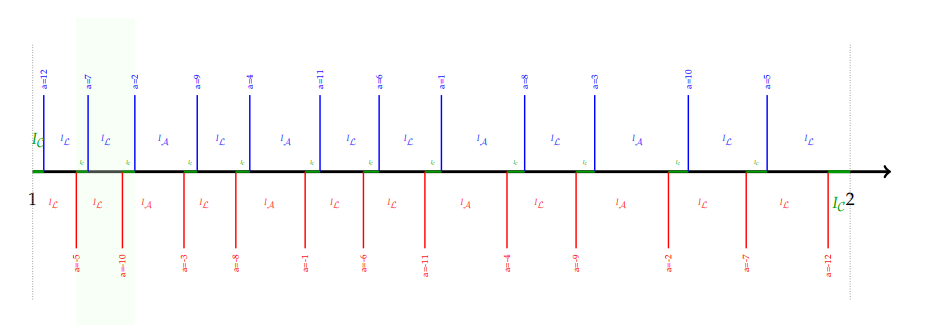
As illustrated in Figure 1, mapping these tones onto the unit segment reveals a symmetrical distribution where the distances between adjacent pitches are limited to only three specific intervals (the Limma, the Apotome, and the Comma).
The diagram in Figure 1 illustrates the following key features:
The Pythagorean Comma as a natural limit. The values \(a=12\) and \(a=-12\) identify two tones in close proximity to the endpoints \(1\) and \(2\) (\(f_0\) and \(2f_0\)). Consistently with the discrepancy calculation (22), the gap is the Pythagorean comma \(I_{\mathcal{C}} = 3^{12}/2^{19} \approx 1.0136\). While \(I_{\mathcal{C}}\) represents the structural obstacle to closing the circle, this extreme proximity suggests that \(a=12\) serves as a natural “stopping criterion” for the generative process.
Structural symmetry. The intervals between successive pitches in both the upper sequence (ascending fifths, \(a > 0\), blue) and the lower sequence (descending fifths, \(a < 0\), red) consist of only two types: the Pythagorean limma \(\mathcal{I}_{\cal L} = 2^8/3^5 \approx 1.0534\) defined in (21) and the apotome \[I_{\mathcal{A}} = 3^7/2^{11} \approx 1.0678.\]
The identical distribution of these intervals reflects the underlying algebraic symmetry of the system. The following remarkable relation between the apotome, the comma, and the limma holds: \[I_{\mathcal{C}} \cdot I_{\mathcal{L}} = I_{\mathcal{A}},\] that is a comma plus a limma yields an apotome. To verify it, simply write \[I_{\mathcal{A}}=3^7/2^{11} = 3^{12}/2^{19}\times 2^8/3^5 = I_{\mathcal{C}} \cdot I_{\mathcal{L}}.\]
Sound Zones and Intervals of a Comma. The positioning of the 26 values defines 13 pairs of closely spaced points: \[(1, a=12), \; (a=-5, a=7), \; (a=-10, a=2) \dots (a=-7, a=5), \; (a=-12, 2).\]
Each pair forms an interval of exactly one comma \(I_{\mathcal{C}}\) (highlighted by the green segments). This effectively defines 13 “sound zones” each bounded by a “flat” version (red, from \(a < 0\)) and a “sharp” version (blue, from \(a > 0\)).
The complementary rule. Notably, the indices \(a\) associated with each comma-sized interval always satisfy \(|a_{red}| + |a_{blue}| = 12\). This balance shows how the system achieves a uniform and homogeneous distribution only upon completing the 12-fifth cycle, mapping the entire chromatic space with mathematical consistency.
When we map our 26 Pythagorean tones (\(a = \pm 1, \dots, \pm 12\)) against the 13 equal tempered degrees (5) for \(N=12\) and \(k=0,1, \dots, 12\), a remarkable “bracketing” property emerges. Each equal-tempered degree is framed by two Pythagorean approximations: one by defect (flat) and one by excess (sharp).
| equal-tempered Degree (\(\mathbb{T}_{12}\)) | Pythagorean Bracketing (\(p_{a,b}\)) | ||
|---|---|---|---|
| \(1.0000\) | C (\(*\)) | \(1\) | \(2^{-7}(3/2)^{12}\) |
| \(1.0595\) | C\(\sharp\)/D\(\flat\) | \(2^3(3/2)^{-5}\) | \(2^{-4}(3/2)^7\) |
| \(1.1225\) | D (\(*\)) | \(2^{-1}(3/2)^2\) | \(2^6(3/2)^{-10}\) |
| \(1.1892\) | D\(\sharp\)/E\(\flat\) | \(2^2(3/2)^{-3}\) | \(2^{-5}(3/2)^9\) |
| \(1.2599\) | E (\(*\)) | \(2^{-2}(3/2)^4\) | \(2^5(3/2)^{-8}\) |
| \(1.3348\) | F (\(*\)) | \(2(3/2)^{-1}\) | \(2^{-6}(3/2)^{11}\) |
| \(1.4142\) | F\(\sharp\)/G\(\flat\) | \(2^4(3/2)^{-6}\) | \(2^{-3}(3/2)^6\) |
| \(1.4983\) | G (\(*\)) | \(3/2\) | \(2^7(3/2)^{-11}\) |
| \(1.5874\) | G\(\sharp\)/A\(\flat\) | \(2^3(3/2)^{-4}\) | \(2^{-4}(3/2)^8\) |
| \(1.6818\) | A (\(*\)) | \(2^{-1}(3/2)^3\) | \(2^6(3/2)^{-9}\) |
| \(1.7818\) | A\(\sharp\)/B\(\flat\) | \(2^2(3/2)^{-2}\) | \(2^{-5}(3/2)^{10}\) |
| \(1.8878\) | B (\(*\)) | \(2^{-2}(3/2)^5\) | \(2^5(3/2)^{-7}\) |
| \(2.0000\) | C (\(*\)) | \(2\) | \(2^8(3/2)^{-12}\) |
For diatonic tones (\(*\)), the table prioritizes the value reached with the lower \(|a|\), reflecting the musical principle that stability correlates with harmonic proximity. A profound symmetry is observed: in every row, the sum of the absolute values of the exponents \(|a|\) is exactly \(12\). This confirms that each degree is consistently defined by a pair of tones that together complete the twelve-step horizon.
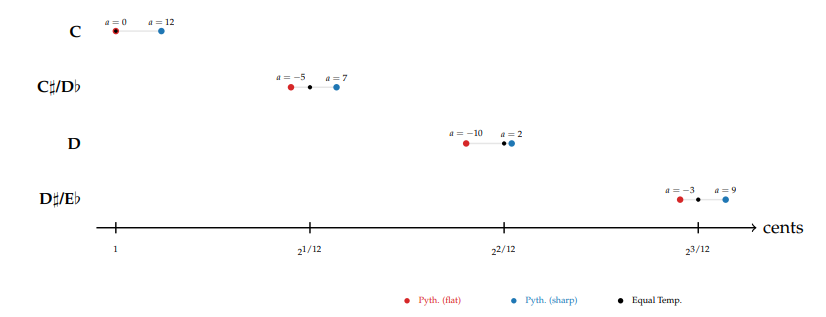
The core of our proposal lies in the observation that the twelve-tone equal-tempered system does not merely approximate the Pythagorean intervals, but rather acts as a geometric mediator. We define the “bracketing” property as the mathematical condition where each pitch of the equal-tempered scale is contained within a narrow interval formed by two distinct Pythagorean pitches.
Specifically, when we consider two cycles of twelve fifths – one ascending and one descending – we generate two sets of Pythagorean frequencies. Our analysis shows that: \[P_{down} < ET < P_{up},\] where \(ET\) represents the equal-tempered sounds and \(P_{down}\), \(P_{up}\) act as the Pythagorean boundaries. This “sandwiching” effect ensures a structural homogeneity that balances the rational purity of the fifths with the necessity of a closed chromatic circle.
In this light, the 12-tone Equal Temperament serves as a resolution of the Pythagorean duality inherent in the 26-tone system. Our analysis reveals that the ordering within the table follows a specific harmonic logic: for diatonic tones (\(*\)), the value reached through fewer iterations (i.e., the lower \(|a|\) value) is listed first. This reflects a fundamental musical principle where stability and clarity are associated with a smaller number of steps within the cycle of fifths. These tones represent the core of the scale, achieved through the most direct harmonic relationships.
Specifically, for a diatonic note like \(D\), the system yields two possibilities: one reached in only \(2\) steps (\(a=2\)) and another reached through \(10\) steps in the opposite direction (\(a=-10\)). By prioritizing the \(a=2\) value, we emphasize the harmonic proximity of the diatonic tones compared to their more distant, enharmonic18 counterparts.
Furthermore, a remarkable mathematical symmetry emerges from this arrangement: for every row in the table, the sum of the absolute values of the two exponents \(|a_1| + |a_2|\) is exactly 12. For instance, for the note \(D\) (\(*\)), we have \(|2| + |-10| = 12\), and for \(G\) (\(*\)), \(|1| + |-11| = 12\). This property confirms that each equal-tempered degree is consistently “bracketed” by two Pythagorean tones that together complete a full cycle of twelve fifths, highlighting the structural balance of the 26-tone system where every pitch is defined by its relative distance—either forward or backward—within the same twelve-step horizon.
The transition to the 12-tone Equal Temperament effectively collapses this “gap” or “shadow” into a single, unified value. Mathematically, by distributing the Pythagorean comma \(I_{\mathcal{C}}\) equally across all twelve fifths of the cycle, we force the two distant ends (\(a=12\) and \(a=-12\)) to meet at the same point. This closing of the circle replaces the systematic bracketing with a single geometric mean.
While this process sacrifices the harmonic purity of the perfect fifths – which are narrowed by approximately 2 cents – it grants the system its most powerful property: transpositional invariance. By erasing the distinction between “flat” and “sharp” approximations, the equal-tempered system ensures that every key and every interval remains perfectly congruent, regardless of the starting pitch \(f_0\).
In summary, this represents an interesting shift from harmonic purity to structural uniformity. While the Pythagorean system preserves the perfect \(3/2\) ratio, it results in a non-congruent set of pitches where every transposition alters the internal geometry of a melody.
The contribution of this work is twofold. In the first part (§3), starting exclusively from the universal and ancient principle of the octave, we derive a formal definition of distance between pitches. From this foundation, we develop the standard models for equidistant tones (Equal Temperament) and for compatible tones whose distance is a multiple of 3 (Pythagorean Intonation). While the literature on this subject is vast, our approach prioritizes a strictly mathematical perspective, highlighting the structural properties of these two sound sets and exploring their musical implications. This framework involves noteworthy mathematical concepts and offers non-trivial insights into both number theory and music theory.
Building upon these premises, the second part (§4) introduces our most significant findings regarding the geometric complementarity and the bracketing effects inherent in a twelve-tone system.
Rather than being arbitrary, the placement of the 12 ascending and 12 descending fifths within the reference octave exclusively delimits three foundational intervals: the Pythagorean comma, the limma, and the apotome.The arrangement into closely-spaced pairs – consisting of one element from the forward sequence and another from the backward sequence – follows a clear principle of complementarity.
Furthermore, the “bracketing” property we have observed is the capacity of each equal-tempered key to act as a “vice” that holds and unifies two different Pythagorean shadows. In this framework, the equal-tempered tone acts as a bridge between opposing Pythagorean “shadows” – a phenomenon that remains cognitively manageable in the 12-tone system but may lead to “harmonic blurring” in higher-resolution configurations, such as the 53-tone system. While the optimality of the 12-tone division is a long-standing subject of debate, this work offers novel procedural insights into why \(12\) represents a particularly effective compromise between harmonic theory and musical practice.
This final point introduces several compelling questions – the subject of our future investigations – concerning whether the 12-tone system possesses an exclusive role compared to other convergent systems. Specifically: if we consider systems with a different number of tones, do the structural properties outlined here still hold? Namely, the “ordered” distribution within the reference interval \([f_0, 2f_0]\), the complementarity in filling the octave, and the bracketing of equal-tempered pitches. Alongside well-established historical, psychoacoustic, and practical advantages, these findings contribute to a broader mathematical justification for the 12-tone system, framed within the field of Diophantine approximations. From a mathematical standpoint, addressing these questions in general terms remains a formidable task and to our knowledge, a comprehensive solution or full resolution to this issue does not exist. Hence, focusing on the specific case of 12 tones has proven to be a necessary and clarifying step. Additionally, this framework could offer a novel perspective on why the 41-tone system receives relatively little attention, or conversely, provide further rationale for the historical interest in the 53-tone system in light of these properties.
Maqam refers to the system of melodic modes used in traditional Arabic music.↩︎
TET (Tone Equal Temperament): This acronym refers to a tuning system where the octave is divided into a specific number of equal intervals. In this framework, the frequency ratio between any two adjacent notes is constant (e.g., \(\sqrt[12]{2}\) for 12-TET). In contemporary musicology, this is often used interchangeably with EDO (Equal Division of the Octave).↩︎
In his Traité, Rameau frequently uses the term réplique (replica) to designate the octave and its multiples, emphasizing that these intervals do not introduce new harmonic content, but merely “repeat” the fundamental unit in different registers.↩︎
While Rameau framed his observations through the physical lengths of a vibrating string (\(1:2\) ratio), his logic aligns with the modern concept of frequency.↩︎
According to Mersenne’s Law, frequency is inversely proportional to length, assuming constant tension and mass.↩︎
Diophantine approximation is the branch of number theory that studies the approximation of real numbers by rational numbers. In this context, Kronecker’s Theorem deals with the distribution of the values \(\{b\theta\}\) modulo 1, or equivalently, the density of the linear form \(a + b\theta\).↩︎
Every integer \(n > 1\) can be uniquely represented as a product of prime powers:\[n = p_1^{a_1} \cdot p_2^{a_2} \cdot \dots \cdot p_k^{a_k},\]where \(p_1 < p_2 < \dots < p_k\) are distinct prime numbers and \(a_i\) are positive integer exponents.↩︎
The harmonic series is the sequence of sounds whose frequencies are integer multiples of a fundamental frequency \(f\). In acoustical physics, when a string vibrates, it does not only produce the root note, but simultaneously oscillates in fractions of its own length (\(1/2, 1/3, 1/4 \dots\)), generating what are known as overtones. The first terms define the “pure” intervals of the Pythagorean system: the octave (\(2:1\)) and the perfect fifth (\(3:2\)).↩︎
Mathematically, transposing a finite sequence \(\{s_i\} \subset \mathcal{S}_N\) by \(r \in \mathbb{P}\) maps \(s_i \mapsto r \cdot s_i\). While \(r \cdot s_i \in \mathbb{P}(f_0)\) always holds, the condition \(r \cdot s_i \in \mathcal{S}_N\) fails for any finite \(N\) because the subdivisions are not equally spaced.↩︎
The substitution of \(a\) for \(b\) as the exponent of base \(3\) (see ([scalapit])) is non-disorienting and maintains internal consistency.↩︎
It should be noted that the number of fifths in ([approxlog]) moves to the denominator; consequently, the roles of “overestimate” and “underestimate” are reversed.↩︎
In the context of the piano, the chromatic scale consists of the complete succession of the twelve white and black keys within an octave, according to the established tuning.↩︎
Historically, before the adoption of Equal Temperament, this discrepancy was often “hidden” in a single, highly dissonant interval known as the Wolf Fifth, which was so out of tune that it was considered unusable by composers.↩︎
Nicholas Mercator (c. 1620–1687), a german mathematician and astronomer, suggested: “If we divide the octave into 53 tiny pieces, the final gap is so minuscule that we can distribute it among all the notes and no one will ever notice.”↩︎
Just Intonation is a system of tuning in which all intervals are represented by ratios of small integers (such as \(3:2\) or \(5:4\)). While the Pythagorean system is based exclusively on the ratio of the perfect fifth (\(3:2\)), Just Intonation also incorporates the natural major third (\(5:4\)), which is derived from the fifth harmonic of the natural series.↩︎
The practical application of the 53-tone system was notably realized in the Bosanquet Enharmonic Harmonium (1872), which featured a specialized generalized keyboard designed to navigate the 53-division of the octave.↩︎
We stress that the Pythagorean major third is \((3^4/2^6) f_0=(81/64) f_0\), while the equal-tempered major third corresponds to \(2^{4/12}f_0\).↩︎
In modern musical notation, enharmonic refers to notes that have different names but sound at the same pitch (e.g., C\(\sharp\) and D\(\flat\)). In the context of this study, it refers to the distinct Pythagorean approximations that converge into a single equal-tempered degree.↩︎