
Inequalities involving integrals play a fundamental role in mathematical analysis, as they provide bounds for integral expressions and connect them to more manageable quantities or to qualitative properties of functions, such as monotonicity or convexity. Classical tools including the inequalities of Jensen, Hölder, Minkowski, and Chebyshev are frequently used to estimate solutions of differential equations, establish convergence, and study function spaces. Their importance lies in the fact that they yield reliable approximations even in situations where exact evaluation of an integral is not feasible, which makes them indispensable in both theoretical investigations and practical applications.
Within this class of results, Chebyshev’s inequality is particularly significant in analysis as well as in probability theory. In the integral context, it states that if two integrable functions vary in the same monotone manner over a given interval, then the average of their product is no less than the product of their respective averages. This observation provides insight into the joint behavior of functions and is often employed in approximation techniques, computational methods, and the study of inequalities. In probability theory, an analogous idea is used to bound the likelihood that a random variable deviates substantially from its expected value, ensuring that large deviations are relatively rare. For more clarity, the Chebyshev-type inequality states that if \(\varphi,\omega : [a,\ell] \to \mathbb{R}\) are integrable functions such that \(\varphi\), \(\omega\) have the same monotonicity, then \[\begin{aligned} \frac{1}{\ell-a} \int_{a}^{\ell} \varphi(x) \omega(x) \mathrm{d}x \geq \left(\frac{1}{\ell-a}\int_{a}^{\ell} \varphi(x) \mathrm{d}x\right) \left(\frac{1}{\ell-a} \int_{a}^{\ell} \omega(x) \mathrm{d}x\right) , \end{aligned}\tag{1}\] and its weight version states that if \(p,\varphi,\omega : [a,\ell] \to \mathbb{R}\) are integrable functions and \(p(x)>0\) on \([a,\ell]\) such that \(\varphi\), \(\omega\) have the same monotonicity, then \[\begin{aligned} \begin{split} & \frac{1}{\int_{a}^{\ell}p(x) \mathrm{d}x} \int_{a}^{\ell} p(x)\varphi(x) \omega(x) \mathrm{d}x \\& \geq \left( \frac{1}{\int_{a}^{\ell}p(x) \mathrm{d}x} \int_{a}^{\ell}p(x)\varphi(x) \mathrm{d}x\right) \left( \frac{1}{\int_{a}^{\ell}p(x) \mathrm{d}x} \int_{a}^{\ell}p(x) \omega(x) \mathrm{d}x\right) . \end{split} \end{aligned}\tag{2}\]
The inequalities (1) and (2) are reversed with different sign when the functions \(\varphi\) and \(\omega\) have the opposite monotonicity.
The Chebyshev integral inequality is a classical result used to relate the integrals of functions and their products, typically under monotonicity assumptions. A precise formulation of this inequality is given below.
Let \(a, b \in \mathbb{R}\) with \(b > a\) and let \(f, g : [a, b] \to \mathbb{R}\) be two differentiable functions such that \[\sup_{x \in [a,b]} |f'(x)| < +\infty, \qquad \sup_{x \in [a,b]} |g'(x)| < +\infty.\]
Then we have \[ \left| \frac{1}{b – a} \int_a^b f(x)g(x)\,dx – \left( \frac{1}{b – a} \int_a^b f(x)\,dx \right) \left( \frac{1}{b – a} \int_a^b g(x)\,dx \right) \right| \le \frac{\eta \alpha (b – a)^2}{12},\] where \[ \eta=\sup_{x \in [a,b]} |f'(x)| , \qquad \text{and} \quad \alpha=\sup_{x \in [a,b]} |g'(x)|.\]
We refer the reader to the monograph [1] for further background. Recent developments on Chebyshev-type integral inequalities can be found in [2–10]. However, to the best of the author’s knowledge, a general formulation of such inequalities for Hölder-continuous functions has not yet appeared in the literature, suggesting that this area remains relatively unexplored. Many authors established extensions of Hölder inequality and its application in some inequalities of Hardy, Hilbert, and Chebyshev-type, see, for examples, the papers [11–18]. In particular, Chesneau in [16] applied Hölder’s inequality to establish a new extension of Chebyshev-type inequality. Let \(a, b \in \mathbb{R}\) with \(b > a\), and let \(f, g : [a, b] \to \mathbb{R}\) be two functions such that there exist \(\alpha, \beta, \kappa, \omega \ge 0\) satisfying, for any \(x, y \in [a, b]\), \[|f(x) – f(y)| \le \kappa |x – y|^{\alpha}, \qquad |g(x) – g(y)| \le \omega |x – y|^{\beta}. \]
Then, we have \[ \left| \frac{1}{b – a} \int_a^b f(x)g(x)\,dx – \left( \frac{1}{b – a} \int_a^b f(x)\,dx \right) \left( \frac{1}{b – a} \int_a^b g(x)\,dx \right) \right| \le \frac{\kappa \omega (b – a)^{\alpha + \beta}}{(\alpha + \beta + 1)(\alpha + \beta + 2)}.\tag{3}\]
Additionally, the author employed the inequality (3) and Hölder’s inequality with a connection between integral conditions on the derivatives of the functions \(f\) and \(g\) to get the following result.
Let \(a, b \in \mathbb{R}\) with \(b > a\), \(p, r > 1\), \(q = \frac{p}{p – 1}\), \(s = \frac{r}{r – 1}\), and let \(f, g : [a, b] \to \mathbb{R}\) be two differentiable functions such that \[\int_a^b |f'(x)|^p \, dx < +\infty, \qquad \int_a^b |g'(x)|^r \, dx < +\infty. \]
Then, we have \[ \left| \frac{1}{b – a} \int_a^b f(x)g(x)\,dx – \left( \frac{1}{b – a} \int_a^b f(x)\,dx \right) \left( \frac{1}{b – a} \int_a^b g(x)\,dx \right) \right| \le \frac{\gamma \theta (b – a)^{\frac{1}{q} + \frac{1}{s}}} {\left(\frac{1}{q} + \frac{1}{s} + 1\right)\left(\frac{1}{q} + \frac{1}{s} + 2\right)},\tag{4}\] where \[\gamma = \left( \int_a^b |f'(x)|^p \, dx \right)^{1/p}, \qquad \theta = \left( \int_a^b |g'(x)|^r \, dx \right)^{1/r}.\]
Our aim in this paper is to establish some generalizations for inequalities of Chebyshev-type involving weighted functions. Our main results represent the generalized weight version of the classical inequalities (3) and (4) proved by Chesneau in [16]. These results will be proved by adding a weighted function \(\psi\) of Chesneau’s results, an increasing function \(\lambda\), and applying Hölder’s inequality with a connection between integral conditions on the derivatives of the functions.
Now, we are prepared to establish our first result by adding a positive weighted function \(\psi\) and an increasing function \(\lambda\).
Theorem 1. Let \(a, b \in \mathbb{R}\) with \(b > a\), and \(\psi\) be a positive weighted function on \([a, b]\). Furthermore, if \(\lambda, f, g : [a, b] \to \mathbb{R}\) such that \(\lambda\) is increasing and there exist \(\alpha, \beta, \kappa, \omega \ge 0\) satisfying, for any \(x, y \in [a, b]\), \[ \psi(x) |f(x) – f(y)| \leq \kappa \lambda'(x) \left|\lambda(x)-\lambda(y) \right|^{\alpha},\tag{5}\] and \[ \psi(y) |g(x) – g(y)| \leq \omega \lambda'(y) \left|\lambda(x)-\lambda(y) \right|^{\beta}.\tag{6}\]
Then we have \[\begin{aligned} &\left|\frac{1}{\int_a^b \psi(x) \mathrm{d}x} \int_a^b \psi(x) f(x)g(x)\,dx – \left( \frac{1}{\int_a^b \psi(x) \mathrm{d}x} \int_a^b \psi(x) f(x)\,dx \right) \left( \frac{1}{\int_a^b \psi(x) \mathrm{d}x} \int_a^b \psi(x) g(x)\,dx \right)\right| \\& \qquad\leq \frac{\kappa \omega}{(\alpha+\beta+1)(\alpha+\beta+2)} \frac{\left[\lambda(b)-\lambda(a)\right]^{\alpha+\beta+2}}{\left(\int_a^b \psi(x) \mathrm{d}x\right)^2} . \end{aligned}\tag{7}\]
Proof. Utilizing the properties of integration rules, we have \[\begin{aligned} &\frac{1}{\int_a^b \psi(x) \mathrm{d}x} \int_a^b \psi(x) f(x)g(x)\,dx – \left( \frac{1}{\int_a^b \psi(x) \mathrm{d}x} \int_a^b \psi(x) f(x)\,dx \right) \left( \frac{1}{\int_a^b \psi(x) \mathrm{d}x} \int_a^b \psi(x) g(x)\,dx \right) \\ &= \frac{1}{2\left(\int_a^b \psi(x) \mathrm{d}x\right)^2} \left[ \left(\int_a^b \psi(y) \mathrm{d}y\right) \int_a^b \psi(x) f(x)g(x)\,dx + \left(\int_a^b \psi(x) \mathrm{d}x\right) \int_a^b \psi(y) f(y)g(y)\,dy \right. \\ &\quad\left. – \left( \int_a^b \psi(x) f(x)\,dx \right)\left( \int_a^b \psi(y) g(y)\,dy \right) – \left( \int_a^b \psi(y) f(y)\,dy \right)\left( \int_a^b \psi(x) g(x)\,dx \right) \right] \\ &= \frac{1}{2\left(\int_a^b \psi(x) \mathrm{d}x\right)^2} \int_a^b \int_a^b \psi(x) \psi(y) (f(x) – f(y))(g(x) – g(y)) \, dx \, dy. \end{aligned}\tag{8}\]
Using the triangle inequality on the right-side of (8), it follows that \[\begin{aligned} &\left|\frac{1}{\int_a^b \psi(x) \mathrm{d}x} \int_a^b \psi(x) f(x)g(x)\,dx – \left( \frac{1}{\int_a^b \psi(x) \mathrm{d}x} \int_a^b \psi(x) f(x)\,dx \right) \left( \frac{1}{\int_a^b \psi(x) \mathrm{d}x} \int_a^b \psi(x) g(x)\,dx \right)\right| \\ &= \frac{1}{2\left(\int_a^b \psi(x) \mathrm{d}x\right)^2} \left|\int_a^b \int_a^b \psi(x) \psi(y) (f(x) – f(y))(g(x) – g(y)) \, dx \, dy\right| \\& \leq \frac{1}{2\left(\int_a^b \psi(x) \mathrm{d}x\right)^2} \int_a^b \int_a^b\left| \psi(x) \psi(y) (f(x) – f(y))(g(x) – g(y)) \right| dx dy \\& =\frac{1}{2\left(\int_a^b \psi(x) \mathrm{d}x\right)^2} \int_a^b \int_a^b \psi(x) \psi(y) \left|f(x) – f(y) \right| \left|g(x) – g(y) \right| dx dy. \end{aligned}\tag{9}\]
Substituting the assumptions (5) and (6) into (9), we find that
\[\begin{aligned} &\left|\frac{1}{\int_a^b \psi(x) \mathrm{d}x} \int_a^b \psi(x) f(x)g(x)\,dx – \left( \frac{1}{\int_a^b \psi(x) \mathrm{d}x} \int_a^b \psi(x) f(x)\,dx \right) \left( \frac{1}{\int_a^b \psi(x) \mathrm{d}x} \int_a^b \psi(x) g(x)\,dx \right)\right| \\& \leq \frac{\kappa \omega}{2\left(\int_a^b \psi(x) \mathrm{d}x\right)^2} \int_a^b \int_a^b \lambda'(x) \lambda'(y) \left|\lambda(x)-\lambda(y) \right|^{\alpha} \left|\lambda(x)-\lambda(y) \right|^{\beta} dx dy \\& =\frac{\kappa \omega}{2\left(\int_a^b \psi(x) \mathrm{d}x\right)^2} \int_a^b \int_a^b \lambda'(x) \lambda'(y) \left|\lambda(x)-\lambda(y) \right|^{\alpha+\beta} dx dy. \end{aligned}\tag{10}\]
Noticing that \[\begin{aligned} &\int_a^b \int_a^b \lambda'(x) \lambda'(y) \left|\lambda(x)-\lambda(y) \right|^{\alpha+\beta} dx dy \\& =\int_a^b \left(\int_a^y \lambda'(x) \lambda'(y) \left|\lambda(x)-\lambda(y) \right|^{\alpha+\beta} dx +\int_y^b \lambda'(x) \lambda'(y) \left|\lambda(x)-\lambda(y) \right|^{\alpha+\beta} dx \right) dy \\& =\int_a^b \lambda'(y) \left( \int_a^y \lambda'(x) \left|\lambda(x)-\lambda(y) \right|^{\alpha+\beta} dx +\int_y^b \lambda'(x) \left|\lambda(x)-\lambda(y) \right|^{\alpha+\beta} dx \right) dy. \end{aligned}\tag{11}\]
Since \(\lambda\) is increasing, then we have \[\begin{aligned} &\int_a^y \lambda'(x) \left|\lambda(x)-\lambda(y) \right|^{\alpha+\beta} dx +\int_y^b \lambda'(x) \left|\lambda(x)-\lambda(y) \right|^{\alpha+\beta} dx \\& =\int_a^y \lambda'(x) \left[\lambda(y)-\lambda(x)\right]^{\alpha+\beta} dx +\int_y^b \lambda'(x) \left[\lambda(x)-\lambda(y)\right]^{\alpha+\beta} dx. \end{aligned}\tag{12}\]
Utilizing the integration by substitution with \(\lambda(x)=\xi\) and \(d \xi=\lambda'(x) dx,\) on the right-side of (12), we get \[\begin{aligned} &\int_a^y \lambda'(x) \left[\lambda(y)-\lambda(x)\right]^{\alpha+\beta} dx +\int_y^b \lambda'(x) \left[\lambda(x)-\lambda(y)\right]^{\alpha+\beta} dx \\& =\int_{\lambda(a)}^{\lambda(y)} \left[\lambda(y)-\xi\right]^{\alpha+\beta} d \xi +\int_{\lambda(y)}^{\lambda(b)} \left[\xi -\lambda(y)\right]^{\alpha+\beta} d\xi \\& = \left. \frac{-1}{\alpha+\beta+1} \left[\lambda(y)-\xi\right]^{\alpha+\beta+1} \right| _{\lambda(a)}^{\lambda(y)} +\left. \frac{1}{\alpha+\beta+1} \left[\xi-\lambda(y)\right]^{\alpha+\beta+1} \right|_{\lambda(y)}^{\lambda(b)} \\& = \frac{1}{\alpha+\beta+1} \left[\lambda(y)-\lambda(a)\right]^{\alpha+\beta+1} + \frac{1}{\alpha+\beta+1} \left[\lambda(b)-\lambda(y)\right]^{\alpha+\beta+1} \\& = \frac{1}{\alpha+\beta+1} \left( \left[\lambda(y)-\lambda(a)\right]^{\alpha+\beta+1} + \left[\lambda(b)-\lambda(y)\right]^{\alpha+\beta+1}\right). \end{aligned}\tag{13}\]
Combining (12) and (13), we observe that \[\begin{aligned} &\int_a^y \lambda'(x) \left|\lambda(x)-\lambda(y) \right|^{\alpha+\beta} dx +\int_y^b \lambda'(x) \left|\lambda(x)-\lambda(y) \right|^{\alpha+\beta} dx \\& = \frac{1}{\alpha+\beta+1} \left( \left[\lambda(y)-\lambda(a)\right]^{\alpha+\beta+1} + \left[\lambda(b)-\lambda(y)\right]^{\alpha+\beta+1}\right). \end{aligned}\tag{14}\]
From (11) and (14), we observe that \[\begin{aligned} &\int_a^b \int_a^b \lambda'(x) \lambda'(y) \left|\lambda(x)-\lambda(y) \right|^{\alpha+\beta} dx dy \\& = \frac{1}{\alpha+\beta+1} \int_a^b \lambda'(y) \left( \left[\lambda(y)-\lambda(a)\right]^{\alpha+\beta+1} + \left[\lambda(b)-\lambda(y)\right]^{\alpha+\beta+1}\right) dy. \end{aligned}\tag{15}\]
Using the integration by substitution with \(\lambda(y) =\tau\) and \(d \tau =\lambda'(y) dy\), on the right-side of (15), it follows that \[\begin{aligned} & \int_a^b \lambda'(y) \left( \left[\lambda(y)-\lambda(a)\right]^{\alpha+\beta+1} + \left[\lambda(b)-\lambda(y)\right]^{\alpha+\beta+1}\right) dy \\& = \int_{\lambda(a)}^{\lambda(b)} \left( \left[\tau-\lambda(a)\right]^{\alpha+\beta+1} + \left[\lambda(b)-\tau\right]^{\alpha+\beta+1}\right) d \tau \\ & = \left. \frac{1}{\alpha+\beta+2} \left[\tau-\lambda(a)\right]^{\alpha+\beta+2}\right|_{\lambda(a)}^{\lambda(b)} -\left. \frac{1}{\alpha+\beta+2} \left[\lambda(b)-\tau\right]^{\alpha+\beta+2} \right|_{\lambda(a)}^{\lambda(b)} \\& =\frac{2}{ \alpha+\beta+2} \left[\lambda(b)-\lambda(a)\right]^{\alpha+\beta+2}. \end{aligned}\tag{16}\]
Taking into account (15) and (16), it gives \[\begin{aligned} \int_a^b \int_a^b \lambda'(x) \lambda'(y) \left|\lambda(x)-\lambda(y) \right|^{\alpha+\beta} dx dy = \frac{2}{(\alpha+\beta+1)(\alpha+\beta+2)} \left[\lambda(b)-\lambda(a)\right]^{\alpha+\beta+2}. \end{aligned}\tag{17}\]
Substituting (17) into (10), we find that \[\begin{aligned} &\left|\frac{1}{\int_a^b \psi(x) \mathrm{d}x} \int_a^b \psi(x) f(x)g(x)\,dx – \left( \frac{1}{\int_a^b \psi(x) \mathrm{d}x} \int_a^b \psi(x) f(x)\,dx \right) \left( \frac{1}{\int_a^b \psi(x) \mathrm{d}x} \int_a^b \psi(x) g(x)\,dx \right)\right| \\& \leq \frac{\kappa \omega}{(\alpha+\beta+1)(\alpha+\beta+2)} \frac{\left[\lambda(b)-\lambda(a)\right]^{\alpha+\beta+2}}{\left(\int_a^b \psi(x) \mathrm{d}x\right)^2} , \end{aligned}\tag{18}\] which is the main finding (7) and this completes the proof. ◻
Remark 1. Determining \(\psi(x)=1\) and \(\lambda(x)=x\) for all \(x \in [a,b]\) in Theorem 1, we get the classical inequality (3) established by Chesneau in [16].
Taking \(\lambda(x)=x\) in Theorem 1, we have the following result.
Theorem 2. Let \(a, b \in \mathbb{R}\) with \(b > a\), and \(\psi\) be a positive weighted function on \([a, b]\). Furthermore, if \(f, g : [a, b] \to \mathbb{R}\) such that there exist \(\alpha, \beta, \kappa, \omega \ge 0\) satisfying, for any \(x, y \in [a, b]\), \[ \psi(x) |f(x) – f(y)| \leq \kappa \left|x-y \right|^{\alpha},\tag{19}\] and \[ \psi(y) |g(x) – g(y)| \leq \omega \left|x-y \right|^{\beta}.\tag{20}\]
Then we have \[\begin{aligned} &\left|\frac{1}{\int_a^b \psi(x) \mathrm{d}x} \int_a^b \psi(x) f(x)g(x)\,dx – \left( \frac{1}{\int_a^b \psi(x) \mathrm{d}x} \int_a^b \psi(x) f(x)\,dx \right) \left( \frac{1}{\int_a^b \psi(x) \mathrm{d}x} \int_a^b \psi(x) g(x)\,dx \right)\right| \\& \leq \frac{\kappa \omega}{(\alpha+\beta+1)(\alpha+\beta+2)} \frac{\left[b-a\right]^{\alpha+\beta+2}}{\left(\int_a^b \psi(x) \mathrm{d}x\right)^2} . \end{aligned}\tag{21}\]
In the following result, we apply the weighted Chebyshev-type inequality in Theorem 2 by employing Hölder’s inequality and the bounded function.
Theorem 3. Let \(a, b \in \mathbb{R}\) with \(b > a\), \(\delta>0\), \(p,r> 1\), \(q=p/(p-1)\), \(s=r/(r-1)\), \(f, g : [a, b] \to \mathbb{R}\), and \(\psi\) be a positive weighted function on \([a, b]\) such that \[\delta=\sup_{x\in [a,b]} \psi(x) < \infty, \quad \int_a^b |f'(x)|^p \, dx <\infty, \quad \text{and} \quad \int_a^b |g'(x)|^r dx<\infty.\]
Then, \[\begin{aligned} &\left|\frac{1}{\int_a^b \psi(x) \mathrm{d}x} \int_a^b \psi(x) f(x)g(x)\,dx – \left( \frac{1}{\int_a^b \psi(x) \mathrm{d}x} \int_a^b \psi(x) f(x)\,dx \right) \left( \frac{1}{\int_a^b \psi(x) \mathrm{d}x} \int_a^b \psi(x) g(x)\,dx \right)\right| \\& \leq \frac{\delta^{2} \vartheta \gamma}{\left(\frac{1}{q}+\frac{1}{s}+1\right) \left(\frac{1}{q}+\frac{1}{s}+2\right)} \frac{\left[b-a\right]^{\frac{1}{q}+\frac{1}{s}+2}}{\left(\int_a^b \psi(x) \mathrm{d}x\right)^2} , \end{aligned}\tag{22}\] where \[\gamma=\left( \int_a^b |f'(x)|^p \, dx \right)^{1/p} \quad \text{and}\quad \vartheta =\left( \int_a^b |g'(x)|^r dx \right)^{1/r}.\]
Proof. Employing Hölder’s inequality with indices \(p> 1\) and \(q=p/(p-1)\), we find that \[\begin{aligned} |f(x) – f(y)| &= \left| \int_x^y f'(t)\,dt \right| \\& \leq \int_x^y \left| f'(t) \right| dt \\& \leq \left( \int_x^y |f'(t)|^p \, dt \right)^{1/p} \left( \int_x^y 1 \, dt \right)^{1/q} \\& \leq \left( \int_a^b |f'(x)|^p \, dx \right)^{1/p} |x – y|^{1/q} \\& = \gamma |x – y|^{1/q}. \end{aligned}\tag{23}\]
Again by applying Hölder’s inequality with indices \(r> 1\) and \(s=r/(r-1)\), it follows that \[\begin{aligned} |g(x) – g(y)| &= \left| \int_x^y g'(t)\,dt \right| \\& \leq \int_x^y \left| g'(t) \right| dt \\& \leq \left( \int_x^y |g'(t)|^r \, dt \right)^{1/r} \left( \int_x^y 1 \, dt \right)^{1/s} \\& \leq \left( \int_a^b |g'(x)|^r \, dx \right)^{1/r} |x – y|^{1/s} \\& = \vartheta |x – y|^{1/s}. \end{aligned}\tag{24}\]
Since \(\delta= \sup_{x\in [a,b]} \psi(x) < \infty\), then we have \[\begin{aligned} \psi(x) \leq \delta \quad \text{for any} \quad x \in [a,b]. \end{aligned}\tag{25}\]
From (23) and (25), we obtain \[\begin{aligned} \psi(x) |f(x) – f(y)| \leq \delta \gamma |x – y|^{1/q}. \end{aligned}\tag{26}\]
Combining the two inequalities (24) and (25), we have \[\begin{aligned} \psi(y) |g(x) – g(y)| \leq \delta \vartheta |x – y|^{1/s}. \end{aligned}\tag{27}\]
Noticing that the inequalities (26) and (27) satisfy the the assumptions (19) and (20) with \[\kappa=\delta \gamma, \quad \alpha=\frac{1}{q}, \quad \omega=\delta \vartheta, \quad \text{and} \quad\beta=\frac{1}{s}.\]
Thus, by applying Theorem 2, where \[\sup_{x\in [a,b]} \psi(x) < \infty, \quad \kappa=\delta \gamma, \quad \alpha=\frac{1}{q}, \quad \omega=\delta \vartheta, \quad \text{and} \quad\beta=\frac{1}{s},\] we get \[\begin{aligned} &\left|\frac{1}{\int_a^b \psi(x) \mathrm{d}x} \int_a^b \psi(x) f(x)g(x)\,dx – \left( \frac{1}{\int_a^b \psi(x) \mathrm{d}x} \int_a^b \psi(x) f(x)\,dx \right) \left( \frac{1}{\int_a^b \psi(x) \mathrm{d}x} \int_a^b \psi(x) g(x)\,dx \right)\right| \\& \leq \frac{\delta^{2} \vartheta \gamma}{\left(\frac{1}{q}+\frac{1}{s}+1\right) \left(\frac{1}{q}+\frac{1}{s}+2\right)} \frac{\left[b-a\right]^{\frac{1}{q}+\frac{1}{s}+2}}{\left(\int_a^b \psi(x) \mathrm{d}x\right)^2} , \end{aligned}\tag{28}\] which is the desired inequality (22) and this completes the proof. ◻
Remark 2. Choosing \(\psi(x)=1\) for all \(x \in [a,b]\) in Theorem 3, where \(\delta=\sup_{x \in [a,b]} \psi(x)=1\), we obtain the classical inequality (4) established by Chesneau in [16].
In this section, we examine the validity of the conditions (5) and (6), and present some examples that illustrate the validity of these generalized conditions. The next examples include a non-constant value of the function \(\psi\).
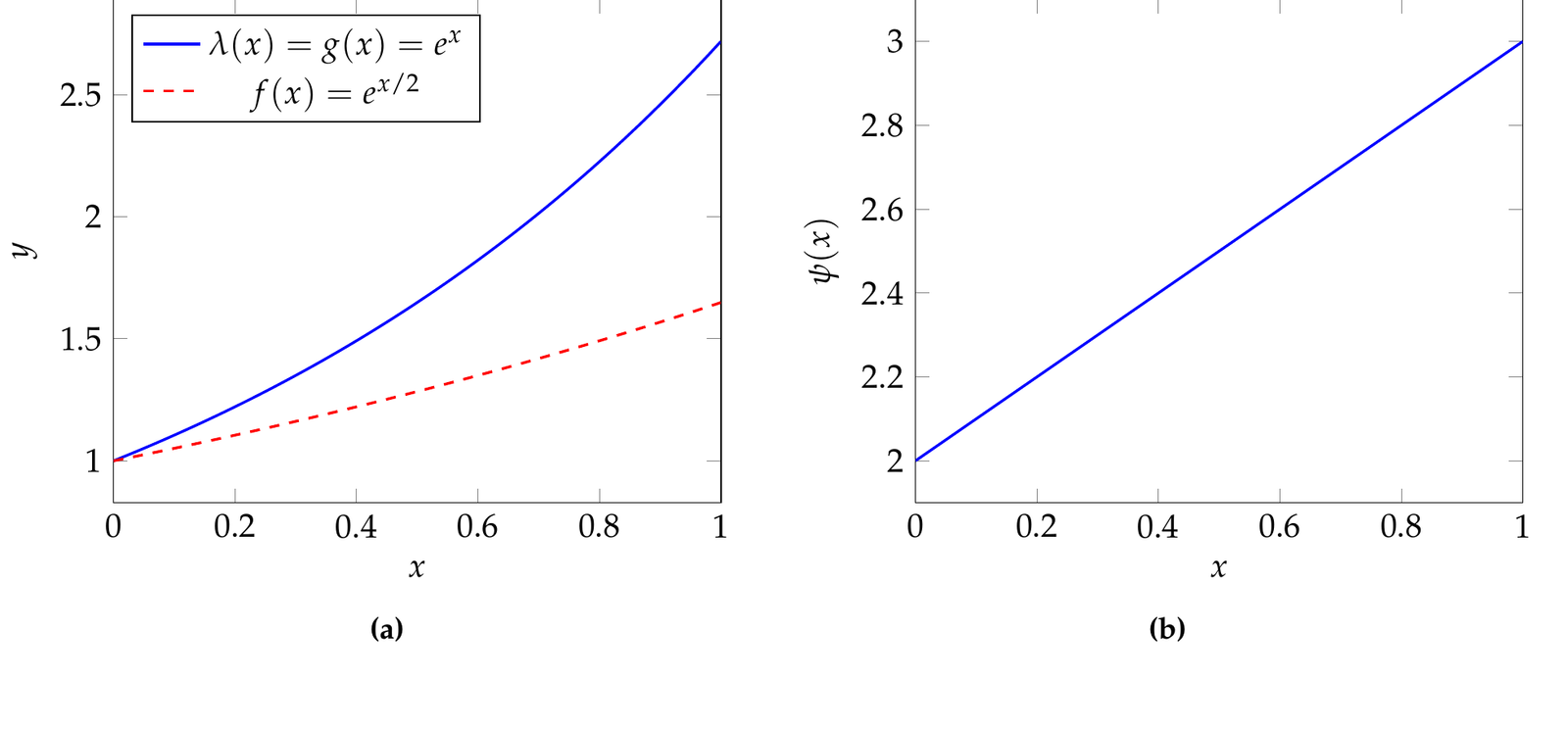
Example 1. Taking \([a,b]=[0,1]\), \(\lambda(x)=e^{x}\), \(\psi(x)=2+x\), \(f(x)=e^{\frac{x}{2}}=\sqrt{\lambda(x)}\), and \(g(x)=e^{x}=\lambda(x)\) for \(x \in [0,1]\).
First, we start checking the validity of (5). Let \(u=\lambda(x)\) and \(v=\lambda(y)\), where \(\lambda'(x)=e^x=\lambda(x)=u\). Then, we have \[|u-v|=(\sqrt{u}+\sqrt{v})|\sqrt{u}-\sqrt{v}|.\] In this case, we obtain \[\begin{aligned} \psi(x)|f(x)-f(y)|= (2+x)|f(x)-f(y)|\leq 3 |f(x)-f(y)| =3|\sqrt{u}-\sqrt{v}|=\frac{3|u-v|}{\sqrt{u}+\sqrt{v}}. \end{aligned}\tag{29}\]
Since \(u,v \in [1,e]\), then \(\sqrt{u}+\sqrt{v}\geq 2\) and \[\begin{aligned} \frac{1}{\sqrt{u}+\sqrt{v}} \leq \frac{1}{2} =\frac{1}{2u}* u \leq \frac{1}{2}* u. \end{aligned}\tag{30}\]
From (29) and (30), we observe that \[\begin{aligned} \psi(x) |f(x) – f(y)|\leq \frac{3}{2}* u |u-v|. \end{aligned}\tag{31}\]
Comparing the two inequalities (5) and (31), we find that (5) holds with \(\kappa=\frac{3}{2}\) and \(\alpha=1\).
By checking the inequality (6), where \(v \in [1,e]\) and \(\lambda'(y)=\lambda(y)=v\), we have \[\begin{aligned} \psi(y) |g(x) – g(y)|=(2+y) |g(x) – g(y)| \leq 3 |g(x) – g(y)| =3|u-v|=\frac{3}{v}*v|u-v| \leq 3* v|u-v|. \end{aligned}\tag{32}\]
Comparing the inequalities (6) and (32), we find that (6) holds with \(\omega=3\) and \(\beta=1\).
Before demonstrating the second example, we introduce the following auxiliary lemma that will be needed in the proof.
Lemma 1. For any \(u,v \geq 0\) and \(0<p<1\), we get \[|u^{p}-v^{p}| \leq |u-v|^{p}.\]
Proof. For \(u \geq v \geq 0\), then \(|u^{p}-v^{p}|=u^{p}-v^{p}\) and \(|u-v|=u-v.\) Thus, we need to prove that \[\begin{aligned} u^{p}-v^{p} \leq (u-v)^{p}. \end{aligned}\tag{33}\]
To prove (33), we set \(t=u-v \geq 0\) and define \[F(t):=(v+t)^{p}-v^{p}-t^{p}, \quad t \geq 0.\]
Since \(F'(t)=p\left[(v+t)^{p-1}-t^{p-1}\right]\), \(v \geq 0\) and \(0<p<1\), then we have \(v+t \geq t\) and \((v+t)^{p-1} \leq t^{p-1}\). Thus, \(F'(t) \leq 0\), i.e. \(F\) is nonincreasing function. Since \(t \geq 0\), then we have \[F(t)\leq F(0)=0.\]
In that case, we have \[F(t)=(v+t)^{p}-v^{p}-t^{p}\leq 0,\] and this implies that \[(v+t)^{p}-v^{p}\leq t^{p}.\]
By substituting \(t=u-v\), we get \[u^{p}-v^{p}\leq (u-v)^{p},\] and this inform the validity of (33). Therefore, in general, we can write \[\left|u^{p}-v^{p}\right|\leq |u-v|^{p},\] for \(u,v \geq 0\) and \(0<p<1\). ◻
The following example will be established by employing Lemma 1.
Example 2. Determining \([a,b]=[0,1]\), \(\lambda(x)=e^x\), \(\psi(x)=\frac{1}{1+\lambda(x)} =\frac{1}{1+e^x}\), \(f(x)=e^{\frac{x}{2}}=\sqrt{\lambda(x)}\), and \(g(x)=e^{\frac{x}{3}} =\left[\lambda(x)\right]^{\frac{1}{3}} .\)
We set \(u=\lambda(x)\) and \(v=\lambda(y)\), where \(u,v \in [1,e]\), \(\lambda'(x)=u\), and \(\lambda'(y)=v.\)
Applying Lemma 1 with \(p=\frac{1}{2}\), we have \[|f(x)-f(y)|=\left|u^{\frac{1}{2}}-v^{\frac{1}{2}}\right| \leq |u-v|^{\frac{1}{2}}.\]
Thus, (note \(u \in [1,e]\)) \[\begin{aligned} \psi(x) |f(x)-f(y)|&=\frac{1}{1+u} |f(x)-f(y)| \\& \leq \frac{1}{1+u} |u-v|^{\frac{1}{2}} \\&= \frac{1}{u(1+u)}* u |u-v|^{\frac{1}{2}} \\& \leq \frac{1}{2} u |u-v|^{\frac{1}{2}}. \end{aligned}\tag{34}\]
Comparing the inequalities (5) and (34), we find that the inequality (5) holds with \(\kappa=\frac{1}{2}\) and \(\alpha=\frac{1}{2}\).
Again by employing Lemma 1 with \(p=\frac{1}{3}\), we get \[|g(x)-g(y)|=\left|u^{\frac{1}{3}}-v^{\frac{1}{3}}\right| \leq |u-v|^{\frac{1}{3}}.\]
Therefore, (note \(v \in [1,e]\))
\[\begin{aligned} \psi(y) |g(x)-g(y)|&=\frac{1}{1+v} |g(x)-g(y)|\\ &\leq \frac{1}{1+v} |u-v|^{\frac{1}{3}}\\ &= \frac{1}{v(1+v)}* v |u-v|^{\frac{1}{3}}\\ &\leq \frac{1}{2} v |u-v|^{\frac{1}{3}}. \end{aligned}\tag{35}\]
Comparing the inequalities (6) and (35), we observe that the inequality (6) holds with \(\omega=\frac{1}{2}\) and \(\beta=\frac{1}{3}\).
In this section, we present some concrete examples with graphs to confirm the validity of our results in this work.
Example 3. Determining \([a,b]=[0,1]\), \(\lambda(x)=e^{x}\), \(\psi(x)=2+x\), \(f(x)=e^{\frac{x}{2}}=\sqrt{\lambda(x)}\), and \(g(x)=e^{x}=\lambda(x)\) for \(x \in [0,1]\). Then, we find that (5) holds with \(\kappa=\frac{3}{2}\) and \(\alpha=1\). Additionally, we have the fact that (6) holds with \(\omega=3\) and \(\beta=1\). Therefore, in this case, the left-side of (7) gives \[\begin{aligned} &\left|\frac{1}{\int_a^b \psi(x) \mathrm{d}x} \int_a^b \psi(x) f(x)g(x) \mathrm{d}x – \left( \frac{1}{\int_a^b \psi(x) \mathrm{d}x} \int_a^b \psi(x) f(x) \mathrm{d}x \right) \left( \frac{1}{\int_a^b \psi(x) \mathrm{d}x} \int_a^b \psi(x) g(x) \mathrm{d}x \right)\right| \\& = \left|\frac{1}{\int_{0}^{1} (2+x) \mathrm{d}x} \int_{0}^{1} (2+x) e^{\frac{3x}{2}} \mathrm{d}x – \left( \frac{1}{\int_{0}^{1} (2+x) \mathrm{d}x} \int_{0}^{1} (2+x) e^{\frac{x}{2}} \mathrm{d}x \right) \left( \frac{1}{\int_{0}^{1} (2+x) \mathrm{d}x} \int_{0}^{1} (2+x) e^{x} \mathrm{d}x \right)\right| \\& = \left| \frac{2}{3} \frac{1}{\int_{0}^{1} (2+x) \mathrm{d}x} \int_{0}^{\frac{3}{2}} \left(2+\frac{2}{3} u\right) e^{u} \mathrm{d}u – \left( \frac{2}{\int_{0}^{1} (2+x) \mathrm{d}x} \int_{0}^{\frac{1}{2}} (2+2u) e^{u} \mathrm{d}u \right) \left( \frac{1}{\int_{0}^{1} (2+x) \mathrm{d}x} \int_{0}^{1} (2+x) e^{x} \mathrm{d}x \right)\right| \\& = \left| \frac{4}{15} * 9.12394116 – \left( \frac{8}{25} * 1.6487212707 \right)* \left( 4.436563656 \right)\right|\\ &=0.092522, \end{aligned}\tag{36}\] and the right-side of (7) becomes \[\begin{aligned} \frac{\kappa \omega}{(\alpha+\beta+1)(\alpha+\beta+2)} \frac{\left[\lambda(b)-\lambda(a)\right]^{\alpha+\beta+2}}{\left(\int_a^b \psi(x) \mathrm{d}x\right)^2} &= \frac{9}{24} \frac{\left[e-1\right]^{4}}{\left(\int_{0}^{1} (2+x) \mathrm{d}x\right)^2}\\ &=0.5231. \end{aligned}\tag{37}\]
From (36) and (37), we observed that the inequality (7) is valid.
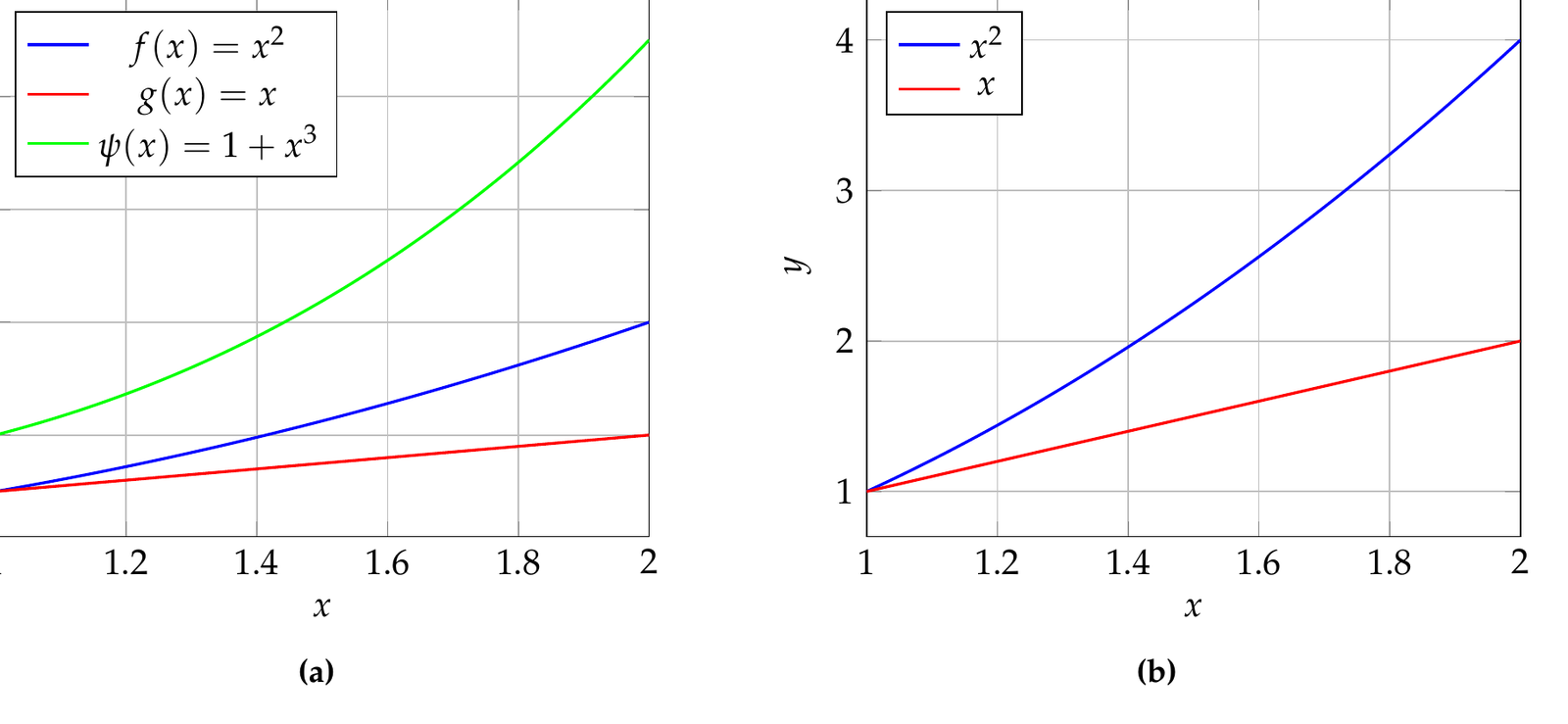
Example 4. Let \([a, b]=[1,2]\), \(\psi(x)=1+x^3\), \(f(x)=x^2\), \(g(x)=x\) for \(x,y \in [1,2]\). Then \[\begin{aligned} \psi(x) |f(x) – f(y)| &= \left(1+x^3\right) |x^2 – y^2| = \left(1+x^3\right) \left|x-y \right| |x+y| \leq 36 |x-y|, \end{aligned}\tag{38}\] and this informs that (19) is satisfied with \(\kappa=36\) and \(\alpha=1\). Additionally, we have \[ \psi(y) |g(x) – g(y)| = \left(1+x^3\right) |x-y| \leq 9 \left|x-y \right|.\] This indicates that (20) holds with \(\omega=9\) and \(\beta=1\). In that case, the left-side of (21) gives \[\begin{aligned} & \left|\frac{1}{\int_a^b \psi(x) \mathrm{d}x} \int_a^b \psi(x) f(x)g(x)\,dx – \left( \frac{1}{\int_a^b \psi(x) \mathrm{d}x} \int_a^b \psi(x) f(x)\,dx \right) \left( \frac{1}{\int_a^b \psi(x) \mathrm{d}x} \int_a^b \psi(x) g(x)\,dx \right)\right| \\&= \left|\frac{1}{\int_{1}^{2} \left(1+x^3\right) \mathrm{d}x} \int_{1}^{2} \left(x^3+x^6\right) \mathrm{d}x – \frac{1}{\left(\int_{1}^{2} \left(1+x^3\right) \mathrm{d}x\right)^2} \left(\int_{1}^{2} \left(x^2+x^5\right) \mathrm{d}x \right) \int_{1}^{2} \left(x+x^4\right) \mathrm{d}x \right| \\&=\frac{4}{19}* \frac{613}{28}- \left(\frac{4}{19}\right)^{2} *\frac{77}{6} *\frac{77}{10} =0.229063, \end{aligned}\tag{39}\] and the right-side of (21) becomes \[\begin{aligned} \frac{\kappa \omega}{(\alpha+\beta+1)(\alpha+\beta+2)} \frac{\left[b-a\right]^{\alpha+\beta+2}}{\left(\int_a^b \psi(x) \mathrm{d}x\right)^2} = \frac{324}{12} * \frac{16}{361} =1.1966759. \end{aligned}\tag{40}\]
From (39) and (40), we find that (21) is valid.
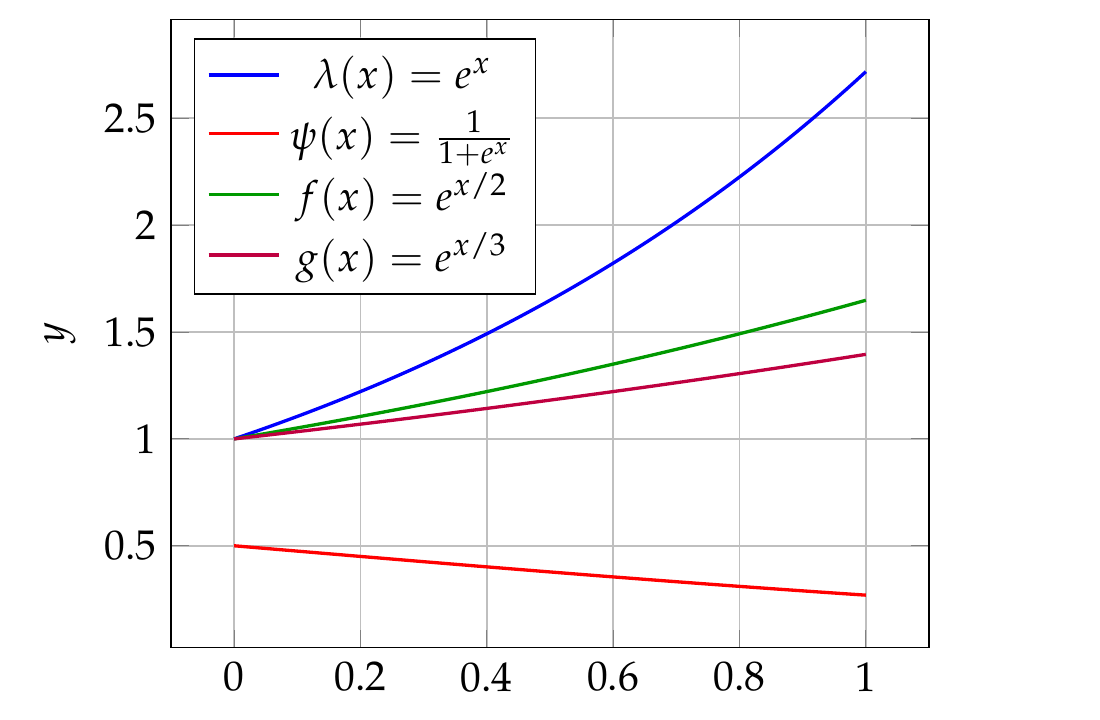
Example 5. Determining \([a,b]=[0,1]\), \(\lambda(x)=e^x\), \(\psi(x)=\frac{1}{1+e^x}\), \(f(x)=e^{\frac{x}{2}}\), and \(g(x)=e^{\frac{x}{3}}\). Then the inequalities (5) and (6) hold with \(\omega=\frac{1}{2}\), \(\beta=\frac{1}{3}\), \(\kappa=\frac{1}{2}\), and \(\alpha=\frac{1}{2}\). Thus, the left-side of (7) gives
\[\begin{aligned} &\left|\frac{1}{\int_a^b \psi(x) \mathrm{d}x} \int_a^b \psi(x) f(x)g(x)\,dx – \left( \frac{1}{\int_a^b \psi(x) \mathrm{d}x} \int_a^b \psi(x) f(x)\,dx \right) \left( \frac{1}{\int_a^b \psi(x) \mathrm{d}x} \int_a^b \psi(x) g(x)\,dx \right)\right| \\& =\left| \frac{1}{\int_{0}^{1} \frac{1}{1+e^x} \mathrm{d}x} \int_{0}^{1} \frac{e^{\frac{5x}{6}}}{1+e^x} \mathrm{d}x – \left(\frac{1}{\int_{0}^{1} \frac{1}{1+e^x} \mathrm{d}x}\right)^{2} \left( \int_{0}^{1} \frac{e^{\frac{x}{2}}}{1+e^x} \mathrm{d}x \right) \left( \int_{0}^{1} \frac{e^{\frac{x}{3}}}{1+e^x} \mathrm{d}x \right)\right| \\&= \frac{1}{0.379931}* 0.4466 – \left(\frac{1}{0.379931}\right)^{2} *0.369*0.3112 \\&=0.38, \end{aligned}\tag{41}\] and the right-side of (7) becomes \[\begin{aligned} \frac{\kappa \omega}{(\alpha+\beta+1)(\alpha+\beta+2)} \frac{\left[\lambda(b)-\lambda(a)\right]^{\alpha+\beta+2}}{\left(\int_a^b \psi(x) \mathrm{d}x\right)^2} = \frac{0.25}{\frac{11}{6}* \frac{17}{6}} * \frac{\left[e-1\right]^{\frac{17}{6}}}{0.144348286561} = 2.53, \end{aligned}\tag{42}\] and thus (41) and (42) confirm the validity of (7).
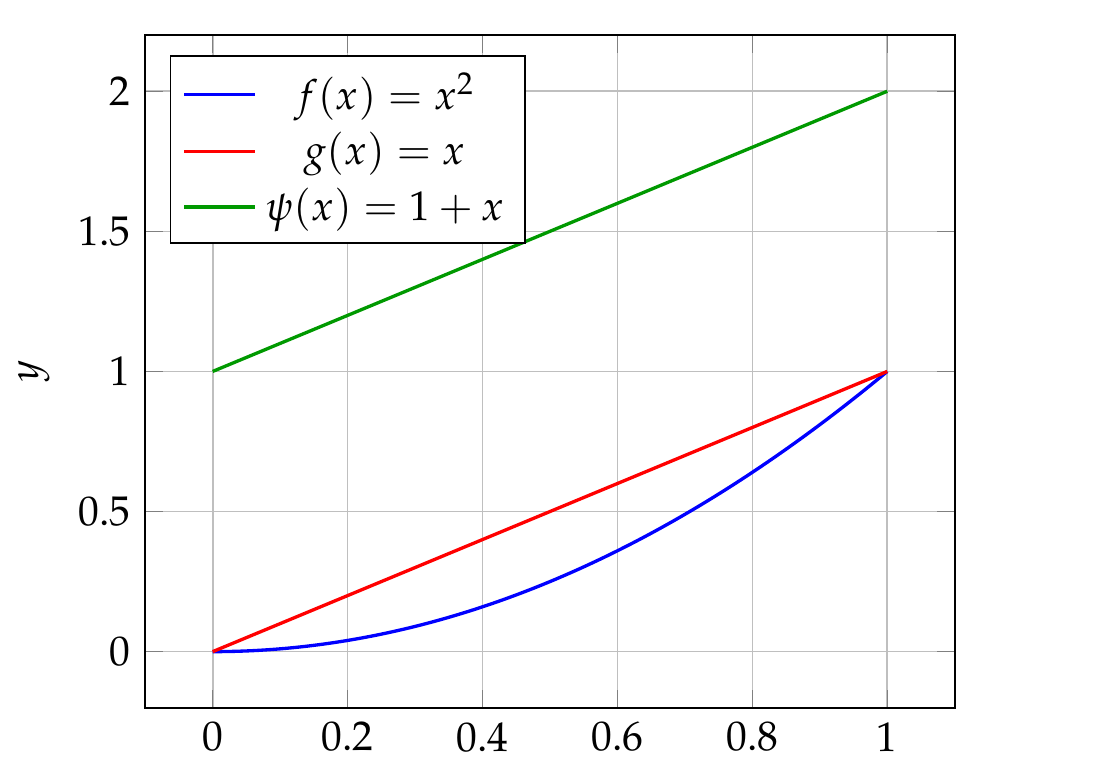
Example 6. Let \(a=0\), \(b=1\), \(\delta=2\), \(p=2\), \(r=3\), \(q=2\), \(s=\frac{3}{2}\), \(f(x)=x^2\), \(g(x)=x\), and \(\psi(x)=1+x\). Then the left-side of (22) gives
\[\begin{aligned} & \left|\frac{1}{\int_a^b \psi(x) \mathrm{d}x} \int_a^b \psi(x) f(x)g(x)\,dx – \left( \frac{1}{\int_a^b \psi(x) \mathrm{d}x} \int_a^b \psi(x) f(x)\,dx \right) \left( \frac{1}{\int_a^b \psi(x) \mathrm{d}x} \int_a^b \psi(x) g(x)\,dx \right)\right| \\&= \left|\frac{1}{\int_0^1 (1+x) \mathrm{d}x} \int_0^1 (1+x) x^{3} \mathrm{d}x – \left( \frac{1}{\int_0^1 (1+x) \mathrm{d}x} \right)^{2} \left( \int_0^1 (x+x^2) \mathrm{d}x \right) \int_0^1 \left(x^{2}+x^{3}\right) \mathrm{d}x \right| \\&= \frac{2}{3} *0.45 – \frac{4}{9} *0.8333333*0.5833333333 \\&=0.08395, \end{aligned}\tag{43}\] and the right-side of (22) becomes
\[\begin{aligned} \frac{\delta^{2} \vartheta \gamma}{\left(\frac{1}{q}+\frac{1}{s}+1\right) \left(\frac{1}{q}+\frac{1}{s}+2\right)} \frac{\left[b-a\right]^{\frac{1}{q}+\frac{1}{s}+2}}{\left(\int_a^b \psi(x) \mathrm{d}x\right)^2} =\frac{128}{247 \sqrt{3}} =0.2992, \end{aligned}\tag{44}\] where \[\gamma=\left( \int_a^b |f'(x)|^p \mathrm{d}x \right)^{\frac{1}{p}} =2 \left( \int_0^1 x^2 \mathrm{d}x \right)^{\frac{1}{2}} =\frac{2}{\sqrt{3}},\] and \[\vartheta =\left( \int_a^b |g'(x)|^r dx \right)^{\frac{1}{r}} =1.\]
From (43) and (44), we observe that the inequality (22) is valid.
Conflicts of Interest: The author of this paper declares that he has no conflicts of interest.
Acknowledgments: The paper is funded by the EU NextGenerationEU through the Recovery and Resilience Plan for Slovakia under the project No. 09I03-03-V02-00040 and the Slovak Research and Development Agency under the Contract no. VV-MVP-24-0424. Additionally, the author gratefully acknowledges the support provided by Comenius University during his doctoral studies. The author gratefully acknowledges Prof. Josip Pečarić for his valuable comments and constructive suggestions, which significantly improved the presentation of this work.