
Boron–diol interactions provide a chemically plausible mechanism for selective stabilization within complex prebiotic mixtures [1–3]. In aqueous environments, boron exists predominantly as boric acid and its conjugate base, borate, with speciation governed by a pKa of ~9.2. The tetrahedral borate species exhibits enhanced affinity for vicinal diols, forming cyclic esters through coordination to adjacent hydroxyl groups [1–4]. These interactions are highly sensitive to diol geometry, favoring cis-configured hydroxyl groups and selectively stabilizing furanose sugars such as ribose.
The resulting complexes are moderate in strength (\(10^{1}\text{–}10^{4}\,\mathrm{M}^{-1}\)) yet kinetically labile, enabling rapid exchange and continuous equilibration within chemically diverse mixtures. Beyond simple chelation, borate can form bridging interactions between multiple diol-containing species, generating transient networks that reduce molecular mobility and introduce an emergent level of organization [3–7]. Crucially, borate ester formation is fully reversible, allowing environmental fluctuations—including pH variation and wet–dry cycling—to dynamically reshape complex distributions.
We argue that, under such conditions, boron-mediated complexation operates as a form of thermodynamic selection. Rather than directing specific reaction pathways, boron biases equilibrium populations toward geometrically and electronically compatible structures. In this way, boron may act as a primitive chemical “editor,” constraining prebiotic chemical space and promoting the persistence of biologically relevant sugars [1,3,4,8].
The prebiotic synthesis of carbohydrates generates highly complex mixtures characterized by structural diversity, instability and rapid interconversion. Classical reactions such as the formose reaction produce broad distributions of sugars and degradation products, with little inherent selectivity toward biologically relevant species [9–11]. Ribose, despite its central role in contemporary biology, is particularly unstable under alkaline conditions and readily decomposes [12–14].
This lack of selectivity presents a fundamental challenge: how can specific molecular scaffolds emerge from chemically heterogeneous environments in the absence of enzymatic control? Proposed solutions—including mineral templating, phosphorylation and environmental cycling—offer plausible routes to partial selection, but often rely on narrowly defined conditions or fail to capture the intrinsically dynamic nature of prebiotic systems [15,16].
We argue that reversible molecular interactions, rather than irreversible synthetic pathways alone, may have played a central role in constraining chemical space. In this framework, selection emerges at the level of equilibrium, with transient stabilization mechanisms biasing molecular populations toward compatible structures.
Recent experimental work further refines this view by demonstrating that borate does not increase the peak yield of ribose, but instead suppresses its degradation, leading to enhanced accumulation over time [12,13]. This distinction indicates that boron-mediated selection operates primarily through differential stability rather than preferential synthesis. Rather than directing the formation of ribose, boron extends its lifetime within dynamic reaction networks, thereby biasing chemical composition over time.
Boron is geochemically plausible in a range of prebiotic settings, including evaporitic deposits, hydrothermal systems and localized continental environments. Its distribution reflects its incompatibility in rock-forming minerals, leading to enrichment in evolved crustal settings and evaporative basins. Although the extent of boron availability on the early Earth remains debated, evidence from ancient sediments and boron-bearing minerals suggests that localized boron-rich environments were likely present [17,18].
In aqueous solution, boron exists primarily as boric acid and borate, with speciation governed by pH (pKa \(\approx\) 9.2). This equilibrium is highly sensitive to environmental conditions, including mineral buffering, evaporation and ionic composition. Unlike typical Brønsted acids, boric acid functions as a Lewis acid, forming tetrahedral borate upon hydroxide coordination [1–8]. This structural transition is critical, as the tetrahedral borate species exhibits enhanced affinity for vicinal diols, enabling selective interactions with carbohydrate-like molecules [5,7].
Importantly, plausible prebiotic environments were unlikely to be static, but instead characterized by spatiotemporal heterogeneity in pH, solute concentration and water activity. Such fluctuations—arising from processes such as evaporation, fluid mixing and wet–dry cycling—would have dynamically modulated boron speciation and, consequently, its reactivity. Under these conditions, boron–diol interactions would not be constant but continuously redistributed, linking environmental variability to chemical selection processes [1,4,8].
Boron interacts selectively with cis-diols, forming cyclic esters through coordination to adjacent hydroxyl groups. The stability of these complexes depends on diol geometry, conformational preorganization and solution conditions. Five-membered furanose sugars, including ribose, present favorable binding motifs and are therefore preferentially stabilized relative to less compatible isomers or open-chain forms [16,19,20].
These interactions are moderate in strength (\(10^{1}\text{–}10^{4}\,\mathrm{M}^{-1}\)) yet kinetically labile, enabling rapid association–dissociation and continuous exchange within complex mixtures. Consequently, boron–diol chemistry operates under conditions of dynamic equilibration, allowing the system to sample multiple binding configurations while favoring thermodynamically stable complexes [20–22].
Beyond simple chelation, borate can form bridging interactions between multiple diol-containing molecules, generating transient networks and higher-order assemblies (Figure 1). Such interactions reduce molecular mobility and effectively partition mixtures into bound and unbound populations, introducing an emergent level of organization within otherwise disordered systems [1,3–6].
Crucially, borate ester formation is fully reversible, placing these interactions within the framework of dynamic covalent chemistry. Environmental perturbations—including pH shifts, concentration changes and wet–dry cycles—continuously redistribute boron–diol complexes [1,3,4,7]. Under these conditions, stability and exchange act in concert, enabling selective persistence of compatible structures over time.
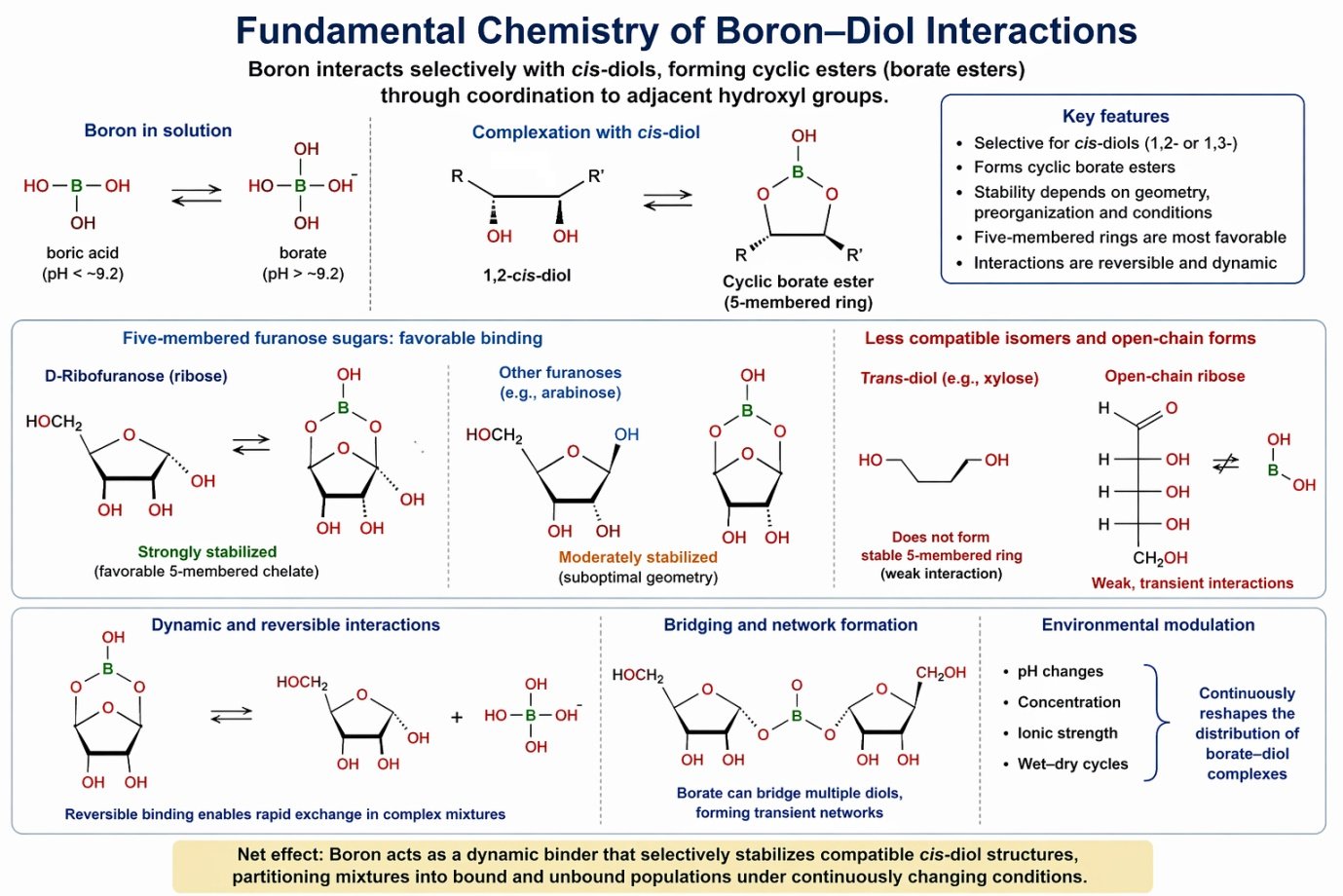
We argue that boron-mediated complexation operates as a form of thermodynamic editing, in which reversible binding selectively stabilizes compatible molecular structures while allowing others to dissipate. In this framework, selection arises not from directed synthesis but from differential persistence within dynamically equilibrating systems.
This process differs fundamentally from catalytic control. Rather than accelerating specific reaction pathways, boron biases equilibrium populations by preferentially stabilizing molecules that satisfy geometric and electronic criteria for complexation. In carbohydrate mixtures, this manifests as the stabilization of cis-diol-containing sugars, particularly furanose forms, relative to less favorably configured isomers [3,23,24].
Recent experimental studies further clarify this mechanism by demonstrating that borate does not increase the peak yield of ribose, but instead suppresses its degradation, leading to enhanced accumulation over time [12,13]. This distinction underscores that boron-mediated selection operates primarily through differential stability rather than preferential synthesis.
Under fluctuating environmental conditions, such as drying–wetting cycles, this selection process becomes iterative. Less stable complexes dissociate during perturbation, while more favorable structures persist and accumulate [3,4,25]. The result is a progressive biasing of chemical composition over time, driven by repeated cycles of stabilization and exchange rather than by specific synthetic pathways.
This conceptual framework aligns with broader models of prebiotic chemistry in which selection emerges from physicochemical constraints rather than encoded information, suggesting that dynamic, reversible interactions can act as primitive selectors in complex chemical systems [8,26–28].
The preferential stabilization of ribose by borate has been experimentally demonstrated, but its implications extend beyond simple preservation [12,13]. By constraining the accessible pool of sugars, boron-mediated selection can reshape downstream reaction networks, influencing processes such as phosphorylation, nucleoside formation and polymerization.
Importantly, this mechanism does not require the exclusive production of ribose. Instead, it operates through relative enrichment, increasing the persistence and availability of ribose compared with competing species (Figure 2). Such biasing of molecular populations may be sufficient to shift reaction pathways toward biologically relevant outcomes, even in chemically heterogeneous environments [16,20–22].
More broadly, boron-mediated complexation provides a mechanism by which environmental conditions can be translated into molecular-level selection. Through its sensitivity to pH, concentration and hydration state, boron effectively couples geochemical dynamics to the stability and distribution of organic molecules. In this sense, boron may act as a mediator between environmental variability and emergent chemical organization, facilitating the accumulation of key molecular precursors to early biopolymers [3,4,29].
In this way, boron-mediated selection may have contributed to the emergence of biologically relevant molecules by linking environmental fluctuations to the persistence of specific chemical structures.
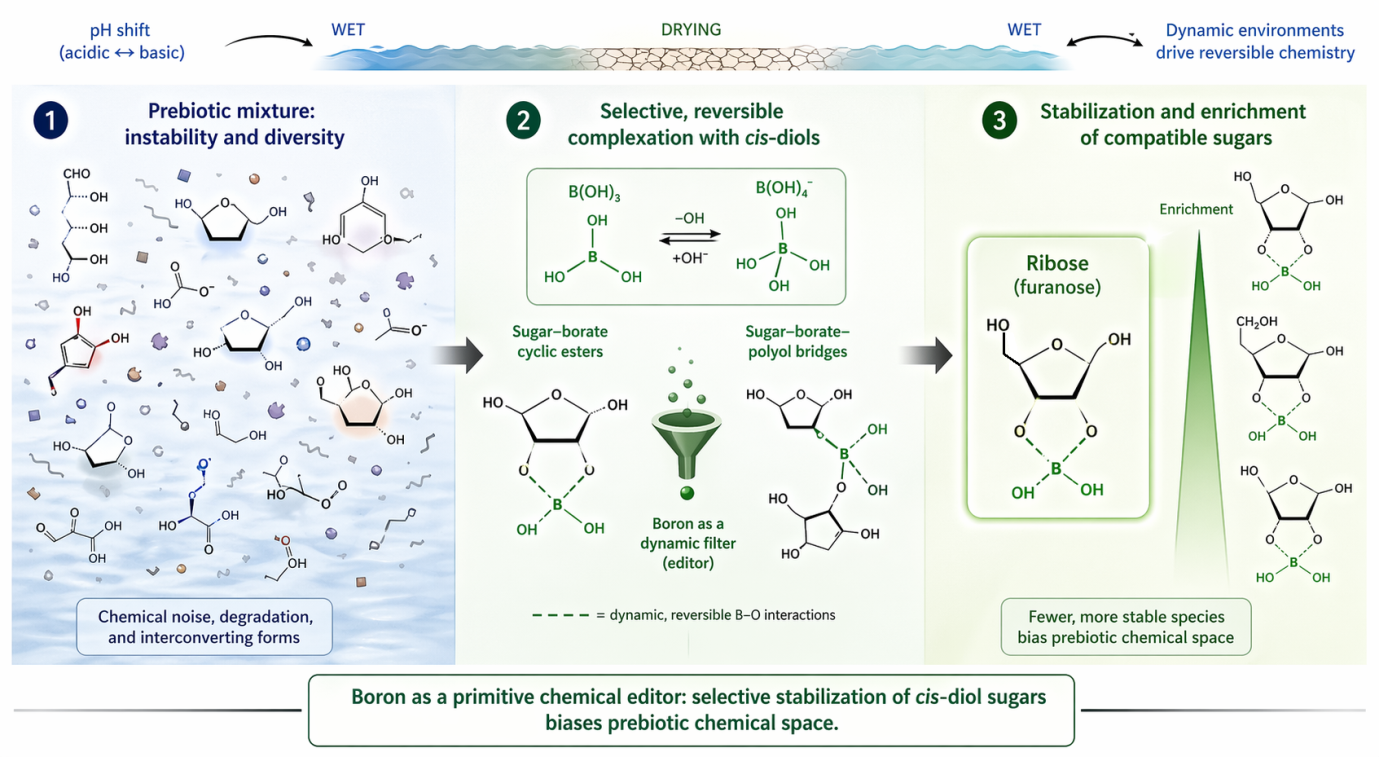
Despite its conceptual appeal, the boron-mediated selection model raises several important uncertainties. The availability, concentration and spatial distribution of boron in specific prebiotic environments remain incompletely constrained, and competing ligands—such as phosphate, silicates or other polyols—may significantly influence boron–diol interactions [8,30–32]. In addition, while borate complexes are stabilizing under controlled conditions, their persistence and functional relevance under fluctuating, heterogeneous environments require further experimental validation [1,8,33–35].
Alternative selection mechanisms—including mineral surface interactions, eutectic freezing and phosphorylation chemistry—may operate in parallel with, or in competition with, boron-mediated processes. These mechanisms differ in their dependence on environmental parameters and in the types of selectivity they impose. A key challenge is therefore to determine whether boron acts as a dominant selector in specific niches or as one component within a broader network of interacting selection processes.
Future work should prioritize system-level investigations that move beyond simplified model reactions. Experiments that integrate multiple environmental variables—such as pH oscillations, drying–wetting cycles and mixed chemical systems—will be essential for evaluating how boron-mediated interactions function within realistic prebiotic contexts.
The role of boron in prebiotic chemistry may exemplify a broader principle: reversible, environment-responsive interactions can act as selectors in complex chemical systems. Rather than directing specific reaction pathways, such processes bias molecular populations by stabilizing certain structures over others, thereby shaping chemical outcomes over time.
In this view, boron is not merely a stabilizing additive but part of a wider class of chemical agents capable of modulating molecular distributions through equilibrium bias and dynamic exchange. These mechanisms do not encode information in a biological sense, yet they impose constraints that guide the trajectory of chemical evolution.
Recognizing the role of such dynamic selection processes may be essential for understanding how prebiotic chemistry transitioned from disordered mixtures to systems capable of persistence, organization and, ultimately, function. More broadly, this perspective suggests that the emergence of biologically relevant molecules may have been driven not solely by synthetic pathways, but by physicochemical processes that selectively stabilized compatible structures within complex environments.
Author Contributions: V.M.D. and A.O.T. conceived and designed the study. V.M.D. conducted the data analysis and drafted the manuscript, with inputs from V.M.D. and A.O.T. revised the text.
Conflicts of Interest: The authors declare no competing interests.