
Microbial infections encompass a wide spectrum of threats to human health and well-being, including acute and chronic diseases that may cause substantial morbidity and mortality [1–4]. These threats are intensified by the emergence and transmission of drug-resistant organisms, which complicate the management of infections that were previously amenable to conventional treatment. They also include the risk of emerging outbreaks, healthcare-associated infections that compromise patient safety, rising expenditure across healthcare systems, and economic losses associated with reduced productivity. Long-term complications following infection, together with the ongoing evolution of pathogenic microorganisms, further demonstrate the need for surveillance, preventive measures, and the investigation of new therapeutic strategies [5–12]. These challenges underscore the importance of robust public-health measures, appropriate antibiotic stewardship, and innovative antimicrobial research [13–18]. Imidazole-containing materials, including polymeric derivatives, have attracted attention because heterocyclic functional groups can contribute to tunable physicochemical behaviour, while the combination of different monomeric components provides opportunities to modify polymer structure and properties. Work on benzimidazole-containing polymer therapeutics and terpolymer derivatives illustrates these possibilities [19–21]. Separately, structure-based computational studies have investigated a variety of antibacterial targets in Staphylococcus aureus, demonstrating the value of integrating molecular modelling and biological evaluation in the discovery of potential antimicrobial compounds [22–26]. Further experimental and computational investigations of terpolymers have likewise considered the relationships among structural design, electronic properties, solvation behaviour, and biological interactions [27].
Several studies have examined imidazole-containing polymers, related heterocyclic compounds, and metal-associated terpolymer systems in relation to biological activity. Studenovský and colleagues [19] investigated polymer conjugates of the benzimidazole anthelmintic mebendazole and related therapeutics, considering their potential for repurposing in anticancer treatment. This work included polymer-based approaches intended to alter delivery and physicochemical performance rather than establishing the biological efficacy of every imidazole-containing terpolymer. Similarly, Mujafarkani and colleagues [20] synthesized and characterized a terpolymer–metal complex and assessed its antioxidant and antimicrobial effects using laboratory assays, including disc diffusion against selected bacterial and fungal organisms. Their investigation considered microbial species such as Staphylococcus aureus, Escherichia coli, Candida albicans, and Aspergillus niger. Another investigation by Mujafarkani and co-workers [21] examined the synthesis, characterization, and molecular modelling of a phenylenediamine–phenylhydrazine–formaldehyde terpolymer (PPHF) as a potential anti-inflammatory material. Predicted molecular interactions involving proteins 6JD8, 5TKB, and 4CYF were compared with those of ibuprofen. Such docking calculations provide hypotheses concerning ligand–protein recognition, but computational affinity estimates alone cannot establish the strength or specificity of biological inhibition. Collectively, these studies support further characterization of terpolymeric ligands and their possible antibacterial, antifungal, and broader biological activities.
Despite sustained scientific efforts to reduce the burden of microbial infections, resistant pathogens continue to present serious clinical challenges. The present investigation therefore examines the structural, electronic, antimicrobial, and cell-viability characteristics of an imidazole terpolymer derivative (DBF). The biological experiments consider A. niger, C. albicans, E. coli, and S. aureus, selected in view of their clinical relevance, including the documented problem of antibiotic resistance in S. aureus [28]. The broader importance of human infections caused by E. coli has also been discussed in the clinical literature [29]. Experimental synthesis, infrared and NMR spectral characterization, antimicrobial screening, and MDA-MB-231 breast-cancer cell assays were complemented by density functional theory, UV–visible excitation analysis, electron-density-based calculations, and molecular docking. The study also considered the human estrogen receptor (PDB 7MSA), a target relevant to estrogen-receptor-positive breast cancer; this target should not be regarded as a molecular surrogate for every form of breast cancer or as a validated receptor for the triple-negative MDA-MB-231 cell line. By examining spectroscopic properties, electronic descriptors, interaction patterns, and measured biological responses, the study seeks to assess the possible value of DBF as a starting point for further antimicrobial and anticancer research. The combined results are intended to inform subsequent experimental validation, rather than to establish clinical therapeutic efficacy from predicted molecular interactions alone.
A mixture containing 4,4′-diaminodiphenylmethane (1 mol), benzimidazole (1 mol), and formaldehyde was placed in a round-bottom flask. The mixture was refluxed in an oil bath at 130 \(^\circ\)C for 6 hours, with intermittent agitation to maintain a homogeneous reaction medium. At the end of the reaction period, the flask contents were poured into a beaker containing ice crystals, with vigorous mixing to promote separation of the resin. The separated material was washed thoroughly with a large quantity of cold water and subsequently air-dried. The resin was then extracted with water to remove residual, unreacted monomers. Additional purification was carried out using a 1:1 hydrochloric acid–water mixture, followed by the addition of 12% sodium hydroxide with continuous stirring. The resulting resin was filtered, washed successively with hot water, methanol, and acetone, and subsequently dried overnight in an oven at 75 \(^\circ\)C. The dried material was finely ground, passed through a 100-mesh sieve to obtain a more uniform particle size, and stored in a polyethylene container before characterization. The proposed molecular representation of the DBF terpolymeric ligand is shown in Scheme 1. The quantity of formaldehyde and the precise purification sequence should be confirmed from the original laboratory record to ensure that the synthesis is reproducible.
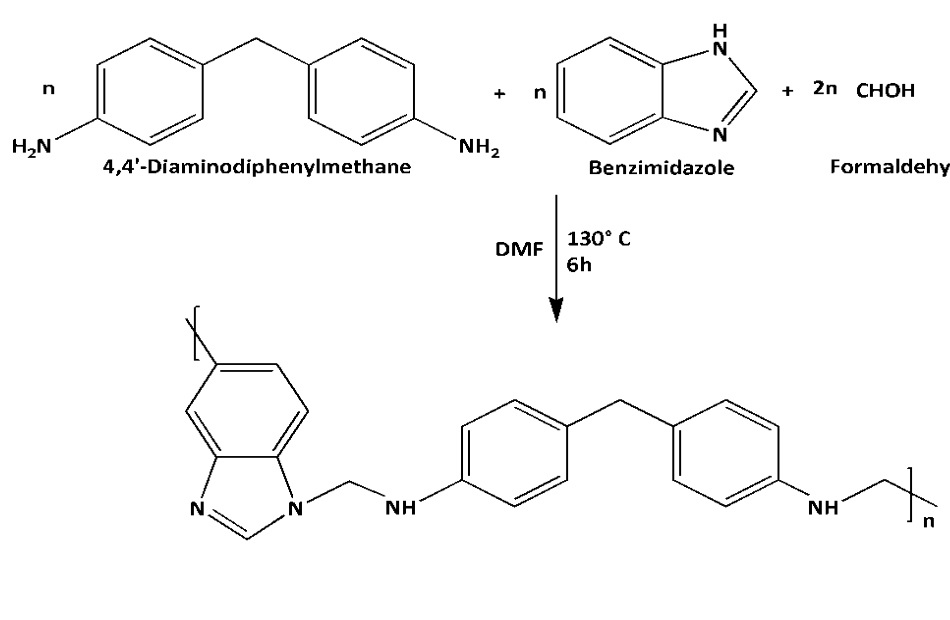
The terpolymer prepared from 4,4′-diaminodiphenylmethane, benzimidazole, and formaldehyde was obtained as an off-white resin. Its solubility behaviour was assessed in a range of solvents to provide preliminary information about its processing characteristics and chemical compatibility. The material was reported to be soluble in hydrochloric acid (HCl) and sulfuric acid (H\(_2\)SO\(_4\)), whereas it was insoluble in chloroform, benzene, toluene, ethanol, and diethyl ether under the conditions investigated. These observations indicate solvent-dependent behaviour and should be interpreted in relation to the actual acid concentrations and experimental conditions used.
On the basis of the reported analytical measurements, the empirical formula assigned to the repeating unit of the resin was C\(_{22}\)H\(_{21}\)N\(_4\). The authors considered the measured percentages of carbon, hydrogen, and nitrogen to be consistent with the calculated elemental composition, as summarized in Supplementary Table S1. The average molecular weight and the polydispersity index of the resin were reported in Supplementary Table S2. These supplementary results are needed for independent evaluation of the elemental-composition assignment and polymer molecular-weight distribution.
The experimental FT-IR spectrum of the DBF terpolymer is presented in Supplementary Figure S1. An absorption band observed near 2850 cm\(^{-1}\) was associated with a methylene (–CH\(_2\)) group within the terpolymer structure. The broad band at 3407.75 cm\(^{-1}\) was assigned to N–H stretching associated with the 4,4′-diaminodiphenylmethane component, whereas the relatively weak feature at 2918.55 cm\(^{-1}\) was attributed to methylene-linkage vibrations. A band at 1256.57 cm\(^{-1}\) was interpreted as an aromatic amine C–N stretching vibration. Features at 1126.4 and 809.07 cm\(^{-1}\) were also reported and associated with the substituted aromatic framework. The experimental assignments and tabulated frequencies are reproduced in Supplementary Table S3; definitive vibrational assignments require consideration of the original spectrum.
The \(^1\)H NMR spectrum was recorded at 400 MHz using dimethyl sulfoxide (DMSO) as the solvent and is provided in Supplementary Figure S2. Signals in the \(\delta\) 6.4–7.5 ppm interval were assigned to the aromatic protons of the terpolymer. A signal at \(\delta\) 5.8 ppm was attributed to the –NH bridging group, while the signals at \(\delta\) 3.5 and 2.5 ppm were associated with Ar–N–CH\(_2\) linkages and methylene groups, respectively. The assignments are reported in Supplementary Table S4 and were considered together with the corresponding chemical environments in the proposed terpolymeric structure.
The \(^{13}\)C NMR spectrum provides complementary information on the carbon environments of the resin and is included as Supplementary Figure S3. Resonances at \(\delta\) 116.36, 117.98, 118.16, 119.89, 120.81, and 121.30 ppm were assigned to the aromatic carbon atoms C1–C6 in the 4,4′-diaminodiphenylmethane component. An additional signal at \(\delta\) 40.15 ppm was associated with an Ar–CH\(_2\) group, whereas a resonance at \(\delta\) 39.80 ppm was reported in relation to a carbon environment affected by C–N bonding. The detailed assignments appear in Supplementary Table S5 and should be assessed alongside the complete spectrum and atom-numbering scheme.
The chemical reagents used in the investigation were described in relation to methods reported by Agnihotri and colleagues [30]. Bovine serum albumin was purchased from Sigma-Aldrich Chemicals Pvt. Ltd. (India), while the other reagents were obtained from HiMedia Laboratories Pvt. Ltd. (India). The procedures reported in the cited study concern a related in-vitro context and should not be taken as direct documentation of an identical DBF synthesis or screening protocol; original experimental procedures remain the primary record of the present work.
The human breast cancer cell line MDA-MB-231 was procured and maintained for the cell-viability investigation. A related study of human breast cancer cell lines by Kumar and colleagues is cited as background for breast cancer experimentation [31]. The source does not, by itself, establish the identity of the growth medium, serum concentration, cell authentication procedures, or culture conditions used for the present experiments. Those details should be checked against the original cell-culture documentation before journal submission.
The DBF terpolymeric ligand was optimized using density functional theory (DFT) with the B3LYP exchange–correlation approach [32]. Geometry optimization was performed at the B3LYP/aug-cc-pVDZ level of theory and the molecular representation of the optimized structure is shown in Figure 2. GaussView 6.0.16 was used to visualize the molecular structure and associated results [33], while Gaussian 09 was identified as the electronic-structure calculation software [34]. To investigate the electronic properties and internal interactions of the DBF terpolymer in greater detail, several complementary analyses were considered, including frontier molecular orbitals (FMOs), natural bond orbitals (NBOs), the electron localization function (ELF), and non-covalent interactions (NCIs). The NCI output was visualized using the Visual Molecular Dynamics (VMD) package [35]. The HOMO and LUMO isosurface plots were visualized using Chemcraft, and additional quantum-chemical descriptors were calculated to characterize electron donation, electron acceptance, and solvent-dependent electronic behaviour. The exact calculation files are required to reproduce the chosen basis set, solvent model, and numerical outputs.
Molecular docking calculations were undertaken with AutoDock Vina [36]. The optimized DBF terpolymer representation was docked against five selected structures obtained from the Protein Data Bank: 1ACZ, a granular-starch-binding domain of Aspergillus niger glucoamylase; 1ZAP, a secreted aspartic protease from Candida albicans; 4RJ2, purine nucleoside phosphorylase from Escherichia coli; 4DKI, a penicillin-binding protein associated with Staphylococcus aureus; and 7MSA, a human estrogen-receptor-alpha structure relevant to estrogen-receptor-positive breast cancer. These identifiers indicate the origins and molecular identities of the docking targets; the protein structures should not automatically be interpreted as equivalent indicators of cellular susceptibility or clinical disease response. Receptor preparation was described as the removal of water molecules, heteroatoms, and previously bound ligands, followed by the addition of polar hydrogen atoms using BIOVIA Discovery Studio software [37]. The reported binding-site coordinates and search radii for the five structures are provided in Table 1. The docking exhaustiveness parameter was set to 8. Gentamicin (GEN), fluconazole (FLU), and doxorubicin (DXB) were also included as comparator ligands for bacterial, fungal, and cancer-associated targets, respectively. Each comparator was examined computationally alongside DBF to provide a reference for the predicted docking score and interactions; these comparisons do not substitute for target-specific inhibitor controls or laboratory assays. The resulting ligand–protein complexes were examined using Discovery Studio for interaction mapping, and the molecular structures were prepared from the synthesized ligand representation after the DFT geometry optimization described above. Independent docking validation would require the precise receptor and ligand coordinate files, protonation states, binding-site definitions, Vina configuration settings, and resulting pose files.
| Protein ID | X coordinate | Y coordinate | Z coordinate | Radius |
|---|---|---|---|---|
| 1ACZ | 0.377947 | -2.435421 | -2.038947 | 19.000000 |
| 1ZAP | 10.886646 | 29.336303 | 2.271455 | 26.481506 |
| 4DKI | 7.129977 | 38.063883 | 44.396543 | 60.540215 |
| 7MSA | 9.970985 | -6.897141 | 34.973801 | 46.758930 |
| 4RJ2 | -64.073369 | 1.916068 | -72.810869 | 37.879265 |
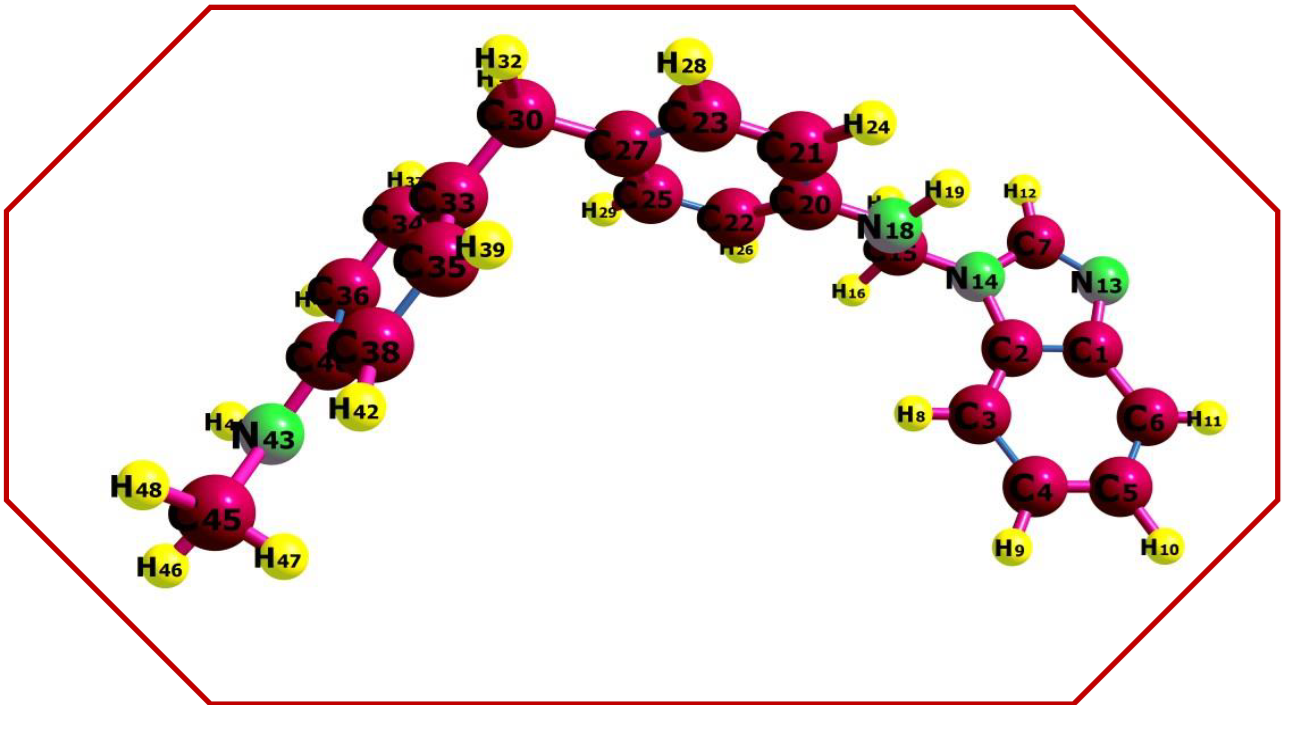
To determine the most favorable structural arrangement and achieve energy minimization, the studied compound underwent a process of structural optimization. Additionally, the bond lengths selected for the compound under study (see Figure Figure 2) in different solvents are presented in Supplementary Table S6. Comparative analysis and changes in bond length were observed for the polymer in different solvent environments: dimethylsulfoxide (DMSO) – C\(_{21}\)–C\(_{23}\)=1.39453, C\(_{25}\)–H\(_{29}\)=1.09068, C\(_{20}\)–N\(_{18}\)=1.40052, N\(_{14}\)–C\(_7\)=1.37467, C\(_7\)–N\(_{13}\)=1.31633, N\(_{13}\)–C\(_1\)=1.39554, C\(_1\)–C\(_6\)=1.40273, N\(_{43}\)–H\(_{44}\)=1.01114, N\(_{43}\)–C\(_{45}\)=1.45412; ethanol (EtOH) – C\(_{21}\)–C\(_{23}\)=1.39450, C\(_{25}\)–H\(_{29}\)=1.09065, C\(_{20}\)–N\(_{18}\)=1.40049, N\(_{14}\)–C\(_7\)=1.37491, C\(_7\)–N\(_{13}\)=1.31612, N\(_{13}\)–C\(_1\)=1.39551, C\(_1\)–C\(_6\)=1.40270, N\(_{43}\)–H\(_{44}\)=1.01110, N\(_{43}\)–C\(_{45}\)=1.45399; methanol (MeOH) – C\(_{21}\)–C\(_{23}\)=1.39452, C\(_{25}\)–H\(_{29}\)=1.09066, C\(_{20}\)–N\(_{18}\)=1.40050, N\(_{14}\)–C\(_7\)=1.37479, C\(_7\)–N\(_{13}\)=1.31623, N\(_{13}\)–C\(_1\)=1.39552, C\(_1\)–C\(_6\)=1.40271, N\(_{43}\)–H\(_{44}\)=1.01112, N\(_{43}\)–C\(_{45}\)=1.45405; and water (H\(_2\)O) – C\(_{21}\)–C\(_{23}\)=1.39455, C\(_{25}\)–H\(_{29}\)=1.09069, C\(_{20}\)–N\(_{18}\)=1.40054, N\(_{14}\)–C\(_7\)=1.37456, C\(_7\)–N\(_{13}\)=1.31643, N\(_{13}\)–C\(_1\)=1.39555, C\(_1\)–C\(_6\)=1.40275, N\(_{43}\)–H\(_{44}\)=1.01116, N\(_{43}\)–C\(_{45}\)=1.45418. Among the reported bond lengths, the N\(_{43}\)–H\(_{44}\) bond is the shortest in each of the four investigated solvents. However, the individual bond-length differences between DMSO, ethanol, methanol, and water are small, and the listed values do not establish a uniform shortening of all bonds in ethanol. The geometry results therefore support a broadly similar optimized molecular structure across the four environments, rather than demonstrating that ethanol is necessarily the most suitable experimental solvent for the terpolymer.
Fourier-transform infrared (FT-IR) spectroscopy probes molecular vibrations and thereby provides useful information about the functional groups, chemical bonding environments, and structural characteristics of a compound. The position and intensity of infrared absorptions depend on bond strengths, the masses of the atoms involved, and changes in dipole moment during a vibration. The theoretical frequency assignments for the DBF terpolymer in DMSO, water, methanol, and ethanol are collected in Table 2. Experimental bands can then be considered alongside the corresponding calculated frequencies, recognizing that differences in modelling assumptions, solvent treatment, hydrogen bonding, and anharmonicity may affect direct agreement. The values listed in the table have been preserved from the supplied calculations.
| Vibrational mode | DBF_DMSO (cm\(^{-1}\)) | DBF_H\(_2\)O (cm\(^{-1}\)) | DBF_MeOH (cm\(^{-1}\)) | DBF_ethanol (cm\(^{-1}\)) |
|---|---|---|---|---|
| C–H | \(V_{\mathrm{as}}\,3178.70\) | \(V_{\mathrm{as}}\,3074.42\) | \(V_{\mathrm{s}}\,2982.63\) | \(V_{\mathrm{s}}\,2982.51\) |
| N–H | \(V_{\mathrm{s}}\,3562.43\) | \(V_{\mathrm{s}}\,3562.25\) | \(V_{\mathrm{s}}\,3562.67\) | \(V_{\mathrm{s}}\,3562.96\) |
| C–N | \(V_{\mathrm{s}}\,1275.93\) | \(V_{\mathrm{s}}\,1302.96\) | \(V_{\mathrm{s}}\,1302.93\) | \(V_{\mathrm{s}}\,1294.20\) |
| C=N | \(V_{\mathrm{s}}\,1623.61\) | \(V_{\mathrm{s}}\,1623.56\) | \(V_{\mathrm{s}}\,1623.66\) | \(V_{\mathrm{s}}\,1623.70\) |
C–H stretching vibrations occur across a range of wavenumbers depending on whether the carbon environment is aromatic, aliphatic, or otherwise substituted [38]. The experimental DBF spectrum exhibited an absorption band at 2850.93 cm\(^{-1}\), whereas the computed C–H stretching bands appeared at 3178.70 cm\(^{-1}\) in DMSO, 3074.42 cm\(^{-1}\) in water, 2982.63 cm\(^{-1}\) in methanol, and 2982.51 cm\(^{-1}\) in ethanol. These findings indicate variation between the measured and predicted vibration frequencies. The difference is especially evident for the DMSO and water calculations, and it should not be described as uniformly negligible across all solvents. Comparison of the observed and computed features requires consistent assignment of the underlying C–H vibration modes, as well as consideration of potential scaling corrections and the experimental sample environment.
The N–H stretching region is sensitive to the chemical environment and the strength of possible hydrogen-bonding interactions [38]. The calculated N–H stretching frequencies were 3562.43 cm\(^{-1}\) in DMSO, 3562.25 cm\(^{-1}\) in water, 3562.67 cm\(^{-1}\) in methanol, and 3562.96 cm\(^{-1}\) in ethanol. The corresponding experimental band was reported at 3407.75 cm\(^{-1}\). The calculated bands are thus located at higher wavenumbers than the measured band, which may reflect differences between the harmonic calculations and experimental molecular environments. However, the present values alone cannot isolate an increased repulsive solvent effect as the cause of the observed differences.
Aromatic amino-group C–N stretching vibrations are often identified within a spectral region influenced by ring substitution, conjugation, and neighbouring functional groups [38]. In the experimental DBF spectrum, a band was assigned at 1256.57 cm\(^{-1}\). The theoretical results were 1275.93 cm\(^{-1}\) for DMSO, 1302.96 cm\(^{-1}\) for water, 1302.93 cm\(^{-1}\) for methanol, and 1294.20 cm\(^{-1}\) for ethanol, as listed in Table 2. The relatively limited variation among the calculated values supports a broadly comparable computed bonding environment across these solvent conditions. A conclusive interpretation nevertheless depends on normal-mode displacement analysis and consideration of any coupled vibrations rather than the numerical range alone.
The theoretical stretching frequencies associated with the C=N group were 1623.61 cm\(^{-1}\) for DMSO, 1623.56 cm\(^{-1}\) for water, 1623.66 cm\(^{-1}\) for methanol, and 1623.70 cm\(^{-1}\) for ethanol. These closely grouped values show limited solvent-related variation in the calculated C=N stretching mode. The manuscript also reports an experimental absorption at 1126.4 cm\(^{-1}\); however, assignment of that feature to a C=N stretching mode is not established by the available information and should be reviewed against the original FT-IR spectrum and normal-mode analysis. The experimental measurement is retained here without treating the proposed functional-group assignment as independently verified.
Absorption in the ultraviolet and visible spectral regions occurs when electromagnetic radiation promotes electronic transitions between molecular energy levels. In an electronic excitation, an electron is promoted from an occupied orbital to a higher-energy available state; excitations involving frontier molecular orbitals can make important contributions to the observed absorption profile [39,40]. The roles of sigma (\(\sigma\)), pi (\(\pi\)), and non-bonding (\(n\)) orbitals depend on the detailed transition assignments and molecular electronic structure. UV–visible calculations therefore provide information about predicted absorption wavelengths (\(\lambda\)), excitation energies (\(E\)), oscillator strengths (\(f\)), orbital contributions, and the character of individual electronic transitions. The calculated excitation data for DBF in the investigated solvents are presented in Table 3. Of the reported transitions, the highest calculated excitation energy was obtained for DBF in water at the \(S_0\rightarrow S_3\) transition (4.2879 eV), followed by DMSO (4.2819 eV) and methanol (4.2817 eV), with ethanol showing a corresponding value of 4.2781 eV. These high-energy transitions correspond to relatively short predicted wavelengths, ranging approximately from 289.15 to 289.81 nm for the indicated \(S_0\rightarrow S_3\) features. The \(S_0\rightarrow S_1\) transition in each solvent showed a substantial orbital contribution but a low oscillator strength, whereas the \(S_0\rightarrow S_3\) transitions had larger oscillator strengths. This distinction is important because an orbital contribution does not, by itself, imply high optical transition intensity. The electronic spectra thus indicate solvent-dependent shifts of limited magnitude and provide a basis for comparing the predicted transition properties of the DBF ligand.
| Compound/solvent | Excitation Type | Energy (eV) | \(\lambda\) (nm) | Molecular contribution (Mc (%)) | Oscillator Strength (f) | Transition |
|---|---|---|---|---|---|---|
| DBF_DMSO | S0\(\rightarrow\)S1 | 4.0338 | 307.37 | 91\(\rightarrow\) 92(82.27) | 0.0001 | H \(\rightarrow\)L |
| S0\(\rightarrow\)S2 | 4.2158 | 294.10 | 91\(\rightarrow\)93(74.64) | 0.0226 | H \(\rightarrow\) L+1 | |
| S0\(\rightarrow\)S3 | 4.2819 | 289.55 | 91\(\rightarrow\)94(71.58) | 0.0497 | H \(\rightarrow\) L+2 | |
| DBF _ETOH | S0\(\rightarrow\)S1 | 4.0358 | 307.21 | 91\(\rightarrow\)92(82.41) | 0.0001 | H \(\rightarrow\)L |
| S0\(\rightarrow\)S2 | 4.2217 | 293.68 | 91\(\rightarrow\)93(73.35) | 0.0216 | H \(\rightarrow\) L+1 | |
| S0\(\rightarrow\)S3 | 4.2781 | 289.81 | 91\(\rightarrow\)94(70.67) | 0.0478 | H \(\rightarrow\) L+2 | |
| DBF_H20 | S0\(\rightarrow\)S1 | 4.0329 | 307.43 | 91\(\rightarrow\)92(82.23) | 0.0001 | H \(\rightarrow\)L |
| S0\(\rightarrow\)S2 | 4.2159 | 294.08 | 91\(\rightarrow\)93(77.18) | 0.0208 | H \(\rightarrow\) L+1 | |
| S0\(\rightarrow\)S3 | 4.2879 | 289.15 | 91\(\rightarrow\)94(73.67) | 0.0467 | H\(\rightarrow\) L+2 | |
| DBF_MEOH | S0\(\rightarrow\)S1 | 4.0348 | 307.28 | 91\(\rightarrow\)92(82.35) | 0.0001 | H\(\rightarrow\)L |
| S0\(\rightarrow\)S2 | 4.2208 | 293.75 | 91\(\rightarrow\)93(74.82) | 0.0209 | H \(\rightarrow\) L+1 | |
| S0\(\rightarrow\)S3 | 4.2817 | 289.56 | 91\(\rightarrow\)94(71.89) | 0.0466 | H\(\rightarrow\) L+2 |
Nuclear magnetic resonance (NMR) calculations were used to examine proton and carbon chemical environments in the DBF terpolymer under different solvent conditions. The experimental \(^1\)H and \(^{13}\)C NMR spectra are included in the supplementary information. Aromatic protons frequently resonate in the approximate \(\delta\) 6–8 ppm region, although the actual positions depend on their local chemical environments. The reported \(^1\)H NMR chemical shifts were referenced to tetramethylsilane (TMS), with signals at \(\delta\) 6.4–7.5 ppm assigned to aromatic hydrogen atoms, \(\delta\) 5.8 ppm to an –NH bridging group, \(\delta\) 3.5 ppm to an Ar–N–CH\(_2\) unit, and \(\delta\) 2.5 ppm to a methylene environment. Supplementary Table S8 presents the calculated data for the DMSO, water, ethanol, and methanol solvent models. The experimental and theoretical assignments should be assessed using the full molecular structure and the corresponding atom numbering.
The experimental \(^1\)H NMR spectrum of the DBF terpolymer is provided in Supplementary Figure S2. The highest calculated proton chemical shift was reported at \(\delta\) 7.83 ppm for aromatic hydrogen H(28), while the corresponding experimentally assigned aromatic signal was observed at approximately \(\delta\) 7.5 ppm. These values are in the same general aromatic-proton region, supporting a qualitative comparison between the calculated and measured assignments. Nonetheless, the numerical difference should be retained when assessing agreement, and a more rigorous comparison would require the full list of proton assignments and their calculated-versus-observed deviations.
The theoretical and experimental \(^{13}\)C NMR data were also compared. The reported theoretical chemical shifts across the different solvent models extended approximately from \(\delta\) 22.16 to 139.00 ppm, while the experimental values were described as spanning \(\delta\) 112.59–148.19 ppm. Within the calculations, a prominent aromatic carbon resonance assigned to C6 was reported near \(\delta\) 139.63 ppm in DMSO, methanol, and water; the highest experimental signal was reported at \(\delta\) 147.13 ppm and assigned to a carbon environment influenced by C–N bonding. These ranges and specific assignments are reproduced as stated, although the quoted maximum of 139.63 ppm is not consistent with an upper bound of 139.00 ppm. The original spectral tables should be used to reconcile that discrepancy before finalizing the quantitative NMR comparison.
Frontier molecular orbital theory provides a useful description of the roles of the highest occupied molecular orbital (HOMO) and lowest unoccupied molecular orbital (LUMO) in chemical reactivity [39,40]. The HOMO is commonly associated with the electron-donating capacity of a molecule, whereas the LUMO reflects its capacity to accept electronic density under appropriate reaction conditions [41,42]. The HOMO–LUMO energy gap is an electronic-structure descriptor that can inform comparisons of relative molecular reactivity, although it should not be interpreted as a direct measurement of biological activity or pharmacological potency [43]. Solvent-dependent electronic environments may alter orbital energies and related descriptors, thereby affecting predictions of electron transfer and molecular interactions [44,45].
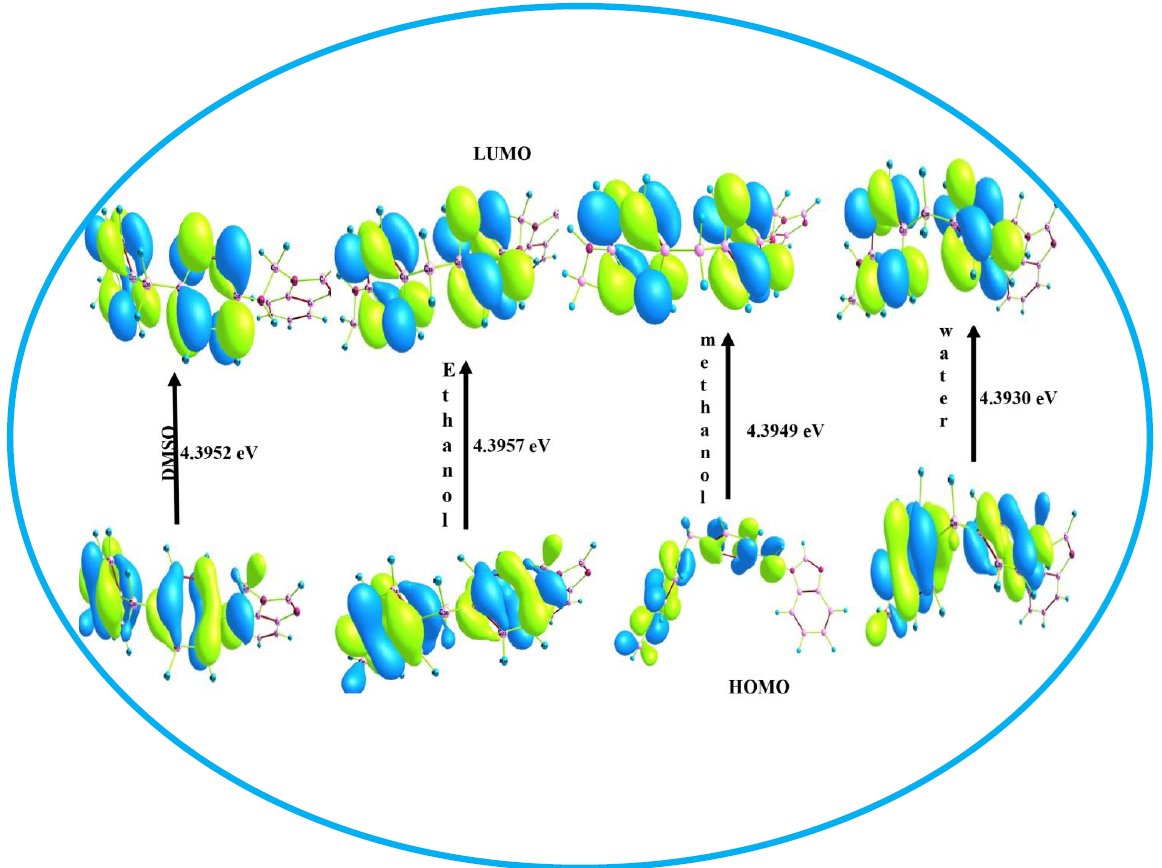
Studies combining experimental and electronic characterization with biological modelling provide additional methodological context [46]. The energy gap of DBF was assessed by subtracting the HOMO energy from the LUMO energy in the four investigated solvent models: dimethyl sulfoxide, ethanol, methanol, and water. The resulting gaps and the corresponding frontier orbital energies are reported in Table 4. Such electronic energy differences are useful for examining possible differences in molecular electronic stability and reactivity between modeled environments [47–49]. Nevertheless, the computed values depend on the selected density functional, basis set, and solvent model, and their interpretation should remain consistent with those computational assumptions.
As illustrated in Figure 3, the HOMO of DBF is distributed primarily over the two benzene rings and the nitrogen-containing NH and NH\(_2\) groups, while the LUMO is mainly located on the two central benzene rings. The HOMO localization around nitrogen-containing groups is compatible with the possible contribution of lone-pair electron density. The calculated HOMO–LUMO gaps (\(\Delta E\)) were 4.3952, 4.3957, 4.3930, and 4.3949 eV in DMSO, ethanol, methanol, and water, respectively. Although the values differ only slightly across the four solvents, methanol produced the smallest computed gap (4.3930 eV), suggesting marginally greater electronic softness in that model. This result should not be interpreted as demonstrating enhanced antimicrobial efficacy in methanol, because no solvent-specific biological response has been established by these calculations. The energy-gap values and associated descriptors allow a comparison of the electronic properties of the studied molecular structure [50–52].
| Solvents | HOMO | LUMO | \(\Delta\)E | (\(\eta\)) | CS | EN | (\(\mu\)) | (\(\omega\)) |
|---|---|---|---|---|---|---|---|---|
| DBF_DMSO | -5.4420 | -1.0468 | 4.3952 | 2.1976 | 0.2275 | 3.2444 | -3.2444 | 1.6222 |
| DBF_Ethanol | -5.4368 | -1.0411 | 4.3957 | 2.1978 | 0.2274 | 3.2389 | -3.2389 | 1.6194 |
| DBF_Water | -5.4444 | -1.0495 | 4.3949 | 2.1974 | 0.2275 | 3.2469 | -3.2469 | 1.6230 |
| DBF_Methanol | -5.4368 | -1.0438 | 4.3930 | 2.1965 | 0.2276 | 3.2403 | -3.2403 | 1.6201 |
Several additional descriptors, including electrophilicity, chemical hardness, chemical softness, chemical potential, and electronegativity, were derived from the orbital energies [53]. The electrophilicity index (\(\omega\)) describes a model-based tendency to accept electronic density, and its possible relationship to toxicological behaviour has been discussed in theoretical studies [54]. For DBF, the calculated electrophilicity was greatest in water at 1.6230 eV and smallest in ethanol at 1.6194 eV. Chemical potential (\(\mu\)) is related to the negative of electronegativity and characterizes changes in electronic energy with electron number [55,56]. The computed chemical softness was highest in methanol, with a value of 0.2276 eV\(^{-1}\), a result consistent with the smallest reported energy gap. Chemical hardness (\(\eta\)), which characterizes resistance to electronic-density redistribution, decreased in the sequence ethanol (2.1978 eV), DMSO (2.1976 eV), water (2.1974 eV), and methanol (2.1965 eV). The associated electronegativity values were 3.2389, 3.2403, 3.2444, and 3.2469 eV for ethanol, methanol, DMSO, and water, respectively. These closely spaced values indicate limited electronic variation under the four modeled solvent conditions. As summarized in Table 4, the descriptor trends are useful for comparing theoretical reactivity but do not independently demonstrate specific interactions with proteins, cell membranes, or biological targets.
Natural bond orbital (NBO) analysis is a quantum-chemical method used to interpret electron density in terms of localized bonding and nonbonding orbitals [57–59]. It provides a systematic way to examine donor–acceptor interactions, charge delocalization, and orbital contributions to molecular bonding [60]. Second-order perturbation theory is applied in this context to estimate the stabilizing effects of electron donation from occupied orbitals into suitable antibonding orbitals [61]. In comparison with a purely classical Lewis-structure representation, this approach can provide a more detailed view of the electronic interactions that influence molecular conformation and stability. NBO results can therefore complement the structural and vibrational analyses, as further considered in methodological discussions of natural orbitals [62], although numerical donor–acceptor stabilization energies should not be treated as experimental protein-binding energies or direct indicators of antimicrobial activity [63,64].
The calculated perturbation energies for DBF are summarized in Supplementary Table S9. The four solvent models showed comparable types of donor–acceptor interactions and closely related stabilization energies. In particular, an LP\(_{(1)}\)–\(\pi^*\) interaction associated with N\(_{14}\) and the C\(_7\)–N\(_{13}\) bond exhibited stabilization energies of 20.49, 20.46, 20.50, and 20.48 kcal/mol in DMSO, ethanol, water, and methanol, respectively. This interaction represented one of the stronger calculated intramolecular delocalization pathways in the supplied results. Additional interactions were assigned between the bonding \(\pi\) orbital of C\(_1\)–C\(_6\) and antibonding \(\pi^*\) orbitals associated with C\(_2\)–C\(_3\) and C\(_7\)–N\(_{13}\). An interaction from \(\sigma\)(C\(_5\)–C\(_6\)) to \(\sigma^*\)(C\(_1\)–N\(_{13}\)) was associated with a stabilization energy of approximately 8.7 kcal/mol in each solvent.
The reported orbital occupancies of 1.90942, 1.96743, 1.97454, and 1.91906 electrons corresponded to the listed N18, C\(_1\)–C\(_2\), C\(_1\)–N\(_{13}\), and C\(_7\)–N\(_{13}\) environments, respectively. These values are compatible with highly occupied localized orbitals, although an acceptability threshold for a Lewis-like representation is not by itself a complete validation of a proposed molecular structure. Other reported orbital interactions, including \(\sigma\)–\(\sigma^*\) and \(\pi\)–\(\pi^*\) donation, provide further information concerning electronic delocalization within DBF. Their implications for biological activity remain hypotheses that require additional molecular and experimental evidence rather than conclusions drawn solely from the NBO output.
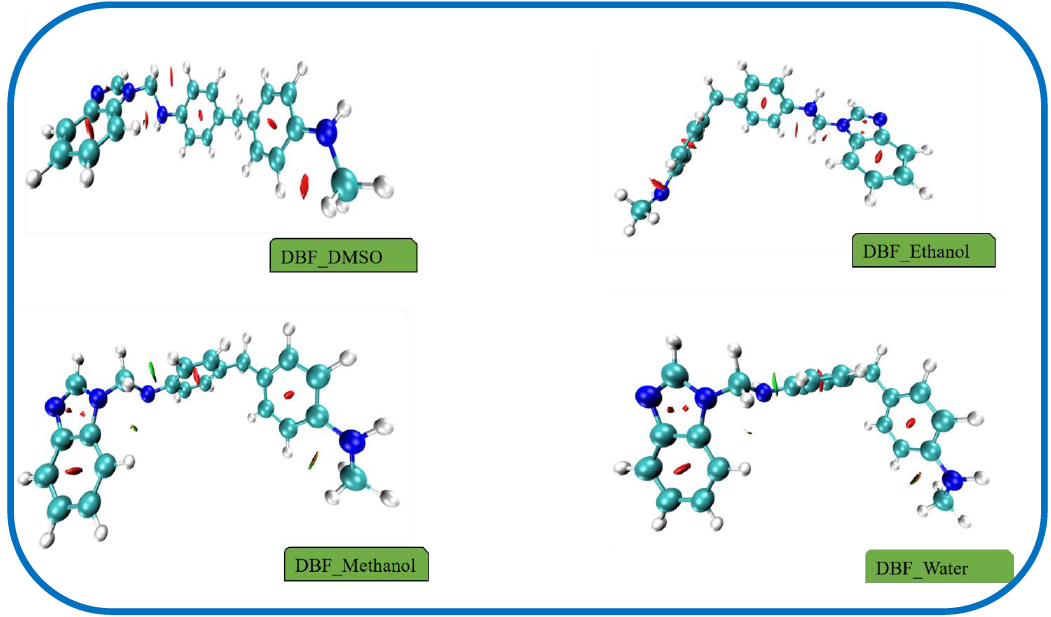
Non-covalent interaction (NCI) analysis visualizes regions associated with attractive and repulsive contacts through the reduced density gradient and electron-density-based descriptors [65]. NCI plots can distinguish qualitative patterns of relatively weak interactions, including van der Waals contacts, from stronger attractive regions and steric repulsion [66,67]. Green isosurfaces are commonly associated with weak interactions, blue regions with relatively stronger attractive interactions, and red regions with steric or repulsive behaviour, subject to the underlying sign(\(\lambda_2\))\(\rho\) colour convention. These visualizations provide a useful complement to molecular structure and electronic analysis, but the presence of a particular coloured region does not itself quantify biological activity or establish binding to a chosen receptor [68].
As displayed in Figure 4, the NCI visualizations for DBF show broadly similar qualitative interaction patterns under the investigated solvent conditions. Red regions were observed around portions of the benzene-ring system, suggesting locally repulsive or sterically constrained environments in the adopted representation. Green regions near selected carbon and nitrogen atoms were interpreted as comparatively weak non-covalent contacts. Similar features appeared between selected hydrogen atoms, although the qualitative plot alone does not establish a rigorous ranking of interaction energies. The distribution of these regions depends on the electron-density features and the geometry of the optimized structure. Weak non-covalent forces, including van der Waals interactions, can contribute to the stability and conformational preferences of molecules and molecular assemblies. However, their presence within an isolated ligand does not establish a corresponding intermolecular binding mode with a protein. Protein–ligand recognition would need to be assessed by inspecting the receptor-bound geometry and, where appropriate, by experimental interaction measurements.
The electron localization function (ELF) describes features of electronic localization based on quantities related to electron-pair probability and the Pauli principle [69,70]. ELF values are commonly expressed on a scale from 0 to 1, with values approaching 1 indicating relatively strong localization and lower values indicating less localization within the selected representation. Values near 0.5 have a particular interpretive role and are often associated with more delocalized electronic behaviour. ELF analysis can help characterize molecular bonding, lone-pair regions, and changes in electron distribution, although interpretation depends on the local electron-density environment rather than colour alone. In graphical maps, relatively high values may be represented by red or warm-coloured regions, intermediate values by yellow or green, and relatively low values by blue, depending on the selected colour scale.
Supplementary Figure S9 illustrates ELF features associated with selected carbon, nitrogen, and hydrogen atomic environments in the DBF structure. The regions around hydrogen atoms were reported to show comparatively strong localization features, while other regions near carbon and nitrogen exhibited distinct changes in the plotted localization values. A reddish region in an ELF map should not, by itself, be described as evidence of strong Pauli repulsion, because ELF measures localization rather than a direct repulsive interaction energy. The C–N bonding regions were represented by intermediate-to-high ELF values, including values reported around 0.8–0.9 in selected areas. These results provide qualitative information on the distribution of bonding-related electron density and should be interpreted together with the NBO and molecular-orbital analyses.
The antimicrobial activity of the DBF terpolymer ligand was evaluated using a disc-diffusion method, with gentamicin described as a reference agent for the antibacterial measurements. The resulting inhibition zones are presented in Table 5 and illustrated in Figure 5, with an additional image referenced as Supplementary Figure S4. The recorded treatment levels were expressed as 25, 50, 75, and 100 \(\mu\)L; because these are application volumes rather than defined mass-per-volume concentrations, the amount or concentration of DBF used at each level should be confirmed before the data are described quantitatively as concentration-dependent. For Staphylococcus aureus, inhibition zones increased from 14 mm at 25 \(\mu\)L to 20 mm at 100 \(\mu\)L, matching the reported 20-mm control zone at the highest application volume. For Escherichia coli, the corresponding values increased from 12 to 18 mm, remaining below the reported 20-mm control. In the fungal assays, the inhibition zones for Candida albicans and Aspergillus niger increased from 16 to 22 mm over the same treatment-volume range, with both exceeding the tabulated 20-mm control at the highest volume. These findings indicate increased inhibition under the reported treatment conditions for all four test organisms. Because gentamicin is an antibacterial comparator rather than a standard antifungal agent, the identity and appropriateness of the fungal control should be verified using the original assay records before an efficacy comparison is finalized.
| Sample | 25 \(\mu\)l | 50 \(\mu\)l | 75 \(\mu\)l | 100 \(\mu\)l | Control |
|---|---|---|---|---|---|
| Staphylococcus aureus | 14 | 16 | 18 | 20 | 20 |
| Escherichia coli | 12 | 14 | 16 | 18 | 20 |
| Candida albicans | 16 | 18 | 20 | 22 | 20 |
| Aspergillus niger | 16 | 18 | 20 | 22 | 20 |
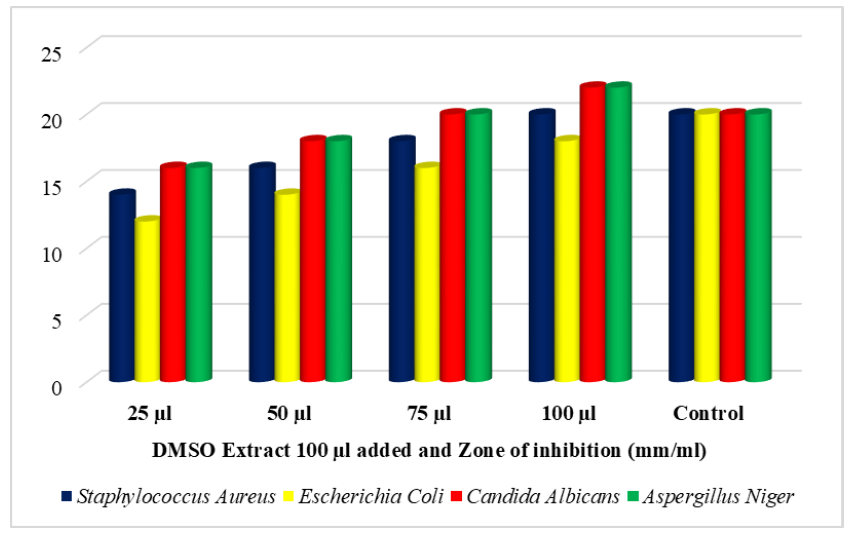
The results show a consistent increase in the recorded inhibition-zone diameter as the applied volume of DBF increased from 25 to 100 \(\mu\)L. The effect was apparent for both bacterial strains, although the largest zones differed: 20 mm for S. aureus and 18 mm for E. coli. In comparison, both fungal strains exhibited inhibition zones of 16, 18, 20, and 22 mm at the four reported application volumes. These measurements suggest that DBF inhibited the growth of all tested organisms under the assay conditions. Nevertheless, direct comparison with a reference control requires the same exposure conditions, appropriate controls for the organism under study, and clarification of the total mass of material applied to each disc. The results therefore provide preliminary evidence of antimicrobial activity rather than proof that DBF is superior to an established antibacterial or antifungal drug. Further quantitative testing, including minimum inhibitory concentration measurements, replicate-level statistics, and assessment of the polymer’s solubility and diffusion in the assay medium, would help clarify the magnitude and mechanism of activity.
Rani and colleagues [71] studied the antimicrobial properties of synthesized sulfanilamide-derived compounds and their metal complexes. The present study reports zones of approximately 14–20 mm against S. aureus and 12–18 mm against E. coli; the source text attributes bacterial inhibition zones of approximately 16–17 mm for E. coli and around 16 mm for S. aureus to the cited sulfanilamide work. It also describes fungal inhibition zones of 35–55 mm for C. albicans, compared with the 16–22 mm reported for DBF. These numerical cross-study comparisons should be verified against the original source tables and interpreted cautiously because assay design, tested concentrations, compound diffusion, and the particular organism strains may differ considerably. The present measurements against A. niger ranged from 16 to 22 mm, but the cited source should not be taken as establishing a direct comparison for this organism when no corresponding data were supplied.
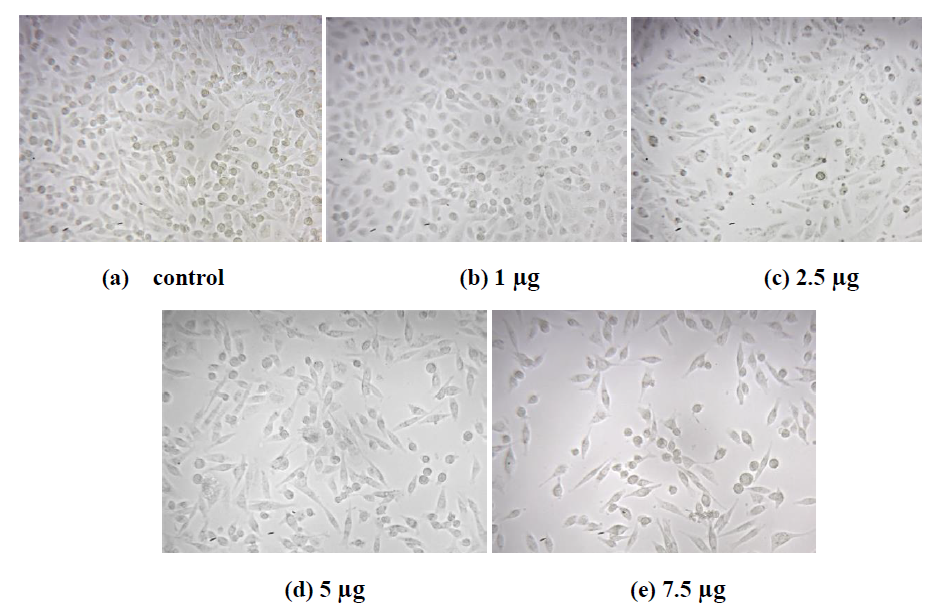
DBF was evaluated against the MDA-MB-231 human breast cancer cell line using a cell-viability assay. The reported percentage of viable cells decreased as the treatment level increased, indicating a treatment-associated reduction in viability under the specified laboratory conditions. The individual observations and the mean and standard deviation values for the control and five treatment levels are presented in Table 6. At the highest reported concentration of 10 \(\mu\)g, the mean cell viability was 25.07645%, compared with 100% for the untreated control. The source text also reports an IC\(_{50}\) of 6.32, but the associated concentration unit, fitting procedure, and underlying dose–response equation were not provided; this estimated endpoint therefore requires verification against the raw viability data. The experiments were described as being performed on at least three occasions in duplicate. Morphological alterations in treated MDA-MB-231 cells, including cell shrinkage, detachment, membrane blebbing, and changes in cell shape, were reported after a 24-hour exposure and are illustrated in Figure 6. The accompanying images compare treatment levels of 1, 2.5, 5, and 7.5 \(\mu\)g/mL with control cultures exhibiting intact cellular morphology. Further characterization would be needed to determine whether the reduction in viability reflects apoptosis, other forms of cell death, or non-specific cytotoxicity.
| DBF | Control | 1 \(\mu\)g | 2.5 \(\mu\)g | 5 \(\mu\)g | 7.5 \(\mu\)g | 10 \(\mu\)g |
|---|---|---|---|---|---|---|
| 100 | 85.3211 | 74.77064 | 63.76147 | 40.82569 | 28.44037 | |
| 100 | 88.07339 | 72.93578 | 59.63303 | 43.57798 | 27.06422 | |
| 100 | 89.44954 | 66.97248 | 55.9633 | 44.95415 | 19.72477 | |
| Average | 100 | 87.61468 | 71.55963 | 59.78593 | 43.11927 | 25.07645 |
| SD | 0 | 2.102098 | 4.077151 | 3.901333 | 2.102107 | 4.685492 |
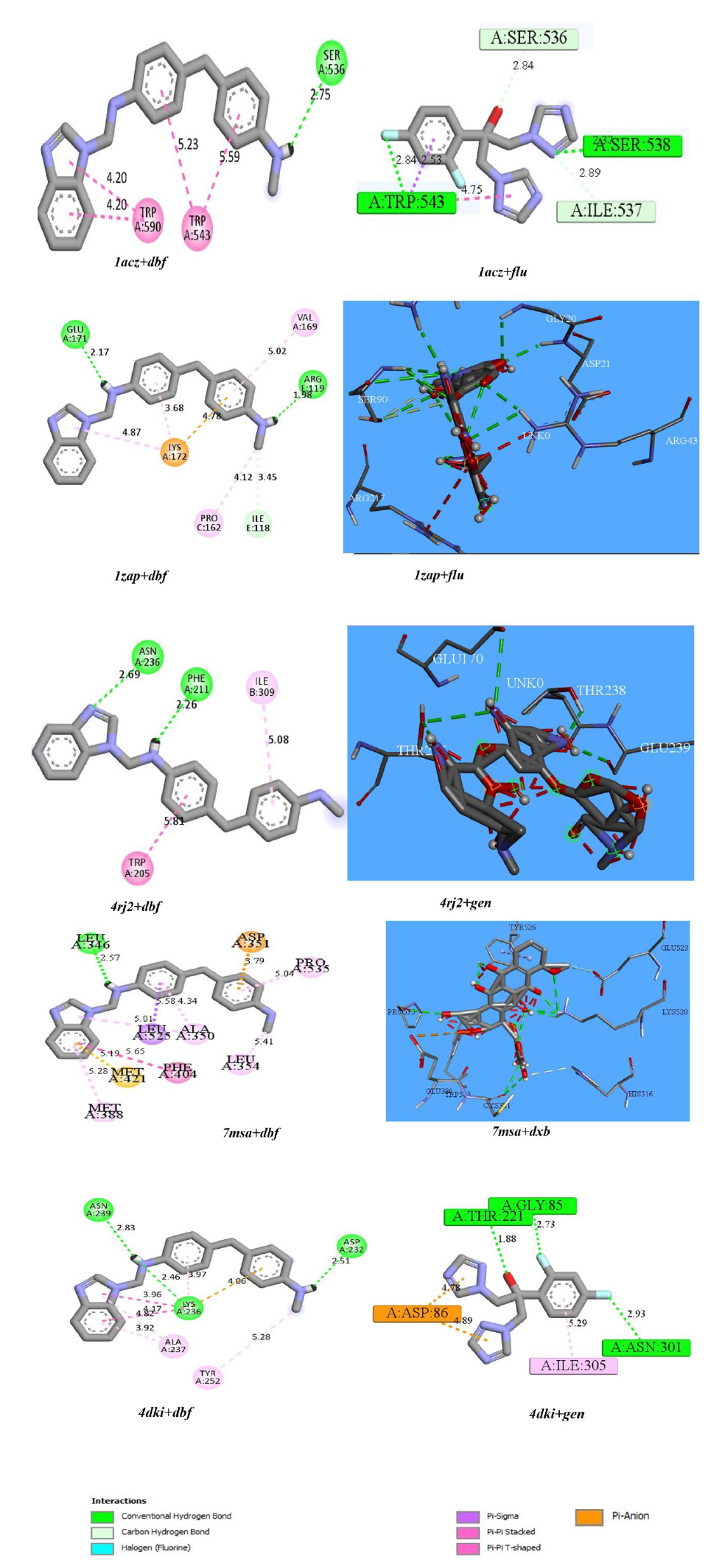
Molecular docking was applied to investigate possible binding modes and relative docking scores for DBF and selected reference drugs against the five chosen protein structures. Docking is a computational approach that estimates the orientation of a ligand within a receptor region and uses a scoring function to rank candidate poses and interactions [36,72–75]. Its usefulness in early-stage drug discovery lies in generating testable hypotheses concerning molecular recognition, potential contact residues, and conformational preferences [76,77]. More negative docking scores may indicate a more favourable model-dependent predicted pose, but the numerical scores should not be regarded as experimental binding free energies or definitive evidence of inhibition [78,79]. In the present investigation, DBF showed activity in the reported antimicrobial assays against A. niger, C. albicans, E. coli, and S. aureus, while the breast-cancer cell-viability assay indicated an effect on MDA-MB-231 cells. These observations motivated computational examinations of proteins 1ACZ, 1ZAP, 4RJ2, 4DKI, and 7MSA, although the latter is a human estrogen-receptor-alpha structure and does not represent the principal receptor phenotype of triple-negative MDA-MB-231 cells. Gentamicin, fluconazole, and doxorubicin were included as computational comparators for the selected bacterial, fungal, and breast-cancer-associated contexts. The docking scores, reported residue contacts, hydrogen-bond distances, and estimated inhibition constants are summarized in Table 7.
The DBF–1ACZ interaction produced a reported docking score of \(-6.9\) kcal/mol, accompanied by a hydrogen-bond interaction with the residue identified as A:SER:536 at 2.76 Å. The corresponding fluconazole score was \(-5.1\) kcal/mol in Table 7, with two reported hydrogen-bond contacts at A:SER:538 and A:TRP:543. Thus, DBF displayed a more negative score for this particular receptor under the stated docking conditions, whereas fluconazole was assigned a greater number of hydrogen-bond contacts. The original docking files are needed to confirm the atom-level interactions and determine whether the selected binding region is relevant to inhibition of the full glucoamylase enzyme. A comparison involving a single ligand pose is insufficient to establish superior antifungal activity without biochemical or cellular evidence.
| Interaction | Binding affinity (kcal/mol) | Ki (\(\mu\)M) | Hydrogen bond | Residue | Distance |
|---|---|---|---|---|---|
| 1ACZ+DBF | -6.9 | 8.76 | 1 | A: SER:536 | 2.76 |
| 1ACZ+FLU | -5.1 | 182.67 | 2 | A: SER:538; A: TRP:543 | 2.33; 2.84 |
| 1ZAP+DBF | -6.3 | 24.10 | 3 | A: ASP:232; A: ASN:239; A: LYS:236 | 2.51; 2.83; 2.46 |
| 1ZAP+FLU | -6.4 | 20.36 | 3 | A: THR: 221; A: GLY:85; A: ASN:221 | 1.88; 2.73; 2.93 |
| 4RJ2+DBF | -9.2 | 0.180 | 2 | A: GLU:171; E: ARG:119 | 2.17; 1.98 |
| 4RJ2+GEN | -10.4 | 0.0238 | 8 | A: GLY:201; A: ASP:21; A: ARG:87; A: SER:90; A: SER:90; A: SER:90; D: ARG:43; D: ARG:43 | 2.43; 2.07; 2.23; 2.53; 2.43; 2.70; 2.83; 2.26 |
| 4DKI+DBF | -7.1 | 6.25 | 2 | A: ASN:236; A: PHE:211 | 2.69; 2.11 |
| 4DKI+GEN | -10.0 | 0.0468 | 7 | B: LYS:281; B: GLY:282; B: ASN:39; B: GLN:396; UNKO; UNKO; UNKO | 2.72; 2.03; 2.62; 2.17; 3.38; 2.80; 2.89 |
| 7MSA+DBF | -8.3 | 0.824 | 1 | A: LEU:346 | 2.57 |
| 7MSA+DXB | -8.6 | 0.497 | 7 | C:LYS:520; C:LYS:520; C:LYS:520; C:LYS:520; B:TYR:526; B:TYR:526; B:TRP:383 | 2.80; 2.09; 2.47; 3.02; 2.48; 2.53; 2.00 |
For the 1ZAP receptor, DBF and fluconazole displayed reported docking scores of \(-6.3\) and \(-6.4\) kcal/mol, respectively. These values are closely comparable, with the fluconazole score being slightly more negative. The DBF interaction was assigned three hydrogen-bond contacts; the residue identities and distances should be checked against the primary docking output because the narrative and the original table contained inconsistent labels. The three residues listed in Table 7 for DBF were A:ASP:232, A:ASN:239, and A:LYS:236, with reported distances of 2.51, 2.83, and 2.46 Å. For fluconazole, the table lists contacts involving A:THR:221, A:GLY:85, and A:ASN:221, although the occurrence of two distinct residues numbered 221 is an additional item for receptor-file verification. The bacterial docking comparisons showed scores of \(-9.2\) kcal/mol for DBF and \(-10.4\) kcal/mol for gentamicin against 4RJ2, with two and eight reported hydrogen-bond contacts, respectively. Against 4DKI, DBF showed a score of \(-7.1\) kcal/mol and two assigned hydrogen-bond contacts with A:ASN:236 and A:PHE:211, while gentamicin showed a more negative score of \(-10.0\) kcal/mol and seven contacts. These comparisons do not support a general conclusion that DBF docked more strongly than gentamicin against the bacterial targets.
For the human estrogen-receptor structure 7MSA, docking scores of \(-8.3\) and \(-8.6\) kcal/mol were recorded for DBF and doxorubicin, respectively, indicating a modestly more negative score for doxorubicin under the same stated computational conditions. This finding is a preliminary observation concerning the selected receptor structure, not a demonstration of anticancer efficacy or a mechanistic explanation for the observed effect on MDA-MB-231 cells. The interaction visualizations are presented in Figure 7, while Supplementary Figure S5 contains additional two-dimensional and PyMOL images. Estimated inhibition constants (\(K_i\)) are listed in Table 7 and were calculated from the reported docking scores using the formal relationship \(\Delta G=RT\ln K_i\), corresponding to \(K_i=\exp(\Delta G/RT)\) after unit conversion, with \(R=0.0019872\) kcal mol\(^{-1}\) K\(^{-1}\) and \(T=298.15\) K. These numerical estimates are conditional on treating docking scores as binding free energies and must not be presented as experimentally measured inhibition constants. Root-mean-square deviation (RMSD) validation was not reported, because the authors did not define a consistent crystallographic reference pose across the chosen receptor systems. Therefore, the docking results remain predictive and require receptor-specific structural validation and suitable experimental assays before therapeutic conclusions can be drawn.
The experimental and computational findings should be considered together, while recognizing that the different measurements address different aspects of the DBF material. Elemental analysis, solubility testing, infrared spectroscopy, and nuclear magnetic resonance characterize aspects of the synthesized resin and its molecular environment. Geometry optimization, the HOMO–LUMO gap, natural bond orbital analysis, and electron-density visualizations instead describe properties of a selected computational representation of the polymer-derived compound. These categories of evidence are complementary but not interchangeable. A predicted molecular orbital feature cannot establish that a resin sample was obtained in a chemically uniform form, and a characteristic experimental absorption band cannot by itself prove that the molecular representation used for docking is an accurate model of the experimental material. For this reason, the repeating-unit composition, polymer molecular-weight distribution, atom numbering, optimized ligand geometry, and original spectra should be reviewed together in the final structural assessment. Supplementary Tables S1–S9 and Supplementary Figures S1–S9 are mentioned in the manuscript but were not included in the supplied LaTeX source; their presence and internal consistency must be checked against the supporting-information files before submission.
The calculated electronic gaps vary by only 0.0027 eV from the smallest value in methanol to the largest value in ethanol. This narrow range is important for the interpretation of solvent effects. It means that the numerical ordering of the solvents is well defined by the values reported here, but the observed differences are too small to justify strong claims of solvent-controlled therapeutic activity without further evidence. In the same way, the differences among the theoretical C–N and C=N stretching frequencies are relatively limited, whereas larger experimental-to-theoretical differences appear for selected C–H and N–H bands. A satisfactory discussion must distinguish the consistency of the computations across the solvent models from the degree of agreement with the actual spectra. The experimental FT-IR band reported at 1126.4 cm\(^{-1}\) particularly requires reassessment before it can be attributed to C=N stretching. NMR interpretation also requires attention to the inconsistently reported limits of the theoretical carbon chemical-shift range. A final atom-by-atom comparison, based on the original spectra and calculated shielding outputs, would provide a stronger basis for evaluating proposed structural assignments.
The antimicrobial assays provide quantitative inhibition-zone measurements, which are useful as a preliminary indication of biological response. However, the source records treatment levels in microlitres, so the reported progression from 25 to 100 \(\mu\)L documents increasing applied volume rather than a defined mass-based concentration until the sample formulation is specified. A controlled disc-diffusion comparison also requires information about disc diameter, inoculum preparation, incubation period, agar medium, solvent controls, and replicate variability. These details can materially influence measured zone diameters and the apparent activity of a polymeric substance, which may diffuse differently from a small-molecule comparator. The distinct response profiles of the bacterial and fungal organisms are worth pursuing, but comparisons with the tabulated 20-mm control should be organism-appropriate. The original assay documentation should establish which antimicrobial agent was used as the fungal control and whether the same reporting units were used in each panel. The present data alone should not be presented as demonstrating clinical superiority to established antifungal drugs.
The cell-viability data likewise support an exposure-associated response, but the biological interpretation depends on how the assay was performed. The viability percentages are accompanied by individual observations and average values, allowing a reader to inspect the measured pattern. However, the reported IC\(_{50}\) cannot be independently confirmed without the precise concentration units, a fitted dose–response curve, and the chosen normalization method. Changes in cell shape and membrane integrity may accompany cytotoxic effects, but they do not uniquely identify apoptosis or a receptor-specific signalling mechanism. An interpretation of DBF as a candidate anticancer agent would be strengthened by confirmation in additional cell models, independent measurements of cell death, appropriate vehicle controls, and comparison with non-malignant cells. Importantly, MDA-MB-231 is ordinarily characterized as a triple-negative breast cancer cell line, while the receptor in PDB entry 7MSA is human estrogen receptor alpha. The docking comparison involving 7MSA therefore does not independently explain why DBF reduced viability in the tested cells.
The docking study provides a parallel set of predictions for microbial and human protein structures, but comparisons between these proteins require caution. Each receptor has a different sequence, structural environment, and plausible ligand-binding region. Consequently, a numerical score obtained for one receptor cannot be assumed to represent a directly comparable experimental affinity for another target. The 1ACZ entry represents a starch-binding domain rather than the entire glucoamylase enzyme, and a predicted pose in that isolated domain need not correspond to enzymatic inhibition. The 1ZAP receptor is a secreted aspartic protease from Candida albicans, whereas the bacterial targets represent different enzyme families. The original receptor preparation and binding-box placement should be validated separately for each structure. Some residue labels in the docking table are internally inconsistent or appear ambiguous; these should be checked against the prepared receptor coordinate files and interaction output instead of being inferred solely from the printed scores. The calculated values identified as \(K_i\) also depend on a thermodynamic conversion of the scoring output and thus are estimates, not measured biological constants. Confirming the receptor identity, protonation states, redocking performance, ligand structure, and replicated docking poses is necessary before describing those values as validated indicators of target inhibition.
Collectively, these considerations distinguish what the current findings demonstrate from what remains to be tested. The manuscript reports the preparation and characterization of a DBF resin, theoretical analyses of a corresponding molecular representation, antimicrobial inhibition zones under specified treatment-volume conditions, viability measurements for a breast cancer cell line, and docking scores for selected receptors. It does not yet establish a clinically useful antimicrobial or anticancer mechanism. Presenting the experimental observations and predictive calculations with their proper limitations strengthens the scientific interpretation and allows subsequent studies to prioritize the most relevant characterization, pharmacological, and mechanistic experiments. The original values and reported comparisons have been retained where possible, while contradictions that cannot be settled from the manuscript alone remain identified for author verification.
This investigation combined experimental characterization, biological screening, and computational calculations to examine the structural, electronic, antimicrobial, and cell-viability characteristics of an imidazole terpolymer derivative designated DBF. Density functional theory calculations at the B3LYP/aug-cc-pVDZ level were performed under four solvent conditions, providing geometrical and electronic results for DMSO, ethanol, methanol, and water. The optimized bond lengths showed limited variation among these environments, suggesting that the computed molecular framework was broadly comparable across the investigated solvents. The FT-IR analysis enabled a comparison of predicted and experimental C–H, N–H, C–N, and C=N stretching features, although selected experimental assignments require further confirmation from the original spectra. UV–visible excitation analysis revealed closely related transition energies across the four solvent models, including the highest reported \(S_0\rightarrow S_3\) excitation energy for the water model. NMR calculations provided supplementary descriptions of the proton and carbon environments, with similarities and identifiable differences between theoretical predictions and experimental chemical shifts.
The frontier molecular orbital results showed HOMO–LUMO gaps of 4.3952, 4.3957, 4.3930, and 4.3949 eV for DMSO, ethanol, methanol, and water, respectively. Methanol therefore produced the smallest calculated energy gap and greatest calculated softness among the modeled solvent environments, although the differences were limited and should not be interpreted as an experimental measure of improved bioactivity. The additional natural bond orbital, non-covalent interaction, and electron localization analyses provided qualitative and quantitative information on electron delocalization, intramolecular interaction regions, and electronic localization within the DBF representation. Together, these calculations characterize features that may be relevant to molecular interactions but cannot independently establish inhibitory or anticancer potency.
In the antimicrobial investigations, increasing the applied DBF treatment volume from 25 to 100 \(\mu\)L was accompanied by progressively larger inhibition zones for both tested bacterial strains and the two fungal organisms. The measured ranges were 14–20 mm for Staphylococcus aureus, 12–18 mm for Escherichia coli, and 16–22 mm for each of Candida albicans and Aspergillus niger. The fungal results exceeded the tabulated control value of 20 mm at the highest volume, but the specific fungal comparator must be established before a claim of superiority over an approved antifungal treatment is justified. The MDA-MB-231 cell study also revealed lower reported viability with higher DBF treatment levels, indicating a response that warrants further mechanistic assessment, compound-specific control experiments, and investigation of cytotoxicity against non-malignant cells.
Molecular docking predicted ligand–protein contacts with structures 1ACZ, 1ZAP, 4RJ2, 4DKI, and 7MSA. DBF produced a more negative docking score than fluconazole against 1ACZ (\(-6.9\) versus \(-5.1\) kcal/mol), whereas fluconazole was marginally more favourable against 1ZAP (\(-6.4\) versus \(-6.3\) kcal/mol). The standard comparator gentamicin showed more negative reported scores than DBF against both bacterial proteins, and doxorubicin showed a more negative score against the human estrogen-receptor structure 7MSA. These calculations should be interpreted as provisional predictions, because several reported residue assignments and the original receptor and pose files have not been independently authenticated. Moreover, 7MSA represents estrogen receptor alpha rather than a receptor that can automatically explain the response of the triple-negative MDA-MB-231 cell line. Further investigation should include quantitative antimicrobial assays, appropriately selected fungal reference drugs, receptor-specific docking validation, molecular structure confirmation, detailed cell-death measurements, and broader selectivity studies. The current findings provide a useful preliminary basis for such work while leaving the therapeutic effectiveness and mechanism of action of DBF to be established experimentally.
Author Contributions: All authors contributed to the preparation of the study. Specific individual contributions should be confirmed with the authors before submission.
Conflicts of Interest: All authors declare that they have no conflicts of interest.
Data Availability: All data are contained within the manuscript and manuscript supporting information document (SI).
Funding Information: This research did not receive funding from any source.