
It is well established that Portland cement is the principal binder used in modern construction. Nevertheless, plain cementitious matrices remain brittle and exhibit limited strain capacity and weak tensile resistance, which restrict their crack tolerance and long-term durability under service loading.
The tensile response of reinforced concrete can be improved by adding crack-controlling elements such as steel bars, fibers, and other promoters that delay the initiation and propagation of microcracks [1].
In recent years, nano-scale additives such as graphene, carbon nanotubes, and nano-silica have attracted considerable interest as reinforcing agents for cement-based materials because they can interact with defects at a much smaller scale than conventional reinforcement [3]. Nano-silica, for example, has been shown to improve the mechanical response of cement matrices [4].
Nano-silica has a specific surface area of about 300 m\(^2\)/g and a predominantly spherical morphology with particle diameters below 30 nm [5]. Its beneficial action is commonly attributed to two mechanisms [6]: first, a nucleation effect that promotes cement hydration because of the high specific surface area, and second, a filler effect that densifies the microstructure by occupying spaces comparable to gel pores. At the same time, its low aspect ratio limits its ability to restrain crack growth once localized defects begin to propagate.
Accordingly, there remains a need to examine alternative nano-additives that may modify matrix texture, interfacial bonding, and resistance to crack development. In parallel, the broader field has shown that non-metallic and textile-type reinforcement systems can markedly improve the mechanical behavior of cementitious materials under different loading conditions [7– 15].
Elsabawy et al. [16– 18] previously reported that soft-metal additions can enhance the ductility and flexibility of selected ceramic and superconducting systems. Motivated by that concept, the present work explores whether nano-scale PbCrO\(_4\) can play a related microstructural role in a cementitious matrix.
The objective of this study is therefore to evaluate nano-lead chromate as a cement-compatible additive and to identify the dosage range that provides the most favorable combination of phase characteristics, microstructural compactness, and measured mechanical response in cement-paste composites. The work is intended as an exploratory materials study focused on synthesis, characterization, and short-term mechanical performance within the investigated laboratory conditions.
Lead chromate nanoparticles were synthesized by chemical co-precipitation. Lead nitrate (20 g) and potassium chromate (40 g) were dissolved separately in 150 mL of distilled water and then combined slowly under continuous stirring. The resulting precipitate was allowed to settle, separated by suction filtration, washed repeatedly with distilled water and ethanol, dried, and finally ground in an agate mortar [19]. The synthesized powder was characterized by powder X-ray diffraction, scanning electron microscopy, ultraviolet spectroscopy, Fourier transform infrared spectroscopy, and TEM. These measurements confirmed the formation of crystalline lead chromate nanoparticles with particle sizes in the approximate range of 47–93 nm and with a well-developed particulate morphology. FTIR analysis was further used to identify the main vibrational features of the synthesized material before its incorporation into the cementitious matrix.
PXRD patterns were collected at room temperature using CuK\(\alpha\) radiation on a MiniFlex II powder X-ray diffractometer (Rigaku, Japan). The scanning range was 2\(\theta\) = 5–55°, the operating voltage was 30 kV, the current was 15 mA, and the scanning rate was 4°/min. UV/Vis. spectra were measured using a Shimadzu double-beam spectrophotometer with the nujol mull technique.
Thermal behavior was examined by TGA/DTA using a Perkin Elmer Pyris STA 6000 thermogravimetric analyzer. Approximately 0.2 g of green cement powder was placed in the sample pan with alumina as the reference, and the temperature was increased from room temperature at a rate of 1\(^o\)C/min. Scanning electron microscopy (SEM), transmission electron microscopy (TEM), and EDX elemental analysis were used to evaluate morphology and elemental distribution. FTIR spectra were recorded on a Shimadzu FT-IR-8101A spectrophotometer in the 4000–400 cm\(^{-1}\) range.
The materials used in the experimental program are described below. The mortar mixes were prepared from ordinary Portland cement, fine aggregate, water, the nano-PbCrO\(_4\) promoter, and a superplasticizer. Natural siliceous sand was used as the fine aggregate throughout the study [20].
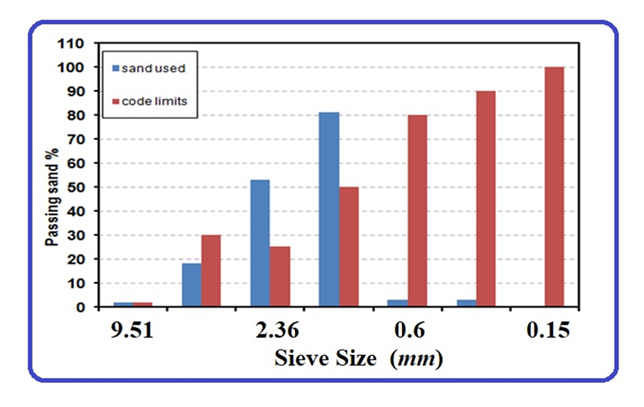
The sand was clean and free from visible impurities, with a specific gravity of 2.65, a fineness modulus of 2.55, and an absorption ratio of 0.81%. It was sieved to obtain standard grading in accordance with Egyptian code 203/2017 for preparation of the mortar test specimens. The sieve analysis results are presented in Table 1 and Figure 1.
| Sieve size mm | 9.51 | 4.75 | 2.36 | 1.18 | 0.6 | 0.3 | 0.15 |
|---|---|---|---|---|---|---|---|
| %passing | 100 | 90-100 | 80-100 | 50-85 | 25-60 | 10-30 | 2-10 |
| %passing sand used | 0 | 3 | 3 | 81 | 53 | 18 | 2 |
A local ordinary Portland Suez cement (OPC CEM I 42.5 N) was used as the matrix binder. The cement exhibited initial and final setting times of about 2 and 5 h, respectively. All cement characterization tests were conducted in accordance with the relevant standard specifications for Portland cement [20, 21]. The chemical composition of the cement is listed in Table 2.
| Constituents | Concentration in Weight (%) |
|---|---|
| Silica as Si O\(_2\) | 19.8 |
| Alumina as AL\(_2\) O\(_3\) | 5.6 |
| Iron as Fe\(_2\) O\(_3\) | 2.4 |
| Potassium as k\(_2\) O | 0.58 |
| Calcium as Ca O | 65.9 |
| Sodium as Na\(_2\) O | 0.29 |
| Sulphur as SO\(_3\) | 2.8 |
| Loss in ignition | 1.2 |
| Insoluble residue | 0.4 |
| Free lime | 0.9 |
| Lime Saturation Factor | 100.4 |
| Lime Combination Factor | 98.9 |
| Silica ratio | 2.48 |
| Alumina ratio | 2.33 |
| Tricalcium Cilicate (C\(_3\) S) | 65.1 |
| Dicalcium Silicate (C\(_2\)S) | 7.6 |
| Tricalcium Aluminate (C\(_3\)A) | 10.8 |
| Tetracalcium Aluminate Ferrite (C\(_4\) AF) | 7.3 |
A superplasticizer complying with ASTM C494 Type F and B.S. 5075 Part 3, with a specific gravity of 1.2, was used to provide the required workability for the mortar mixtures. The commercial product used was Addicrete BVF. The recommended dosage range is 0.5–2% by weight of cementitious material [20– 22].
The mix design included ordinary Portland cement, sand, water, the promoter, and a superplasticizing agent. The objective was to determine the highest practical promoter dosage that could enhance the mechanical response of the mortar matrix without adversely affecting mixture preparation or specimen integrity. All mixes were prepared at a constant water/cement ratio of 0.35, while the superplasticizer dosage was fixed at 2% by weight of cement to maintain workable consistency. The dry constituents were first blended thoroughly, after which the mixing water was added and the batch was remixed manually to obtain a uniform paste. Seven mortar mixtures were investigated, comprising one control mixture and six promoter dosages from 5% to 100%. The mix proportions are listed in Table 3, and representative images of the tested mixtures are given in Figure 2. For each mixture, prismatic specimens with dimensions of 20 × 20 × 25 mm were cast for the loading tests.
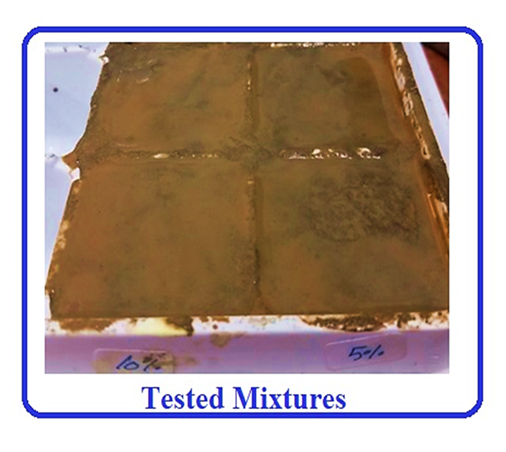
A total of 42 specimens were prepared to improve the reliability of the mechanical dataset (7 mixes × 3 replicates per curing age × 2 testing ages). After casting, all specimens were demolded after 24 h and transferred to lime-saturated water for curing at 23 ± 2 °C and relative humidity above 95% until testing at 7 and 28 days.
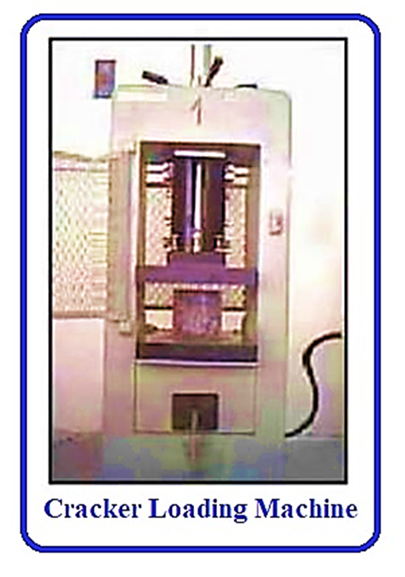
Mechanical tensile test set-up and instrumentation. The specimens were tested under monotonic compressive loading at 7 and 28 days using a hydraulic loading machine in accordance with standard laboratory practice [3, 20, 22]. The load was applied continuously at a constant rate of 0.5 N/mm\(^2\) until failure. The testing machine is shown in Figure 3.
The ultimate load was read directly from the machine dial. In addition to the recorded first-crack and failure loads, these measurements were used to calculate the nominal compressive stress and to estimate the indirect tensile response discussed later for the tested prismatic specimens.
X-ray diffraction was used to identify the principal crystalline phases present in the hardened cementitious composites [23– 25]. The main reflections observed at 2\(\theta\) values of 26.2, 29.39, 32.5, 36, 39.47, 42.46, 50.5, 54.8, 59.97, 67.74, 73.45, and 75.6 (Figure 4) correspond to the dominant fingerprint peaks of the control and promoter-containing samples. The overall diffraction behavior is consistent with the phase assemblages reported by Mollah et al. [24, 25].
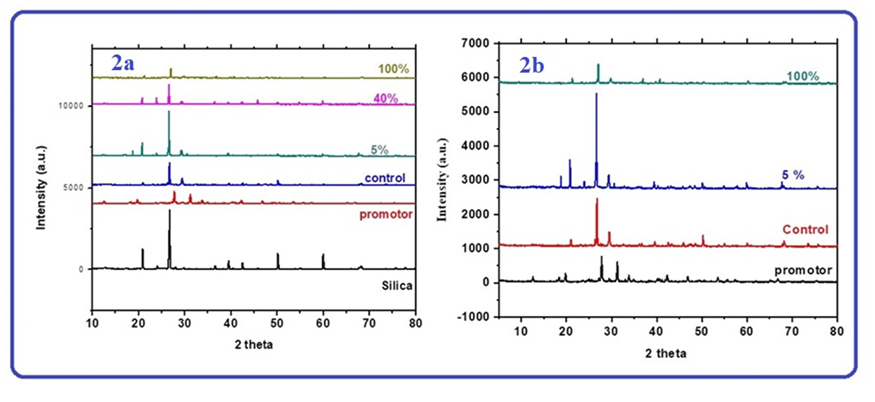
In agreement with previous reports [23, 24], the principal cement-related phases were identified as iron oxide (Fe\(_2\)O\(_3\)), belite (Ca\(_2\)SiO\(_4\)), and alite (Ca\(_3\)SiO\(_5\)). The diffractograms in Figure 4(a,b) also reflect the expected hydration products formed when alite and belite react with water, notably portlandite and amorphous calcium–silica–hydrate (C–S–H). Some Ca(OH)\(_2\) reflections overlap with alite, belite, and ferrite peaks, which complicates strict phase separation in the hydrated matrix. In addition, calcium carbonate can form through secondary carbonation reactions involving portlandite and hydrated phases under ambient exposure [25]. The peaks assigned to chromate-containing phases appear at 2\(\theta\) = 12.59, 18.32, 19.79, 27.77, 31.25, 33.83, 42.32, 46.85, 53.54, 55.64, 57.41, and 65.12, indicating the continued presence of the promoter-related crystalline component within the tested system.
A portion of each synthesized cement block was carefully ground and used for IR and UV/Vis. measurements. Potassium bromide (KBr) was used as the IR reference medium, whereas paraffin oil was used for the UV/Vis. measurements through the nujol mull technique, as shown in Figure 5(a-g) and Figure 5(h-l), respectively.
The principal IR absorption bands and their relative intensities are summarized in Table 4.
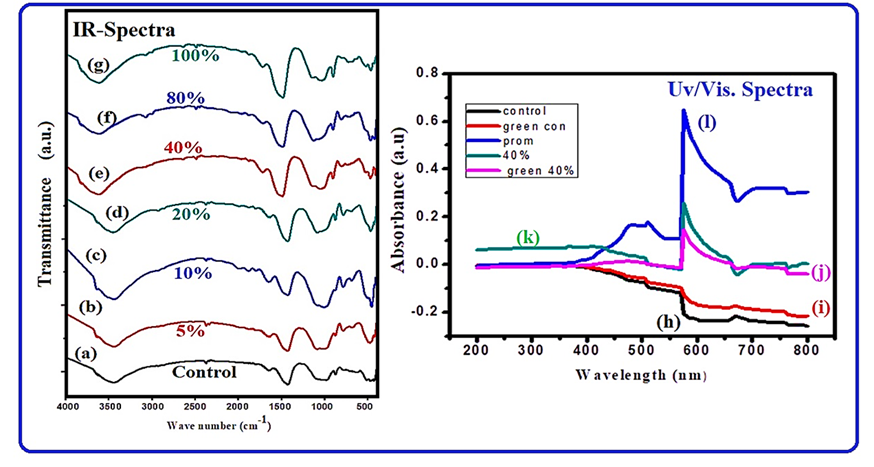
The principal vibrational bands identified in Figure 5(a-g) provide information on the silicate, sulphate, and carbonate groups that dominate the cementitious matrix [26].
The absorption band at 3641 cm\(^{-1}\) is attributed to free OH groups associated with Ca\(^{+2}\) (free lime) [27]. The broad band at 3441–3431 cm\(^{-1}\) is assigned to O–H stretching of physically adsorbed or bound water. The major silicate-related vibrations appear in the 1647–1631 cm\(^{-1}\) and 1431–1429 cm\(^{-1}\) regions, whereas the characteristic carbonate and sulphate bands are observed near 989–983 cm\(^{-1}\) and 875 cm\(^{-1}\), respectively.
Figure 5(h-l) presents the UV/Vis. response of the control mortar, green control sample, 40% green sample, 40% mortar sample, and the promoter. The 40%-containing samples show a spectral profile closer to that of the promoter, including a pronounced absorption feature near 575 nm, whereas the promoter itself exhibits a broader hump around 485 nm. These observations support the interaction of the additive with the cementitious matrix and are broadly consistent with previous reports on modified cement systems [2, 3, 20].
| Sample name | Band location in cm\(^{-1}\) | ||||||
|---|---|---|---|---|---|---|---|
| 420-520 | 600-700 | 700-800 | 800-1100 | 1300-1650 | 1750-2000 | 2300-3000 | |
| promoter | – | – | – | 819 (s,s) | 1379 (s,m) | 1763(b,m) | 2923 (b,w) |
| 893 (s,s) | 1630 (b,w) | 2371 (s,w) | |||||
| silica | 460(s,s) | 689(s,w) | 782(s,m) | 1075(s,s) | 1629(s.w) | 1785(b,w) | 2374(s,w) |
| 1880(s,w) | |||||||
| control | 474(s,s) | 617(b,m) | – | 874(s,m) | 1430(s,s) | – | 2372(s,w) |
| 513(s,s) | 983(b,s) | 1647(s,m) | |||||
| 5% | 472(s,s) | 688(b,w) | 788(s,w) | 876(s,w) | 1430(s,s) | – | 2370(s,w) |
| 1085(b,s) | 1647(s,m) | ||||||
| 10% | 454(s,s) | 686(s,w) | 786(s,m) | 1007(b,s) | 1430(s,m) | 1793(b,w) | 2372(s,w) |
| 1647(b,m) | 1880(b,w) | ||||||
| 20% | 477(s,s) | 687(b,w) | 784(s,m) | 876(s,m) | 1430(s,s) | 1793(b,w) | 2372(s,w) |
| 1083(b,s) | 1631(s,m) | 1880(b,w) | 2927(b,w) | ||||
| 40% | 466(s,m) | – | 718(b,w) | 876(s,m) | 1431(s,s) | – | 2373(s,w) |
| 1010(b,s) | 1647(b,m) | ||||||
| 80% | 424(s,s) | 686(b,w) | 787(s,w) | 875(s,m) | 1430(s,s) | 1880(b,w) | 2373(s,w) |
| 467(s,s) | 1085(s,s) | 1647(b,w) | 2926(s,m) | ||||
| 100% | 461(s,m) | – | 706(b,w) | 874(s,m) | 1430(s,s) | 1793(b,w) | 2374(s,w) |
| 515(s,w) | 1000(b,m) | 1647(b,w) | 2336(s,w) | ||||
| 2518(b,w) | |||||||
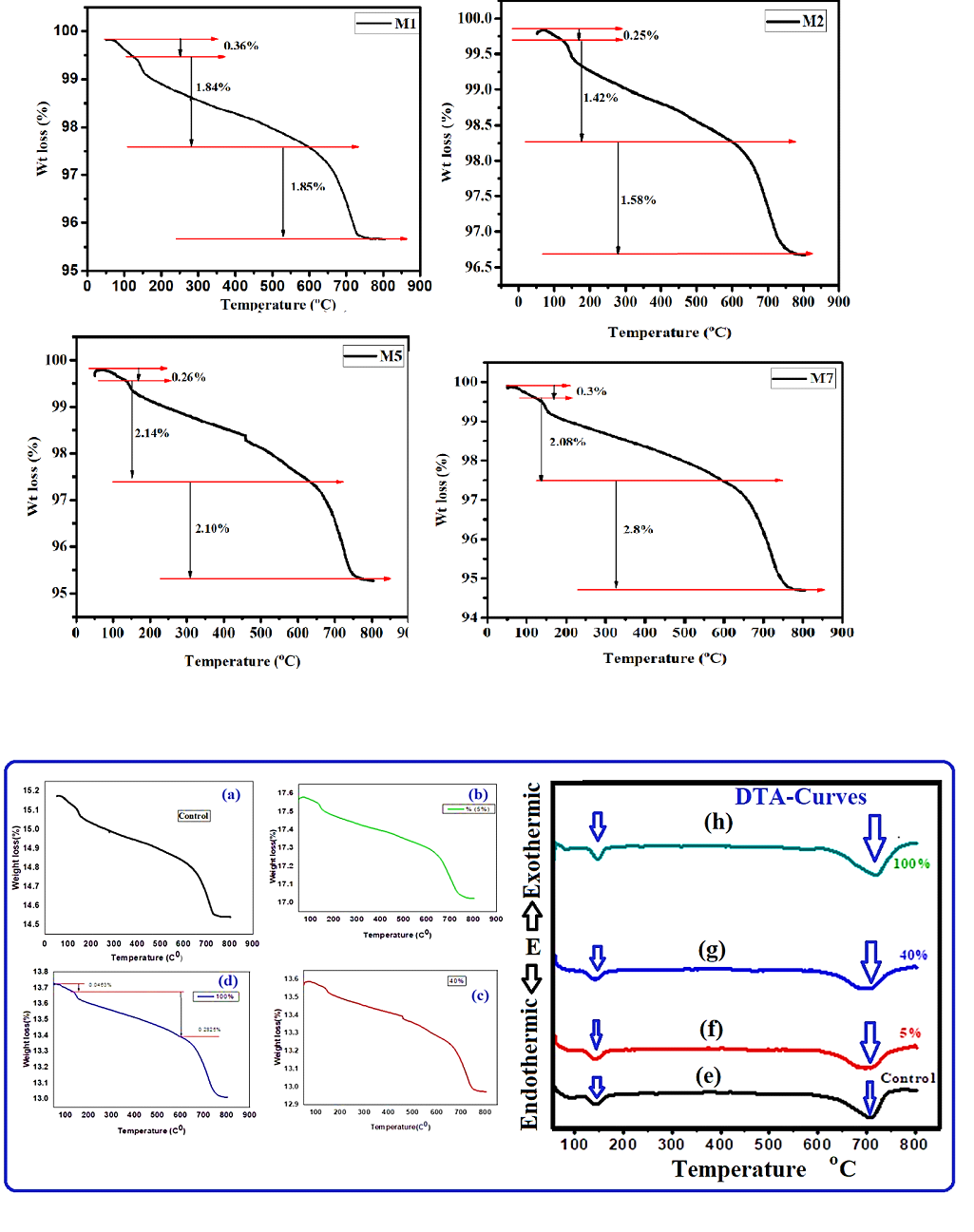
Figure 6(a-h) shows the TGA and DTA curves obtained for the green samples containing 0, 5, 40, and 100% promoter.
The TGA curves in Figure 6(a-d) can be divided into three main mass-loss regions. The first, with a weight loss of about 0.25–0.36%, is attributed mainly to evaporation of free and physically adsorbed water [3, 5, 28]. The second major loss occurs around 145\(^o\)C and ranges from 1.42 to 2.14%, while the third varies between 1.58 and 2.80%. These events are associated with dehydration and decomposition processes involving hydrated products and carbonate-containing phases in the cement system [2, 3].
The DTA curves in Figure 6(e-h) exhibit three principal endothermic features. The first occurs below 100\(^o\)C and is mainly related to moisture loss. Endothermic effects between about 100 and 200\(^o\)C are associated with dehydration of hydration products including C–S–H. A higher-temperature endothermic event near 700\(^o\)C is attributed to carbonation-related decomposition and CaCO\(_3\) breakdown [2, 29].
SEM and TEM were used to investigate the nanostructural characteristics of the cementitious composites.
Concrete is a heterogeneous composite consisting of aggregate particles, hydrated cement paste, and an interfacial transition zone (ITZ), and the quality of this microstructure strongly influences the resulting mechanical behavior [29, 30].
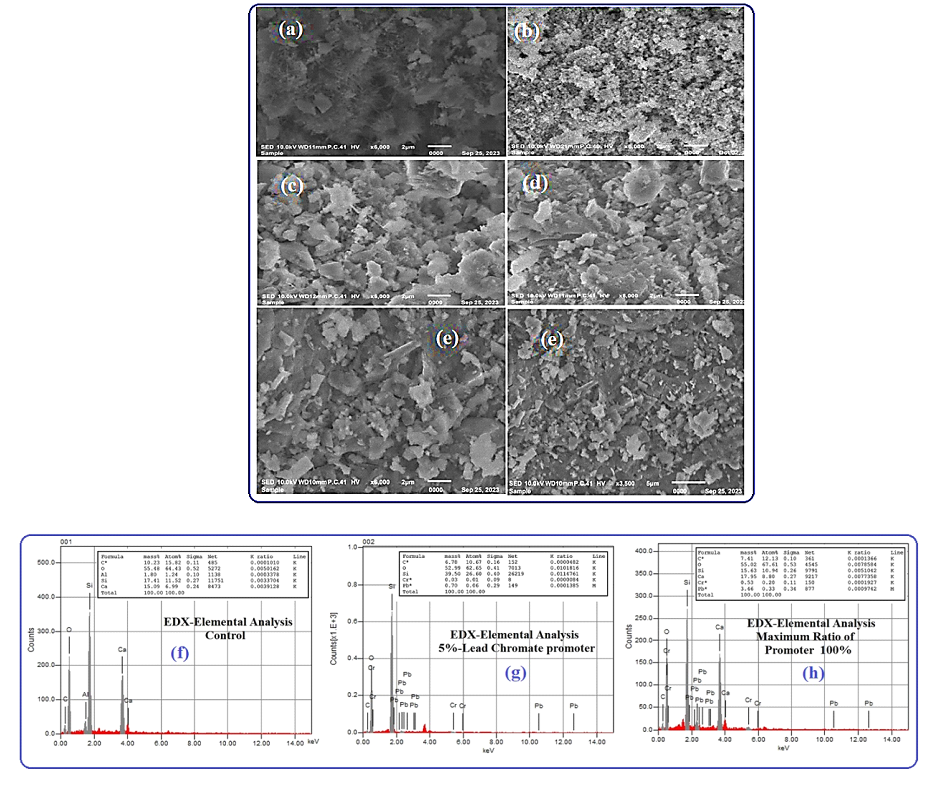
Figure 7(a-e) shows the SEM images captured for the control sample (a), nano lead chromate (b), and different nano admixed systems (c-e), respectively.
Inspection of the SEM images indicates that the promoter modifies the contact zone between the hydrated matrix and the aggregate fraction, leading to improved compactness and better apparent bonding, in line with the general behavior discussed in [30]. In particular, the 5% composite shows a dense and comparatively homogeneous texture, suggesting more uniform nanoparticle distribution and fewer visible microcracks than the control. At higher dosages, the micrographs indicate less uniform dispersion.
On this basis, the 5% mixture appears to provide the most balanced microstructural refinement, which is also supported qualitatively by the EDX elemental maps in Figure 7(f-h).
At the microscopic level, cement paste contains unreacted cement grains, pores, and hydration products such as calcium hydroxide, ettringite, and fibrous C–S–H [31]. The role of additives in high-performance cement systems is therefore to modify these phases and reduce the pore space through physical and chemical effects.
A reduction in capillary and gel porosity is generally associated with improved strength and durability [32]. The present observations suggest that the inclusion of lead chromate changes the local packing and texture of the matrix, producing a more compact morphology and fewer visible defects in comparison with the control. This interpretation is consistent with earlier work in which soft-metal additions were used to alter microstructural behavior in brittle materials [15, 16].
In addition, previous studies have shown that the relative concentrations of lead and chromate ions can influence PbCrO\(_4\) particle formation and growth [15, 16, 33]. In the present composites, the samples in Figure 7(c-e) appear more homogeneous than the control in Figure 7(a), indicating that the promoter contributes to a denser interfacial texture and improved bonding between the cement matrix and the dispersed phase [31].
The synthesized nanochromate powder as well as the applied silicate phase were characterized by TEM, and the corresponding images are shown in Figure 8(a-f).
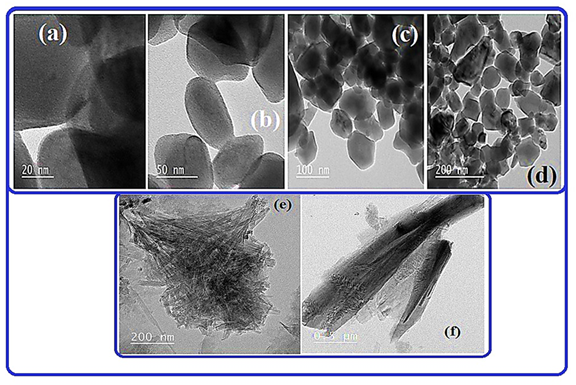
Analysis of the TEM images for the synthesized lead chromate confirms an average particle-size range of about 42–93 nm, as is especially clear in Figure 8(b,c). This nano-metric scale is favorable for dispersion within the cementitious matrix and supports the observed improvement in texture homogeneity and mechanical response [2, 3, 33]. The silicate images are also consistent with the morphologies reported previously for comparable cement-related materials [4, 5, 29].
All specimens from mixtures M1 to M7 were tested using the loading machine shown in Figure 9, as described in the Experimental section. For each mixture, the first-crack load and the ultimate failure load were recorded, and the values plotted in Figure 9 correspond to the average of three independent destructive tests at each curing age.
Standard deviation bars are included in the plots to indicate the repeatability of the measurements. Within the investigated range, the load-bearing capacity increased progressively with promoter dosage. Figure 9 shows that the maximum ultimate load was 12.3 kN for M7, whereas the minimum value was 3.6 kN for the control mix M1 [15, 16]. The maximum first-crack load was 2.3 kN for M7, while the minimum first-crack load was 0.2 kN for M1 and M2.
When these mechanical results are considered together with the SEM/EDX observations, the data suggest that the promoter contributed to improved matrix integrity and more effective stress transfer within the tested composites. The observed trend is also broadly consistent with earlier reports in which increasing soft-metal content was associated with enhanced mechanical response in brittle materials [16– 18].
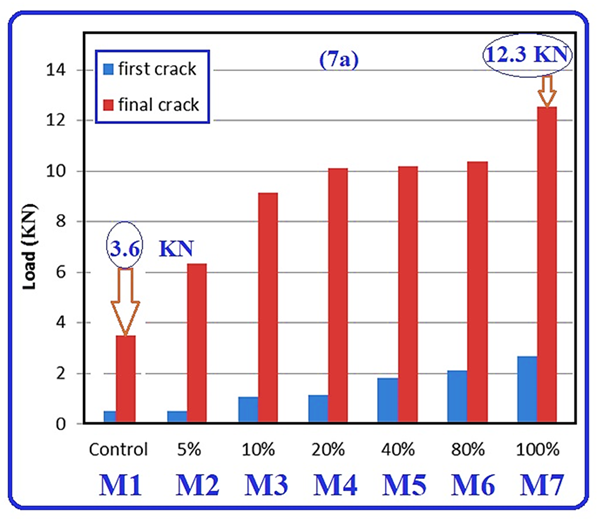
In the present evaluation, the first-crack load was taken as the onset of the initial deviation from linear response, whereas the ultimate load corresponds to the maximum load sustained before failure. The systematic increase in both quantities for the promoter-containing specimens indicates improved resistance to crack initiation and crack propagation under the applied loading conditions.
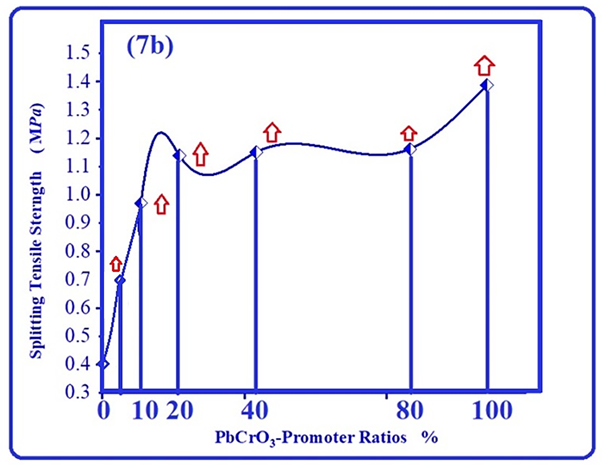
To obtain a tensile-related performance index from the measured failure loads, an empirical procedure [34, 35] was used to estimate the indirect tensile stress for the prismatic cementitious specimens shown in Figure 9.
The indirect tensile stress (\(M_P\)) was estimated for the 20 × 20 × 25 mm specimens using
\(M_P=2 k F/\pi DL\)
where \(F\) is the failure load, \(L\) and \(D\) are the specimen dimensions, and \(k\) is a geometric correction factor introduced to account for the non-cylindrical specimen shape.
As shown in Figure 10, the estimated indirect tensile stress increased with promoter dosage from 5% to 100%. The maximum value, 1.42 MPa, was obtained for mixture M7, corresponding to an increase of about 355% relative to the control specimen. Within the limits of the present test program, this result indicates that the promoter improved the tensile-related performance of the mortar system.
This behavior is consistent with the microstructural observations and suggests that a more uniform PbCrO\(_4\) distribution helps reduce local stress concentrations and delay microcrack development under load [16, 17].
The magnitude of the observed improvement is promising when viewed against published results for other nano-additives. For example, Hamed et al. [36] reported that dispersing nano-clay at 5, 7.5, and 10% replacement levels improved the compressive, splitting tensile, flexural, and bond strengths by about 1.42 to 3.74 times compared with untreated nano-clay mixes. Likewise, Yehia [37] found that nano-clay additions of 3%, 5%, and 7% improved compressive, indirect tensile, and flexural strengths by 35%, 42%, and 41%, respectively. Although the materials and dosage definitions are not identical, these comparisons indicate that the present PbCrO\(_4\) system yields a response that is competitive with other nano-modified cementitious composites.
The conclusive remarks of this study can be summarized as follows:
The present investigation demonstrated the synthesis and application of nano-lead chromate as a microstructural and mechanical promoter for cementitious composites.
The synthesized PbCrO\(_4\) nanoparticles were successfully incorporated into the cementitious matrix and were identified by XRD, FTIR, UV/Vis., TGA/DTA, SEM, EDX, and TEM.
The selected dosage range enabled comparison of the promoter effect over a wide interval of additions referenced to the cement silica content under the same curing and testing conditions.
Microstructural observations indicated that promoter-containing specimens developed a denser and more homogeneous texture than the control, particularly at lower and intermediate dosages, which supports the measured improvement in load-bearing behavior.
The tested composites exhibited a marked increase in estimated indirect tensile performance, reaching up to 3.55 times the control value for the highest dosage investigated.
Within the limits of the present short-term laboratory study, nano-PbCrO\(_4\) can therefore be considered a promising mechanical promoter; however, additional durability, leaching, and long-term performance studies are still required before practical application can be recommended.