
The construction sector comprises a spectrum of methodological approaches related to the planning, implementation, and lifecycle management of infrastructural systems such as transportation arteries, bridges, edifices, and utility networks and constitutes a critical determinant of socio-economic development [1]. In contemporary discourse, this industry is characterized by increasing systemic complexity, rapid technological innovation, and pronounced interdependence among stakeholders, conditions that collectively necessitate an integrated and holistic management approach encompassing the entire project life cycle, from initial conceptualization and initiation through operation and eventual decommissioning [2,3]. The construction of project success within the construction industry remains ambiguously defined. Although achieving project success is a pivotal aim for all stakeholders, its definition is subject to variation among individuals [3].
In developing countries, public-sector construction projects constitute a major component of national capital formation, exerting a significant influence on gross domestic product (GDP) growth, labor market expansion, and the delivery of critical public services [4]. Governments, in collaboration with development partners, implement programs and projects intended to provide essential public services across sectors such as education, healthcare, and public administration. Despite these interventions, substantial constraints remain in the areas of cost control, schedule adherence, quality assurance, safety management, and client or end-user satisfaction. These challenges are particularly pronounced in rapidly urbanizing contexts, such as Gondar, Ethiopia, where the construction sector is dominated by small- to medium-sized contracting firms.
Despite the paramount significance of performance within the realm of public infrastructure delivery, construction projects in Gondar frequently encounter delays, cost overruns, suboptimal quality, and diminished stakeholder expectations. As delineated by [5] and further accentuated by [6], prevalent impediments to performance encompass price escalation, design alterations, resource scarcities, inaccurate estimations, deficiencies in leadership, payment delays, and exogenous factors such as climatic variations and currency exchange fluctuations. Although these challenges are widely recognized within the broader African context and in developing countries, their relative importance warrants locally focused examination in Gondar City.
The majority of existing studies underscore the pivotal role of project performance in the successful delivery of construction projects, particularly within the public facilities sector in developing countries such as Ethiopia. Project performance is typically evaluated using key performance indicators, most notably cost, time, and quality. Consequently, the assessment of performance in the construction industry predominantly depends on a set of interrelated factors operationalized through these three parameters. However, recent research has advocated for the adoption of a broader spectrum of performance indicators that also capture stakeholder satisfaction and the creation of long-term value [3].
Cost performance, for instance is impacted by cause like cost estimating, design changes and inflation of price [7], while time performance is impacted by late approval of designs, scarcity of resources and inefficiencies of contractors in project implementation [8]. Quality performance, being directly connected to materials, workmanship and supervision, is necessary for the sustainability of projects and lifecycle worth [9] . Performance, as stated by Chan [10], refers to the achievement of project goals on a basis of cost, time, quality, safety, satisfaction, and functionality. Chan [3] and Takim [11] believe that performance must include factors beyond the one-dimensional aspect, such as functional performance and client satisfaction. Similarly, the Construction Industry Institute (2006) developed 11 Key Performance Indicators (KPIs), such as schedule predictability, cost predictability and safety, to better understand total performance.
Ngacho & Das [4] developed a performance measurement model tailored to Kenyan public building projects utilizing critical success and failure factors. This more highlights the importance of context-specific indicators for developing countries like Ethiopia. Complexity of public sector construction projects in these nations is typically compounded by bureaucratic procurement procedures, finance limitations and governance deficits [12]. There exists a great level of linkage between leadership capacity, organizational backing and stakeholder participation and project performance [13]. Project managers’ leadership capacities greatly influence performance outcomes, particularly in developing nations where capacity gaps are common [5]. Authors [14,15] in Saudi Arabia also identified the importance of proper communication, decision-making, and coordination among stakeholders.
In addition, measurement systems in developing countries are either used inadequately or are misaligned with project delivery [2]. Such misalignment limits the ability of contractors and government agencies to track progress and make remedies cost-effectively. Accordingly, researchers recommend the application of universal and context specific performance frameworks to improve public sector project delivery [3,4,14].
Despite the existence of numerous studies, empirical evidence on performance measurement in Ethiopian urban contexts, including Gondar City, remains limited. The extant literature predominantly addresses broad themes such as cost overruns, schedule delays, and quality deficiencies; however, the review presented here does not establish how these findings transfer to Gondar City. Consequently, locally grounded research is essential to identify the highest-rated potential factors relating to public building construction performance in Gondar and to develop an analytical framework that is appropriately tailored to the city’s institutional, economic, and socio-technical conditions.
This research aims to address the identified gap in literature by systematically evaluating the performance of public building construction projects in Gondar City. The specific objectives are to: (i) identify and characterize the principal stakeholder-rated factors relating to project performance; (ii) rank the perceived importance of key performance indicators (KPIs); (iii) examine reported performance measurement practices in the construction sector; and (iv) develop a conceptual framework intended to support construction stakeholders including clients, consultants, and contractors in improving project delivery. By generating context-specific, empirically grounded evidence, the study is expected to contribute both to the academic body of knowledge and to the refinement of practical approaches for enhancing the performance of public construction projects in comparable developing-country settings.
The contribution lies in combining local stakeholder rankings with six documentary case studies and a conceptual synthesis for Gondar City. The RII analysis and performance dimensions are applications of existing techniques and concepts, rather than a new measurement method; the evidence does not establish a first-of-its-kind or validated predictive framework.
This investigation employed a research methodology to systematically assess the performance of public building construction projects in Gondar City, Ethiopia. The study was carefully structured to specify the research setting, identify data sources, define data collection instruments, and outline analytical procedures, to support a systematic research process. A mixed-methods approach, integrating both qualitative and quantitative research paradigms, was adopted to address the multifaceted nature of construction project performance. Gondar City, characterized by a high concentration of ongoing public construction activities, provided a particularly suitable empirical context for this inquiry.
Primary data were obtained through the administration of structured questionnaires and the conduct of semi-structured interviews with key project stakeholders, including consultants, contractors, clients, and professional engineers directly engaged in the execution and supervision of these projects.
The research design followed a systematic methodological approach, beginning with an exploratory, unstructured review of the literature to refine the research problem and specify the study objectives. Insights derived from this review guided the formulation of the overall research design, the identification and delimitation of data sources, and the selection of appropriate data collection instruments. Documentary material including monographs, peer-reviewed journal articles, conference papers, electronic resources, and archival records were subjected to critical appraisal in order to construct the conceptual and analytical framework of the study.
Subsequently, a structured questionnaire was developed and administered to the purposively selected stakeholders to obtain primary quantitative data, while semi-structured interviews were conducted in parallel to elicit more in-depth qualitative information.
A purposive sampling technique was employed to select a sample from the ongoing public construction projects in Gondar City. Out of 32 active projects, 22 were selected through purposive sampling to achieve a balance of accessibility and project performance. The sample size was reported as determined utilizing Kish’s formula with a nominal 95% confidence level. The calculation inputs are not supplied, so this calculation cannot be reproduced; purposive selection does not establish statistical representativeness or a design-based 95% confidence interval.
The target population comprised professionals actively engaged in public building construction, including consultants, contractors, clients, and engineers. Participants were selected based on their direct involvement and experience in the projects under investigation. The 22 projects are not a respondent count. Respondent totals by stakeholder group, response rates, survey dates, and the number of respondents per project are not reported; possible clustering within projects and selection bias therefore remain unresolved.
Data collection was conducted using self-administered questionnaires and semi-structured interviews. The design of the questionnaires was guided by the study objectives and a thorough review of existing literature, focusing on critical factors influencing project performance, evaluating current performance measurement methodologies, and identifying critical performance indicators (KPIs).
To assess the clarity and relevance of the research instrument, a pilot study was executed involving six seasoned construction professionals, encompassing roles such as resident engineers, site engineers, and project managers. Feedback obtained during the pilot phase facilitated essential modifications to the questionnaire, specifically enhancing clarity and rectifying grammatical inaccuracies.
The assessment of internal consistency reliability was performed utilizing Cronbach’s Alpha coefficient, a statistical measure that appraises the degree to which questionnaire items evaluate corresponding constructs consistently. Content relevance was reviewed through expert judgment and peer evaluation; this review does not by itself establish construct validity.
The reported results are descriptive summaries produced through the application of SPSS version 20. Descriptive statistics summarized stakeholder ratings and reported performance measurement practices; respondent demographic results are not presented.
The Relative Importance Index (RII) approach was used to determine ranks of key performance factors and KPIs by their weighted importance as rated by respondents. The RII was calculated as:
where, RII is the relative importance index, W is the weight given to each factor by the respondents and ranges from 1 to 5, A = the highest weight = 5, N = the number of valid responses to the factor being rated.
With valid weights from 1 to 5 and A = 5, RII values range from 0.2 to 1, with higher values indicating greater perceived importance of the factors. The sum in (1) is over responses to the same item. Rating anchors, item-level response counts, missing-response treatment, and whether aggregate RII values pool individual responses or average stakeholder-group indices are not specified; the reported aggregate values therefore cannot be independently reconstructed.
The research methodology adhered to a systematic, sequential approach commencing with the identification of the research problem, followed by observational studies, consultations with industry experts, and a comprehensive review of existing literature. This methodology facilitated the determination of critical variables for measurement, guided the development of research instruments, and informed the data collection process. After data collection, processes of data cleaning, coding, and analysis were conducted using the designated statistical techniques. The amalgamation of quantitative survey data with qualitative case study findings provided descriptive context for understanding of the performance of public building projects within the studied region. The findings obtained from the comprehensive analysis were meticulously examined in relation to the existing body of literature and practical experiences within the construction industry. This approach was employed to facilitate the formulation of informed conclusions and to propose realistic, actionable recommendations aimed at enhancing performance management practices in public building construction projects in Gondar City. In essence, the study design integrated strategic sampling, piloted data collection instruments, and descriptive analytical methodologies to investigate stakeholder-rated performance factors. Furthermore, it sought to develop a conceptual performance model specifically adapted to the public building sector within the Ethiopian context. Interview counts, the interview guide, coding procedures, and the method of integrating qualitative and quantitative findings are not reported. Consequently, the qualitative material is treated as reported context, not independently auditable thematic or causal evidence.
The dataset was analyzed using the Relative Importance Index (RII) method to systematically rank the factors influencing project performance and associated key performance indicators (KPIs). Internal consistency was summarized by calculating Cronbach’s alpha. Spearman’s rank correlation coefficient is mentioned in the analysis description, but no coefficients, sample sizes, or uncertainty estimates are reported; no correlation-based inference is therefore made. This analysis summarizes the perceived importance of cost, time, quality, health and safety, client satisfaction, and productivity, rather than their measured effects on project outcomes. The Cronbach’s alpha coefficients corresponding to the six performance factor groups and the KPI group ranged from 0.79 to 0.86, as presented in Table 1.
| S/N | Item | Number of factors | Cronbach Alpha value |
|---|---|---|---|
| 1 | cost factor | 11 | 0.81 |
| 2 | Time Factor | 15 | 0.83 |
| 3 | Quality factor | 6 | 0.82 |
| 4 | Health and Safety factor | 4 | 0.84 |
| 5 | Client Satisfaction factor | 5 | 0.80 |
| 6 | Productivity factor | 5 | 0.86 |
| 7 | Key performance indicator | 7 | 0.79 |
This range summarizes internal consistency, but does not establish that the heterogeneous factor lists measure single latent constructs or that the questionnaire is fully validated. The sample used for the alpha calculations is not specified. Throughout §3.2 and §3.3, ranks describe aggregate importance ratings, not statistical significance, causal effect sizes, or observed performance deficits. Separate stakeholder-group rankings and ranking uncertainty are not reported, so group agreement and the significance of small rank differences cannot be established.
A total of eleven cost-related factors rated in relation to the performance of public building projects were identified. Table 2 presents the ranking of these determinants, established based on the aggregate Relative Importance Index (RII) values, which were compiled from the perspectives of owners, contractors, and consultants.
| Cost Factor | Aggregate RII | Rank |
|---|---|---|
| Escalation of material price | 0.941 | 1 |
| Currency exchange fluctuation | 0.885 | 2 |
| Design changes | 0.863 | 3 |
| Additional work orders | 0.854 | 4 |
| Cost of variation orders | 0.795 | 5 |
| Material changes | 0.749 | 6 |
| Incomplete drawings | 0.702 | 7 |
| Cost of rework | 0.615 | 8 |
| Project complexity | 0.613 | 9 |
| Labor and equipment cost | 0.576 | 10 |
| Motivation cost | 0.404 | 11 |
Rising material costs (RII = 0.941) were the most prominent cost factors, consistent with research by [16] that material cost escalation is one of the leading causes of project cost overruns. This factor frustrates continuity of work and adversely affects the liquidity of owners. Variations in currency exchange rates, reflected by an aggregate Relative Importance Index (RII) of 0.885, were identified as the second highest-rated factor. This finding is consistent with prior studies that emphasize the substantial effect of exchange rate volatility on the stability of budgetary allocations and the financial standing of contractors. Such fluctuations frequently give rise to cost overruns and project delays. Design modifications, with an RII of 0.863, and additional work orders, with an RII of 0.854, were ranked as the third and fourth most critical factors, respectively. The implementation of design changes after the contract award typically entails modifications to the original project scope, which in turn contribute to increased costs and schedule overruns, thereby reinforcing conclusions reported in previous research [17]. Extra work orders increase costs and initiate problems among stakeholders [9]. Variation order cost, material change, and incomplete drawings ranked fifth to seventh; their effects on delay or rework were not quantified.
The instrument summary in Table 1 lists fifteen temporal performance factors for public building construction undertakings within Gondar City, but Table 3 reports item-level results for only six. The other nine items and their ratings are not reported, so the complete time-factor ranking cannot be checked. Through the application of Relative Importance Index (RII) metrics, as evaluated by proprietors, contractors, and consultants, the preeminent factors are delineated in the subsequent discussion (Table 3).
The postponement of payments emerged as a principal factor affecting the temporal performance of projects, as indicated by a composite Relative Importance Index (RII) of 0.937. This factor was ranked first in the aggregate results; separate respondent-group rankings are not reported. This finding is consistent with [18], where they established payment delays as one of the primary causes of poor project delivery. In public building projects, owners’ delayed payments disrupt contractors’ cash flow, causing work suspension and triggering disputes and claims that harm schedules. Resource availability is ranked as the second highest-rated factor (Relative Importance Index = 0.831) contributing to the delay in project timelines. The timely availability of materials, labor, and equipment is crucial for adhering to the planned schedules. This finding is consistent with prior research that underscores the critical role of resource planning and procurement in achieving project success [19]. Contractors are advised to align resource availability with project schedules to mitigate delays and associated cost implications. Design modifications were ranked third, with a Relative Importance Index (RII) of 0.828, indicating their perceived importance for project duration; omissions or scope extensions are possible mechanisms, not effects quantified by these ratings. These modifications often arise due to inadequate initial planning, ineffective communication between owners and consultants, or unanticipated conditions at the project site. Such changes invariably lead to prolonged project completion times and frequently result in increased costs. This underscores the necessity of finalizing the design process comprehensively before commencing construction activities. The financial capability of contractors ranks as the fourth highest-rated factor (Relative Importance Index = 0.814) influencing the successful completion of projects within the stipulated timeline. Contractors possessing adequate financial resources may sustain work during interim payment delays, subject to their available cash and credit. The relevance of contractor capability is discussed in [20]. The inability to mobilize labor or secure materials in a timely manner is attributable to financial deficiencies, resulting in project delays. Challenges related to funding (Relative Importance Index [RII] = 0.784) and inadequate planning (RII = 0.778) ranked fifth and sixth among the reported time factors; their effects on project delays were not measured. Although these factors were not as highly rated as the four leading reported factors, they nonetheless play a vital role in informing strategies aimed at enhancing temporal performance in the execution of public building construction projects.
| Time Performance Factor | Aggregate RII | Rank |
|---|---|---|
| Delay of payment | 0.937 | 1 |
| Unavailability of resources | 0.831 | 2 |
| Contractor’s financial capacity | 0.814 | 4 |
| Design changes | 0.828 | 3 |
| Funding problems | 0.784 | 5 |
| Improper planning | 0.778 | 6 |
This research delineated six rated factors relating to the quality performance of public building construction projects within Gondar City. The Relative Importance Index (RII) analysis, derived from the perspectives of owners, contractors, and consultants, as delineated in Table 4, is accompanied by an in-depth discussion of the critical factors elucidated below.
| Quality Performance Factor | Aggregate RII | Rank |
|---|---|---|
| Availability of personnel with high experience and qualification | 0.878 | 1 |
| Escalation of material prices | 0.816 | 2 |
| Quality of equipment and raw materials | 0.783 | 3 |
| Quality training and meetings | 0.741 | 4 |
| Quality assessment system in the organization | 0.636 | 5 |
| Conformance to specifications | 0.611 | 6 |
The highest-rated factor relating to quality performance is the availability of experienced and skilled human resources, as indicated by an aggregate Relative Importance Index (RII) of 0.878. This finding is consistent with the study by [21], which underscores the pivotal role of skilled manpower in quality management to facilitate quality enhancement, cost efficiency, and adherence to specifications. The aggregate responses ranked this factor first, indicating its perceived importance for quality within the sampled public building projects. The escalation of material costs is identified as the second highest-rated factor relating to quality, as indicated by the aggregate Relative Importance Index (RII) of 0.816. The increase in material prices frequently results in shortages and necessitates substitutions or reductions in quality, thereby adversely affecting project outcomes. This prioritization is reflected in the aggregate responses; stakeholder-specific rankings are not presented. These observations align with the existing literature in the construction domain, which documents that cost escalation disrupt both project flow and quality control [16]. The third and fourth prioritized determinants were identified as the quality of equipment and raw materials, with a Relative Importance Index (RII) of 0.783, and training and meetings focused on quality issues, with an RII of 0.741, respectively. Regular training regarding the quality of materials and equipment may support awareness and adherence to established standards; its effect on project quality was not measured here. The assessment of quality valuation methodologies within organizations, as well as compliance with established specifications, was evaluated as less critical, yet they retain their significance. These lower relative ratings do not establish whether quality control frameworks or compliance with design and contractual specifications are adequate.
The present study elucidates four rated factors relating to the health and safety (H&S) outcomes in public building construction projects. Table 5 delineates the Relative Importance Index (RII) values and their associated rankings as evaluated by the stakeholders, namely owners, contractors, and consultants. The subsequent sections provide an in-depth analysis of these critical factors.
| Health and Safety Performance Factors | Aggregate RII | Rank |
|---|---|---|
| Climate condition | 0.828 | 1 |
| Location of the project | 0.816 | 2 |
| Assurance rate of project | 0.665 | 3 |
| Reportable accidents rate in project | 0.621 | 4 |
The climatic conditions, quantified with an aggregate Relative Importance Index (RII) of 0.828, have been identified as the highest-rated factor relating to health and safety performance. Extreme meteorological phenomena, including thermal stress, frigid temperatures, or substantial wind forces, exert a considerable influence on worker health, safety, and productivity. Lingard [22] Research indicates that adverse climatic conditions exacerbate occupational hazards and contribute to project delays by diminishing working hours or necessitating work stoppages. The aggregate ranking indicates perceived importance in the surveyed sample; agreement across individual stakeholder groups cannot be checked from Table 5. The factor with the second highest ranking, as indicated by an aggregate Relative Importance Index (RII) of 0.816, is the geographical location of the project. Projects that are in constrained or challenging-to-access sites present safety hazards by restricting the mobility of the workforce and diminishing the effectiveness of emergency response measures [23]. The statement underscores that restricted site conditions elevate the probability of accidents and injuries, consequently diminishing the overall health and safety performance. This phenomenon is especially pertinent in urban public construction projects where spatial limitations are prevalent. The assurance rate of the project and the reportable accident rate, despite being ranked lower, continue to be significant factors in occupational health and safety assessments. The assurance rate is interpreted here as confidence in safety management systems and their enforcement, but its questionnaire wording and operational definition are not provided. Table 5 reports importance ratings, not measured assurance or accident rates. These rankings identify perceived priorities but do not establish the adequacy of existing safety protocols or accident reporting.
This investigation elucidated five rated factors relating to client satisfaction in the context of public building construction projects. Table 6 delineates the Relative Importance Index (RII) alongside rankings as assessed by owners, contractors, and consultants, in addition to the synthesized outcomes. The pivotal factors influencing client satisfaction are expounded upon in the subsequent discourse.
Leadership Skill of the project manager was the highest-rated factor relating to client satisfaction, with a mean RII of 0.88. This concurs with [24], who was resolute in good leadership playing a vital role in meeting client expectation and realizing a successful project. The aggregate ranking places this factor first; separate stakeholder-group rankings are not reported. Effective leadership facilitates coordination, prompt decision-making, and checking for quality, with direct impacts on client satisfaction via adherence to specifications, budget, and schedule. The number of reworks ranked second (RII = 0.80), indicating its perceived importance for client satisfaction, not a measured negative effect. Based on Karna (2004) study, excessive rework leads to increased project costs and delays in time, unsatisfying clients and impacting the apparent project quality. The respondent ratings are consistent with this concern, highlighting the importance of first-time workmanship and quality control to minimize reworks in the project. Disputes between the project owners and project participants were ranked third (RII = 0.757), indicating its relative perceived importance for client satisfaction. Disputes frequently happened due to misunderstandings, contractual ambiguities between parties or performance issues, which can bring delay of projects and strain stakeholder relationships. Although not the highest-rated factor, this rating supports considering it in mitigation planning; an effect size is not estimated. Information coordination between the owners and project parties (RII = 0.682) and the speed and reliability of service to the owners (RII = 0.618) were ranked lower but it is important providers to client satisfaction. Effective communication and quick service delivery support transparency and trust, further enhancing the client perceptions of project performance.
| Client Satisfaction Performance Factors | Aggregate RII | Rank |
|---|---|---|
| Leadership skills of the project manager | 0.880 | 1 |
| Number of reworks | 0.800 | 2 |
| Number of disputes between owner and project parties | 0.757 | 3 |
| Information coordination between owner and project parties | 0.682 | 4 |
| Speed and reliability of service to the owner | 0.618 | 5 |
Understanding the major factors affecting productivity in public building construction projects is critical for enlightening performance and project delivery outcomes. Based on the literature and survey responses from owners, contractors and consultants, five important productivity-related factors were analyzed using the Relative Importance Index (RII) method. The summary of the findings is shown in Table 7.
| Productivity Performance Factors | Aggregate RII | Rank |
|---|---|---|
| Climate conditions | 0.845 | 1 |
| Labor relationship management | 0.810 | 2 |
| Project size and complexity | 0.675 | 3 |
| Employees’ motivation and attitude | 0.608 | 4 |
| Non-working holidays | 0.410 | 5 |
Climate conditions emerged as the highest-rated factor (aggregate RII = 0.845) influencing productivity performance. This finding is consistent with previous research that has emphasized the detrimental effects of adverse and unpredictable weather such as extreme rainfall and abrupt wind shifts on construction site productivity. Projects exposed to environmental instability frequently experience schedule delays, particularly during prolonged rainy seasons or periods of extreme temperatures. This rating supports considering adaptive project scheduling and contingency planning, without quantifying weather-related productivity losses in the surveyed projects. The second highest-rated factor is the labor relationship management (Aggregate RII = 0.810). This aligns the findings of [25] and [26], who emphasized those effective labor relations, improves communication, coordination and motivation between managerial and labor levels. Good managerial leadership promotes collaboration, decreases conflict and improves team morale, eventually boosting on-site productivity. Contractors should particularly value this factor due to its direct impact on operational efficiency and workforce harmony. Project size and complexity, ranked third (Aggregate RII = 0.675), constitute principal determinants of overall project productivity. Larger and more complex projects necessitate more sophisticated planning procedures, advanced resource management strategies, and highly skilled project teams. In the absence of appropriate coordination mechanisms, such projects are susceptible to operational inefficiencies and performance shortfalls. Consequently, increased complexity in design and scope elevates the likelihood of schedule delays and communication breakdowns. Employees’ Motivation and Attitude was ranked fourth factor (Aggregate RII = 0.608). While not as dominant as climate or labor management, it remains important. Motivated workers are more productive, adaptable, and committed to quality. Accordingly, low morale and lack of incentives can strictly impair labor productivity. Improving workers’ attitudes through recognition, rewards and helpful environments can yield better outputs. Non-working holidays were ranked the least important factor (Aggregate RII = 0.410). Yet such days may cause intermittent disturbances, their perceived importance was comparatively lower than that of the other listed factors. This is consistent with previous findings [27], which view holidays as manageable scheduling restraints if integrated into project calendars in advance.
This section pinpoints and discusses the main Key Performance Indicators (KPIs) rated for evaluating the performance of public building construction projects, as determined by the perceptions of owners, contractors and consultants. Seven key indicators were drawn from the literature and rated through a questionnaire survey. The analysis ranks these indicators using the Relative Importance Index (RII), as shown in Table 8
| Key Performance Indicators | Aggregate RII | Rank |
|---|---|---|
| Time | 0.961 | 1 |
| Cost | 0.953 | 2 |
| Quality | 0.919 | 3 |
| Client Satisfaction | 0.788 | 4 |
| Health and Safety | 0.710 | 5 |
| Productivity | 0.703 | 6 |
| Innovation and Learning | 0.435 | 7 |
Time is the highest-rated KPI indicator (aggregate RII = 0.961) in the aggregate stakeholder responses. This result directly aligns with literature by [28] and [29], which highlight time as a universal measure of project success. Timely delivery shows project efficiency and the adherence to planning, making it an important parameter in evaluating project performance. Cost, ranked second (RII = 0.953), is another principal measure of success. It reflects whether a project is completed within budget or not. Takim [28] and Kagioglu [30] confirm that cost is a traditional performance measure, often prioritized by contractors and consultants. This study reports a high importance rating for cost management in the surveyed projects; cost-management effectiveness was not evaluated. The third key performance indicator is quality (aggregate RII = 0.919) and it measures adherence to specifications and quality standards in the construction project. As supported by [28]and [30], quality is part of the ’iron triangle’ of project success metrics (time, cost and quality). Consistency in quality can support user satisfaction and durability of public infrastructure. Client satisfaction, with an aggregate RII of 0.788, is the fourth-ranked KPI. It received a lower importance rating than the traditional metrics; this does not establish how often it is measured in practice. It captures whether stakeholders’ needs and expectations are met or not, and it is in line with the findings of [3], who highlighted satisfaction as a measure of overall project success. Health and safety are ranked fifth (RII = 0.710). Its lower relative ranking in this sample does not establish whether safety standards are adequate or undervalued in the Ethiopian context. However, scholars like [22]have highlighted that safety influences both morale and productivity. Productivity ranked sixth place (RII = 0.703). It reflects how efficiently resources are transformed into outputs. The relatively low ranking alone does not establish measurement challenges or inadequate awareness. Innovation and learning (RII = 0.435) received the lowermost rating. The findings show lower perceived importance for this indicator, not the absence of continuous improvement, research and knowledge-sharing practices in public projects. Possible consequences for long-term improvements and competitiveness were not evaluated.
In line with the study’s objective of assessing performance measurement practices among public sector building construction organizations, four structured questions were presented to owners, contractors, and consultants. This section presents and interprets findings related to organizational awareness of project performance objectives, using comparative insights from relevant literature.
Alignment with, and comprehension of, organizational goals is critical for the effective measurement of project performance. Table 9 summarizes the reported performance measurement practices; stakeholder-specific awareness percentages are described below. Most of the respondents stated habitual or regular knowledge of their organizational objectives: 56.25% of owners, 55% of contractors, and 47.37% of consultants reported they “always” knew, while the respective percentages of 37.5% (owners), 20% (contractors), and 36.84% (consultants) reported “often” knowing so. These findings indicate frequent self-reported awareness in the sample, not an independently measured performance culture. The organizational alignment in project performance systems is key since awareness of goals enhances the ability to monitor factors of success such as cost, time, and quality.
| Performance Dimension | Key Result (Overall) | Interpretation |
|---|---|---|
| Awareness of Organizational Goals | Over 80% reported “Often” or “Always” | High reported awareness; alignment not directly measured |
| Existence of Formal Measurement Procedures | Over 90% confirmed presence | Formal procedures reported; implementation not independently assessed |
| Frequency of Measurement | Predominantly Quarterly (\(\approx\)70%+) | Quarterly monitoring reported; corrective-action effectiveness not assessed |
| Application of Earned Value Method (EVM) | Over 85% reported usage | EVM use reported; application quality not assessed |
| Continuity of Performance Monitoring | Very few reported “Never” measuring | Few respondents reported no monitoring |
| Performance Management Culture Level | Moderately High | Qualitative summary; no validated culture scale reported |
Note: Overall percentages are retained as reported; respondent counts and aggregation weights are not supplied. “Continuity” and “Culture Level” are descriptive summary categories, not separately validated scales. The table reports awareness and use, not demonstrated effectiveness.
All contractors and majority of the owners and consultants reported that they have formal performance measurement procedures in place. These mechanisms enable the methodical evaluation of project efficiency and effectiveness for institutionalizing performance measurement frameworks in construction project environments. Quarterly appraisal was the predominant reported frequency; the timeliness of corrective action and the comparative effectiveness of alternative frequencies were not evaluated. Such reported practices are consistent with the recommendations put forward by [3], who emphasize frequent monitoring for the purpose of maintaining control over schedule and budget in public sector projects. EVM use was reported by organizations in scope, particularly by contractors. The cost, schedule and scope measures are intended to provide visibility of project health; the reported adoption of EVM does not demonstrate its implementation quality or predictive accuracy.
The results indicate that while a notable portion of respondents report awareness of their organization’s objectives, awareness is not uniform across all stakeholder groups involved; institutionalization of measurement is not directly assessed. Mainly, a reported percentage of consultants (15.78%) reported “never” or “rarely” being aware of performance goals. Fragmented project roles and unclear communication amongst parties are possible explanations for uneven awareness, but these explanations were not tested. In complex public building construction projects, a shortage of communal understanding between participants can insipid the efficiency of tools. Regardless of the awareness expressed, the degree to which this translates into systematic measurement practices remains indeterminate. The literature by [3] explained that performance measurement necessitates not only awareness but also formal tools, such as Key Performance Indicator (KPI) frameworks, benchmarks/standards and monitoring systems. Though this study reports tool use rather than evaluating implementation or effectiveness, the high self-reported awareness levels are hopeful precursors to enhance practices if correctly supported by institutional systems. The presence of awareness amongst most respondents grants an opportunity for scaling up performance measurement tools and policies. Yet variation in consultants’ reported awareness suggests considering more integrated performance frameworks across stakeholders. To complement the survey and interview findings, six case studies were conducted on public building construction projects in Gondar City. These case studies focused on analyzing cost and time performance based on the project’s progress reports and archival documents. Each project was publicly funded, supervised by a national consulting firm and executed by local contractors with varying experience levels. The selection of the six cases, their relationship to the 22 sampled projects, and the reporting dates are not specified. The progress percentages in Tables 10 and 11 show that none was reported as complete. The accounting basis of “Actual Cost” and whether “Actual Duration” denotes elapsed or forecast total duration are not documented; these values must not be treated as verified final completion outcomes. All six projects have reported costs above the original contract amounts, with percentage differences ranging from 7.59% to 37.06% in Table 10. The “Cost Overrun” column is the percentage excess of the listed actual cost over the original contract amount, not a verified final cost overrun. These differences indicate departures from original cost baselines, but do not isolate cost-control inefficiency from scope changes or price escalation. The reported contributors to these cost differences, as identified in document reviews and stakeholder reports includes, Frequent design changes and variation orders, Escalation of material prices, limitations on foreign currency exchange, Contractors’ financial constraints, Additional work orders. These reports identify concerns for cost forecasting and risk management in unpredictable economic conditions, without quantifying the independent contribution of each factor.
| S/N | Project | Contract am. (ETB) | Actual Cost (ETB) | Cost Overrun (%) | Project Progress (%) |
|---|---|---|---|---|---|
| 1 | A | 335,260,766.15 | 459,497,202.89 | 37.06% | 93.37% |
| 2 | B | 105,107,160.36 | 139,061,362.54 | 32.30% | 87.73% |
| 3 | C | 706,172,381.00 | 892,100,774.39 | 26.33% | 66.15% |
| 4 | D | 370,264,019.53 | 405,693,006.13 | 9.57% | 32.82% |
| 5 | E | 769,583,999.70 | 936,063,200.02 | 21.63% | 83.23% |
| 6 | F | 250,070,735.35 | 269,047,845.80 | 7.59% | 65.8% |
All reported durations exceeded the planned durations, with actual-to-planned duration ratios ranging from 169.59% to 593.11% in Table 11. These percentages express the listed actual duration as a percentage of planned duration; they are not time-overrun percentages, which would exclude the planned 100%. Some of the reported contributors are pointed out in the records including, Customer delayed payments, Design change during construction, Lack of resources, Inadequate planning of the project, Outstanding claims. These departures identify schedule concerns in the six cases, but do not independently establish systemic causes or ineffective control systems.
| S/N | Project | Planned Duration | Actual Duration | Actual/Planned (%) | Project Pr (%) |
|---|---|---|---|---|---|
| 1 | A | 600 | 1857 | 309.5% | 93.37% |
| 2 | B | 450 | 2669 | 593.11% | 87.73% |
| 3 | C | 1095 | 1857 | 169.59% | 66.15% |
| 4 | D | 900 | 1647 | 183% | 32.82% |
| 5 | E | 900 | 1973 | 219.22% | 83.23% |
| 6 | F | 240 | 1168 | 486.67% | 65.8% |
Note: The duration unit, reporting dates, and extension-of-time status are not specified. The ratios require a common duration unit and comparable baselines. Project Pr denotes the reported project progress.
These case summaries are not matched-project comparisons: reporting stage, scope revisions, and cost bases are not controlled. Reported use of measurement systems and continuing baseline departures can coexist. Without linking each project’s measurement practices to its outcomes and a comparable baseline, the present evidence cannot estimate the effectiveness of EVM or the proposed framework.
A conceptual framework is a framework of analysis that combines prominent concepts and variables that influence project outcomes and is intended to guide consideration of the problems. It plays a role in the explanation of how performance variables interact with each other and influence the overall performance of public buildings projects. On the basis of empirical facts gained from questionnaire surveys, case studies, and literature reviews, the conceptual model was developed in this study for hands-on and systematic guidance to performance management in public construction. As proposed by [31] The model was developed to be simple, systematic, easy to understand, and applicable to real projects. It maps and links key factors rated as important for building project performance, providing a structured approach to cost, time, quality, safety, client satisfaction, and productivity. Based on questionnaire and case study results, the following framework was developed, covering the main performance indicators and the factors affecting project performance. Figure 1 selectively summarizes leading reported factors rather than all 46 instrument items; no formal selection threshold is specified. “Innovation and Learning” is rated in Table 8, but no corresponding factor group or pathway is operationalized in the six-dimension framework.
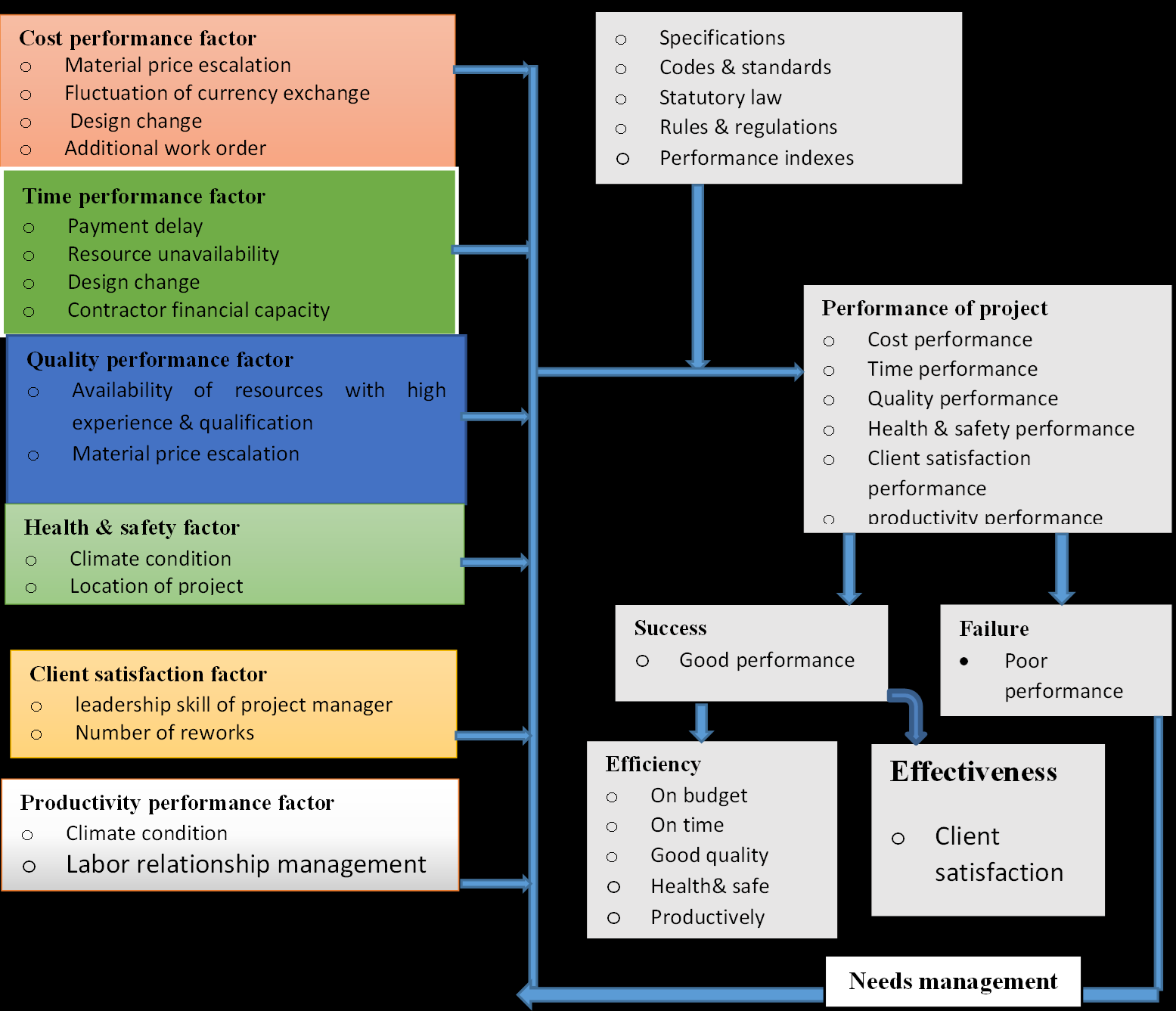
Figure 1 presents a conceptual framework that proposes relationships among project performance factors and project outcomes. The model proposes that six categories of performance factors—Cost, Time, Quality, Health & Safety, Client Satisfaction, and Productivity—relate to overall Project Performance; the arrows are conceptual, not estimated causal relationships. Success (good performance), Failure (poor performance), Efficiency, and Effectiveness are conceptual assessment categories with respect to client requirements, not classifications computed for the six projects. No calibrated weights, success/failure thresholds, or implemented feedback procedure are specified. The standards and regulatory box denotes contextual considerations, not verified compliance, and the feedback arrow does not establish a control or stability result. The case studies provide cost and time descriptions only; they do not validate all framework dimensions or demonstrate performance improvement.
Conclusion: This investigation addressed performance-related issues within public building construction projects in Gondar City, Ethiopia. Utilizing both questionnaire surveys and case studies, the research addressed its four primary objectives at a descriptive level. Subsequently, the stakeholder-rated factors relating to project performance were identified. Among the 46 variables listed in the instrument summary, the highest-rated reported factors included: escalation in material prices, fluctuations in foreign currency, modification of designs, issuance of additional work orders, delayed payments, scarcity of resources, contractors’ financial capacity, availability of qualified personnel, climatic conditions, project site location, project-manager leadership, rework occurrences, and labor relationship management. In the subsequent phase of the study, an analysis was conducted to delineate the primary performance indicators, with time, cost, and quality emerging as the highest-rated metrics for evaluating project success; no comparison against measured industry benchmarks was performed. Furthermore, an evaluation of current performance measurement practices was performed, indicating that most respondents reported frequent awareness of organizational objectives. Performance measurements were reported as predominantly quarterly, with Earned Value Management (EVM) reported as used; comparative tool effectiveness was not evaluated. Ultimately, the research proposed a conceptual performance measurement framework intended to assist stakeholders in reviewing project outcomes through an emphasis on goal alignment, systematic assessment, and the implementation of actionable measures. The following recommendations reflect the descriptive findings and literature, not tested performance improvements. Project Owners must ensure timely payments, define project scope, complete design documentation pre-contract, and minimize change orders. Consultants should deliver thorough design documents, prepare precise BOQs, and coordinate with stakeholders. Contractors need to prioritize safety, hire skilled managers, maintain labor relations, avoid over-commitment, anticipate inflation, and manage cost and schedule variances. The contribution is limited to the selected Gondar projects, reported importance rankings, and conceptual synthesis. Missing respondent-level details, incomplete time-factor reporting, and unverified case-record bases limit reproducibility and generalization. Further studies should develop predictive models for performance measurement in public construction projects.
Author Contributions: All authors contributed equally to the conception, development, and preparation of the manuscript. All authors have read and approved the final version of the manuscript for publication.
Conflicts of Interest: The authors declare that there are no conflicts of interest related to this work.
Data Availability: No datasets were generated or analyzed during the present study; therefore, data availability is not applicable.
Funding Information: This research received no external funding.