
The idea of graph labeling was first introduced by Alexander Rosa in his 1967 paper, where he defined \(\beta\) labeling, also known as \(\beta\) valuations [1]. This concept was further explored by Golomb, who renamed it graceful labeling [2]. Over time, researchers have developed various analogues of graceful graphs by altering the permissible vertex labels, leading to \(k\)-graceful, Skolem-graceful, odd graceful, cordial graceful, and other forms of labeling. Authors in [3– 5] studied concepts like Cycle-super magic labeling of polyomino linear and zig-zag chains, novel resolvability parameter etc. Numerous additional labeling techniques have been introduced and studied since then. Graph labeling involves assigning labels to vertices, edges, or both, under certain conditions. For a comprehensive overview of different labeling types, readers can refer to [6], which encompasses a vast body of literature on labelings and discusses various kinds along with new discoveries in the field.
In 1990, Harary introduced the concept of sum graphs [7]. A graph \(G(V, E)\) is termed a sum graph if there is a bijective labeling \(f\) from the vertex set \(V\) to a set \(S\) of positive integers such that \(xy \in E\) if and only if \(f(x) + f(y) \in S\). This intriguing idea attracted many researchers, leading to numerous contributions in this domain. Bergstrand et al. extended this concept by introducing the product analog to sum graphs and made significant advancements in the field [8].
The literature on graph labeling has grown substantially over time. However, traditional graphs are limited by fixed parameters, whereas hypergraphs can encode more information. While graphs are restricted to modeling pairwise interactions, hypergraphs can represent complex group interactions. Number-associated hypergraphs have recently become popular in computer vision for representing geometrical information, providing a comprehensive, suitable, and general method for data representation on stateful machines. The growing importance of these applications has motivated the extension of labeling techniques to hypergraphs.
This extension opened new avenues of research, enabling a richer combinatorial framework and expanding the scope of potential applications in many areas such as network analysis, database systems, VLSI design, and biological modeling. Many researchers contributed to this area and studied well – known lalelings such as Anti magic vertex labeling [9], co prime labeling [10], exclusive sum lalelings [11], Super Edge-Magic Labeling [12], \((\alpha, \beta)\)-labelling [13] etc. while others have proposed new labeling suited to their unique structural properties of hypergraphs, thereby enabling appications across comminication networks, biology, databases and social network analysis and many more, some of which are mentioned in [14].
In [15], the problem of hypergraph labeling was introduced, leading to the concept of edge product hypergraphs. This study also investigated domination in edge product hypergraphs and presented results related to the sum of domination parameters in hypergraphs and their complements.
In this work, we introduced the notion of an edge sum labeling in hypergraph \(\mathcal{H}\) and initiated a study on this type of labeling in hypergraph \(\mathcal{H}\). We also extended the set of labels to introduced the concept of zero edge sum hypergraphs and conducted an analysis of their properties. Furthermore, we established several results enabling the determination of whether a given hypergraph conforms to the criteria of a zero edge sum hypergraph.
We start this section by revisiting key definitions outlined in [16– 19], which are pertinent to our objectives.
Definition 1. A hypergraph \(\mathcal{H}\) is a pair \(\mathcal{H}(V, E)\) where \(V\) is a finite nonempty set and \(E\) is a collection of subsets of \(V\). The elements of \(V\) are called vertices and the elements of \(E\) are called edges or hyperedges. And \(\displaystyle \cup_{e_i\in E}{e_i}=V\) and \({e_i \neq \phi}\) are required for all \({e_i \in E}.\) The number of vertices in \(\mathcal{H}\) is called the order of the hypergraph and is denoted by \(|V|\). The number of edges in \(\mathcal{H}\) is called the size of \(\mathcal{H}\) and is denoted by \(|E|\). A hypergraph of order \(n\) and size \(m\) is called a \((n, m)\) hypergraph. The number \(|{e_i}|\) is called the degree (cardinality) of the edges \({e_i}\). The rank of a hypergraph \(\mathcal{H}\) is \(\displaystyle r(\mathcal{H})= max_{e_i \in E}{|e_i|}\).
Definition 2. For any vertex \(v\) in a hypergraph \(\mathcal{H}(V, E)\), the set \(N[v]=\{u \in V:u ~is ~adjacent ~to ~v\} \cup \{v\}\) is called the closed neighborhood of \(v\) in \(\mathcal{H}\) and each vertex in the set \(N[v]\setminus \{v\}\) is called neighbor of \(v\). The open neighborhood of the vertex \(v\) is the set \(N[v] \setminus \{v\}\). If \(S \subseteq V\) then \(\displaystyle N(S)=\cup_{v\in S}{N(v)}\) and \(N[S]=N(S) \cup S\).
Definition 3. A simple hypergraph (or sperner family) is a hypergraph \(\mathcal{H}(V, E)\) where \(E={\{e_1, e_2, \cdots, e_m\}}\) such that \({e_i\subset e_j}\) implies \(i=j\).
Definition 4. For any hypergraph \(\mathcal{H}(V, E)\) two vertices \(v\) and \(u\) are said to be adjacent if there exists an edge \(e\in E\) that contains both \(v\) and \(u\) and non-adjacent otherwise.
Definition 5. For any hypergraph \(\mathcal{H}(V, E)\) two edges are said to be adjacent if their intersection is nonempty. If a vertex \(v_i \in V\) belongs to an edge \(e_j\in E\) then we say that they are incident to each other.
Definition 6. The vertex degree of a vertex
\(v\) is the number of vertices
adjacent to the vertex \(v\) in \(\mathcal{H}\). It is denoted by \(d(v)\).
The maximum (minimum) vertex degree of a hypergraph is denoted by \(\Delta(\mathcal{H})(\delta(\mathcal{H}))\).
Definition 7. The edge degree of a vertex \(v\) is the number of edges containing the vertex \(v\). It is denoted by \(d_E(v)\).
The maximum (minimum) edge degree of a hypergraph is denoted by \(\Delta_E(\mathcal{H})(\delta_E(\mathcal{H}))\). A vertex of a hypergraph which is incident to no edge is called an isolated vertex.
Definition 8. The hypergraph \(\mathcal{H}(V, E)\) is called connected if for any pair of its vertices, there is a path connecting them. If \(\mathcal{H}\) is not connected then it consists of two or more connected components, each of which is a connected hypergraph.
Definition 9. A hypergraph is said to be of rank \(k\) if each of its edge contains at most \(k\) vertices.
Definition 10. The complement of \(\bar{\mathcal{H}}\) of a hypergraph \(\mathcal{H}(V,E)\) is defined as \(\bar{\mathcal{H}}(V,\bar{E})\) where \(\bar{E}=\{\bar{e} | e \in E\}\) with \(\bar{e} \in \bar{E}, \bar{e}=\{v \notin e | e \in E\}\).
Definition 11. For a hypergraph \(\mathcal{H}(V, E)\), a set \(D \subseteq X\) is called a dominating set of \(\mathcal{H}\) if for every \(v \in X \setminus D\) there exists \(u \in D\) such that \(u\) and \(v\) are adjacent in \(\mathcal{H}\), that is there exists \(e \in E\) such that \(u, v \in e\).
Definition 12. A dominating set \(D\) of a hypergraph \(\mathcal{H}\) is called a minimal dominating set, if no proper subset of \(D\) is a dominating set of \(\mathcal{H}\). The minimum cardinality of a minimal dominating set in a hypergraph \(\mathcal{H}\) is called the domination number of \(\mathcal{H}\) and is denoted by \(\gamma(\mathcal{H})\).
Definition 13. Let \(D \in D^0(\mathcal{H})\), the set of all minimum dominating sets (of cardinality \(\gamma(\mathcal{H})\)). An inverse dominating set with respect to \(D\) is any dominating set \(D'\) of \(\mathcal{H}\) such that \(D' \subseteq X \setminus D\). The inverse domination number of \(\mathcal{H}\) is defined as \[\gamma^{-1}(\mathcal{H}) = min\{|D'|~ \mid~ D \in D^0(\mathcal{H}), D' ~is ~an ~inverse ~dominating ~set ~with ~respect ~to ~D\}.\]
Definition 14. For a hypergraph \(\mathcal{H}(V, E)\), a subset \(S\) of \(V\) is called an independent set of \(\mathcal{H}\) if no two vertices of \(S\) are adjacent in \(\mathcal{H}\).
Definition 15. If a dominating set \(D\) of a hypergraph \(\mathcal{H}\) is independent, then \(D\) is called an independent dominating set of \(\mathcal{H}\).
The minimum cardinality of an independent dominating set of \(\mathcal{H}\) is called the independent domination number of \(\mathcal{H}\) and is denoted by \(i(\mathcal{H})\).
The maximum cardinality of an independent set in \(\mathcal{H}\) is called the independence number of \(\mathcal{H}\) and is denoted by \(\beta_0(\mathcal{H})\)
Here, we consider a simple hypergraph \((n, m)\) without isolated vertices and of size \(m>1\).
This section presents the introduction of an edge sum labeling, with example and study concerning disconnectedness, adjacency and edge degree of an edge sum labeling of a hypergraph \(\mathcal{H}\). Furthermore, we explore the determination of domination and inverse domination numbers for this labeling, as well as their complements.
Definition 16. Let \(\mathcal{H}(V, E)\) be a simple and connected hypergraph. Let \(V(\mathcal{H})\) and \(E(\mathcal{H})\) be the vertex set and the edge set of \(\mathcal{H}\) respectively . Let \(P\) be a set of positive integers such that \(|E|=|P|\). Then any bijection \(f: E \to P\) is called an edge function of the hypergraph \(\mathcal{H}\).
Definition 17. The induced mapping \(f^*\) on \(V(\mathcal{H})\) given by, \(f^*(v)=\sum f(e)\), where edge \(e\) is incident to the vertex \(v\) is called an edge sum function of the edge function \(f\).
Definition 18. A labeling is called an edge sum labeling of a hypergraph \(\mathcal{H}\) if the edge function \(f: E \to P\) and its induced edge sum function \(f^*\) on \(V(\mathcal{H})\) satisfy the following two conditions:
\(f^*(v) \in P\), for every \(v \in V\).
If \(f(e_1) + f(e_2) + \ldots + f(e_p) \in P\), for some edges \({e_1, e_2, \ldots, e_p} \in E\), then the edges \(e_1, e_2, \ldots, e_p\) are all incident to a vertex \(v \in V\).
The hypergraph that admits an edge sum labeling is called an edge sum hypergraph \(\mathcal{H}\).
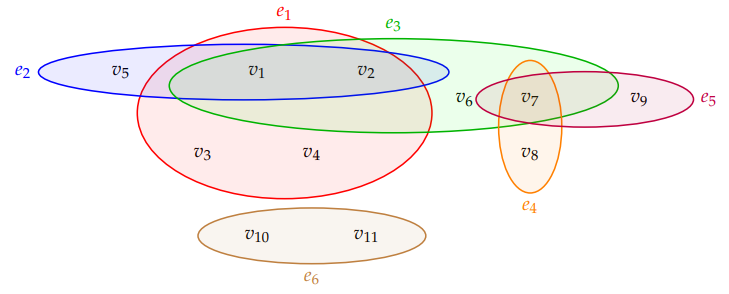
Example 1. Let \(\mathcal{H}(V, E)\) be a hypergraph, where \(V={\{v_1, v_2, \ldots, v_{11}\}}\) and \(E={\{e_1, e_2, e_4, e_5 \}}\). In which the edges of \(\mathcal{H}\) and their corresponding edge function \(f : E \to P\), \(P\) being a set of positive integers, are defined as follows: \[\begin{aligned} e_1 &= \{ v_1, v_2, v_3, v_4 \}, &f(e_1)&=6 \\ e_2 &= \{ v_1, v_2, v_5 \}, &f(e_2)&=9\\ e_3 &= \{ v_1, v_2, v_6, v_7 \}, &f(e_3)&=5 \\ e_4 &= \{ v_7, v_8 \}, &f(e_4)&=7 \\ e_5 &= \{ v_7, v_9 \}, &f(e_5)&=8 \\ e_6 &= \{ v_{10}, v_{11} \}, &f(e_6)&=20. \end{aligned}\]
Then the induced edge sum function \(f^*\) of \(f\) will be, \(f^* (v_1)=20\), \(f^* (v_2)=20\), \(f^* (v_3)=6\), \(f^* (v_4)=6\), \(f^* (v_5)=9\), \(f^* (v_6)=5\), \(f^* (v_7)=20\), \(f^* (v_8)=7\), \(f^* (v_9)=8\), \(f^* (v_{10})= f^* (v_{11})=20\). Clearly, both the conditions of an edge sum labeling are satisfied. Thus, the given hypergraph is an edge sum hypergraph as shown below.
Theorem 19. Edge sum hypergraph is always disconnected.
Proof. Let \(\mathcal{H}(V, E)\) be an edge sum hypergraph with \(f\) and \(f^*\) be its edge function and the corresponding induced edge sum function respectively. Let us denote the largest element in the set of positive integers \(P\) by \(k\). Then there exists an edge \(e \in E\) such that \(f(e)=k\), for the bijection \(f :E \to P\). Now suppose the edge \(e\) is adjacent to any other edge \(e_i\) in \(\mathcal{H}\). Subsequently, we have \(v \in (e \cap e_i)\) with its induced vertex label \(f^*(v)= f(e)+ f(e_i)> f(e)=k\), which is a contradiction. Hence the edge \(e\) is not adjacent to any other edge \(e_i\) in \(\mathcal{H}\). Thus \(\mathcal{H}\) is a disconnected hypergraph. ◻
Remark 1. A hypergraph of the size one is the only connected edge sum hypergraph.
Note 20. To make given hypergraph an edge sum hypergraph one can add any edge of cardinality less than or equal to \(n\) but we add a subset of \(V\) of cardinality two, in order to avoid inconvenience.
Corollary 21. If \(\mathcal{H}(V, E)\) is an edge sum hypergraph, then \(K_2\) is the component of \(\mathcal{H}\).
Proof. Follows from the Theorem 19. ◻
Theorem 22. Let \(\mathcal{H}(V, E)\) be an edge sum hypergraph. Let \(u\) be a vertex such that the edges \({e_1, e_2, \ldots, e_q}\) are incident to it and \(e_k \in E\) such that \(f^*(u)=f(e_k)\). Then if an edge \(e_k \in E\) is adjacent to any edge (excluding \({e_1, e_2, \ldots, e_q}\)) in \(\mathcal{H}\), then that edge must contains a vertex \(v\) such that \(d_E(v) \geq q+1\).
Proof. Let \(\mathcal{H}\) be an edge sum hypergraph. Let \(u\) be incident to the edges \({e_1, e_2, \ldots, e_q}\) in \(\mathcal{H}\). Then \(f^*(u)={f(e_1) + f(e_2) + \ldots + f(e_p)} \in P\). Suppose the edge \(e_k\) is adjacent to the edge \(e_m\) in \(\mathcal{H}\) and \(e_m \neq e_i\), for \({i=1, 2, \ldots, q}\). Subsequently, we have a vertex \(x \in {e_k \cap} e_m\) with its induced vertex label \(f^*(x)={f(e_k) + f(e_m)} \in P\) which implies \(f^*(x)={f(e_1) + f(e_2) + \ldots + f(e_q) + f(e_m)} \in P\). Hence the edges \({e_1, e_2, \ldots, e_q, e_m}\) are incident to a vertex \(v \in V(\mathcal{H})\) with the edge degree greater than or equal to q+1. Hence the proof. ◻
Theorem 23. Let \(\mathcal{H}(V, E)\) be an edge sum hypergraph. Let \(u\) be a vertex such that edges \({e_1, e_2, \ldots, e_q}\) are incident to it and \(e_k \in E\) such that \(f^*(u)=f(e_k)\). If edge \(e_k\) is adjacent to any edge \(e_m\) (excluding \({e_1, e_2, \ldots , e_q}\)) in \(\mathcal{H}\), then \(e_m\) must adjacent to the edges \({e_1, e_2, \ldots, e_q}\) in \(\mathcal{H}\).
Proof. Let \(\mathcal{H}\) be the given hypergraph. Suppose the edge \(e_k\) is adjacent to any edge \(e_m\) in \(\mathcal{H}\), where \(e_m \neq e_i\), for \(i = 1, 2, \ldots, q\). Then there exists a vertex \(v \in e_k \cap e_m\) such that \(f^*(v) = f(e_k) + f(e_m) \in P\). Since the edges \(e_1, e_2, \ldots, e_q\) are incident to \(u\) with \(f^*(u)=f(e_k), f^*(v) = f(e_1) + f(e_2) + \cdots + f(e_q) + f(e_m) \in P\). Hence the edge \(e_m\) is adjacent to the edges \(e_1, e_2, \ldots e_q\). ◻
Theorem 24. Let \(\mathcal{H}(V, E)\) be an edge sum hypergraph with \({e_1, e_2, \ldots, e_m}\) be the edges incident to a vertex \(u\) and \({l_1, l_2, \ldots, l_n}\) be the edges incident to a vertex \(v\). If there exists a proper sub-collection \({e_1, e_2, \ldots, e_p}\) of \({e_1, e_2, \ldots, e_m}\) and \({l_1, l_2, \ldots, l_q}\) of \({l_1, l_2, \ldots, l_n}\) such that the sum of labels of the edges \({e_1, e_2, \ldots, e_p}\) and \({l_1, l_2, \ldots, l_q}\) are equal, then there exist vertices \(r_1\) and \(r_2\) such that \(d_E(r_1)= m-p+q\) and \(d_E(r_2)=n-q+p\) in \(\mathcal{H}\).
Proof. Let \(\mathcal{H}(V, E)\) be an edge sum hypergraph satisfying the hypothesis. Let \({e_1, e_2, \ldots, e_m}\) be the edges incident to a vertex \(u\) and \(e_1, e_2, \ldots, e_p\) is the sub-collection of \({e_1, e_2, \ldots, e_m}\) and \(p < m\). Then the induced vertex label of the vertex \(u\) is, \[f^*(u)={f(e_1) + f(e_2) + \ldots + f(e_p) + f(e_{p+1}) + f(e_{p+2}) + \ldots + f(e_m)} \in P,\] which also implies \[f^*(u)={f(l_1) + f(l_2) + \ldots + f(l_q) + f(e_{p+1}) + f(e_{p+2}) + \ldots + f(e_m)} \in P.\]
Therefore the edges \({l_1, l_2, \ldots, l_q, e_{p+1}, e_{p+2}, \ldots e_m}\) are all incident to a vertex say \(r_1 \in V\) and the edge degree of \(r_1\) is \(m-p+q\). Similarly, \[f^*(v) ={f(l_1) + f(l_2) + \ldots + f(l_q) + f(l_{q+1}) + f(l_{q+2}) + \ldots \times f(l_n)} \in P,\] which also implies \[f^*(v) ={f(e_1) + f(e_2) + \ldots + f(e_p) + f(l_{q+1}) + f(l_{q+2}) + \ldots + f(l_n)} \in P.\]
Hence the edges \({e_1, e_2, \ldots, e_p, l_{q+1}, l_{q+2}, \ldots, l_n}\) all are incident to a vertex, say \(r_2\in V\) and the edge degree of \(r_2\) is \(n-q+p\). ◻
This labeling induces a class of hypergraphs that exibit specific structural properties, the characterization of which remains essential for further theoretical development and potential applications. In [20], Meenakshi et al. studied domination in labeling, opening a novel pathway for studying domination within labeled hypregraph structures. This work serves as a key motivation for all our domination related work in which we explore domination within the framework of this new labeling.
Theorem 25. If \(\mathcal{H}(V, E)\) is an edge sum hypergraph, then any singleton subset of \(\mathcal{H}\) cannot be a dominating set of \(\mathcal{H}\).
Proof. Follows from the Theorem 19. ◻
In order to avoid the trivial anomalies, whenever we talk about \(\bar{\mathcal{H}}\), we confine ourselves to those hypergraphs which satisfies the condition that, every vertex \(v\) of \(\mathcal{H}\) is incident with some edge \(e\) of cardinality, \(2 \leq |e| \leq |v|-2\), and avoiding \(v\) and \(d_E(v)<|E|\) and \(|V| \geq 4\).
Theorem 26. Let \(\mathcal{H}(V, E)\) be an edge sum hypergraph. Then \(\gamma(\bar{\mathcal{H}})=\gamma^{-1}(\bar{H})=1\).
Proof. Let \(\mathcal{H}\) be an edge sum hypergraph. Let \(e_k= \{u,v\}\) be a \(K_2\) component in \(\mathcal{H}\). Let \(w \in X \setminus {\{u,v\}}\). Then there exists \(e \in E\) such that \(w \notin e\). Since \(e_k\) is a \(K_2\) component of \(\mathcal{H}\), \(\bar{e}=X \setminus e\) contains vertices \(w,u,v\). Hence \(u\) and \(v\) are dominated by \(w\). Now for any vertex \(x \in X \setminus {\{u,v\}}\), we have \(\bar{e}_k=X \setminus {e_k}\) contains both \(x\) and \(w\). Hence \(w\) dominates \(x\). Therefore \(\{w\}\) is a dominating set of \(\bar{\mathcal{H}}\). Similarly \(\{x\}\) forms an inverse domination of \(\bar{\mathcal{H}}\) and \(x \in X \setminus {\{u,v\}}\). Thus, \(\gamma(\bar{\mathcal{H}})=\gamma^{-1}(\bar{\mathcal{H}})=1\). ◻
The evolution of labeling has been marked by extension of label set to uncover new labeling framework and gain insight into theoretic structures. Aligned with this direction, we also extended the set of labels which introduces new concepts for further investigation.
In this section, we extended the set of labels to introduce the concept of zero edge sum labeling and thoroughly investigated its implications. Furthermore, we explored various conditions for verifying whether a given hypergraph is a zero edge sum hypergraph or not. Later, we studied the domination in zero edge sum labeling and investigated the properties of a zero edge sum hypergraph when its domination number is known.
Definition 27. In an edge sum labeling, if the set of labels \(P\) contains zero, then that labeling is called a zero edge sum labeling of a hypergarph \(\mathcal{H}\).
Definition 28. The hypergraph which admits zero edge sum labeling is called a zero edge sum hypergraph.
The edge to whom we assigned a label zero is called a zero edge of a hypergraph \(\mathcal{H}\), otherwise it is called non zero-edge of \(\mathcal{H}\).
Theorem 29. If \(\mathcal{H}\) is a zero edge sum hypergraph, then the zero edge of hypergraph must intersects all the edges of \(\mathcal{H}\) .
Proof. Let \(\mathcal{H}(V, E)\) be a zero edge sum hypergraph with its zero edge \(e^* \in E\). Let \(e_j\) be any edge in \(\mathcal{H}\) such that \(f(e_j) \in P\). Let us suppose the edge \(e_j\) is not adjacent to \(e^*\) in \(\mathcal{H}\). Subsequently, \(e_j \cap e^* ={\phi}\). Now, \(f(e_j)=f(e_j) + 0 = {f(e_j) + f(e^*) \in P}\). Therefore the edges \({e_j}\) and \(e^*\) are incident to a vertex \(v \in V\). This contradicts to our assumption and hence \({e^*}\) must intersects all the edges of \(\mathcal{H}\). ◻
Corollary 30. If \(\mathcal{H}\) is a zero edge sum hypergraph, then it is connected.
Proof. Follows from the Theorem 29. ◻
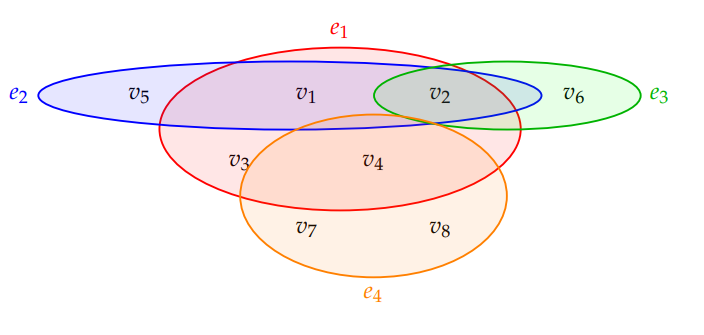
Example 2. Let \(\mathcal{H}(V, E)\) be a hypergraph, where \(V={\{v_1, v_2, \ldots, v_{8}\}}\) and \(E={\{e_1, e_2, e_3, e_4\}}\). In which the edges of \(\mathcal{H}\) and their corresponding edge function \(f : E \to P, P\) being a set of positive integers, are defined as follows: \[\begin{aligned} e_1 &= {\{v_1, v_2, v_3, v_4 \}}, &f(e_1)&=0 \\ e_2&={\{v_1, v_2, v_5\}}, &f(e_2)&=3 \\ e_3&={\{v_2, v_6 \}}, &f(e_3)&=5 \\ e_4&={\{v_4, v_7, v_8 \}}, &f(e_4)&=8. \end{aligned}\]
Then the induced edge sum function \(f^*\) of \(f\) will be: \(f^* (v_1)= 3\), \(f^* (v_2)=8\), \(f^* (v_3)=0\), \(f^* (v_4)= 8\), \(f^* (v_5)= 3\), \(f^* (v_6)=5\), \(f^* (v_7)= 8\), \(f^*(v_8)=8\). Clearly, both the conditions of a zero edge sum labeling are satisfied. Thus, the given hypergraph is a zero edge sum hypergraph as shown below.
Theorem 31. If \(\mathcal{H}\) is a zero edge sum hypergraph, then the vertex with maximum edge degree \(\Delta_E(\mathcal{H})\) must belongs to the zero edge of \(\mathcal{H}\).
Proof. Let \(\mathcal{H}\) be a zero edge sum hypergraph with a zero edge \(e^*\). The mapping \(f: E \to P\) be an edge function and \(f^*\) be the corresponding induced edge sum function of \(f\) in \(\mathcal{H}\). Let \(v\) be the vertex with maximum edge degree \(\Delta_E(\mathcal{H})=k\), where \(k\) is a positive integer in \(\mathcal{H}\). Suppose the vertex \(v\) is not in the zero edge \(e^*\) of \(\mathcal{H}\). Now let \({e_1, e_2, \ldots, e_k}\) be the edges incident to the vertex \(v\). Then the induced vertex label \(f^*(v)={f(e_1) + f(e_2)+ \ldots + f(e_k)} \in P\). But \(f^*(v)=f^*(v) + 0 \in P\) which also implies \(f^*(v)={f(e_1) + f(e_2) + \ldots + f(e_k) + f(e^*)} \in P\). Hence the edges \({e_1, e_2, \ldots, e_k, e^*}\) are incident to a vertex \(v \in V\) with the edge degree \(k+1 >\Delta_E(\mathcal{H})\), which is a contradiction. Hence the vertex \(v\) must belongs to the \(e^*\) in \(\mathcal{H}\). ◻
Theorem 32. Let \(\mathcal{H}(V, E)\) be a hypergraph with an edge \(e^{*} \in E\) such that every edge in \(\mathcal{H}\) is adjacent to the edge \(e^*\) only . Then \(\mathcal{H}\) is a zero edge sum hypergraph.
Proof. Let \(\mathcal{H}(V, E)\) be a hypergraph satisfying the hypothesis. Let \(e_1, e_2, \ldots, e_{m-1}\) be other edges in \(\mathcal{H}\) and all are adjacent to the edge \(e^*\) only. Subsequently, we have at least one vertex belongs to the intersection of \(e_i\) and \(e^*\), for \({i=1, 2, \ldots, m-1}\). Let \(v_1^i, v_2^i, \cdots, v_{r_i}^i\) be the vertices belongs to \({e_i} \cap {e^*}\) in \(\mathcal{H}\), for \(i=1, 2, \ldots, m-1\), where \(r_1, r_2, \ldots, r_{m-1}\) are the non-negative integers representing the number of elements in \({e_i} \cap {e^*}\), for \({i=1, 2, \ldots, m-1}\) respectively. Let \({t_1, t_2, \ldots, t_q}\) be the other vertices in \(\mathcal{H}\) such that \({t_1, t_2, \ldots, t_q} \notin {e_i} \cap {e^*}\) for \({i=1, 2, \ldots, m-1}\) which implies \({t_1, t_2, \ldots, t_q}\) are the pendant vertices in \(\mathcal{H}\). The set of all elements of \(P={\{0, 2, 2^2, \ldots, 2^{m-1}\}}\). Now we define the edge function \(f: E \to P\) by, \(f(e^*)=0, f(e_i)=2^i\) for \(i=1, 2, \ldots m-1\). Then the induced edge sum function \(f^*\) of \(f\) will be: \[\begin{aligned} f^*(v_1^1)&=f^*(v_2^1)=f^*(v_3^1)=\cdots=f^*(v_{r_1}^1)=2 \\ f^*(v_1^2)&=f^*(v_2^2)=f^*(v_3^2)=\cdots=f^*(v_{r_2}^2)=2^2 \\ &\vdots\\ f^*(v_1^{m-1})&= f^*(v_2^{m-1})= f^*(v_3^{m-1})=\cdots=f^*(v_{r_{m-1}}^{m-1})=2^{m-1} \\ f^*(t_j)&=0, \end{aligned}\] for \(1 \leq j \leq q\).
Here for every vertex \(v \in V(\mathcal{H})\), we have \(f^*(v) \in P\) and if the sum of a collection of more than one element of \(P\) is in \(P\), then the collection consists of exactly two elements \(0\) and \(2^i\). For \(0\) and \(2^i\), we have edges \(e^*\) and \(e_i\) incident to a vertex in \(V(\mathcal{H})\). Hence the given hypergraph is a zero edge sum hypergraph. ◻
Note 33. In above theorem one can use any set of labels satisfying the conditions of zero edge sum labeling.
Theorem 34. If \(\mathcal{H}(V, E)\) be a zero edge sum hypergraph, then it contains at least one edge which is adjacent to only zero edge in \(\mathcal{H}\) .
Proof. Let \(\mathcal{H}\) be a zero edge sum hypergraph with its zero edge \(e^* \in E\). Let \(f\) be an edge function and \(f^*\) be an induced edge sum function of \(f\). Let us denote \(p\) as the largest element in the set of labels \(P\). Then there exists an edge \(e \in E\) such that \(f(e)=p\) for bijection \(f: E \to P\). Now consider there is no edge in \(\mathcal{H}\) which is adjacent to \(e^*\) only. Subsequently, the edge \(e\) must adjacent to some other edge \(e_j \in E\) in \(\mathcal{H}\). Hence we have a vertex \(v \in e \cap e_j\) or \(v \in e \cap e_j \cap e^*\) with its induced vertex label \(f^*(v)=f(e) + f(e_j) > p\) or or \(f^*(v)=f(e)+ f(e_j) + f(e^*)>p\), which is a contradiction. Thus, \(\mathcal{H}\) contains at least one edge which is adjacent to \(e^*\) only. ◻
Theorem 35. Let \(\mathcal{H}\) be a zero edge sum hypergraph with its zero edge \(e^{* }\) in \(\mathcal{H}\). Let \({v_1, v_2, \ldots, v_r}\) be the pendant vertices in \(e^{*}\). Then \(\gamma(\mathcal{H}) \leq |e^*|-r\).
Proof. Let \(\mathcal{H}\) be a zero edge sum hypergraph. By Theorem 19, we have \(u_i \in (e_i \cap e^*)\). Hence \({u_1, u_2, \ldots, u_{m-1}}\) be non-pendant vertices in \(e^*\) (which may or may not be distinct). Now each \(u_i\) dominates rest of all vertices of \(e_i\), for \({i=1, 2, \ldots, m-1}\). Therefore \({\{u_1, u_2, \ldots, u_{m-1}\}}\) is a dominating set of \(\mathcal{H}\) with cardinality \(|e^*|-r\). Hence \(\gamma(\mathcal{H}) \leq |e^*|-r\). ◻
Theorem 36. Let \(\mathcal{H}\) be a zero edge sum hypergraph with \(\gamma(\mathcal{H})+ \Delta(\mathcal{H})=|V|\) and let \(v\) be a vertex of degree \(\Delta(\mathcal{H})\). Then the zero edge of \(\mathcal{H}\) contains at least \(|\mathcal{H}\setminus N[v]|\) number of vertices.
Proof. Let \(\mathcal{H}\) be a hypergraph satisfying the hypothesis. Let \(e^*\) be the zero edge of \(\mathcal{H}\). Since it is a zero edge sum hypergraph, it follows the edge containing the vertex \(x \in \mathcal{H} \setminus N[v]\) is adjacent to the zero edge in \(\mathcal{H}\). Hence for every \(x \in \mathcal{H} \setminus N[v]\) we have, a vertex \(y \in e^*\), adjacent to \(x\) and belongs to the intersection of the zero edge and the edge containing the vertex \(x\). Let us assume, to the contrary that the cardinality of the zero edge is less than \(|\mathcal{H}\setminus N[v]|\). Consequently, there does not exist a distinct vertex \(y \in {e^*}\) for each \(x \in {\mathcal{H}\setminus N[v]}\).
Now let for \({x_1, x_2} \in{\mathcal{H}\setminus N[v]}\), we have a single vertex \(y \in {e^*}\) then \(D\) is a dominating set of \(\mathcal{H}\) with cardinality \(|D| = 2 + |V| – \Delta(\mathcal{H})-1- 2\) \(= |V| -\Delta(\mathcal{H})-1\) which is a contradiction. Hence the zero edge contains at least \(|\mathcal{H}\setminus N[v]|\) number of vertices. ◻
Theorem 37. Let \(\mathcal{H}\) be a zero edge sum hypergraph with \(i(\mathcal{H})+\Delta(\mathcal{H})=|V|\) and let \(u\) be a vertex of degree \(\Delta(\mathcal{H})\). Then there exists at least \(|V \setminus N[u]|\) non-zero edges in \(\mathcal{H}\).
Proof. Let \(\mathcal{H}\) be a hypergraph following the given conditions of the theorem. Since it is a zero edge sum hypergraph, the edge containing the vertex \(w \in V\setminus N[u]\) is adjacent to the zero edge in \(\mathcal{H}\). Suppose there are \(n\) non-zero edges in \(\mathcal{H}\) and \(n < V \setminus N[u]\) . Then there exist two vertices \({s, t} \in V \setminus N[u]\) such that \(s\) and \(t\) are adjacent. Hence the cardinality of any strongly independent dominating set of \(V \setminus N[u]\) is at most \(|V \setminus N[u]|-1\). Thus, \(i(\mathcal{H}) \leq |V \setminus N[u]|-1+|{u}| = |V|- \Delta(\mathcal{H})-1\), which is a contradiction. Hence there exist at least \(|V\setminus N[u]|\) non-zero edges in \(\mathcal{H}\). ◻
Theorem 38. Let \(\mathcal{H}(V, E)\) be a zero edge sum hypergraph with \(e^*\) be its zero edge containing at least two pendant vertices. Then \(\gamma(\bar{\mathcal{H}})=\gamma^{-1}(\bar{\mathcal{H}})=1\).
Proof. Let \(\mathcal{H}\) be a zero edge sum hypergraph with \(e^* \in E\) be its zero edge. Let \(u\) and \(v\) be the pendant vertices in \(e^*\). By Theorem 34, there exists an edge \(e_j\) in \(\mathcal{H}\) which is adjacent to \(e^*\) only. Now for the vertex \(s \in X \setminus{e_j \cup \{u\}}\), we have \(\bar{e}_j=X \setminus{e_j} \in \bar{E}\) such that \(u, s\) are in \(\bar{e}_j\). Hence the vertex \(u\) dominates the vertex \(s\) in \(\bar{\mathcal{H}}\). Now let \(t \in e_j\). Then there exists \(e_k \in E\) such that \(t \notin e_k\). Since \(u\) and \(t\) are not in \(e_k\), the edge \(\bar{e}_k=X \setminus {e_k} \in \bar{E}\) contains the vertices \(u\) and \(t\) both. Therefore the vertex \(t\) is dominated by \(u\). Hence \(\{u\}\) is a dominating set of \(\bar{\mathcal{H}}\) and \(\{v\}\) is the inverse dominating set of \(\bar{\mathcal{H}}\). ◻