
Let \(G=(V(G),E(G))\) be a simple connected graph with vertex set \(V(G)=\{v_1,v_2,\ldots, v_n\}\) and edge set \(E(G)\). Let \(|V(G)|\) and \(|E(G)|\) be the number of vertices and edges of \(G\), respectively. A connected graph is unicyclic if and only if \(|E(G)| = |V(G)|\), and bicyclic if and only if \(|E(G)| = |V(G)| + 1\). In what follows, we denote by \(\mathcal{U}_{n}\) and \(\mathcal{B}_{n}\), respectively, the set of unicyclic graphs and bicyclic graphs with \(n\) vertices. By the notations \(P_n\), \(S_n\) and \(C_n\), we denote the path, star and cycle on \(n\) vertices, respectively.
The degree of a vertex \(v_i\) in \(G\), denoted by \(d_{G}(v_{i})\) (or \(d_{i}\) ), is the number of its neighbors. The adjacency matrix \(A(G)\) of \(G\), is a real symmetric matrix of order \(n\) whose \((i, j)\)-th entry is \(1\), if \(i\) and \(j\) are adjacent, and \(0\) otherwise. The largest eigenvalue of \(A(G)\), denoted by \(\lambda_{A}(G)\), is called the spectral radius of \(G\).
In mathematical chemistry, topological indices of graphs are frequently employed to predict the physicochemical properties and biological activities of compounds. These numerical invariants, derived from graph structures, provide a powerful mathematical framework for establishing quantitative structure-property relationship (QSPR) and quantitative structure-activity relationship (QSAR) models by precisely capturing topological features such as molecular connectivity, branching patterns, size, and shape. In 2022, Ali et al. [1] proposed a novel degree-based topological index, called the atom-bond sum-connectivity index (\(ABS\) index for short), which is defined as \[ABS(G)=\sum_{v_iv_j\in E(G)}\sqrt{\frac{d_i+d_j-2}{d_i+d_j}}=\sum_{v_iv_j\in E(G)}\sqrt{1-\frac{2}{d_i+d_j}}.\]
This index has garnered significant attention and become an active field of research in mathematical chemistry, see for example [2– 7].
From an algebraic perspective, Lin et al. [8] proposed the \(ABS\) matrix, denoted by \(\Omega(G)\), whose entries are defined as \[\omega_{ij}= \left\{ \begin{array}{ll} \sqrt{1-\cfrac{2}{d_{i}+d_{j}}} ,& \textrm{if $v_{i}v_{j}\in E(G)$};\\ \hspace{1cm}0 ,& \text{otherwise.} \end{array} \right.\]
The largest eigenvalue of the \(ABS\) matrix of \(G\) is called the \(ABS\) spectral radius, denoted by \(\lambda_{ABS}(G)\). Lin et al. [8] showed that the \(ABS\) spectral radius is useful in predicting certain physicochemical properties of molecules with an accuracy higher than the atom-bond sum-connectivity index.
The extremal problem of the spectral radius of graph matrices is a research topic of great importance in both spectral graph theory and mathematical chemistry. Let \(T_{n}\) be a tree with \(n\) vertices. Lin et al. [8] proved that \[\lambda_{ABS}(P_n)\leq \lambda_{ABS}(T_n)\leq \lambda_{ABS}(S_n),\] with equality in the left (respectively, right) inequality if and only if \(T_n\cong P_n\) (respectively, \(T_n \cong S_n\)). For a unicyclic graph \(U_n\) with \(n\geq 17\) vertices, Lin and Liu [9] showed that \[\lambda_{ABS}(C_n)\leq \lambda_{ABS}(U_n)\leq \lambda_{ABS}(U_n^{1}),\] where the left equality holds if and only if \(U_n\cong C_n\) and the right equality holds if and only if \(U_n\cong U_n^{1}\). For the spectral properties of \(ABS\) matrix, the reader is referred to the references [8, 10– 12].
In 1981, Cvetković [13] outlined twelve promising directions for further research in spectral graph theory, one of which is classifying and ordering graphs. Hence ordering graphs with various properties by their spectra, became an attractive topic.
Previous studies have centered on the extremal problems of the \(ABS\) spectral radii for trees and unicyclic graphs. We extend this research paradigm to accomplish the \(ABS\) spectral radius-oriented ordering of unicyclic graphs and carry out pioneering exploration on the \(ABS\) spectral radius-driven ordering of bicyclic graphs. This work generalizes the \(ABS\) spectral radius ordering methodology to the general class of unicyclic graphs and the emerging class of bicyclic graphs, establishing a theoretical foundation for subsequent in-depth studies on the spectral properties of complex graphs.
In this paper, we determine the first two largest \(ABS\) spectral radii of the unicyclic graphs and bicyclic graphs, and characterize the corresponding extremal graphs.
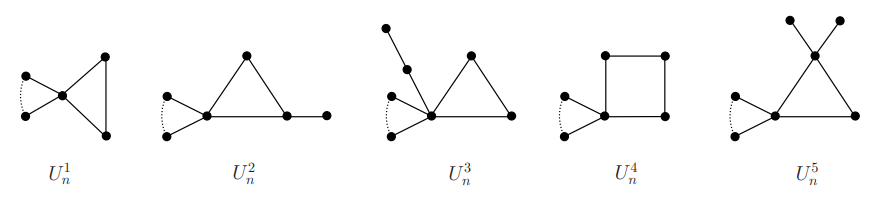
Let \(U_n^1\) be the unicyclic graph obtained by adding one edge to two pendant vertices of a star \(S_n\). Let \(U_n^2\) be the unicyclic graph obtained from \(U_{n-1}^{1}\) by adding an edge incident to a vertex of degree two, \(U_n^3\) the unicyclic graph obtained from \(U_{n-1}^{1}\) by adding an edge incident to a vertex of degree one, \(U_n^4\) the unicyclic graph obtained from a quadrangle by adding \(n-4\) edges incident to a common vertex, and \(U_n^5\) the unicyclic graph obtained from \(U_{n-2}^{1}\) by adding two edges incident to a vertex of degree two, as displayed at Figure 1.
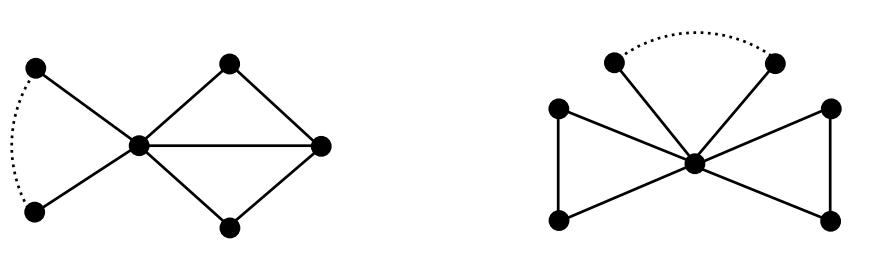
Denote by \(B_n^1\) and \(B_n^2\) with \(n\geq 5\) the two bicyclic graphs obtained from a star \(S_n\) by adding two adjacent edges and two non-adjacent edges, as displayed at Figure 2.
Lemma 1([14]).Suppose that \(M =(m_{i,j} )\) and \(N=(n_{i,j} )\) are two \(n\times n\) nonnegative symmetric matrices. If \(M \geq N\), i.e., \(m_{i,j} \geq n_{i,j}\) for all \(i, j\), then \(\lambda(M) \geq \lambda(N)\), where \(\lambda(M)\) is the largest eigenvalue of matrix \(M\). Furthermore, if \(N\) is irreducible and \(M\neq N\), then \(\lambda(M) > \lambda(N)\).
Lemma 2([15]). The characteristic polynomials of the adjacency matrices \(A(U_n^4)\) and \(A(U_n^5)\) are given as follows: \[\begin{aligned} P_{A}(U_n^4)=& x^{n – 4}(x^4 – nx^2 + 2n – 8), \\ P_{A}(U_n^5) =& x^{n – 4}(x^4 – nx^2 – 2x + 3n – 13). \end{aligned}\]
Lemma 3([9]).Let \(n \geq 9\) and \(U_n\in \mathcal{U}_{n}\). Then \(\lambda_{ABS}(U_n)<\sqrt{n – 3}< \lambda_{ABS}(U_n^2)< \lambda_{ABS}(U_n^1)\).
Lemma 4([16]).Let \(n \geq 11\) and \(B_n \in \mathcal{B}_{n}\setminus\{B_n^1, B_n^2\}\). Then \(\lambda_{A}(B_n)<\sqrt{n-1}\).
Theorem 1. Let \(n \geq 17\) and \(U_n \in \mathcal{U}_{n} \setminus \{U_n^1, U_n^2\}\), \(U_n^1\) and \(U_n^2\) be shown in Figure 1. Then \[\lambda_{ABS}(U_n)<\lambda_{ABS}(U_n^2)< \lambda_{ABS}(U_n^1),\] where \(\lambda_{ABS}(U_n^1)\) and \(\lambda_{ABS}(U_n^2)\), respectively, are the largest roots of the following equations: \[\begin{aligned} & (2n^2 + 2n)x^4 – (2n^3 – 3n^2 – n + 12)x^2 – 2\sqrt{2}n(n – 1)x+ n^3 – 4n^2 + n + 6=0,\\ & (10n^3-10n)x^4-(10n^4-29n^3+10n^2+109n+20)x^2-4(n-1)\sqrt{15(n^{4}-2n^3-n^2+2n)}x \\ &\qquad +(11n^4-61n^3+45n^2+127n+10)= 0. \end{aligned}\]
Proof. The first fifth largest unicyclic graphs ordered according to their spectral radius were determined in [15], that is \(\lambda_A(U_n^1)>\lambda_A(U_n^2)>\cdots>\lambda_A(U_n^5)>\lambda_A(U_n)\) for \(U_n\in \mathcal{U}_{n} \setminus \{U_n^1, U_n^2, \ldots, U_n^5 \}\), as shown in Figure 1. By Lemma 2, we have \[\begin{aligned} P_{A}(U_n^4)=& x^{n – 4}(x^4 – nx^2 + 2n – 8), \\ P_{A}(U_n^5) =& x^{n – 4}(x^4 – nx^2 – 2x + 3n – 13). \end{aligned}\]
Thus, we have \[\lambda_A(U_n^5) <\sqrt{n – 2}<\lambda_A(U_n^4),\] for \(n \geq 17\) , where \(U_n^4\) is shown in Figure 1. If \(U_n\in \mathcal{U}_{n}\), then \(d_i + d_j \leq n+1\) for \(v_i v_j \in E(U_n)\). Since \(f(x, y) = \sqrt{1 – \frac{2}{x + y}}\) is strictly increasing in both \(x\) and \(y\) for \(x \geq 1\) and \(y \geq 1\), by Lemma 1 , we have \[\lambda_{ABS}(U_n) < \sqrt{\frac{n – 1}{n+1}} \lambda_A(U_n) < \sqrt{\frac{n – 1}{n+1}} \lambda_A(U_n^5) < \sqrt{\frac{(n – 1)(n – 2)}{n+1}},\] for \(n \geq 17\) and \(U_n\in \mathcal{U}_{n} \setminus \{U_n^1, U_n^2, \ldots, U_n^5 \}\).
By direct computation, we obtain the characteristic polynomial of the \(ABS\) matrix \(\Omega(U_n^4)\) as follows: \[\begin{aligned} P_{ABS}(U_n^4, x) =&det(xI_{n}-\Omega(U_n^4)) = \left|\begin{array}{ccccccccccccccccccccccccc} x & -\sqrt{\frac{1}{2}} & 0 & -\sqrt{\frac{n-2}{n}} & 0 & \cdots & 0 \\ -\sqrt{\frac{1}{2}} & x & -\sqrt{\frac{1}{2}} & 0 & 0 & \cdots & 0 \\ 0 & -\sqrt{\frac{1}{2}} & x & -\sqrt{\frac{n-2}{n}} & 0 & \cdots & 0 \\ -\sqrt{\frac{n-2}{n}} & 0 & -\sqrt{\frac{n-2}{n}} & x & -\sqrt{\frac{n-3}{n-1}} & \cdots & -\sqrt{\frac{n-3}{n-1}} \\ 0 & 0 & 0 & -\sqrt{\frac{n-3}{n-1}} & x & \cdots & 0 \\ \vdots & \vdots & \vdots & \vdots & \vdots & & \vdots\\ 0 & 0 & 0 & -\sqrt{\frac{n-3}{n-1}} & 0 & \cdots & x \end{array}\right|\\ =&\frac{x^{n-4}}{n(n-1)}\left[(n^2-n)x^4-(n^3-4n^2+ 5n +4)x^2 +n^3-7n^2 + 12n\right], \end{aligned}\] and \[\lambda_{ABS}(U_n^4)=\sqrt{\frac{n^3-4n^2+ 5n +4+\sqrt{(n^3-4n^2+ 5n +4)^2-4(n^2-n)(n^3-7n^2 + 12n)}}{2(n^2-n)}},\] for \(n\geq11\), it follows that \[\lambda_{ABS}(U^4_n)<\sqrt{\frac{(n – 1)(n – 2)}{n+1}}.\]
The characteristic polynomial of the \(ABS\) matrix \(\Omega(U_n^3)\) is \[\begin{aligned} P_{ABS}(U_n^3, x) =&det(xI_{n}-\Omega\left(U_n^3)\right)\\ =& \left|\begin{array}{ccccccccccccccccccccccccc} x & -\sqrt{\frac{1}{2}} & -\sqrt{\frac{n-2}{n}} & 0 & 0 & 0 & \cdots & 0\\ -\sqrt{\frac{1}{2}} & x & -\sqrt{\frac{n-2}{n}} & 0 & 0 & 0 & \cdots & 0\\ -\sqrt{\frac{n-2}{n}} & -\sqrt{\frac{n-2}{n}} & x & -\sqrt{\frac{n-2}{n}} & 0 & -\sqrt{\frac{n-3}{n-1}} & \cdots & -\sqrt{\frac{n-3}{n-1}}\\ 0 & 0 & -\sqrt{\frac{n-2}{n}} & x & -\sqrt{\frac{1}{3}} & 0 & \cdots & 0\\ 0 & 0 & 0 & -\sqrt{\frac{1}{3}} & x & 0 & \cdots & 0\\ 0 & 0 & -\sqrt{\frac{n-3}{n-1}} & 0 & 0 & x & \cdots & 0\\ \vdots & \vdots & \vdots & \vdots & \vdots & \vdots & & \vdots \\ 0 & 0 & -\sqrt{\frac{n-3}{n-1}} & 0 & 0 & 0 & \cdots & x \end{array}\right|\\ =&\frac{x^{n-6}}{6n(n – 1)}[(6n^2 – 6n)x^6 + (6n^3 + 25n^2 – 31n – 36)x^4 – 6\sqrt{2}(n^2-3n +2 )x^3 \\ &-(5n^3 – 32n^2 + 53n – 14)x^2 + 2\sqrt{2}(n^2-3n +2 )x – n^3 + 8n^2 – 15n]\\ =&\frac{x^{n-6}}{6n(n – 1)}f(x). \end{aligned}\]
By taking the derivative, we have \[\begin{aligned} f'(x) = & 36(n^2 – n)x^5 + 4(6n^3 + 25n^2 – 31n – 36)x^3 – 18\sqrt{2}(n^2-3n +2 )x^2\\ & -2(5n^3 – 32n^2 + 53n – 14)x+ 2\sqrt{2}(n^2-3n +2 ). \end{aligned}\]
Since \(f'(x) > 0\) on the interval \(x \in \left[\sqrt{\frac{(n – 1)(n – 2)}{n+1}}, +\infty\right)\), \(f(x)\) is strictly increasing on the interval \(\left[\sqrt{\frac{(n – 1)(n – 2)}{n+1}}, +\infty\right)\), and \[\begin{aligned} f\left(\sqrt{\frac{(n – 1)(n – 2)}{n+1}}\right) =&\frac{1}{(n+1)^3}[(6n^2 – 6n)(n – 1)^3(n – 2)^3\\ &+(6n^3 + 25n^2 – 31n – 36)(n – 1)^2(n – 2)^2(n+1) \\ & -(6\sqrt{2}n^2 – 18\sqrt{2}n + 12\sqrt{2})(n – 1)^{\frac{3}{2}}(n – 2)^{\frac{3}{2}}(n+1)^{\frac{3}{2}}\\ & -(5n^3 – 32n^2 + 53n – 14)(n – 1)(n – 2)(n+1)^2] \\ &+(2\sqrt{2}n^2 – 6\sqrt{2}n + 4\sqrt{2})x – n^3 + 8n^2 – 15n\\ =&\frac{1}{(n+1)^3}[12n^8 – 70n^7 + 175n^6 – 346n^5 + 680n^4 – 904n^3 + 545n^2\\ & + 24n – 116-6\sqrt{2}(n^2-3n +2 )(n – 1)^{\frac{3}{2}}(n – 2)^{\frac{3}{2}}(n+1)^{\frac{3}{2}}\\ &+2\sqrt{2}(n^2-3n +2 )(n – 1)^{\frac{1}{2}}(n – 2)^{\frac{1}{2}}(n+1)^{\frac{5}{2}}]- n^3 + 8n^2 – 15n > 0, \end{aligned}\] for \(n \geq 6\), we have \(\lambda_{ABS}(U_n^3)<\sqrt{\frac{(n – 1)(n – 2)}{n+1}}.\) By Lemma 3, it follows that \[\lambda_{ABS}(U_n^3)<\sqrt{\frac{(n – 1)(n – 2)}{n+1}}< \sqrt{n – 3}< \lambda_{ABS}(U_n^2) < \lambda_{ABS}(U_n^1).\]
In summary, we have \(\lambda_{ABS}(U_n)<\lambda_{ABS}(U_n^2)< \lambda_{ABS}(U_n^1),\) for \(U_n \in \mathcal{U}_{n} \setminus \{U_n^1, U_n^2\}\). This completes the proof. ◻
Theorem 2. Let \(n \geq 25\) and \(B_{n} \in \mathcal{B}_{n} \setminus \{B_n^1, B_n^2\}\), \(B_n^1\) and \(B_n^2\) be shown in Figure 2. Then \[\lambda_{ABS}(B_n)<\lambda_{ABS}(B_n^2)<\lambda_{ABS}(B_n^1),\] where \(\lambda_{ABS}(B_n^1)\) and \(\lambda_{ABS}(B_n^2)\), respectively, are the largest roots of the following equations: \[\begin{aligned} &(5n^3 + 15n^2 + 10n)x^4 + (- 5n^4 – 6n^3 + 7n^2 – 52n – 80)x^2 \\ &\qquad -\left( 4n^3 +12n^2+ 8n\right)\sqrt{\frac{15 n(n – 1)}{(n + 1)(n + 2)}}x+6n^4 – 18n^3 – 48n^2 + 72n + 96=0, \\ &4n(n + 1)x^6 -(4n^3 – 4n^2 + 40)x^4 – 8\sqrt{2}n(n – 1)x^3+ (4n^3 – 15n^2 + 5n + 40)x^2 \\ &\qquad + 4\sqrt{2}n(n – 1)x-( n^3 – 6n^2 +3n +10)=0. \end{aligned}\]
Proof. Note that \(f(d_i, d_j)=\sqrt{1-\frac{2}{d_i+d_j}}\) is an increasing function on \(d_i+d_j\). If \(B_n\in \mathcal{B}_n\), then \(d_i+d_j\leq n+2\) for every edge \(v_iv_j\in E(B_n)\). Thus, we have \[\omega_{ij}=f(d_i, d_j)\leq \sqrt{1-\frac{2}{n + 2}}=\sqrt{\frac{n}{n +2}},\] for every edge \(v_iv_j\in E(B_n)\), which yields that \(\Omega(B_n) \leq \sqrt{\frac{n}{n + 2}}A(B_n)\). By Lemma 1, we have \[\lambda_{ABS}(B_n) \leq \sqrt{\frac{n }{n + 2}}\lambda_{A}(B_n).\]
If \(B_n\) is not \(B_n^{1}\) and \(B_n^{2}\), by Lemma 4, we have \[\lambda_{ABS}(B_n) < \sqrt{\frac{n }{n + 2}} \cdot \sqrt{n-1}=\sqrt{\frac{n(n – 1)}{n + 2}}.\]
Now we claim that \(\lambda_{ABS}(B_n^{2})>\sqrt{\frac{n(n – 1)}{n + 2}}\). With a suitable permutation of vertices, the characteristic polynomial of the \(ABS\) matrix \(B_n^{2}\) can be written as \[\begin{aligned} P(B_n^{2},x) =& \det\left(xI_n-\Omega\left(B_n^{2}\right)\right) = \left|\begin{array}{ccccccccccccccccccccccccc} x &-\sqrt{\frac{n – 1}{n + 1}} & -\sqrt{\frac{n-1}{n+1} }& -\sqrt{\frac{n-1}{n+1}} & -\sqrt{\frac{n-1}{n+1}} & -\sqrt{\frac{n-2}{n}} & \cdots & -\sqrt{\frac{n-2}{n}} \\ -\sqrt{\frac{n-1}{n+1}} & x & -\sqrt{\frac{1}{2}} & 0 & 0 & 0 & \cdots & 0 \\ -\sqrt{\frac{n-1}{n+1}} & -\sqrt{\frac{1}{2}} & x & 0 & 0 & 0 & \cdots & 0 \\ -\sqrt{\frac{n-1}{n+1}} & 0 & 0& x & -\sqrt{\frac{1}{2}} & 0 & \cdots & 0\\ -\sqrt{\frac{n-1}{n+1}} & 0 & 0 & -\sqrt{\frac{1}{2}} & x & 0 & \cdots & 0 \\ -\sqrt{\frac{n-2}{n}} & 0 & 0 & 0 & 0 & x & \cdots & 0\\ \vdots & \vdots & \vdots & \vdots & \vdots & \vdots & & \vdots\\ -\sqrt{\frac{n-2}{n}} & 0 & 0 & 0 & 0 & 0 & \cdots & x \end{array}\right|\\ =&\frac{x^{n-6}}{4n(n + 1)}[ 4n(n + 1)x^6 -(4n^3 – 4n^2 + 40)x^4 – 8\sqrt{2}n(n – 1)x^3+\\ &(4n^3 – 15n^2 + 5n + 40)x^2 + 4\sqrt{2}n(n – 1)x-( n^3 – 6n^2 +3n +10)]\\ =&\frac{x^{n-6}}{4n(n + 1)}g_{1}(x). \end{aligned}\]
By taking the derivative, we have \[g_{1}'(x)= 24(n^2 + n)x^5 -16(n^3 – n^2 + 10)x^3 -24\sqrt{2}n(n – 1)x^2 +(8n^3 – 30n^2 + 10n + 80)x+ 4\sqrt{2}n(n – 1).\]
Since \(g_{1}'(x) > 0\) on the interval \(x \in \left[\sqrt{\frac{n(n-1)}{n + 2}}, +\infty\right)\), \(g_{1}(x)\) is strictly increasing on the interval \(\left[\sqrt{\frac{n(n-1)}{n + 2}}, +\infty\right)\), and \[\begin{aligned} g_{1}\left(\sqrt{\frac{n(n-1)}{n + 2}}\right) =&\frac{1}{(n+2)^3}[4n^4(n+1)(n-1)^3 – (4n^3 – 4n^2 + 40)n^2(n-1)^2(n+2)\\ &+(4n^3 – 15n^2 + 5n + 40)n(n-1)(n+2)^2 – (n^3 – 6n^2 + 3n + 10)(n+2)^3\\ &-4\sqrt{2}n(n-1)\sqrt{n(n-1)}(2n+1)(n-2)(n+2)^{3/2}]\\ =&\frac{1}{(n+2)^3}[8n^6 – 92n^5 + 64n^4 + 336n^3 – 148n^2 – 304n – 80\\ &-4\sqrt{2}n(n-1)\sqrt{n(n-1)}(2n+1)(n-2)(n+2)^{3/2}]\\ <&0, \end{aligned}\] for \(n\geq6\), we have \(\lambda_{ABS}(B_n^{2})>\sqrt{\frac{n(n – 1)}{n + 2}}\).
With a suitable permutation of vertices, the characteristic polynomial of the \(ABS\) matrix \(B_n^{1}\) can be written as \[\begin{aligned} P(B_n^{1},x) =& \det(xI_n-\Omega\left(B_n^{1}\right))\\ =& \left|\begin{array}{ccccccc} x &-{\sqrt\frac{3}{5}} & 0 & -\sqrt{\frac{n – 1}{n + 1}} & 0 & \cdots & 0 \\ -{\sqrt\frac{3}{5}} & x & -\sqrt{\frac{3}{5}} & -\sqrt{\frac{n-1}{n +1}} & 0 & \cdots & 0 \\ 0 & -\sqrt{\frac{3}{5}} & x & -\sqrt{\frac{n – 1}{n + 1}} & 0 & \cdots & 0 \\ -\sqrt{\frac{n – 1}{n + 1}} & -\sqrt{\frac{n – 1}{n + 1}}& -\sqrt{\frac{n – 1}{n + 1}} & x & -\sqrt{\frac{n – 2}{n }} & \cdots & -\sqrt{\frac{n – 2}{n }} \\ 0 & 0 & 0 & -\sqrt{\frac{n – 2}{n }} & x & \cdots & 0 \\ \vdots & \vdots&\vdots & \vdots&\vdots & &\vdots \\ 0 & 0 & 0 & -\sqrt{\frac{n – 2}{n }} & 0 & \cdots & x \end{array}\right|\\ =&\frac{x^{n-6}}{5n(n + 1)(n + 2)}[(5n^3 + 15n^2 + 10n)x^4 – ( 5n^4 + 6n^3 – 7n^2 + 52n + 80)x^2 -\\ & \left( 4n^3 +12n^2+ 8n\right)\sqrt{\frac{15 n(n – 1)}{(n + 1)(n + 2)}}x+6n^4 – 18n^3 – 48n^2 + 72n + 96]\\ =&\frac{x^{n-6}}{5n(n + 1)(n + 2)}g_{2}(x). \end{aligned}\]
By taking the derivative, we have \[g_{2}'(x)=(20n^3 + 60n^2 + 40n)x^3 -(10n^4 + 12n^3 – 14n^2 + 104n + 160)x -\left( 4n^3 +12n^2+ 8n\right)\sqrt{\frac{15 n(n – 1)}{(n + 1)(n + 2)}}.\]
Since \(g_{2}'(x) > 0\) on the interval \(x \in \left[\sqrt{\frac{n(n-1)}{n + 2}}, +\infty\right)\), \(g_{2}(x)\) is strictly increasing on the interval \(\left[\sqrt{\frac{n(n-1)}{n + 2}}, +\infty\right)\).
Let \[\begin{aligned} h(x) =&g_{1}(x)-g_{2}(x)\\ =&4n(n + 1)x^6 – (9n^3 + 11n^2 + 10n + 40)x^4 – 8\sqrt{2}n(n – 1)x^3\\ &+(5n^4 + 10n^3 – 22n^2 + 57n + 120)x^2-6n^4 + 17n^3 + 54n^2 – 75n – 106\\ &+\left[4\sqrt{2}n(n – 1)+\left( 4n^3 +12n^2+ 8n\right)\sqrt{\frac{15 n(n – 1)}{(n + 1)(n + 2)}}\right]x. \end{aligned}\]
Then \[\begin{aligned} h'(x) =&24n(n + 1)x^5 – (36n^3 + 44n^2 + 40n + 160)x^3 – 24\sqrt{2}n(n – 1)x^2\\ &+(10n^4 + 20n^3 – 44n^2 + 114n + 240)x \\ &+4\sqrt{2}n(n – 1)+\left( 4n^3 +12n^2+ 8n\right)\sqrt{\frac{15 n(n – 1)}{(n + 1)(n + 2)}}. \end{aligned}\]
Since \(h'(x) > 0\) on the interval \(x \in \left[\sqrt{\frac{n(n-1)}{n + 2}}, +\infty\right)\), \(h(x)\) is strictly increasing on the interval \(\left[\sqrt{\frac{n(n-1)}{n + 2}}, +\infty\right)\), and \[\begin{aligned} h\left(\sqrt{\frac{n(n-1)}{n+2}}\right) =&\frac{1}{(n+2)^3}[6n^7 + 25n^6 – 46n^5 + 255n^4 + 548n^3 \\ & -308n^2 – 480n -8\sqrt{2}n^{\frac{5}{2}}(n – 1)^{\frac{5}{2}}(n + 2)^{\frac{3}{2}}]\\ &+\left[4\sqrt{2}n(n – 1)+\left( 4n^3 +12n^2+ 8n\right)\sqrt{\frac{15 n(n – 1)}{(n + 1)(n + 2)}}\right]\sqrt{\frac{n(n-1)}{n+2}}\\ &-6n^4 + 17n^3 + 54n^2 – 75n – 106\\ >&0, \end{aligned}\] for \(n \geq 25\), we have \(\lambda_{ABS}(B_n^{2})< \lambda_{ABS}(B_n^{1})\).
In summary, we have \[\lambda_{ABS}(B_n)<\lambda_{ABS}(B_n^2)< \lambda_{ABS}(B_n^1),\] for \(B_n \in \mathcal{B}_{n} \setminus \{B_n^1, B_n^2\}\). This completes the proof. ◻