
Graph coloring and domination are two central themes in graph theory. A proper coloring separates adjacent vertices into distinct color classes, whereas domination records how effectively selected vertices cover a graph through their neighborhoods. Dominator coloring combines these requirements by asking for a proper coloring in which each vertex dominates an entire color class. This condition is stronger than proper coloring because the location and size of each color class matter, not merely the number of classes. It is also more structured than ordinary domination because the dominating property must be compatible with a proper coloring of the whole graph.
Throughout the manuscript, graphs are finite, simple, undirected, and connected unless stated otherwise. For a graph \(G\), the vertex set and edge set are written as \(V(G)\) and \(E(G)\). The closed neighborhood of a vertex \(v\) is \[N_G[v]=\{v\}\cup\{u\in V(G):uv\in E(G)\}.\]
A set \(S\subseteq V(G)\) is a dominating set if every vertex of \(V(G)\setminus S\) is adjacent to at least one vertex of \(S\). The domination number \(\gamma(G)\) is the minimum cardinality of a dominating set. A proper coloring is a map from \(V(G)\) to a set of colors such that adjacent vertices receive different colors. The minimum number of colors in a proper coloring is the chromatic number \(\chi(G)\).
A dominator coloring of \(G\) is a proper coloring \(\varphi\) with the following additional property: for every vertex \(v\in V(G)\), there is at least one color class \(C_i=\varphi^{-1}(i)\) satisfying \(C_i\subseteq N_G[v]\). The dominator chromatic number \(\chi_d(G)\) is the smallest number of colors in such a coloring. The concept was introduced by Gera, Horton, and Rasmussen [1], building on earlier work on dominating partitions [2,3]. Algorithmic properties and exact values for several graph classes have been developed in [4–10].
The modular product is a natural setting in which dominator coloring becomes sensitive to both adjacency and non-adjacency in the factors. For connected graphs \(G\) and \(H\), the modular product \(G\diamond H\) has vertex set \(V(G)\times V(H)\). Distinct vertices \((u,v)\) and \((u’,v’)\) are adjacent whenever one of the following conditions holds:
\(u=u’\) and \(vv’\in E(H)\), or \(v=v’\) and \(uu’\in E(G)\);
\(uu’\in E(G)\) and \(vv’\in E(H)\);
\(u\ne u’\), \(v\ne v’\), \(uu’\notin E(G)\), and \(vv’\notin E(H)\).
This product contains adjacency inherited from each factor as well as compatibility between simultaneous edges and simultaneous non-edges. Consequently, paths and cycles produce product graphs whose row-column structure is regular enough for exact formulas, but still rich enough to require separate treatment of parity and small-order cases.
The main contribution is a complete determination of \(\chi_d(P_n\diamond P_m)\) and \(\chi_d(C_n\diamond C_m)\) for all \(n,m\geq 3\). The formulas are expressed through \(h=\min\{n,m\}\) and \(g=\max\{n,m\}\) so that the statements are symmetric in the two factors. The proofs provide explicit color assignments and explain why the designated second-row vertices must receive the additional colors required by the dominator condition. The displayed colorings are not only examples; they show the structural mechanism that forces the formulas.
The following known results are used in the proofs. They establish exact dominator chromatic numbers for basic graph families and provide a general comparison with chromatic and domination numbers.
Proposition 1 ([1]). For the complete graph \(K_n\), the dominator chromatic number is \[\chi_d(K_n)=n.\]
Proposition 2 ([10]). For the path \(P_n\), \(n\geq 2\), \[\chi_d(P_n)= \begin{cases} \left\lceil \dfrac{n}{3}\right\rceil+1, & n=2,3,4,5,7,\\[0.15cm] \left\lceil \dfrac{n}{3}\right\rceil+2, & \text{otherwise.} \end{cases}\]
Proposition 3 ([10]). For the cycle \(C_n\), \[\chi_d(C_n)= \begin{cases} \left\lceil \dfrac{n}{3}\right\rceil, & n=4,\\[0.15cm] \left\lceil \dfrac{n}{3}\right\rceil+1, & n=5,\\[0.15cm] \left\lceil \dfrac{n}{3}\right\rceil+2, & \text{otherwise.} \end{cases}\]
Theorem 1 ([10]). If \(G\) is a connected graph, then \[\max\{\chi(G),\gamma(G)\}\leq \chi_d(G)\leq \chi(G)+\gamma(G).\]
In the products considered below, vertices are denoted by \((a_s,b_t)\), where the first coordinate belongs to the factor of order \(h\) and the second coordinate belongs to the factor of order \(g\). The notation is chosen so that the formulas are unaffected by interchanging the two factors. A color class is called singleton when it contains exactly one vertex. Such classes are decisive in dominator coloring, because a vertex always dominates its own singleton class.
This section determines the dominator chromatic number of \(P_n\diamond P_m\) and \(C_n\diamond C_m\). The proofs use the same general strategy. A lower bound is obtained from the proper coloring requirement together with the vertices that must be separated in order to satisfy the dominator condition. An explicit coloring then gives the matching upper bound. The verification of each coloring has two parts: adjacent vertices receive distinct colors, and every vertex dominates at least one complete color class.
Theorem 2. For integers \(n,m\geq 3\), let \(h=\min\{n,m\}\) and \(g=\max\{n,m\}\). Then \[\chi_d(P_n\diamond P_m)= \begin{cases} 4, & g=h=3,\\[0.1cm] 8, & g=h=4,\\[0.1cm] 6, & g=4,\ h=3,\\[0.1cm] \dfrac{4h+g-3}{2}, & g\equiv 1\pmod 2\ \text{and}\ (g,h)\ne(3,3),\\[0.25cm] \dfrac{4h+g-2}{2}, & g\equiv 0\pmod 2\ \text{and}\ (g,h)\notin\{(4,3),(4,4)\}. \end{cases}\]
Proof. Let \[V(P_n\diamond P_m)=\{(a_s,b_t):1\leq s\leq h, 1\leq t\leq g\}.\]
The edge set is determined by the modular product adjacency stated above. The product has \(hg=mn\) vertices. Define \[\varphi:V(P_n\diamond P_m)\longrightarrow \{1,2,\ldots,\chi_d(P_n\diamond P_m)\}.\]
The proof is divided according to the exceptional small products and the parity of \(g\).
Case (i): \(g=h=3\).
The product has order \(9\). Its central vertex \((a_2,b_2)\) is adjacent to all other vertices. The graph requires four colors for a proper coloring, and the following assignment gives a dominator coloring: \[\varphi(a_s,b_t)= \begin{cases} 1, & s=1,\ t\equiv 1\pmod 2,\ \text{or}\ s=3,\ t=2,\\ 2, & s=3,\ t\equiv 1\pmod 2,\ \text{or}\ s=1,\ t=2,\\ 3, & s=2,\ t\equiv 1\pmod 2,\\ 4, & s=t=2. \end{cases}\]
The singleton class containing \((a_2,b_2)\) is dominated by every vertex, while the central vertex dominates its own class. Therefore \[\chi_d(P_3\diamond P_3)=4.\]
Case (ii): \(g=h=4\).
For \(P_4\diamond P_4\), a proper coloring alone does not make every vertex dominate a complete color class. The assignment \[\varphi(a_s,b_t)= \begin{cases} 1, & s=1,\ t\equiv 1\pmod 2,\ \text{or}\ s=3,\ t=2,\\ 2, & s=1,\ t\equiv 0\pmod 2,\ \text{or}\ s=3,\ t=3,\\ 3, & s=2,\ t\equiv 1\pmod 2,\ \text{or}\ s=4,\ t=2,\\ 4, & s=3,\ t=1,4,\\ 5, & s=4,\ t=1,4,\\ 6,7,8, & (s,t)=(2,2),(2,4),(4,3),\ \text{respectively}, \end{cases}\] separates the three vertices whose closed neighborhoods supply the necessary singleton domination. The first five classes remain proper under the modular product adjacency, and the three singleton classes ensure that each vertex dominates at least one class. No coloring with fewer colors can separate all forced singleton positions while preserving properness, hence \[\chi_d(P_4\diamond P_4)=8.\]
Case (iii): \(g=4\) and \(h=3\).
For the rectangular product \(P_3\diamond P_4\), the proper coloring lower bound is strengthened by the two second-row vertices with even second coordinate. A dominator coloring is obtained from \[\varphi(a_s,b_t)= \begin{cases} 1, & s=1,\ t\equiv 1\pmod 2,\ \text{or}\ s=3,\ t=2,\\ 2, & s=1,\ t\equiv 0\pmod 2,\ \text{or}\ s=3,\ t=3,\\ 3, & s=2,\ t\equiv 1\pmod 2,\\ 4, & s=3,\ t=1,4,\\ 5,6, & (s,t)=(2,2),(2,4),\ \text{respectively}. \end{cases}\]
The vertices \((a_2,b_2)\) and \((a_2,b_4)\) are assigned singleton colors. Every other vertex lies in the closed neighborhood of at least one of these singleton classes or one of the earlier color classes. Thus \[\chi_d(P_3\diamond P_4)=6.\]
Case (iv): \(g=5\) and \(h\in\{4,5\}\).
The first non-exceptional odd product already exhibits the general pattern. The chromatic part uses \(2h-1\) colors, and the even-positioned vertices in the second row require two additional singleton colors. Define \[\varphi(a_s,b_t)= \begin{cases} 1, & s=1,\ t\equiv 1\pmod 2,\\ 2, & s=1,\ t\equiv 0\pmod 2,\\ 3, & s=2,\ t=1,4,\\ h+1, & s=2,\ t=3,\\ 4,5,\ldots,h+1, & 3\leq s\leq h,\ t\equiv 1\pmod 2,\\ h+2,h+3,\ldots,2h-1, & 3\leq s\leq h,\ t\equiv 0\pmod 2,\\ 2h,2h+1, & (s,t)=(2,2),(2,5),\ \text{respectively}. \end{cases}\]
The singleton vertices \((a_2,b_2)\) and \((a_2,b_5)\) supply the domination needed by the remaining vertices, and the number of colors is \(2h+1=(4h+5-3)/2\). Therefore \[\chi_d(P_n\diamond P_m)=2h+1 \quad \text{when } g=5,\ h\in\{4,5\}.\]
The coloring displayed in Figure 1 shows the role of the second row in the odd path product. The vertices with even second coordinate cannot all remain in nonsingleton classes without leaving some vertex unable to dominate a complete class. Assigning the necessary distinct colors to these positions completes the dominator coloring while keeping the remaining rows in repeated parity-controlled classes.
Case (v): remaining path products.
For \(1\leq s\leq h\) and \(1\leq t\leq g\), begin with \[\varphi(a_s,b_t)= \begin{cases} 1, & s=1,\ t\equiv 1\pmod 2,\\ 2, & s=1,\ t\equiv 0\pmod 2,\\ 3, & s=2,\ t\equiv 1\pmod 2, \end{cases}\] and, for rows \(3\) through \(h\), assign \[\varphi(a_s,b_t)= \begin{cases} 4,5,\ldots,h+1, & 3\leq s\leq h,\ t\equiv 1\pmod 2,\\ h+2,h+3,\ldots,2h-1, & 3\leq s\leq h,\ t\equiv 0\pmod 2. \end{cases}\]
These classes account for all vertices except the even positions of the second row. Those vertices form the set that must be distinguished to satisfy the dominator condition.
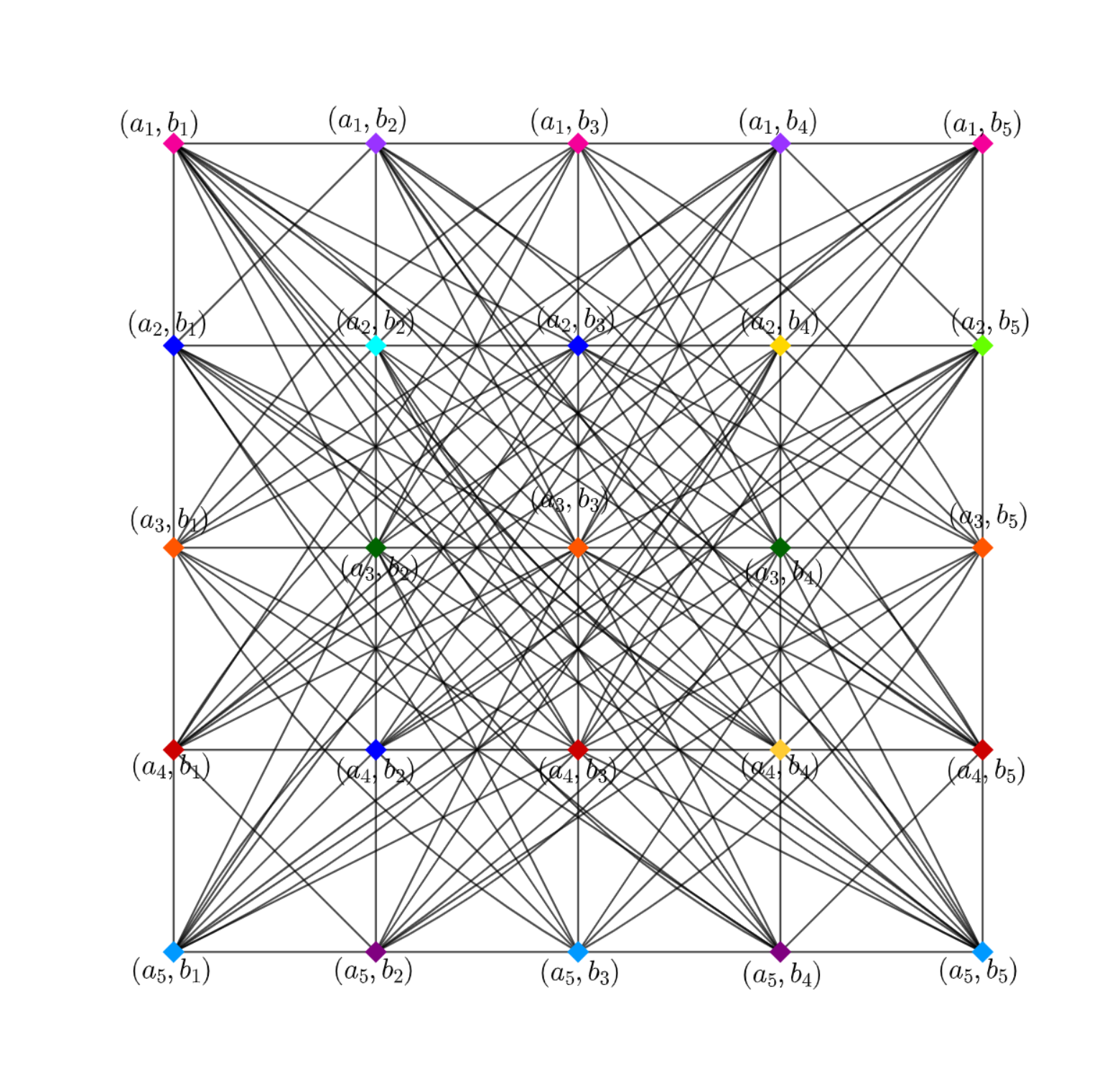
If \(g\) is odd and \((g,h)\ne(3,3)\), the number of such second-row positions is \((g-1)/2\). Their colors are assigned as \[\varphi(a_2,b_t)\in \left\{2h,2h+1,\ldots,\frac{4h+g-3}{2}\right\}, \qquad t\equiv 0\pmod 2.\]
Thus \[\chi_d(P_n\diamond P_m)=\frac{4h+g-3}{2} \quad \text{for odd } g.\]
If \(g\) is even and \((g,h)\notin\{(4,3),(4,4)\}\), the number of even positions in the second row is \(g/2\), and the required colors are \[\varphi(a_2,b_t)\in \left\{2h,2h+1,\ldots,\frac{4h+g-2}{2}\right\}, \qquad t\equiv 0\pmod 2.\]
This gives \[\chi_d(P_n\diamond P_m)=\frac{4h+g-2}{2} \quad \text{for even } g.\]
In both parity cases the coloring is proper because adjacent vertices are separated by row parity or by singleton assignment. The dominator condition follows from the fact that every vertex has at least one of the designated second-row singleton classes in its closed neighborhood, or else dominates a nonsingleton class entirely contained in its closed neighborhood. The stated lower bounds follow from the necessity of distinguishing these forced positions. The proof is complete.
Theorem 3. For integers \(n,m\geq 3\), let \(h=\min\{n,m\}\) and \(g=\max\{n,m\}\). Then \[\chi_d(C_n\diamond C_m)= \begin{cases} 9, & g=h=3,\\[0.1cm] 6, & (g,h)=(4,4)\ \text{or}\ (g,h)=(4,3),\\[0.1cm] 8, & g=5,\ h=3,4,\\[0.1cm] 11, & g=h=5,\\[0.1cm] 2h+1+\left\lceil \dfrac{g}{3}\right\rceil, & h=3,\ g\equiv 1\pmod 2,\ g\notin\{3,5\},\\[0.25cm] 2h-1+\dfrac{g}{2}, & g\equiv 0\pmod 2\ \text{and either } g=h\ \text{or}\ h\equiv 1\pmod 2,\\[0.25cm] 2h+\left\lfloor \dfrac{g}{2}\right\rfloor, & g\equiv 1\pmod 2,\ h\equiv 0\pmod 2,\ g\ne 5,\\[0.25cm] 2h+\left\lfloor \dfrac{g}{2}\right\rfloor, & g=h\equiv 1\pmod 2,\ g\ne 3,5. \end{cases}\]
Proof. Let \[V(C_n\diamond C_m)=\{(a_s,b_t):1\leq s\leq h, 1\leq t\leq g\}.\]
The edge set follows from the modular product rule with cycle adjacency in both factors. The cyclic boundary creates additional adjacencies between the first and last rows and between the first and last columns. These boundary adjacencies are the reason that the cycle product has more exceptional cases than the path product.
Define \[\varphi:V(C_n\diamond C_m)\longrightarrow \{1,2,\ldots,\chi_d(C_n\diamond C_m)\}.\]
The proof again separates the small products from the parity-controlled families.
Case (i): \(g=h=3\).
The product \(C_3\diamond C_3\) is the complete graph \(K_9\). By Proposition 2, \(\chi_d(C_3\diamond C_3)=\chi_d(K_9)=9.\)
Case (ii): \(g=4\) and \(h=3\).
For \(C_3\diamond C_4\), the following six-color assignment is proper and satisfies the dominator condition: \[\varphi(a_s,b_t)= \begin{cases} 1, & s=1,\ t\equiv 1\pmod 2,\\ 2, & s=1,\ t\equiv 0\pmod 2,\\ 3, & s=2,\ t\equiv 1\pmod 2,\\ 4, & s=2,\ t\equiv 0\pmod 2,\\ 5, & s=3,\ t\equiv 1\pmod 2,\\ 6, & s=3,\ t\equiv 0\pmod 2. \end{cases}\]
Each vertex dominates at least one of the parity classes in a row, and no two adjacent vertices receive the same color. Hence \[\chi_d(C_3\diamond C_4)=6.\]
Case (iii): \(g=h=4\).
For \(C_4\diamond C_4\), the cyclic symmetry allows six colors to satisfy both properness and domination: \[\varphi(a_s,b_t)= \begin{cases} 1, & s=1,\ t\equiv 1\pmod 2,\ \text{or}\ s=3,\ t\equiv 0\pmod 2,\\ 2, & s=1,\ t\equiv 0\pmod 2,\ \text{or}\ s=3,\ t\equiv 1\pmod 2,\\ 3, & s=4,\ t\equiv 1\pmod 2,\\ 4, & s=4,\ t\equiv 0\pmod 2,\\ 5, & s=2,\ t\equiv 1\pmod 2,\\ 6, & s=2,\ t\equiv 0\pmod 2. \end{cases}\]
The alternating classes in the second row are decisive: together they ensure that every vertex dominates a full class, while the paired classes in rows \(1\) and \(3\) preserve properness under the wrap-around cycle adjacency. Therefore \[\chi_d(C_4\diamond C_4)=6.\]
Case (iv): \(g=5\) and \(h=3\).
For \(C_3\diamond C_5\), the odd column count prevents a purely alternating two-class pattern in each row. A dominator coloring is given by \[\varphi(a_s,b_t)= \begin{cases} 1, & s=1,\ t\equiv 1\pmod 2,\ t<5,\\ 2, & s=1,\ t\equiv 0\pmod 2,\\ 3, & (s,t)=(1,5)\ \text{or}\ (2,3),\\ 4, & s=3,\ t\equiv 1\pmod 2,\ t<5,\\ 5, & s=3,\ t\equiv 0\pmod 2,\\ 6, & (s,t)=(3,5)\ \text{or}\ (2,2),\\ 7, & s=2,\ t=1,4,\\ 8, & s=2,\ t=5. \end{cases}\]
The final vertex of the second row must be separated from the paired second-row class to complete the domination property. Thus \(\chi_d(C_3\diamond C_5)=8.\)
Case (v): \(g=5\) and \(h=4\).
For \(C_4\diamond C_5\), eight colors are sufficient: \[\varphi(a_s,b_t)= \begin{cases} 1, & s=1,\ t\equiv 1\pmod 2,\ t<5,\ \text{or}\ s=3,\ t=2,\\ 2, & s=1,\ t\equiv 0\pmod 2,\ \text{or}\ s=3,\ t=3,\\ 3, & (s,t)=(1,5)\ \text{or}\ s=3,\ t=1,4,\\ 4, & (s,t)=(2,2)\ \text{or}\ s=4,\ t=1,3,\\ 5, & s=4,\ t\equiv 0\pmod 2,\ \text{or}\ (s,t)=(2,3),\\ 6, & s=2,\ t=1,4,\ \text{or}\ (s,t)=(4,5),\\ 7, & (s,t)=(2,5),\\ 8, & (s,t)=(3,5). \end{cases}\]
The colors on the fifth column resolve the incompatibility created by the odd cycle. All vertices dominate at least one class under this assignment, and the lower bound follows from the required separation of the fifth-column vertices. Hence \[\chi_d(C_4\diamond C_5)=8.\]
Case (vi): \(g=h=5\).
For \(C_5\diamond C_5\), the product has \(25\) vertices. The following assignment uses eleven colors: \[\varphi(a_s,b_t)= \begin{cases} 1, & s=1,\ t\equiv 1\pmod 2,\ t<5,\ \text{or}\ (s,t)=(4,2),\\ 2, & s=1,\ t\equiv 0\pmod 2,\ \text{or}\ (s,t)=(4,3),\\ 3, & (s,t)=(1,5),(2,2),(3,4),(4,1),\\ 4, & s=5,\ t\equiv 1\pmod 2,\ t<5,\ \text{or}\ (s,t)=(3,2),\\ 5, & s=5,\ t\equiv 0\pmod 2,\ \text{or}\ (s,t)=(3,3),\\ 6, & (s,t)=(5,5)\ \text{or}\ (3,5),\\ 7, & (s,t)=(3,1)\ \text{or}\ (4,4),\\ 8, & (s,t)=(2,4)\ \text{or}\ (4,5),\\ 9,10,11, & (s,t)=(2,1),(2,3),(2,5),\ \text{respectively}. \end{cases}\]
The three alternate vertices in the second row require distinct singleton colors. If two of them are merged, at least one vertex fails to dominate a full color class. Therefore \[\chi_d(C_5\diamond C_5)=11.\]
Case (vii): \(h=3\), \(g\equiv 1\pmod 2\), and \(g\notin\{3,5\}\).
For the first and third rows, use \[\varphi(a_s,b_t)= \begin{cases} 1, & s=1,\ t\equiv 1\pmod 2,\ t<g,\\ 2, & s=1,\ t\equiv 0\pmod 2,\\ 3, & (s,t)=(1,g),\\ 4, & s=3,\ t\equiv 1\pmod 2,\ t<g,\\ 5, & s=3,\ t\equiv 0\pmod 2. \end{cases}\]
The second row must be divided according to residues modulo \(3\). If \(g\equiv 0\) or \(2\pmod 3\), set \[\varphi(a_s,b_t)= \begin{cases} 6, & (s,t)=(3,g)\ \text{or}\ s=2,\ t\equiv 0\pmod 3,\ t<g,\\ 7, & s=2,\ t\equiv 2\pmod 3,\\ 8,9,\ldots,2h+1+\left\lceil \dfrac{g}{3}\right\rceil, & s=2,\ t\equiv 1\pmod 3,\ \text{or}\ (s,t)=(2,g). \end{cases}\]
If \(g\equiv 1\pmod 3\), set \[\varphi(a_s,b_t)= \begin{cases} 6, & s=2,\ t\equiv 2\pmod 3,\\ 7, & s=2,\ t\equiv 0\pmod 3,\\ 8,9,\ldots,2h+1+\left\lceil \dfrac{g}{3}\right\rceil, & s=2,\ t\equiv 1\pmod 3. \end{cases}\]
The residue classes control which second-row vertices can share a color without violating properness. The vertices assigned the last group of colors are exactly those that must become singleton classes. Hence \[\chi_d(C_n\diamond C_m)=2h+1+\left\lceil \frac{g}{3}\right\rceil,\] for this case.
Case (viii): \(g\equiv 0\pmod 2\) and either \(g=h\) or \(h\equiv 1\pmod 2\).
For this family, use \[\varphi(a_s,b_t)= \begin{cases} 1, & s=1,\ t\equiv 1\pmod 2,\\ 2, & s=1,\ t\equiv 0\pmod 2,\\ 3, & s=2,\ t\equiv 1\pmod 2,\\ 4,5,\ldots,h+1, & 3\leq s\leq h,\ t\equiv 1\pmod 2,\\ h+2,h+3,\ldots,2h-1, & 3\leq s\leq h,\ t\equiv 0\pmod 2,\\ 2h,2h+1,\ldots,2h-1+\dfrac{g}{2}, & s=2,\ t\equiv 0\pmod 2. \end{cases}\]
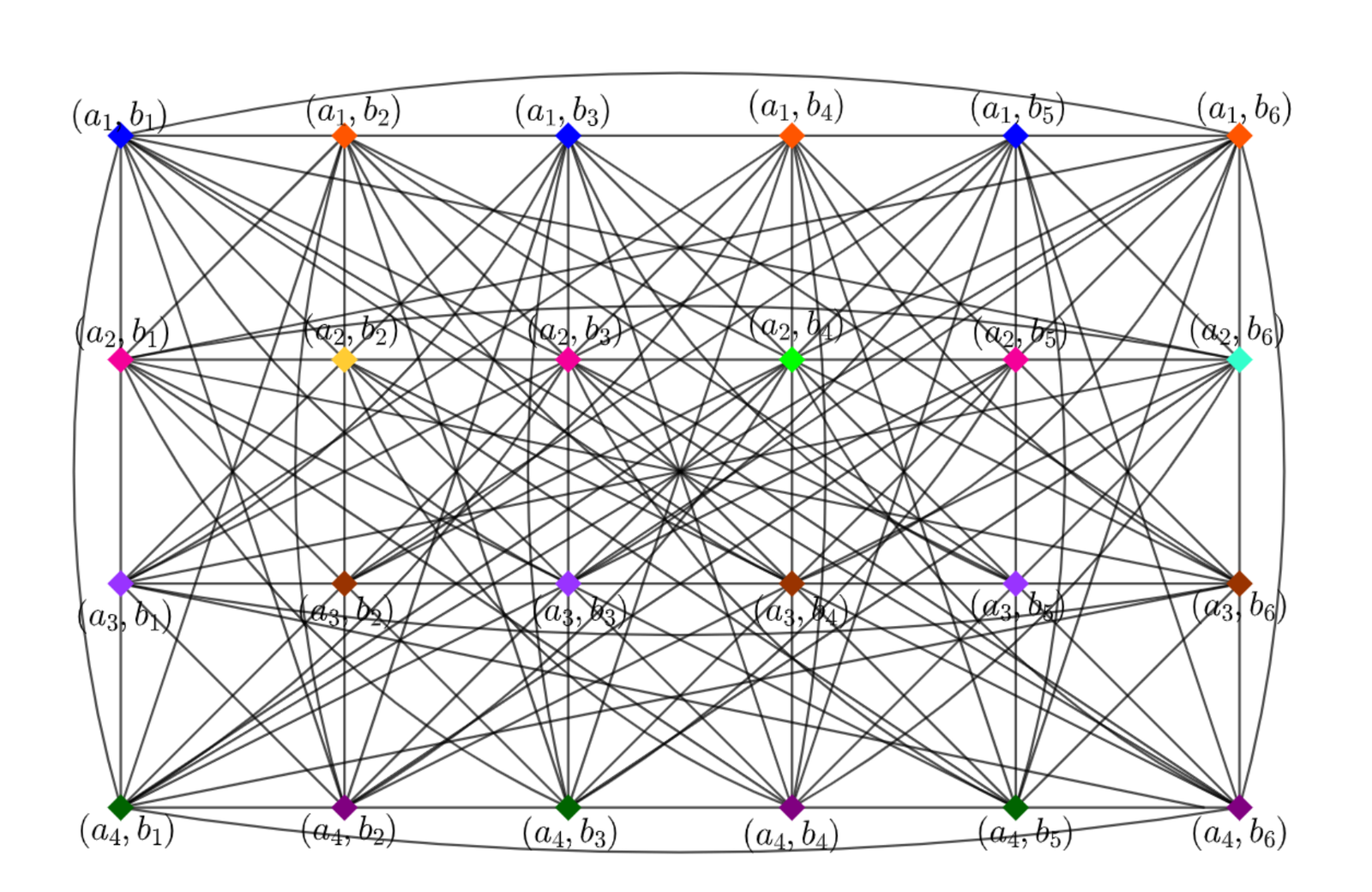
The even positions in the second row account for \(g/2\) singleton classes. Without these distinct colors, some vertex would fail to dominate a color class because of the cycle boundary between \(b_g\) and \(b_1\). Hence \[\chi_d(C_n\diamond C_m)=2h-1+\frac{g}{2}.\] The coloring in Figure 2 illustrates the even-column cycle case. The wrap-around edges make the first and last columns interact, so the even second-row vertices cannot be absorbed into the alternating row classes. Their distinct colors are precisely the additional colors counted by \(g/2\).
Case (ix): odd cycle products not covered above.
Assume either \(g=h\equiv 1\pmod 2\) with \(g\ne3,5\), or \(g\equiv 1\pmod 2\), \(h\equiv 0\pmod 2\), with \(g\ne5\). Define \[\varphi(a_s,b_t)= \begin{cases} 1, & s=1,\ t\equiv 1\pmod 2,\ t<g,\\ 2, & s=1,\ t\equiv 0\pmod 2,\\ 3, & s=1,3,\ t=g,\ \text{or}\ s=2,\ t\equiv 1\pmod 2,\ 3\leq t<g,\\ 4, & s=h,\ t\equiv 1\pmod 2,\ t<g,\\ 5, & s=h,\ t\equiv 0\pmod 2,\\ 6, & (s,t)=(h,g),(h-2,1),\\ 6, & s=h-1,\ t\equiv 1\pmod 2,\ 3\leq t<g,\\ 7, & s=3,\ t\equiv 1\pmod 2,\ 3\leq t<g,\\ 7, & s=2,4,\ t=g. \end{cases}\]
For the remaining positions, set \[\varphi(a_s,b_t)= \begin{cases} s+4, & 4\leq s\leq h-2,\ t\equiv 1\pmod 2,\ 3\leq t<g,\\ \varphi(a_{s+1},b_3), & 3\leq s\leq h-3,\ t=1,\\ \varphi(a_{s-1},b_3), & 5\leq s\leq h-1,\ t=g,\\ h+3,\ldots,2h-1, & 3\leq s\leq h-2,\ t\equiv 0\pmod 2,\ 3\leq t<g,\\ 2h, & s=2,h-1,\ t=1,\\ 2h+1,\ldots,2h+\left\lfloor \dfrac{g}{2}\right\rfloor, & s=1,\ t\equiv 0\pmod 2. \end{cases}\]
The odd cycle boundary produces one more alternating obstruction than in the even case. The colors \(2h+1\) through \(2h+\lfloor g/2\rfloor\) separate the vertices that cannot share a color class without breaking the domination property. The coloring is proper by construction, and every vertex dominates one of the specified classes. Consequently, \[\chi_d(C_n\diamond C_m)=2h+\left\lfloor \frac{g}{2}\right\rfloor,\] for the remaining odd cases. This completes the proof.
The dominator chromatic numbers of the modular products \(P_n\diamond P_m\) and \(C_n\diamond C_m\) have been determined for all \(n,m\geq3\). For paths, the value is governed mainly by the parity of \(g=\max\{n,m\}\) after three small products are separated. The decisive vertices are the even positions in the second row; assigning them distinct colors yields the exact number of additional classes required beyond the repeated row-parity coloring. For cycles, the same row-column principle remains visible, but cyclic boundary adjacencies create additional exceptional products and a separate residue pattern when \(h=3\) and \(g\) is odd.
The findings show that dominator coloring of modular products is controlled not only by the chromatic constraints of the product but also by the location of vertices whose closed neighborhoods must contain a full color class. The formulas therefore clarify how path endpoints, cycle wrap-around edges, and parity jointly determine the dominator chromatic number. These exact results provide a reference point for studying dominator coloring in other graph products whose adjacency rules mix inherited edges with simultaneous non-adjacencies.
Conflicts of Interest: “The authors declare no conflict of interest.”