
Robotic grippers are essential end-effectors for automated handling systems since they determine the transfer of mechanical motion to the handled object. This task becomes critical in agricultural harvesting, food handling, and manipulation of fragile objects where uncertainties in object pose and geometry as well as restrictions on the maximum allowable contact force exist. The development of compliant gripping technologies thus becomes one of the most popular trends since they can enhance adaptability and minimize the risk of damaging mechanical contacts [1, 2, 3, 4].
Recently, there has been an understanding that the performance of the gripper depends not only on its mechanical architecture but also on the synergy of compliance, sensing, and control loops. Reviews of soft and flexible robotic grippers point at the requirement for safe interaction with the object that becomes critical when fragile objects or biological materials should be grasped [5, 6, 7]. In addition, the popularity of the model-based and feedback-oriented approaches increases since the reliable grasping process should include coordination of jaw motion, contact establishment, and force regulation [8, 9].
Even though the advanced grippers based on soft robotics technologies are rapidly developing, many real-world systems still employ simple electromechanical designs because they are cheaper and easier to implement both for experimental purposes and educational applications. In this case, force sensing becomes a straightforward approach towards safer interaction without employing complicated architectures of functional materials. Recent studies on adaptive force control, flexible force-sensing grippers, tactile grippers, and fruit handling end-effectors prove that sensing and feedback-based force regulation can significantly improve the contact behavior even in miniaturized gripper constructions [10, 11, 12, 13, 14].
Need for force perception is especially critical in the cases when the handled object is fragile. Such products as fruits, vegetables, eggs and other fragile products require generation of sufficient normal force to prevent slipping while avoiding damaging peaks of pressure. All the experimental works on harvesting grippers and end-effectors equipped with sensors identify contact force regulation as one of the key factors in damage-free grasping [15, 16, 17, 18]. Also, general reviews on fruit harvesting robotics demonstrate that the interaction with the object is one of the main challenges on the way from the experimental prototype to the real-world field system [19, 20, 21, 22].
Earlier studies devoted to application-oriented grippers for fruit-harvesting machines give valuable examples of inexpensive end-effectors development for agricultural manipulators [23, 24]. In this study, a more specific research question is investigated: can a compact and inexpensive gripper driven by screws provide stable, reliable, and safe low force grasping of fragile objects using the force feedback and simple controller? To answer this question, a force-controlled prototype of the gripper has been developed, fabricated, calibrated, and experimentally tested.
The main contributions of this study can be listed as follows. Firstly, the architecture of the compact and inexpensive electromechanical gripper incorporating screw-driven drive mechanism, jaw linkage, motor actuator, and load cell-based force sensing is proposed. Secondly, an approach to implementation of force control is suggested using exponential moving average filtering, contact detection, proportional-derivative control, deadzone compensation, and minimum pulse-width modulation compensation. Thirdly, the prototype is experimentally verified by calibration, gain tuning, assessment of the performance of the interface of fingers with the object, repeatability test, and fragilobject grasping experiments. These results lay the foundation for the force-aware grasping where the combination of low cost, mechanical simplicity, and safe contact behavior is required [25, 26, 27, 28, 29, 30].
The developed system is a compact force-controlled gripper intended for robust low-force manipulation of sensitive objects. Since the controlling parameter is the gripping force and not just jaw position, the mechanical design was done taking into account sensing and control requirements of the system. Transmission design, jaw construction, actuator positioning, and force transfer pathway were considered to ensure controllability, sturdiness, and built-in sensing unit. The prototype’s mechanical design is shown in Figure 1.
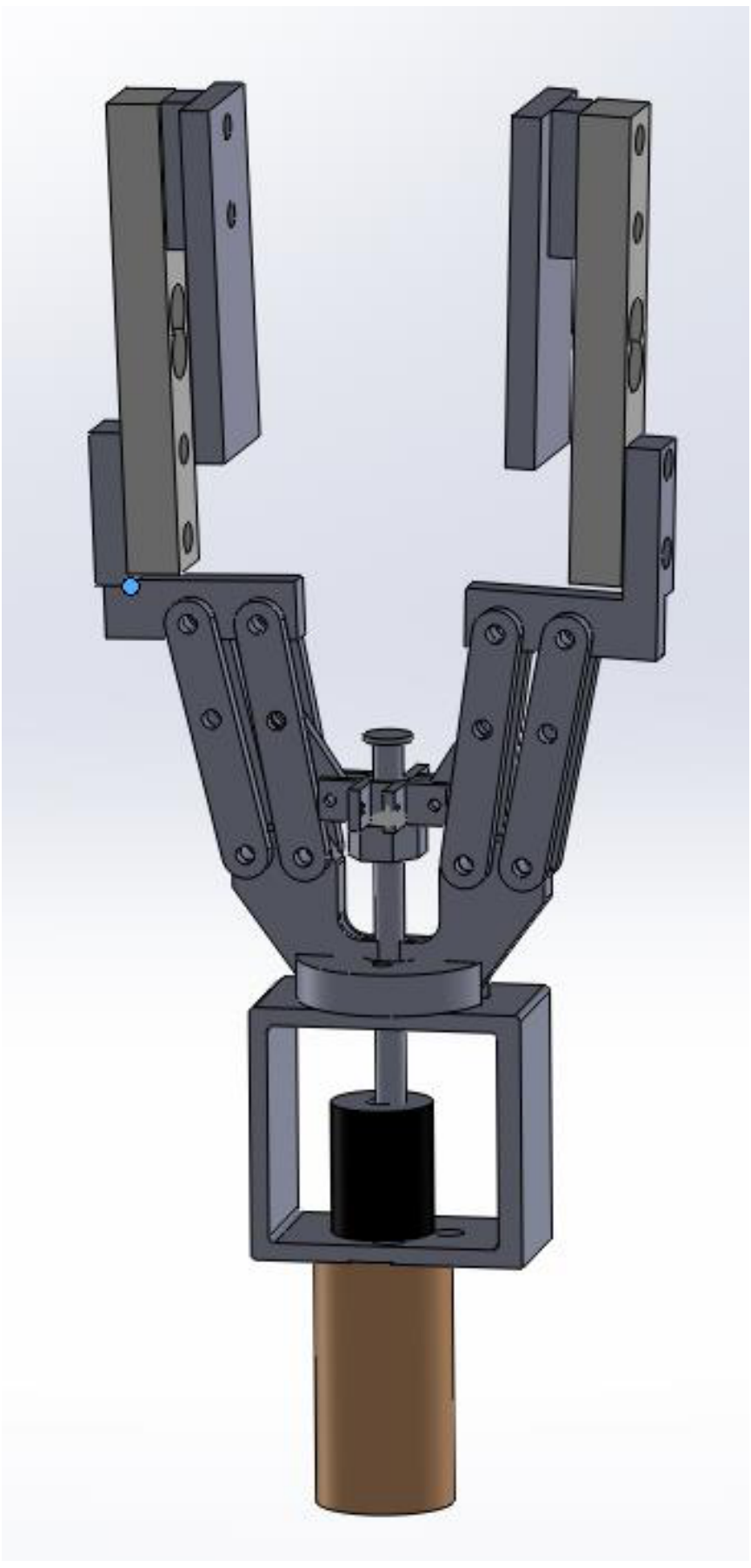
The system includes the screw drive mechanism, where rotational movements of the geared DC motor are transformed into translational movements necessary for jaw actuation. Such solution was chosen because of its compactness, stability of displacements, and appropriate mechanical leverage for low-force manipulation. The motor is placed below the main frame and is coaxial with the screw shaft. The upper part of the system is represented by the jaw linkage and finger support, whereas the load-cell is positioned on the force transfer path allowing the measurement of the gripping force. The supporting frame includes the motor, screw mechanism, sensor, and jaws together.
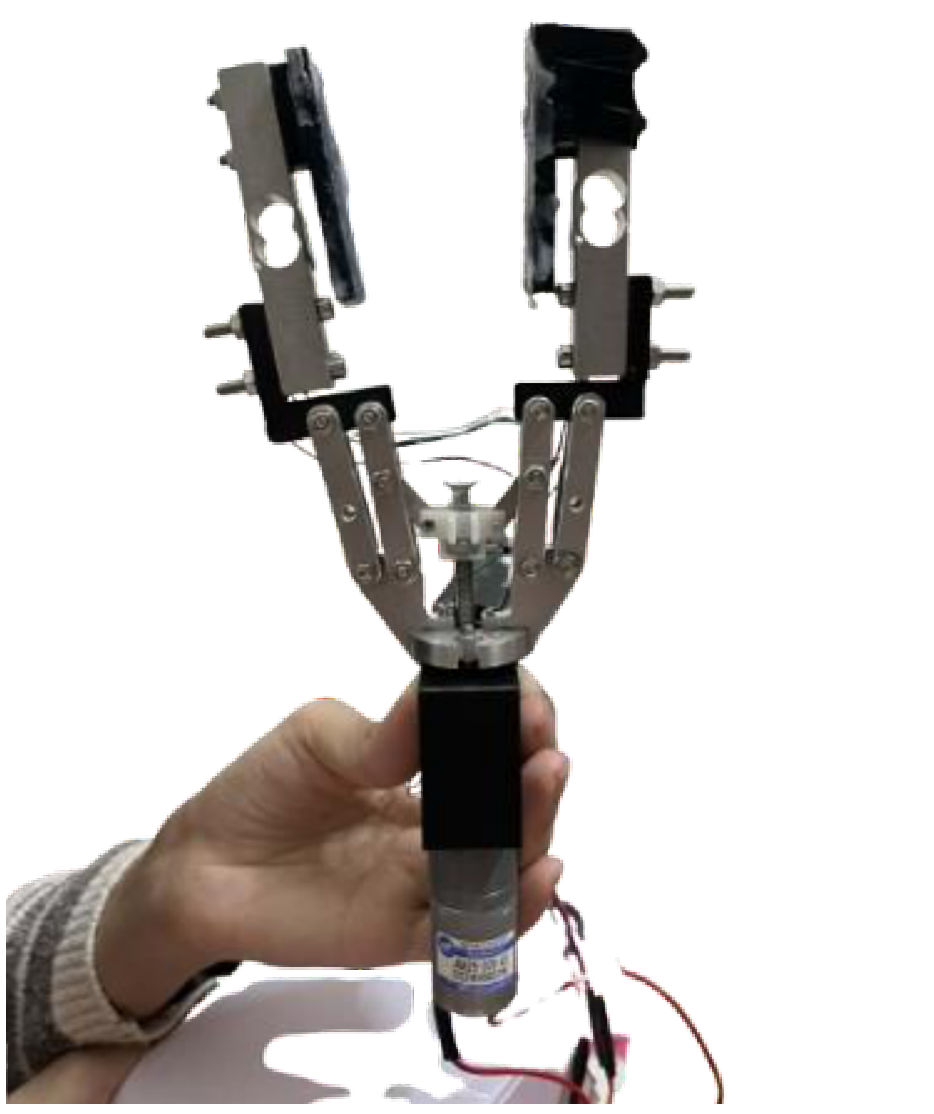
The realized prototype in Figure 2 reflects the major characteristics of the mechanical design: screw drive, jaw linkage, motor positioning, and sensing path. This prototype was used to evaluate force measurement accuracy, closed-loop force-control performance, and practical grasping capability.
The sensing chain of force measurement comprises a YZC-131 force sensor and the HX711 amplification and digitization system. As the controller relies on force feedback, it is necessary to calibrate the sensing chain before performing closed loop experiments. The load-cell output signal is processed using a linear model
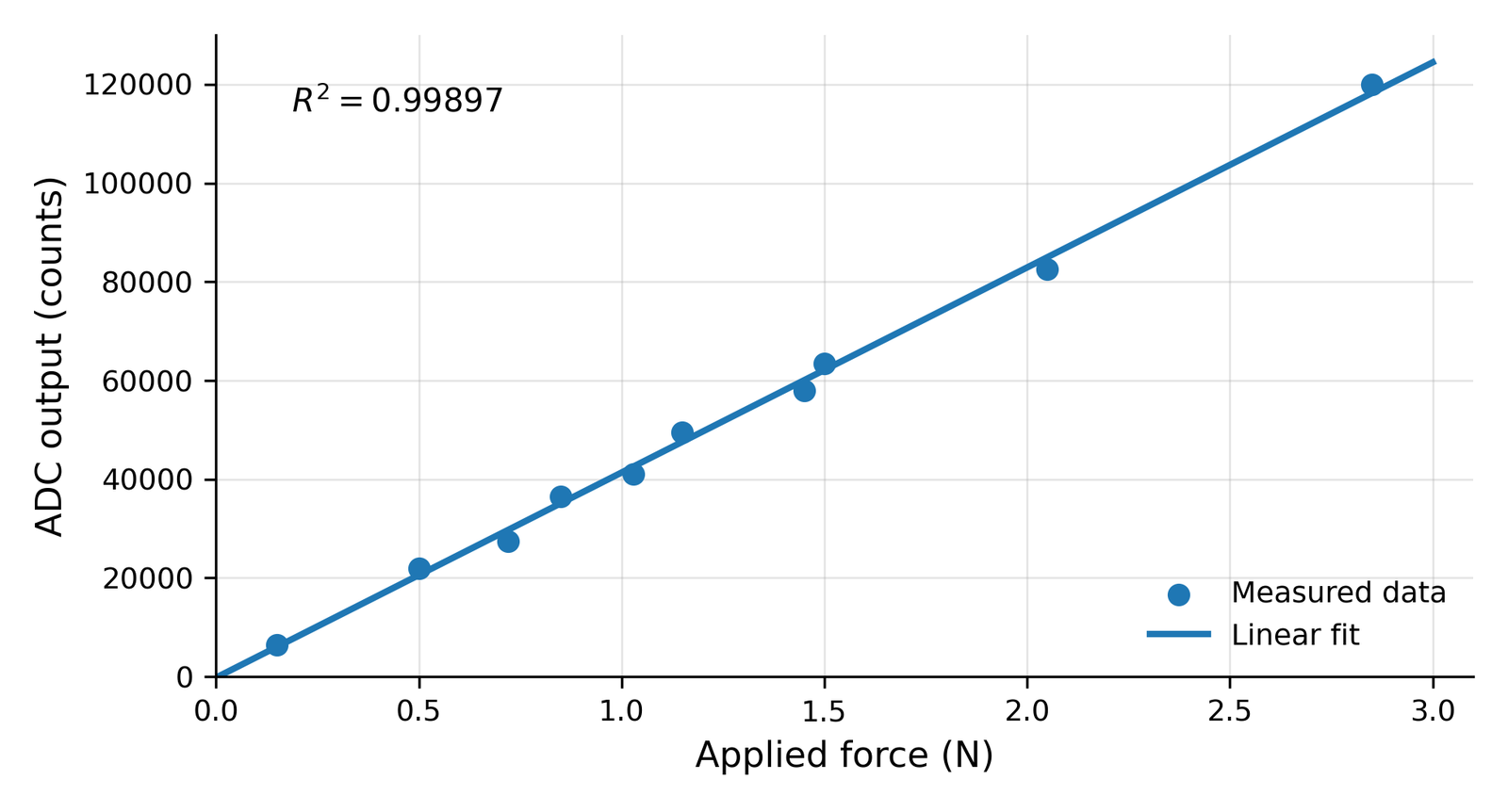
where \(F\) is the force applied by the gripper, \(ADC\) is the output of the sensor, digitized, and \(a\) and \(b\) are the regression coefficients. The linear relationship for calibration is illustrated in Figure 3.
The measured force signal is passed through an exponential moving average filter before carrying out the controller action to minimize measurement variations due
where \(F(k)\) is the currently measured force, \(F_f(k)\) is the filtered force, and \(\alpha\) is the smoothing parameter. For the experiments, the value of \(\alpha\) equal to 0.15 was chosen to balance noise reduction and response time.
The gripper works in two phases. In the free closing phase, the motor moves the jaws until the force reaches the threshold for touch force detection \(F_{touch}=0.08\) N. After the touch detection, the control switches to the active phase with force regulation. The force-control error can be written as
where \(F_{des}\) is the desired gripping force. The nominal proportional-derivative control law is
Where \(K_P\) and \(K_D\) represent proportional and derivative gain terms, respectively, and \(u(t)\) represents the motor control command. The derivative term is used for reducing oscillations and providing good settling performance after contact.
In order to avoid unnecessary motor actions due to small error values, a deadzone term is introduced in the control loop. The applied control command can be written as
with \(e_{dz}=0.018\) N. The minimum pulse-width-modulation compensation technique is then used whenever a non-zero corrective control signal is necessary to help the motor overcome the mechanical friction and stiction in the transmission process without constantly moving around the setpoint.
The experimental test involved five different procedures. The first one involved applying certain loads for calibration purposes of the load cell/HX711 measurement chain. The second step involved varying the proportional gain for observing the impact of this parameter on the rise time, overshoot, and steady state performance. The third step involved varying the derivative gain for examining the damping effect on oscillation and settling. The fourth step involved testing the force response both with and without silicone coated fingertips in order to observe the effect of compliance in the contact interface. In addition, repeatability and grasping tests were performed on fragile and common items. The gripping force required for the principal validation tests was \(F_{des} = 0.7\) N.
From the calibration results, the near-linear relationship between the input and digitized sensor output was observed. It was reported that the coefficient of determination was \(R^2 = 0.99897\). Therefore, the load cell and HX711 module can serve as a reliable base for feedback control since the error in Eq. (3) is defined by the input-output function directly. As a matter of fact, the small intercept shows that there was no offset from zero in the sensor chain. This feature is beneficial for low-forces operations since the absolute errors are significant.
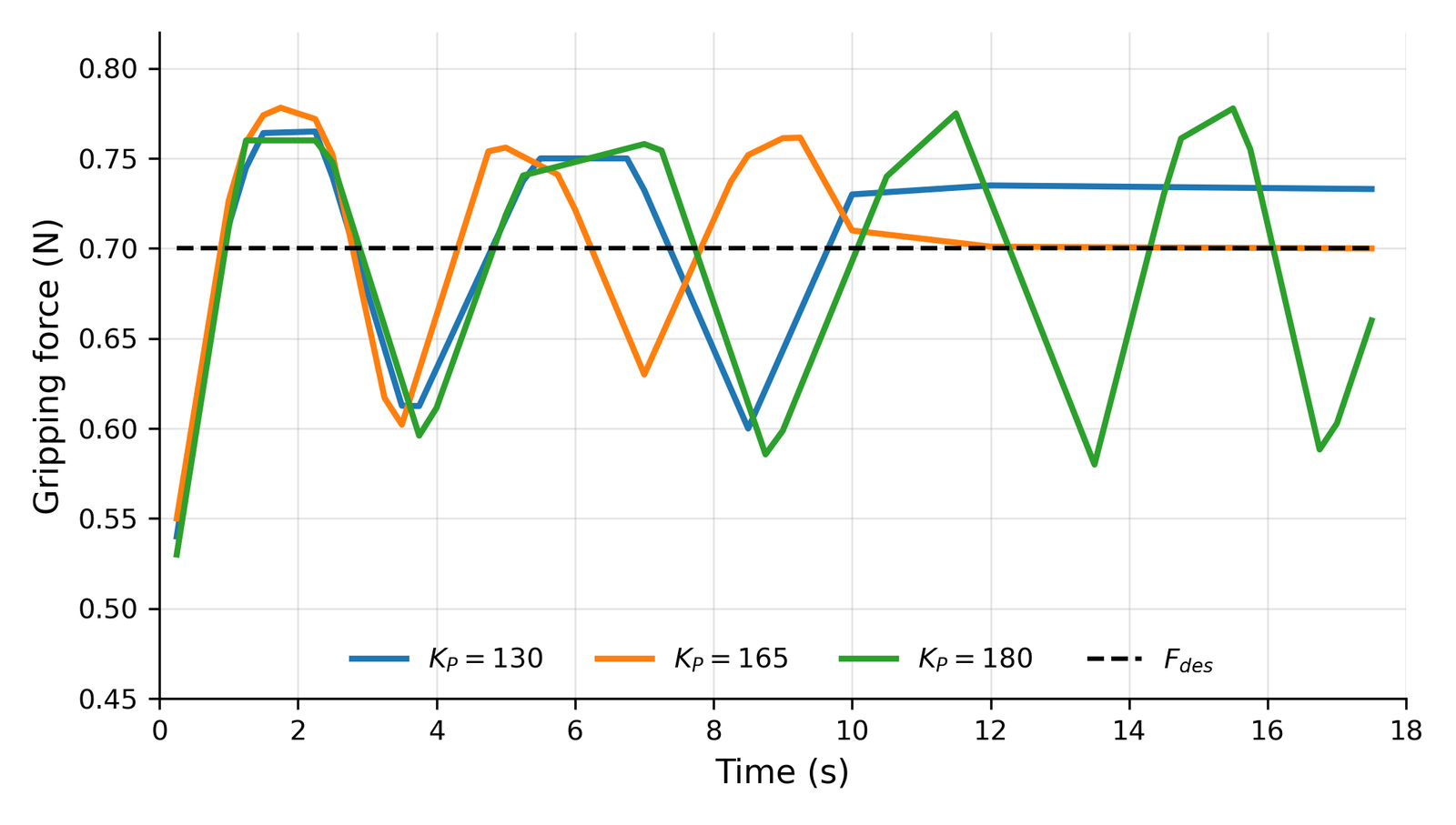
The influence of the proportional gain was studied for three different gains of \(K_P=130\), 165, and 180. In Figure 4, the desired force was chosen to be 0.7 N to study the controller performance in fragile-object contact conditions as in the previous experiments on grasping.
Figure 4 shows how significantly the proportional gain changes the trade-off between the speed of the response and the transient safety of the controller. For \(K_P=130\) the response reaches the desired force almost without overshooting and with a gradual settling. The typical one reached the maximum force of 0.734 N, which corresponds to the 4.86% of the overshoot. The other characteristic parameters were 0.52 N/s as the maximum force rate, 10.5 s as the settling time, and about 5% of the steady-state error. These values are acceptable for the manipulation with the delicate objects since the peak of the force stays relatively low. Increased proportional gain shortened certain parts of the response but caused oscillations, showing that a proportional attack could cause unnecessary force oscillations on the contacts. Increased proportional gain shortened certain parts of the response but caused oscillations, showing that a proportional attack could cause unnecessary force oscillations on the contacts.
Derivative gain was analyzed through the comparison of values \(K_D=0\), 1.5, 3, and 5, depicted in Figure 5. In this test, the damping effect due to derivative control after making physical contact is studied.
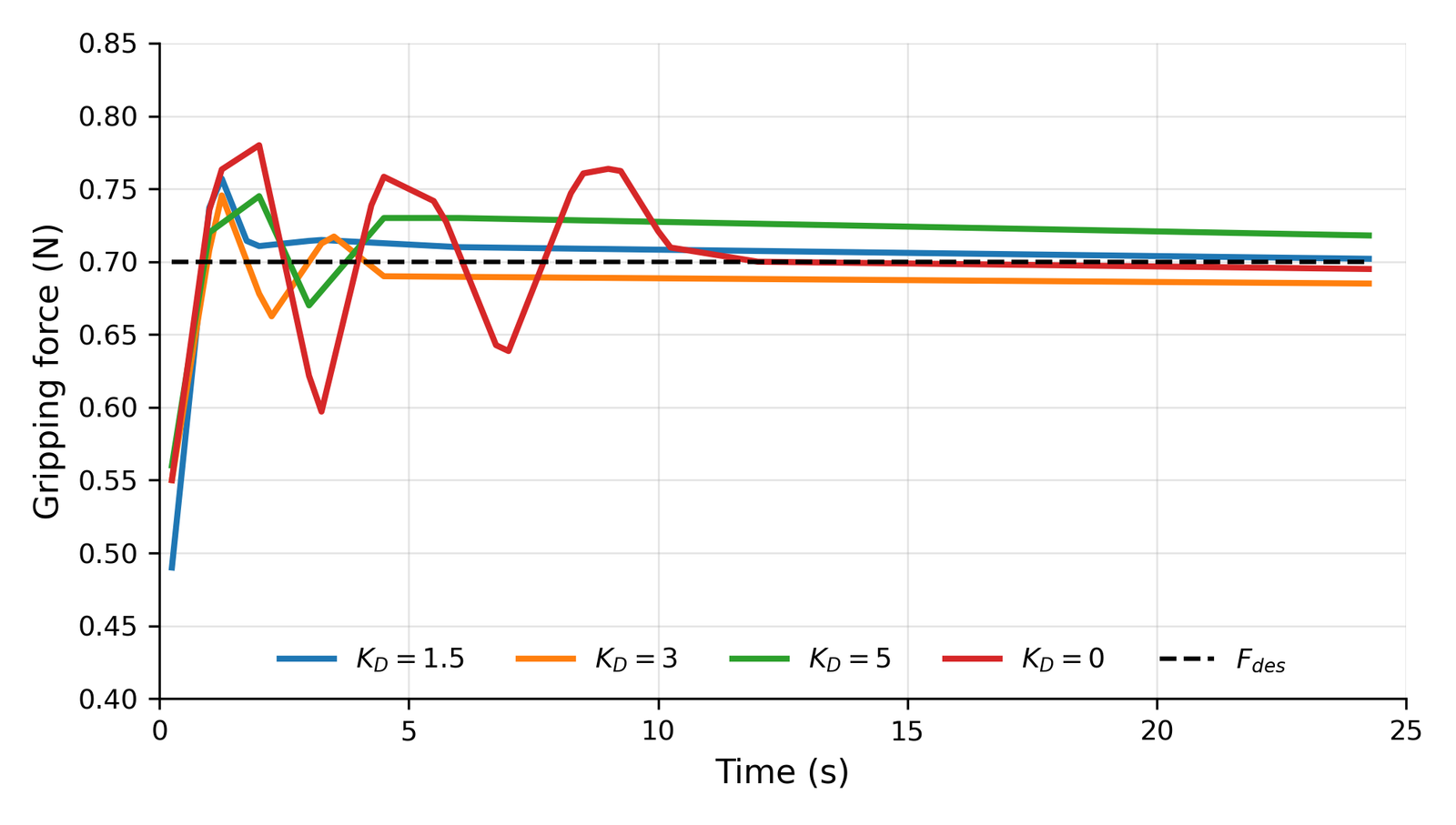
The behavior shown in Figure 5 suggests that derivative term is necessary to ensure reduction in oscillations about the target force level. The lack of derivative gain results in repeated overshooting below and above the desired force. An increase in \(K_D\) enhances damping, while overcompensation may result in slower correction process and offset. Therefore, the obtained experimental data justifies usage of a balanced combination of derivative and selected proportional gains as a trade-off between the contact safety and stability of the control.
The behavior exhibited by the system during the performed experiments is conditioned by the integrated embedded control system rather than the PD law in its pure form. The EMA filter ensures stabilization of the measurements at high frequencies, contact detection allows delaying the feedback control until the object contact, the deadzone provides suppression of small corrections near the equilibrium point, and PWM minimum compensation assists the motor to overcome the friction in the screw drive. This is what makes a cheap simple controller capable of performing stable force control in the compact mechanical setup.
Practical gripping abilities of the presented system were assessed using tests with coated fingertips, repeatability analysis, and handling of different objects. The first validation experiment was conducted using fingertips coated with silicone, see Figure 6.
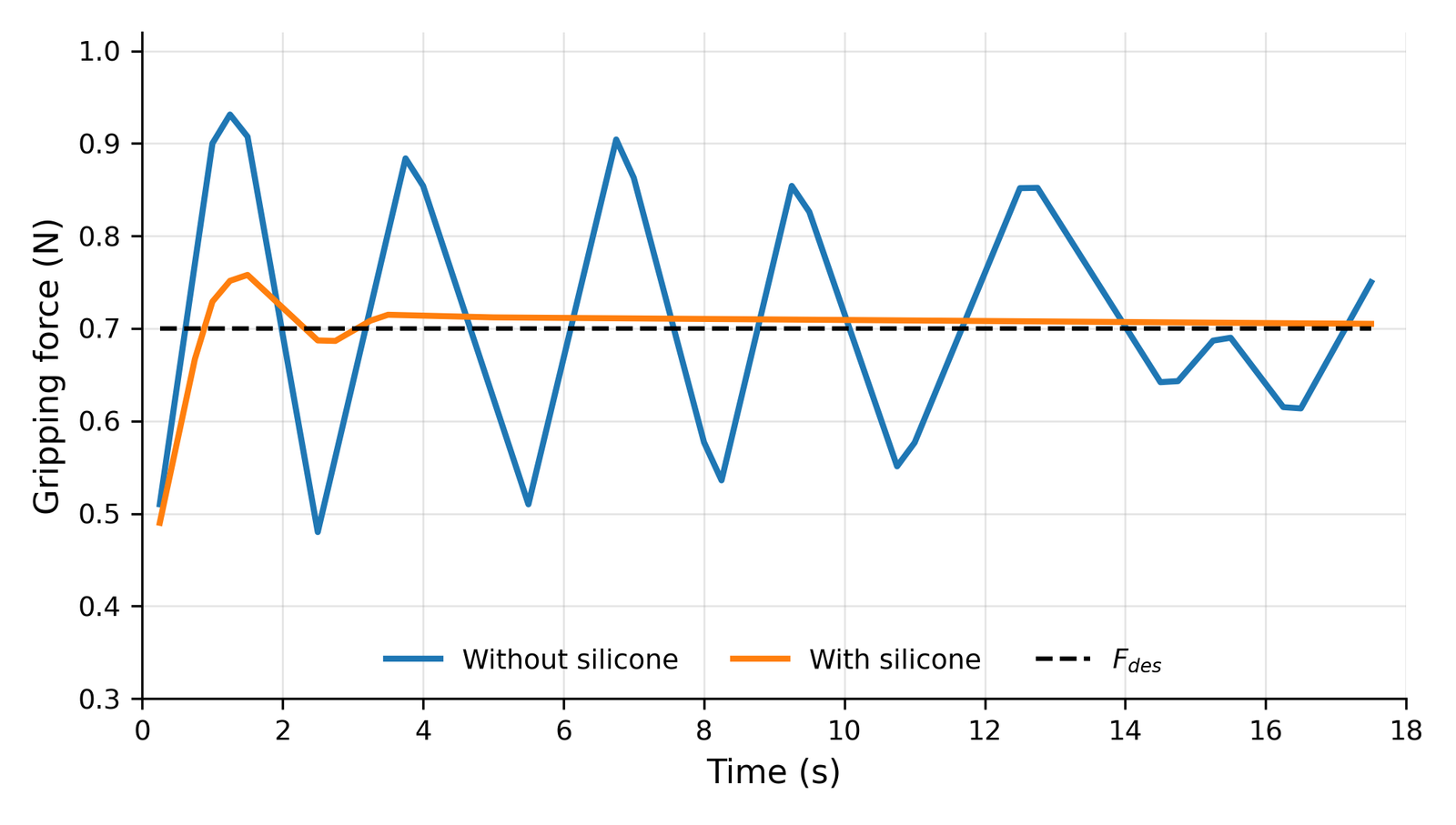
The fingertip test in Fig. 6 demonstrates that the nature of the contact interface plays a significant role in the gripping dynamics. Indeed, applying silicone coating to the fingertips provides local compliance and increased friction between the jaw and the object. Therefore, the coated fingertips result in decreased slippage, gentler contacts, and a stable settling process. The uncoated fingertips have relatively large force oscillations, resulting in higher chances for damaging fragile objects. Thus, it can be stated that the fingertips’ material must be considered a key design variable in force-controlled gripping and not just an additional mechanical feature.
The repeatability test was performed by performing five repeated runs with identical force control setpoints (see Fig. 7).
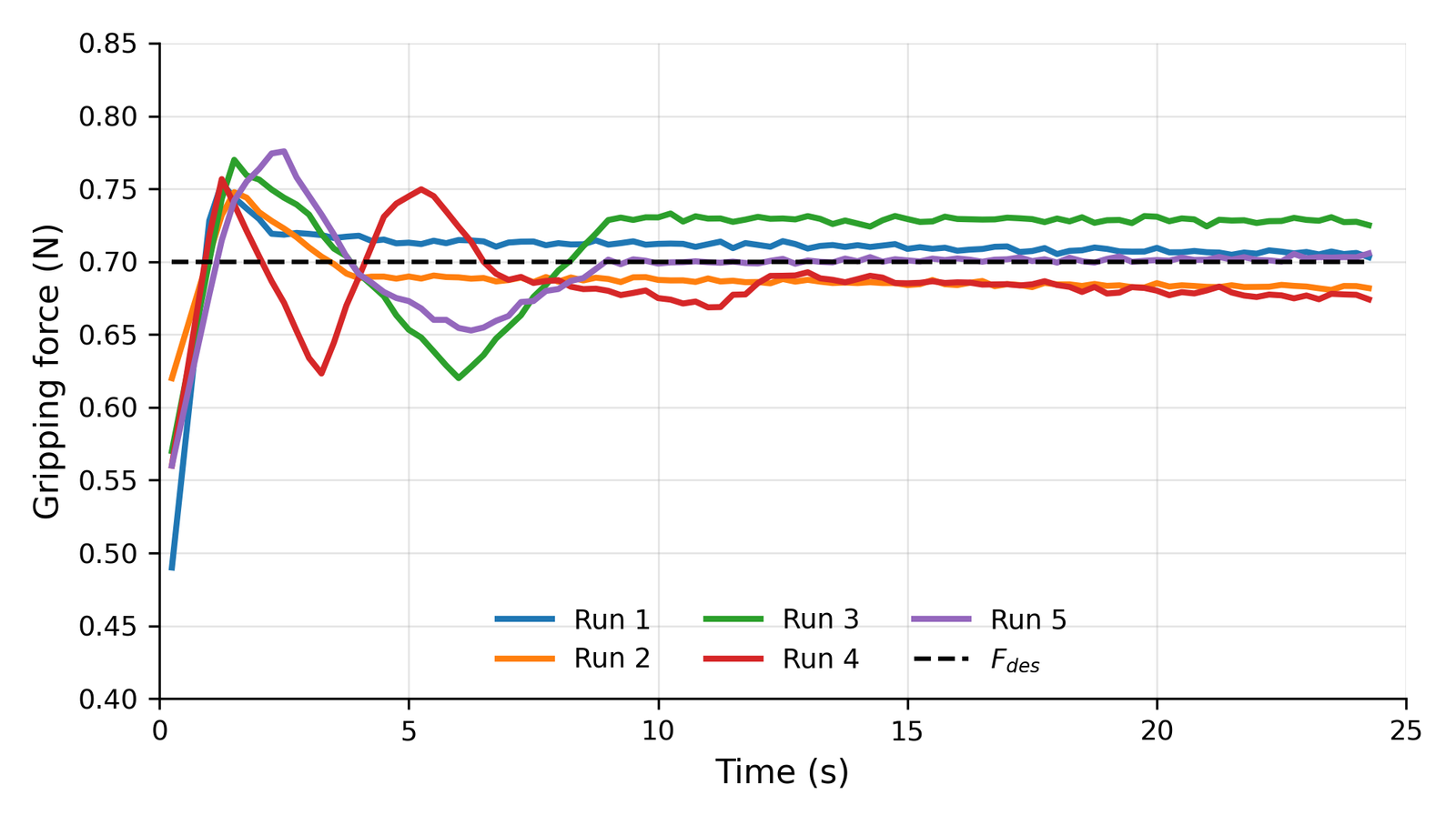
The repeatability tests in Figure 7 demonstrate generally consistent transient and steady state response characteristics. Variability is expected due to the fact that the actuation principle involves sliding friction, screw drive friction, slight variability in contact position on the object, and sensor noise. Regardless, the responses stay relatively close to the target force following the transient period. Such repeatability confirms the validity of the calibration and control approach, especially taking into consideration the fact that the device consists of affordable parts and has a simple mechanical design.
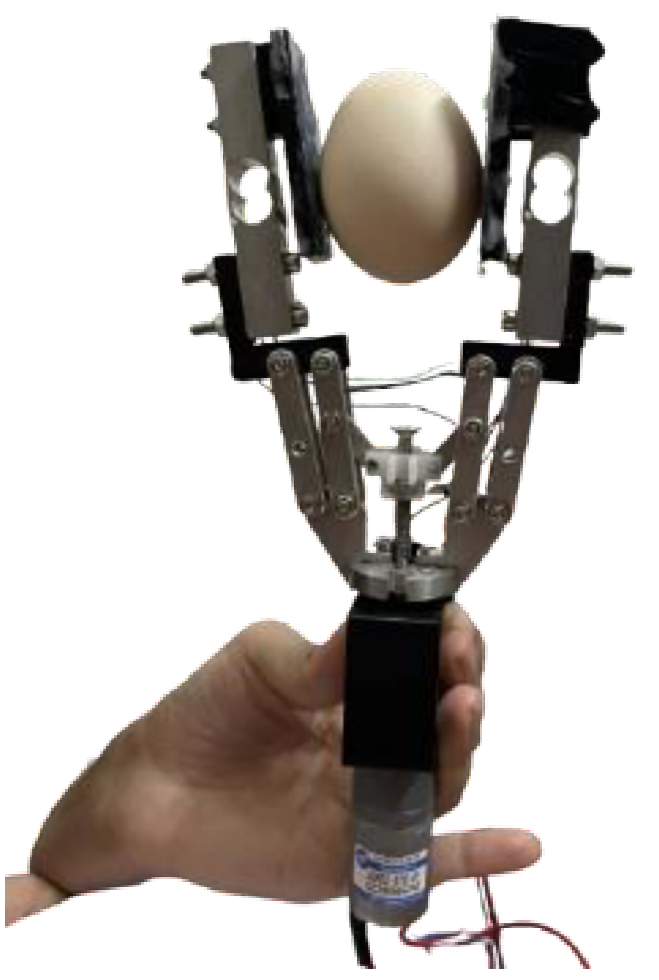
The validation test using a fragile object was conducted by grasping a chicken egg at the specified low-force setting as shown in Figure 8.
The egg grasping test in Figure 8 proves that the actuator is able to produce enough normal force to grasp the fragile object without causing any observable shell deformation. This test directly answers the research question posed in the study as the prototype is capable of performing safe low-force grasping when direct force sensing and proper control tuning is employed. The test is also practical since the object in question has a curved surface and is relatively fragile.
Additional handling tests were conducted using objects with different sizes, shapes, and surface conditions, as shown in Figure 9.
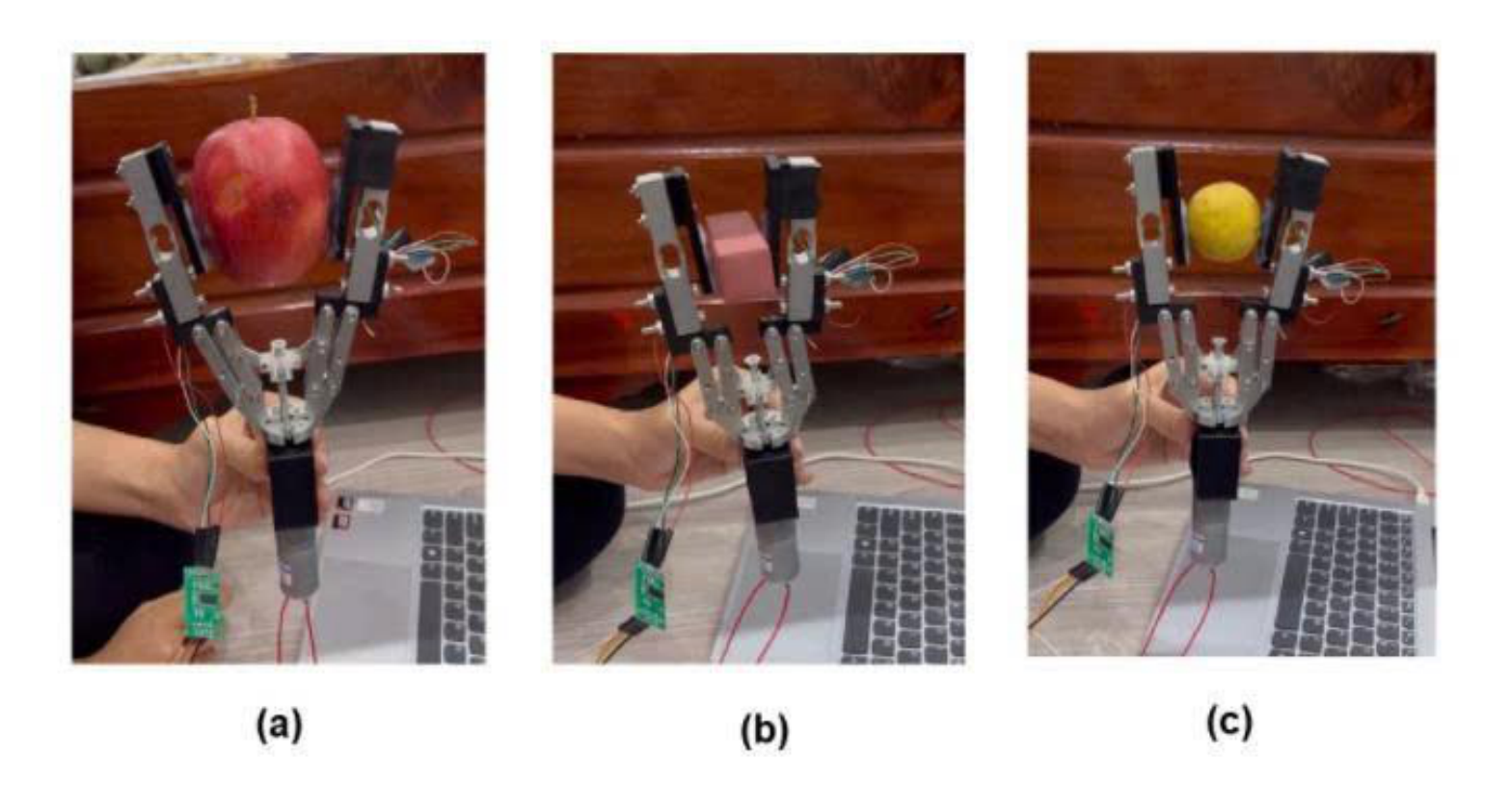
Tests with different objects shown in Fig. 9 confirm the fact that the gripper is not limited to only one object. It has been tested with an apple, a lipstick, and a lemon, which means that the same force-regulating approach can provide several different contact states. Although these tests cannot be regarded as comprehensive, they prove that the prototype is flexible enough to be used in various scenarios. Major disadvantages are small number of objects, controller gains found experimentally, and lack of the contact-mechanics model. However, friction, deformations, and slipping were taken into account by fingertip compliance, filtering, gain tuning, deadzone logic, and PWM regulation. Thus, the experiments proved that an affordable force-controlled gripper can perform safe and reproducible delicate object handling in lab conditions.
The current study aimed at exploring the possibility of building a compact and low-cost robotic gripper capable of performing safe and efficient handling of fragile objects with the help of direct force feedback and embedded control. This system consists of screw-driven gripper mechanism, YZC-131 load cell, HX711 signal acquisition unit, Arduino-based controller, DRV8871 motor driver, and geared DC motor. Instead of purely position control approach, this prototype controls the force of contact using EMA filtering, contact detection, PD control, deadzone logic, and minimum PWM regulation.
Thus, the question raised in the beginning of the paper was answered positively. In this regard, the experiments have shown high linearity of the measurement chain with \(R^2 = 0.99897\) and confirmed that the use of load-cell HX711 combination is quite adequate for low-force feedback control system. Gain tuning experiments have revealed that the proportional gain regulates the tradeoff between response speed and contact force overshoot, while the derivative gain helps to reduce oscillations and improves settling. Experiments with coated silicon fingertip confirmed that the contact interface plays major role in stability and safety of contact. The tests for repeatability have proved that the gripper demonstrates the same behavior during different runs, and experiments with egg have proved that the prototype can keep the real fragile object at required low-force setpoint without damaging it.
The primary contribution made by the study is the proof of the fact that the handling of fragile objects need not necessarily involve costly equipment and/or very complicated actuation schemes when appropriate force feedback is incorporated in the mechanism. This design serves as an effective base for the development of affordable force sensitive manipulators, mechatronic educational systems, and robotic end effectors in the future. In the future, one needs to explore a wider range of objects and measure the performance of grasping, fine-tune the controller parameters, etc.
Acknowledgments: The author acknowledges the support of VNU University of Engineering and Technology during the development and experimental evaluation of the prototype.
Author Contributions: Dang Anh Viet contributed to the conceptualization, mechanical design, system implementation, experiments, analysis, and manuscript preparation.
Conflicts of Interest: The author declares no conflict of interest.