
Let \(G\) be a finite undirected graph. An automorphism \(\varphi\) of \(G\) is a permutation on the vertex-set \(V(G)\) such that the graph preserves adjacency, that is, \(\varphi(v_1)\) is adjacent to \(\varphi(v_2)\) if and only if \(v_1\) is adjacent to \(v_2\). The set of all automorphisms of \(G\) together with the composition operation of permutations forms the automorphism group of \(G\), denoted as \(\operatorname{Aut}\left(G\right)\). For a graph \(G\), determining the structure of \(\operatorname{Aut}\left(G\right)\) is not an easy task, even for the order of \(\operatorname{Aut}\left(G\right)\). This has led to many research papers studying on the automorphism group of a simple graph. For example, Ganesan [1] determined the automorphism group of the complete transposition graph. Mirafzal [2] studied the automorphism group of the bipartite Kneser graph. Ibarra and Rivera determined the automorphism groups of some token graphs in [3]. Let \(W\) be a non-empty subset of \(V(G)\). The subgraph induced by \(W\), whose vertex-set is \(W\) and edge-set is those edges of \(G\) that connect two vertices in \(W\), is denoted by \(\left\langle W \right\rangle\). We denote \(G-W\) as the subgraph obtained from \(G\) by deleting all the vertices in \(W\) and the edges connected to those vertices in \(W\).
This paper is devoted to study the automorphism group of a graph defining on a ring. We first recall the definition of the nil-clean graph of a ring, which is initially introduced by Basnet and Bhattacharyya in [4]. Let \(R\) be a ring with identity. An element in \(R\) is called nil-clean if it is a sum of an idempotent in \(R\) and a nilpotent element in \(R\). The set of idempotent elements, the set of nilpotent elements and the set of nil-clean elements of a ring \(R\) is written as \(Id(R)\), \(Nil(R)\) and \(NC(R)\), respectively. The nil-clean graph of \(R\) is denoted by \(G_{NC}(R)\), and its vertices are all the elements in \(R\), and where two distinct vertices \(x\) and \(y\) are adjacent if and only if \(x+y\in NC(R)\). If the word “distinct” is removed, then the graph may have loops, which is the closed nil-clean graph and denoted as \(\overline{G_{NC}}(R)\). The study of nil clean graphs of rings has also attracted the attention and research by many scholars. In the literature [5], the authors studied the diameter of nil-clean graph of the ring \(\mathbb{Z}_n\). In [6], some topological indices of nil clean graphs have been studied.
In recent years, many scholars have studied the automorphism groups of graphs derived from algebraic structures. Zhou et al., successively determined the automorphisms of the total graph of the ring of all \(2\times 2\) matrices and the zero-divisor graph of the ring of all \(n \times n\) matrices over \(\mathbb{F}_q\) in [7] and [8], respectively. Zhang et al., [9] completely determined the automorphisms of the zero-divisor graph of the \(2\times 2\) matrix ring over \(\mathbb{Z}_{p^s}\), where \(p\) is a prime and \(s\) is a positive integer. The automorphisms of the inclusion ideal graph, the ideal-relation graph and the intersection graph of ideals of the ring of all \(n\times n\) matrices over \(\mathbb{F}_q\) are determined in [10] and [11]. Zhang and Nan [12] determined completely the automorphism groups of the unitary Cayley graph, the unit graph and the total graph over the ring of Gaussian integers modulo a prime power. Ou et al. described the automorphism group of the zero-divisor graph of a finite semisimple ring or a block upper triangular matrix ring over a finite field in [13].
In this section, we want to determine the order of the automorphism groups of the nil-clean graph of the ring \(\mathbb{Z}_n\). We start with some basic facts from graph theory.
Remark 1. Let \(G\) be a graph whose vertex-set \(V(G)=\{v_1,v_2,\ldots,v_n\}\).
Suppose \(\operatorname{Aut}(G)\) acts on the vertex-set \(V(G)\). The orbit of \(v\in V(G)\) is \(\operatorname{O}(v)=\{\varphi(v):\varphi\in \operatorname{Aut}(G)\}\). The stabilizer of \(v\) in \(G\) is \(\operatorname{Stab}(v)=\{\varphi \in \operatorname{Aut}(G):\varphi(v)=v\}\). Then the Orbit-Stabilizer Theorem is described as \(|\operatorname{Aut}(G)|=|\operatorname{O}(v)|\times |\operatorname{Stab}(v)|\).
The \(k\) blow-up of a graph \(G\) refers to the result obtained by replacing each vertex \(v_i\) with \(k\) vertices \(v_{i1},v_{i2},\ldots,v_{ik}\) such that two different vertices \(v_{is}\) and \(v_{jt}\) are adjacent if and only if \(v_i\) and \(v_j\) are adjacent in \(G\) for every \(i,j\in \{1,2,\ldots ,n\}\) and \(s,t\in \{1,2,\ldots,k\}\).
The Kronecker product \(G_1\otimes G_2\) of the graphs \(G_1\) and \(G_2\) has vertex set \(V(G_1\times G_2)\), two vertices \((v_1,u_1)\) and \((v_2,u_2)\) are adjacent if and only if \(v_1\) is adjacent to \(v_2\) in \(G_1\) and \(u_1\) is adjacent to \(u_2\) in \(G_2\).
The following two lemmas are from reference [14], and for the convenience of readers, we also provide their proofs.
Lemma 1. [14, Theorem 2.4] Let the Artin decomposition of a finite commutative ring \(R\) be \(R\cong R_1\times \cdots \times R_s\). Then there is the isomorphism of graphs \(\overline{G_{NC}}(R)\cong \overline{G_{NC}}(R_1\times \cdots \times R_s)\cong \overline{G_{NC}}(R_1)\otimes \cdots \otimes \overline{G_{NC}}(R_s)\).
Proof. For two isomorphic rings, their closed nil-clean graphs are also isomorphic. This shows that \(\overline{G_{NC}}(R)\cong \overline{G_{NC}}(R_1\times \cdots \times R_s)\). Since \(Id(R_i)=\{0,1\}\) and \(Nil(R_i)=J(R_i)=\mathfrak{m}_i\) by [15], where \(J(R_i)\) is the Jacobson radical of \(R_i\) and \(\mathfrak{m}_i\) is the maximal ideal of \(R_i\). So, \(NC(R_i)=Id(R_i)+Nil(R_i)=\{0,1\}+Nil(R_i)=\mathfrak{m}_i\) \(\dot{\cup}\) \(1+\mathfrak{m}_i\), \(NC(R_1\times \cdots \times R_s)=NC(R_1)\times \cdots \times NC(R_s)\). Let \(x=(x_1,\ldots,x_s)\), \(y=(y_1,\ldots,y_s)\in R_1\times \cdots \times R_s\). Then, \(x+y\in NC(R)\) if and only if \(x_i+y_i\in NC(R_i)\) for every \(i=1,\ldots,s\). According to the definition of the Kronecker product of graphs in Remark 1(3), we have \(\overline{G_{NC}}(R_1\times \cdots \times R_s)\cong \overline{G_{NC}}(R_1)\otimes \cdots \otimes \overline{G_{NC}}(R_s)\). ◻
Lemma 2. [14, Corollary 2.1] Let \(R\) be a finite commutative ring. Then \(\overline{G_{NC}}(R)\) is the \(|J(R)|\) blow-up of \(\overline{G_{NC}}\left(R/J(R)\right)\).
Proof. Let \(x=(x_1,\ldots,x_s)\), \(y=(y_1,\ldots,y_s)\in R\). Since a finite commutative ring is an Artinian ring and up to isomorphism, the ring \(R\) can be uniquely written as the direct product \(R\cong R_1\times \cdots \times R_s\) of a finite number of local rings by [15]. So, \((x_1,\ldots,x_s)\) is adjacent to \((y_1,\ldots,y_s)\) in \(\overline{G_{NC}}(R)\) \(\iff\) \(x_i+y_i\in NC(R_i)\) \(\iff\) \(x_i+y_i\in \mathfrak{m}_i\) \(\dot{\cup}\) \(1+\mathfrak{m}_i\) \(\iff\) \((\overline{x_1},\ldots,\overline{x_s})\) is adjacent to \((\overline{y_1},\ldots,\overline{y_s})\) in \(\overline{G_{NC}}\left(R/J(R)\right)\). If \((\overline{x_1},\ldots,\overline{x_s})\) is adjacent to \((\overline{y_1},\ldots,\overline{y_s})\), and we replace each vertex in \(\overline{G_{NC}}\left(R/J(R)\right)\) with \((x_1+\mathfrak{m}_1,\ldots,x_s+\mathfrak{m}_s)\), then each vertex in \((x_1+\mathfrak{m}_1,\ldots,x_s+\mathfrak{m}_s)\) is adjacent to \((y_1\ldots,y_s)\) and each vertex in \((y_1+\mathfrak{m}_1,\ldots,y_s+\mathfrak{m}_s)\) is adjacent to \((x_1,\ldots,x_s)\). Note that \(J(R)=\mathfrak{m}_1\times \cdots \times \mathfrak{m}_s=J(R_1)\times \cdots \times J(R_s)\). Thus, \(\overline{G_{NC}}(R)\) is the \(|J(R)|\) blow-up of \(\overline{G_{NC}}\left(R/J(R)\right)\). ◻
It is worth noting that the automorphism groups of \(\overline{G_{NC}}(\mathbb{Z}_n)\) and \(G_{NC}(\mathbb{Z}_n)\) are isomorphic. For each vertex \(v\), the open neighborhood of its in \(G_{NC}(\mathbb{Z}_n)\) is exactly the same as that in \(\overline{G_{NC}}(\mathbb{Z}_n)\). Thus, we study the automorphism group of \(G_{NC}(\mathbb{Z}_n)\) by studying the automorphism group of \(\overline{G_{NC}}(\mathbb{Z}_n)\).
Theorem 1. Let \(n=p_1^{k_1}p_2^{k_2}\cdots p_s^{k_s}\), where \(p_1, p_2,\ldots, p_s\) are distinct primes and \(k_1,k_2,\ldots,k_s\) are positive integers. Then the following statements hold:
If \(n\) is an even number with \(p_1=2\), then \[|\operatorname{Aut}\left( G_{NC}(\mathbb{Z}_n)\right)|=2^{s-1}{\left[\left( 2^{k_1}p_2^{k_2-1}\cdots p_s^{k_s-1}\right)!\right]}^{p_2\cdots p_s}.\]
If \(n\) is an odd number, then \[|\operatorname{Aut}\left( G_{NC}(\mathbb{Z}_n)\right)|=2^s{\left[\left( p_1^{k_1-1}p_2^{k_2-1}\cdots p_s^{k_s-1}\right)!\right]}^{p_1p_2\cdots p_s}.\]
Proof. When \(n=p_1^{k_1}p_2^{k_2}\cdots p_s^{k_s}\), we know that \(\overline{G_{NC}}(\mathbb{Z}_n)\) is the \(p_1^{k_1-1}p_2^{k_2-1}\cdots p_s^{k_s-1}\) blow-up of \(\overline{G_{NC}}(\mathbb{Z}_{p_1p_2\cdots p_s})\) by Lemma 2.
1. If \(n=2^{k_1}p_2^{k_2}\cdots p_s^{k_s}\) is an even number, then by Lemma 1, \[\begin{aligned} \overline{G_{NC}}(\mathbb{Z}_{2p_2\cdots p_s}) &\cong \overline{G_{NC}}(\mathbb{Z}_2\times \mathbb{Z}_{p_2}\times \cdots \times \mathbb{Z}_{p_s})\\ &\cong \overline{G_{NC}}(\mathbb{Z}_2)\otimes \overline{G_{NC}}(\mathbb{Z}_{p_2})\otimes \cdots \otimes \overline{G_{NC}}(\mathbb{Z}_{p_s})\\ &\cong \overline{G_{NC}}(\mathbb{Z}_2)\otimes \left(\overline{G_{NC}}(\mathbb{Z}_{p_2})\otimes \cdots \otimes \overline{G_{NC}}(\mathbb{Z}_{p_s})\right)\\ &\cong \overline{G_{NC}}(\mathbb{Z}_2)\otimes \overline{G_{NC}}(\mathbb{Z}_{p_2\cdots p_s}). \end{aligned}\]
Since any two points in the graph \(\overline{G_{NC}}(\mathbb{Z}_2)\) are always adjacent, two vertices \((u_s,v_i)\) and \((u_t,v_j)\) are adjacent in \(\overline{G_{NC}}(\mathbb{Z}_2)\otimes \overline{G_{NC}}(\mathbb{Z}_{p_2\cdots p_s})\) if and only if \(v_i\) and \(v_j\) are adjacent in \(\overline{G_{NC}}(\mathbb{Z}_{p_2\cdots p_s})\). This shows that \(\overline{G_{NC}}(\mathbb{Z}_{2p_2\cdots p_s})\) is the 2 blow-up of \(\overline{G_{NC}}(\mathbb{Z}_{p_2\cdots p_s})\). It follows that \(\overline{G_{NC}}(\mathbb{Z}_n)\) is the \(2^{k_1}{p_2}^{k_2-1}\cdots{p_s}^{k_s-1}\) blow-up of \(\overline{G_{NC}}(\mathbb{Z}_{p_2\cdots p_s})\).
Since \(\overline{G_{NC}}(\mathbb{Z}_{p_2\cdots p_s})\cong\overline{G_{NC}}(\mathbb{Z}_{p_2}\times \cdots \times \mathbb{Z}_{p_s})\) and \(NC(\mathbb{Z}_{p_i})=\{\bar{0},\bar{1}\}\) for every \(i=2,\ldots,s\), there are \(2^{s-1}\) vertices with a loop in \(\overline{G_{NC}}(\mathbb{Z}_{p_2}\times \cdots \times \mathbb{Z}_{p_s})\), and the same in \(\overline{G_{NC}}(\mathbb{Z}_{p_2\cdots p_s})\). Clearly, the vertex \(\bar{0}\) is a vertex with a loop in \(\overline{G_{NC}}(\mathbb{Z}_{p_2\cdots p_s})\). Then, \(|\operatorname{O}(\bar{0})|=2^{s-1}\) in \(\overline{G_{NC}}(\mathbb{Z}_{p_2\cdots p_s})\). Thus, \[|\operatorname{O}(\bar{0})|=2^{s-1}2^{k_1}{p_2}^{k_2-1}\cdots{p_s}^{k_s-1},\] and \[|\operatorname{Stab}(\bar{0})|=(2^{k_1}{p_2}^{k_2-1}\cdots{p_s}^{k_s-1}-1)!\times\left[(2^{k_1}{p_2}^{k_2-1}\cdots{p_s}^{k_s-1})!\right]^{p_2\cdots p_s-1},\] in \(\overline{G_{NC}}(\mathbb{Z}_n)\). By Remark 1(1), we have \[|\operatorname{Aut}\left( G_{NC}(\mathbb{Z}_n)\right)|= |\operatorname{Aut}\left(\overline{G_{NC}}(\mathbb{Z}_n)\right)| =|\operatorname{O}(\bar{0})|\times |\operatorname{Stab}(\bar{0})|=2^{s-1}\left[(2^{k_1}{p_2}^{k_2-1}\cdots{p_s}^{k_s-1})!\right]^{p_2\cdots p_s}.\]
2. If \(n\) is an odd number, then \(p_1,p_2,\ldots,p_s\) are distinct odd primes. Since \(\overline{G_{NC}}(\mathbb{Z}_{p_1p_2\cdots p_s})\cong \overline{G_{NC}}(\mathbb{Z}_{p_1}\times \mathbb{Z}_{p_2}\times \cdots\times\mathbb{Z}_{p_s})\) and there are \(2^s\) vertices with a loop in \(\overline{G_{NC}}(\mathbb{Z}_{p_1}\times \mathbb{Z}_{p_2}\times \cdots\times\mathbb{Z}_{p_s})\). Similar to the proof of (1), we can get \[|\operatorname{O}(\bar{0})|=2^sp_1^{k_1-1}p_2^{k_2-1}\cdots p_s^{k_s-1},\] and \[|\operatorname{Stab}(\bar{0})|=(p_1^{k_1-1}p_2^{k_2-1}\cdots p_s^{k_s-1}-1)!\times \left[({p_1}^{k_1-1}{p_2}^{k_2-1}\cdots {p_s}^{k_s-1})!\right]^{p_1p_2\cdots p_s-1},\] in \(\overline{G_{NC}}(\mathbb{Z}_n)\). From the Remark 1(1) and after a simple calculation, we get \[|\operatorname{Aut}\left(G_{NC}(\mathbb{Z}_n)\right)|=|\operatorname{Aut}(\overline{G_{NC}}(\mathbb{Z}_n))|=|\operatorname{O}(\bar{0})|\times|\operatorname{Stab}(\bar{0})|=2^s\left[({p_1}^{k_1-1}{p_2}^{k_2-1}\cdots{p_s}^{k_s-1})!\right]^{p_1p_2\cdots p_s}.\] ◻
In this section, we want to determine the structure of the automorphism groups of the nil-clean graph of the ring \(\mathbb{Z}_n\) for \(n=p^k,pq,2^kp^l\), where \(p,q\) be distinct primes and \(k,l\) be positive integers. Let \(S\) be a group. We denote \(S^k\) as the direct product of \(k\) copies of \(S\). As usual, we denote the symmetric group of degree \(n\) as \(S_n\). Now, we firstly give the automorphism group of \(G_{NC}(\mathbb{Z}_p)\), where \(p\) is a prime.
Proposition 1. Let \(p\) be a prime. Then \(\operatorname{Aut}\left( G_{NC}(\mathbb{Z}_p)\right) \cong S_2\).
Proof. \(G_{NC}(\mathbb{Z}_p)\) is a path by [4, Theorem 3.1]. In fact, \(\operatorname{Aut}\left(G_{NC}(\mathbb{Z}_p)\right)=\{I,\varphi\}\), where \(I\) is the identity transformation and \(\varphi\) is a mapping from \(V(G_{NC}(\mathbb{Z}_p))\) to \(V(G_{NC}(\mathbb{Z}_p))\). If \(p=2\), then \(\varphi(\bar{0})=\bar{1}\), \(\varphi(\bar{1})=\bar{0}\). If \(p>2\), then \(\varphi\) is defined as \(\varphi(v)=\overline{\frac{p+1}{2}}-v\). ◻
Next, we determine the automorphism group of \(G_{NC}(\mathbb{Z}_{p^k})\) for \(p\) is a prime and \(k\) is a positive integer.
If \(G_2\) is a permutation group on \(\{1,2,\ldots,n\}\), then the wreath product \(G_1\wr G_2\) is generated by the direct product of \(n\) copies of \(G_1\), together with the elements of \(G_2\) acting on there \(n\) copies of \(G_1\).
Lemma 3. [16, P.24,P.139] \((1)\)The automorphism group of the complete graph \(K_n\) or the null graph \(N_n\) is the symmetric group \(S_n\).
\((2)\)Let the connected components of \(G\) consist of \(n_1\) copies of \(G_1\), \(n_2\) copies of \(G_2\), \(\cdots\), \(n_r\) copies of \(G_r\), where \(G_1,G_2,\ldots,G_r\) are pairwise non-isomorphic. Then \[\operatorname{Aut}(G)=(\operatorname{Aut}(G_1)\wr S_{n_1})\times (\operatorname{Aut}(G_2)\wr S_{n_2})\times \cdots \times (\operatorname{Aut}(G_r)\wr S_{n_r}).\]
Definition 1. [17, Corollary 2.1] Let \(G\) be a simple graph. Define an equivalence relation on the vertex set \(V(G)\), for any \(u,v\in V(G)\), \(u\) and \(v\) are equivalent if their open neighborhoods are the same. The reduced graph of \(G\) has vertex set \(\{[v]:v\in V(G)\}\), where \([v]\) is the equivalence class of \(v\). Two distinct vertices \([u]\) and \([v]\) are adjacent if and only if their representative elements \(u\) and \(v\) are adjacent in \(G\).
Proposition 2. Let \(p\) be a prime and \(k\) be a positive integer.
\((1)\) If \(p=2\), then \(\operatorname{Aut}(G_{NC}(\mathbb{Z}_{2^k})) \cong S_{2^k}\).
\((2)\) If \(p>2\), then \(\operatorname{Aut}(G_{NC}(\mathbb{Z}_{p^k}))\cong S_{p^{k-1}} \times \left(S_{p^{k-1}}^{\frac{p-1}{2}}\wr S_2\right)\).
Proof. \((1)\) It is easy to see that \(G_{NC}(\mathbb{Z}_{2^k})\) is a complete graph. The conclusion is supported by the Lemma 3(1).
\((2)\) On one hand, we know that \(\overline{G_{NC}}(\mathbb{Z}_{p^k})\) is the \(p^{k-1}\) blow-up of \(\overline{G_{NC}}(\mathbb{Z}_p)\) by Lemma 2. On the other hand, the graph \(G_{NC}(\mathbb{Z}_{p^k})\) is obtained by removing the loops from \(\overline{G_{NC}}(\mathbb{Z}_{p^k})\). The reduced graph of the nil-clean graph \(G_{NC}(\mathbb{Z}_{p^k})\) is given as follows.

In Figure 1, \(A_i=\overline{i}+(\overline{p})(i=0,1,2,\ldots,p-1)\) and each \(A_i\) contains \(p^{k-1}\) vertices. Notice that \(A_0\) and \(A_{\frac{p+1}{2}}\) have loops, and we represent them with dotted lines, which means that the \(p^{k-1}\) vertices in \(A_0\) are adjacent pairwise, and so is \(A_{\frac{p+1}{2}}\), but none of these vertices has a loop. By Definition 3.3, we can know the structure of \(G_{NC}(\mathbb{Z}_{p^k})\). Then, the induced subgraphs \(\left\langle A_0 \right\rangle\) and \(\left\langle A_{\frac{p+1}{2}} \right\rangle\) are two complete graphs and the induced subgraphs \(\left\langle A_i \right\rangle (i\neq 0,\frac{p+1}{2})\) are null graphs. By Lemma 3(1), \(\operatorname{Aut}\left(\left\langle A_i \right\rangle\right) \cong S_{p^{k-1}}(i=0,1,2,\ldots,p-1)\).
For convenience, we denote the points \(A_0,A_1,\cdots,A_{\frac{p+1}{2}}\) in Figure 1 as \(V_1,V_2,\cdots,V_p\) in sequence. Let \(G_{NC}(\mathbb{Z}_{p^k})-V_{\frac{p+1}{2}}=H\) and \(\left\langle V_1\cup \cdots \cup V_{\frac{p-1}{2}}\right\rangle=W\). Note that \(\operatorname{O}(v)=V_{\frac{p+1}{2}}\) for any \(v\in V_{\frac{p+1}{2}}\) and \(\operatorname{O}(w)=V_i\cup V_{p+1-i}\) for any \(w\in V_i\), where \(i\in \{1,2,\ldots,\frac{p-1}{2},\frac{p+3}{2},\ldots,p-1,p\}\). Thus, we can regard \(G_{NC}(\mathbb{Z}_{p^k})\) as two parts, \(\left\langle V_{\frac{p+1}{2}}\right\rangle\) and \(H\). Then \[\operatorname{Aut}\left(G_{NC}(\mathbb{Z}_{p^k})\right)\cong \operatorname{Aut}\left(\left\langle V_{\frac{p+1}{2}}\right\rangle\right) \times \operatorname{Aut}\left(H\right).\]
Since the connected components of \(H\) consist of 2 copies of \(W\), we know that \(\operatorname{Aut}(H) \cong \operatorname{Aut}(W)\wr S_2\) by Lemma 3(2). It is easy to see that \(\operatorname{Aut}(W)\cong S_{p^{k-1}}^{\frac{p-1}{2}}\). Thus, \(\operatorname{Aut}\left(G_{NC}(\mathbb{Z}_{p^k})\right)\cong S_{p^{k-1}} \times \left(S_{p^{k-1}}^{\frac{p-1}{2}}\wr S_2\right)\). This completes the proof. ◻
Then, we determine the automorphism group of \(G_{NC}(\mathbb{Z}_{pq})\), where \(p\) and \(q\) are two distinct primes.
Proposition 3. Let \(p\) be an odd prime. Then, \(\operatorname{Aut}\left(G_{NC}(\mathbb{Z}_{2p})\right) \cong S_2\times \left(S_2^{\frac{p-1}{2}}\wr S_2\right)\).
Proof. By [4, Theorem 3.12], we can obtain the nil-clean graph \(G_{NC}(\mathbb{Z}_{2p})\). Now, by relabeling the vertices of this graph, we get the following graph,
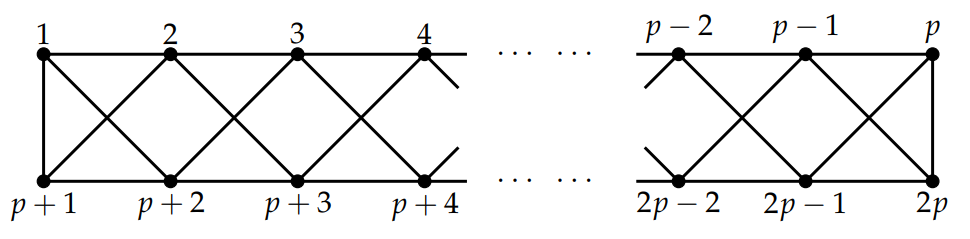
Let \(\left\{1,\cdots,\frac{p-1}{2},p+1,\cdots,\frac{3p-1}{2}\right\}=H_1\) and \(\left\{\frac{p+3}{2},\cdots,p,\frac{3p+3}{2},\cdots, 2p\right\}=H_2\). We know that \(\operatorname{O}\left(\frac{p+1}{2}\right)=\operatorname{O}\left(\frac{3p+1}{2}\right)=\left\{\frac{p+1}{2},\frac{3p+1}{2}\right\}\) by Figure 2. Then we regard Figure 2 as two parts, \(\left\langle\left\{\frac{p+1}{2},\frac{3p+1}{2}\right\}\right\rangle\) and \(\left\langle H_1\cup H_2\right\rangle\). It is not difficult to observe that \[\operatorname{Aut}\left(G_{NC}(\mathbb{Z}_{2p})\right) \cong \operatorname{Aut}\left(\left\langle \{\frac{p+1}{2},\frac{3p+1}{2}\}\right\rangle\right) \times \operatorname{Aut}\left(\left\langle H_1\cup H_2\right\rangle\right).\]
Clearly, \(\operatorname{Aut}\left(\left\langle \{\frac{p+1}{2},\frac{3p+1}{2}\}\right\rangle\right)\cong S_2\). In fact, the induced graph \(\left\langle H_1\cup H_2\right\rangle\) consists of 2 copies of \(H_1\). By Lemma 3(2), \(\operatorname{Aut}\left(\left\langle H_1\cup H_2\right\rangle\right)\cong \operatorname{Aut}(H_1)\wr S_2\). While \(\operatorname{Aut}(H_1)\cong S_2^{\frac{p-1}{2}}\). Thus, \(\operatorname{Aut}\left(G_{NC}(\mathbb{Z}_{2p})\right) \cong S_2\times \left(S_2^{\frac{p-1}{2}}\wr S_2\right)\). ◻
Proposition 4. \(\operatorname{Aut}\left(G_{NC}(\mathbb{Z}_{pq})\right)\cong S_2 \times S_2\), where \(p\) and \(q\) are two distinct odd primes.
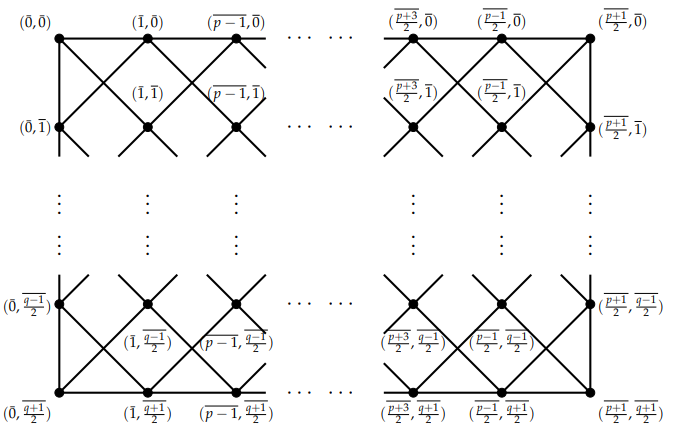
Proof. Since \(\mathbb{Z}_{pq}\cong \mathbb{Z}_p \times \mathbb{Z}_q\), \(G_{NC}(\mathbb{Z}_{pq})\cong G_{NC}(\mathbb{Z}_p \times \mathbb{Z}_q)\). We know that \(x=(x_1,x_2) \in NC(\mathbb{Z}_p \times \mathbb{Z}_q)\) if and only if \(x_1 \in NC(\mathbb{Z}_p)\), \(x_2 \in NC(\mathbb{Z}_q)\) from [5, Proposition 2.1]. It is well known that \(NC(\mathbb{Z}_p)=\{\bar{0},\bar{1}\}\) and hence \(NC(\mathbb{Z}_p \times \mathbb{Z}_q)=\{(\bar{0},\bar{0}), (\bar{0},\bar{1}),(\bar{1},\bar{0}), (\bar{1},\bar{1})\}\). The nil-clean graph of \(\mathbb{Z}_p \times \mathbb{Z}_q\) is shown as follows:
In Figure 3, let the four paths \(\left\{(\bar{0},\bar{0}),(\bar{1},\bar{0}),\cdots,\left(\overline{\frac{p+1}{2}},\bar{0}\right)\right\}\), \(\left\{\left(\bar{0},\overline{\frac{q+1}{2}}\right),\left(\bar{1},\overline{\frac{q+1}{2}}\right),\cdots,\left(\overline{\frac{p+1}{2}},\overline{\frac{q+1}{2}}\right)\right\}\), \(\left\{(\bar{0},\bar{0}),(\bar{0},\bar{1}),\cdots,\left(\bar{0},\overline{\frac{q+1}{2}}\right)\right\}\) and \(\left\{\left(\overline{\frac{p+1}{2}},\bar{0}\right),\left(\overline{\frac{p+1}{2}},\bar{1}\right),\cdots,\left(\overline{\frac{p+1}{2}},\overline{\frac{q+1}{2}}\right)\right\}\) are denoted by \(P_1\), \(P_2\), \(P_3\) and \(P_4\), respectively. Let \(r_1\) and \(r_2\) represent the reflection transformation with the midpoint line of paths \(P_1\) and \(P_2\) as the axis of symmetry and the midpoint line of paths \(P_3\) and \(P_4\) as the axis of symmetry, respectively. It is easy to see that \(I,r_1,r_2,r_1r_2 \in \operatorname{Aut}\left(G_{NC}(\mathbb{Z}_p \times \mathbb{Z}_q)\right)\), which \(I\) is the identity transformation. Then, the images of \(\left(\bar{0},\bar{0}\right)\) under these automorphisms are \((\bar{0},\bar{0})\), \(\left(\overline{\frac{p+1}{2}},\bar{0}\right)\), \(\left(\bar{0},\overline{\frac{q+1}{2}}\right)\) and \(\left(\overline{\frac{p+1}{2}},\overline{\frac{q+1}{2}}\right)\), each of which is of degree 3. All the points except the aforementioned four have a degree of 4 in \(G_{NC}(\mathbb{Z}_p\times \mathbb{Z}_q\) and the automorphism of the graph preserve the degree of the points. So, \(\operatorname{O}\left(\left(\bar{0},\bar{0} \right)\right)=\left\{ (\bar{0},\bar{0}), \left(\overline{\frac{p+1}{2}},\bar{0}\right), \left(\bar{0},\overline{\frac{q+1}{2}}\right), \left(\overline{\frac{p+1}{2}},\overline{\frac{q+1}{2}}\right) \right\}\). By Theorem 2.4, \(|\operatorname{Aut}\left(G_{NC}(\mathbb{Z}_p\times \mathbb{Z}_q)\right)|=2^2=4\). Therefore, \(\operatorname{Aut}\left(G_{NC}(\mathbb{Z}_p\times \mathbb{Z}_q)\right)=\left\{I,r_1,r_2,r_1r_2\right\}\cong S_2\times S_2\). ◻
Finally, we determine the automorphism groups of \(G_{NC}(\mathbb{Z}_{2^kp^l})\), where \(p\) is an odd prime, \(k\) and \(l\) are positive integers.
Proposition 5. \(\operatorname{Aut}\left(G_{NC}(\mathbb{Z}_{2^kp^l})\right)\cong S_{2^kp^{l-1}}\times \left(S_{2^kp^{l-1}}^{\frac{p-1}{2}}\wr S_2\right)\), where \(p\) is an odd prime, \(k\) and \(l\) are positive integers.
Proof. By Lemma 2, we know that \(\overline{G_{NC}}(\mathbb{Z}_{2^kp^l})\) is the \(2^{k-1}p^{l-1}\) blow-up of \(\overline{G_{NC}}(\mathbb{Z}_{2p})\). Now, we give the reduced graph of \(G_{NC}(\mathbb{Z}_{2^kp^l})\),
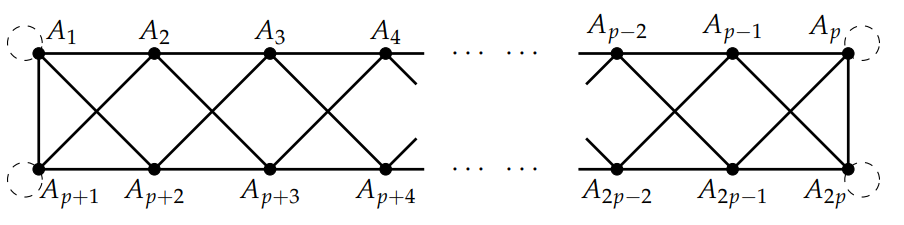
Where each \(A_i(i=1,\ldots,2p)\) contains \(2^{k-1}p^{l-1}\) vertices. Similar to the proof of Proposition 3, we regard Figure 4 as two parts, \(\left\langle A_{\frac{p+1}{2}}\bigcup A_{\frac{3p+1}{2}}\right\rangle\) and \(G_{NC}(\mathbb{Z}_{2^kp^l})-\left(A_{\frac{p+1}{2}}\bigcup A_{\frac{3p+1}{2}}\right)\). Let \(W=\left\langle \bigcup\limits_{i=1}^{\frac{p-1}{2}}A_i, \bigcup\limits_{j=p+1}^{\frac{3p-1}{2}}A_j\right\rangle\). According to the adjacency relationship of the graph, we have \[\operatorname{Aut}\left( G_{NC}(\mathbb{Z}_{2^kp^l})\right) \cong \operatorname{Aut}\left( \left\langle A_{\frac{p+1}{2}}\bigcup A_{\frac{3p+1}{2}}\right\rangle\right) \times \operatorname{Aut}\left(G_{NC}(\mathbb{Z}_{2^kp^l})-\left(A_{\frac{p+1}{2}}\bigcup A_{\frac{3p+1}{2}}\right)\right).\]
Since the subgraph \(\left\langle A_{\frac{p+1}{2}}\bigcup A_{\frac{3p+1}{2}}\right\rangle\) is the null graph with \(2^kp^{l-1}\) vertices, then, we can obtain that \(\operatorname{Aut}\left( \left\langle A_{\frac{p+1}{2}}\bigcup A_{\frac{3p+1}{2}}\right\rangle\right) \cong S_{2^kp^{l-1}}\) by Lemma 3(1). The graph \(G_{NC}(\mathbb{Z}_{2^kp^l})-\left(A_{\frac{p+1}{2}}\bigcup A_{\frac{3p+1}{2}}\right)\) consists of two copies of \(W\). While \(\operatorname{Aut}\left(W \right)\cong S_{2^kp^{l-1}}^{\frac{p-1}{2}}\). By Lemma 3(2), \[\operatorname{Aut}\left(G_{NC}(\mathbb{Z}_{2^kp^l})-\left(A_{\frac{p+1}{2}}\bigcup A_{\frac{3p+1}{2}}\right)\right)\cong S_{2^kp^{l-1}}^{\frac{p-1}{2}}\wr S_2.\]
Thus, \(\operatorname{Aut}\left( G_{NC}(\mathbb{Z}_{2^kp^l})\right)\cong S_{2^kp^{l-1}}\times \left(S_{2^kp^{l-1}}^{\frac{p-1}{2}}\wr S_2\right)\). ◻
This research was supported by the National Natural Science Foundation of China(Grant No. 12261001, 12461001), Research Foundation Ability Enhancement Project for Young and Middle aged Teachers in Guangxi Universities (2025KY0477) and Guangxi Research Project on the Reform of Degree and Postgraduate Education (Grant No. JGY2025361).