
Geometric extremum problems play an important role in secondary and undergraduate mathematics education. Classical methods include reflection transformations, inequality-based reasoning, and calculus techniques [1]. A representative example is the so-called Hu Bugui model, which relates to classical weighted path optimization and optical trajectory problems [2].
Despite their pedagogical value, geometric interpretations often rely on implicit domain assumptions. In particular, expressions of the form \(C-x\) are treated as geometric segment lengths without explicit verification of non-negativity. When the dynamic variable \(x\) ranges over the unconstrained continuum \(\mathbb{R}\), the quantity \(C-x\) can become negative, producing intermediate expressions that lack direct Euclidean interpretation.
In elementary treatments, this issue is often handled implicitly by restricting the admissible position of the dynamic point, or explicitly through piecewise case distinctions. We introduce the term representation legality gap to describe this structural inconsistency between an unconstrained algebraic variable and a non-negative geometric quantity.
This paper proposes an alternative approach: instead of enforcing feasibility externally via piecewise domain subdivisions, we reconstruct the representation by lifting the geometric constraint into an auxiliary scaffolding parameter. This construction ensures that every geometric component remains non-negative and interpretable, allowing global optimization to proceed uniformly over \(\mathbb{R}\).
The reflection method originates from classical geometric optimization problems such as Heron’s shortest path problem [3] and is closely related to Fermat’s principle and Snell’s law in optics [4].
In mathematics education, research on semiotic representations emphasizes cognitive transformations between algebraic, graphical, and geometric registers [5]. However, existing literature primarily focuses on translation between fixed representations rather than algebraic reconstruction to preserve geometric semantics.
In broader mathematical modeling, handling constraints typically involves slack variables, extended formulations, or penalty reformulations [6]. Unlike reflection methods that alter spatial geometric configurations, calculus-based methods that solve the optimization without preserving the underlying geometric representation, or piecewise analysis that fragments the variable domain, our framework maintains the unconstrained objective across \(\mathbb{R}\) by reconstructing its internal representation, embedding geometric feasibility directly into the algebraic decomposition.
Definition 1 (Geometric Legality). Whenever an algebraic expression is interpreted as a Euclidean distance, its value must be non-negative and must correspond to an admissible geometric segment.
Definition 2 (Legality Gap). A representation legality gap occurs when an algebraic objective is defined over a domain \(D \subseteq \mathbb{R}\), but intermediate components fail to maintain geometric legality on subsets of \(D\).
Definition 3 (Constraint Internalization Principle). Constraint internalization is the process of absorbing geometric admissibility conditions into the construction of an auxiliary parametric representation, such that geometric operations act exclusively on legal geometric quantities without requiring piecewise domain restrictions.
To illustrate this mechanism, consider the classical Hu Bugui-type optimization problem over the unconstrained real domain \(x \in \mathbb{R}\):
In the Cartesian coordinate plane with origin \(O(0,0)\), let \(A(0,3)\) be a fixed point on the \(y\)-axis, and let \(P(x,0)\) be a dynamic point sliding along the \(x\)-axis. The term \(\sqrt{x^2+9}\) corresponds to the Euclidean distance:
\[ PA = \sqrt{(x-0)^2 + (0-3)^2} = \sqrt{x^2+9}. \]For the second term \(\frac{3\sqrt{3}-x}{2}\), a direct interpretation as \(\frac{1}{2}PB\) with fixed \(B(3\sqrt{3},0)\) fails for \(x > 3\sqrt{3}\). To maintain geometric legality for all \(x \in \mathbb{R}\), we define the admissible scaffold set for any \(x \in \mathbb{R}\):
\[ \mathcal{L}(x) = \{ L \in \mathbb{R} : L \ge x \}. \]For every \(x \in \mathbb{R}\), \(\mathcal{L}(x)\) is non-empty (for instance, choosing \(L = x + \epsilon\) with \(\epsilon \ge 0\)).
For any chosen \(L \in \mathcal{L}(x)\), we place an auxiliary anchor point \(B(L,0)\) on the \(x\)-axis. Because \(L \ge x\), the segment length \(PB = L – x\) is guaranteed to be non-negative (\(PB \ge 0\)). We construct an auxiliary reference line \(l_L\) passing through \(B(L,0)\), such that the ray from \(B\) toward \(x < L\) makes an angle of \(\alpha = 30^\circ\) with the negative \(x\)-axis:
\[ l_L: x – \sqrt{3}y – L = 0. \]Dropping an orthogonal perpendicular \(PH \perp l_L\) at \(H\) creates a right triangle \(\triangle PBH\) where \(\sin 30^\circ = \frac{PH}{PB} = \frac{1}{2}\), establishing the exact geometric scaling:
\[ PH = \frac{1}{2}PB = \frac{L-x}{2}. \]We now partition the original objective function into an active geometric core \(g(x, L)\) and an algebraic compensating residual:
In this formulation, scaffold validity is explicitly verified by the admissibility condition \(L \in \mathcal{L}(x)\) (which guarantees \(PB \ge 0\)), while reconstruction equivalence is guaranteed unconditionally by the algebraic identity in Eq. (2).
Under this reconstruction, the components of \(g(x, L)\) map faithfully to physical Euclidean segments:
\[ g(x, L) \equiv PA + PH, \quad \text{where } PA = \sqrt{x^2+9} \text{ and } PH = \frac{L-x}{2} \ge 0. \]The residual \(\frac{3\sqrt{3}-L}{2}\) serves as an algebraic compensation and is not required to carry geometric segment semantics. Thus, the reconstructed representation preserves exact algebraic invariance with respect to \(L\). The geometric path minimization on the reference line \(l_L\), illustrated for \(L=3\sqrt{3}\), is shown in Figure 1.
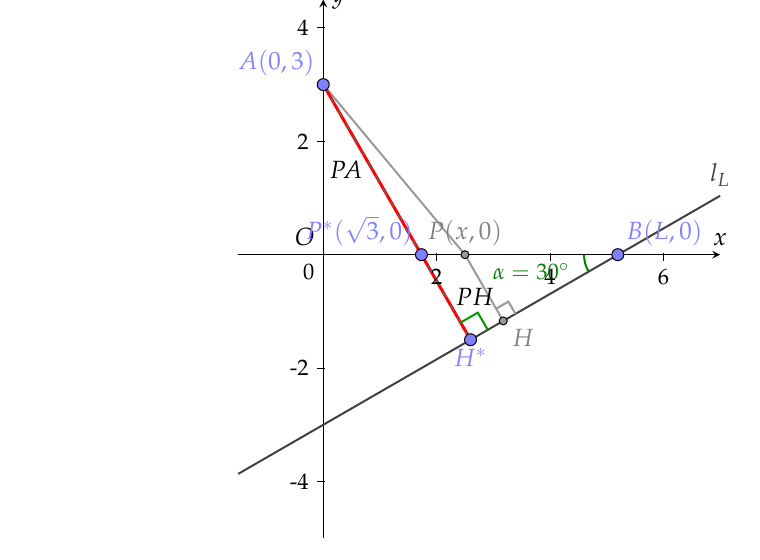
Theorem 1 (Dynamic Geometric Projection Bound). For any \(x \in \mathbb{R}\) and any scaffold parameter \(L \in \mathcal{L}(x)\), the geometric core \(g(x, L) = PA + PH\) satisfies the dynamic projection lower bound:
Proof. In Euclidean plane geometry, for the fixed point \(A(0,3)\) and any point \(H\) on the target reference line \(l_L: x – \sqrt{3}y – L = 0\), the path length satisfies:
\[ PA + PH \ge AH \ge d(A, l_L), \]where the first inequality follows from the Euclidean triangle inequality on \(\triangle PAH\) (with equality holding if and only if \(P\) lies on the line segment \(AH\)), and the second inequality represents the fundamental definition of the orthogonal point-to-line distance (with equality holding if and only if \(AH \perp l_L\)).
Using the point-to-line orthogonal distance formula, the distance from \(A(0,3)\) to \(l_L\) is given by:
\[ d(A, l_L) = \frac{|0 – \sqrt{3}(3) – L|}{\sqrt{1^2 + (-\sqrt{3})^2}} = \frac{|-3\sqrt{3} – L|}{2} = \frac{|L + 3\sqrt{3}|}{2}. \]Because the parametric construction ensures \(g(x, L) \equiv PA + PH\) for any \(L \ge x\), the inequality \(g(x, L) \ge \frac{|L + 3\sqrt{3}|}{2}\) holds unconditionally for all \(x \in \mathbb{R}\) and \(L \in \mathcal{L}(x)\). \(\square\)
Theorem 2 (Global Minimum via Scaffold Invariance). The objective function \(f(x)\) attains a unique global minimum on \(\mathbb{R}\):
\[ f_{\min} = 3\sqrt{3}, \]achieved uniquely at \(x^* = \sqrt{3}\).
Proof. By Theorem 1, for any \(x \in \mathbb{R}\) and any choice of \(L \in \mathcal{L}(x)\), we have \(g(x, L) \ge \frac{|L + 3\sqrt{3}|}{2}\). Using the elementary real inequality \(|u| \ge u\), we obtain:
\[ \frac{|L + 3\sqrt{3}|}{2} \ge \frac{L + 3\sqrt{3}}{2}. \]Substituting this into the reconstructed objective (2) yields:
\[ \begin{aligned} f(x) &= g(x, L) + \frac{3\sqrt{3}-L}{2} \\ &\ge \frac{|L + 3\sqrt{3}|}{2} + \frac{3\sqrt{3}-L}{2} \\ &\ge \frac{L + 3\sqrt{3}}{2} + \frac{3\sqrt{3}-L}{2} \\ &= \frac{L + 3\sqrt{3} + 3\sqrt{3} – L}{2} \\ &= \frac{6\sqrt{3}}{2} = 3\sqrt{3}. \end{aligned} \]The auxiliary parameter \(L\) cancels identically from the inequality, establishing \(f(x) \ge 3\sqrt{3}\) globally for all \(x \in \mathbb{R}\).
To establish equality and uniqueness, all intermediate inequalities must be tight:
Evaluating at \(x^* = \sqrt{3}\) gives \(f(\sqrt{3}) = \sqrt{3+9} + \frac{3\sqrt{3}-\sqrt{3}}{2} = 2\sqrt{3} + \sqrt{3} = 3\sqrt{3}\), confirming the unique global minimum. \(\square\)
Theorem 3 (Parametric Invariant Family). For any constant \(C \in \mathbb{R}\), the global minimum of the parametric family \(f_C(x) = \sqrt{x^2+9} + \frac{C-x}{2}\) shifts linearly with \(C\), while the global minimizer remains invariant:
\[ f_{\min} = \frac{C + 3\sqrt{3}}{2}, \]attained uniquely at \(x^* = \sqrt{3}\) for all \(C \in \mathbb{R}\).
Proof. For any \(x \in \mathbb{R}\) and any scaffold parameter \(L \in \mathcal{L}(x)\), we decompose \(f_C(x)\) into:
\[ f_C(x) = \underbrace{\left(\sqrt{x^2+9} + \frac{L-x}{2}\right)}_{g(x, L)} + \frac{C-L}{2}. \]Here, geometric legality is required only for the active core \(g(x, L)\); the constant residual \(\frac{C-L}{2}\) is purely algebraic and does not need to correspond to a physical geometric distance, thereby accommodating arbitrary \(C \in \mathbb{R}\).
Applying Theorem 1 and the elementary inequality \(|u| \ge u\), we obtain:
\[ f_C(x) \ge \frac{|L + 3\sqrt{3}|}{2} + \frac{C – L}{2} \ge \frac{L + 3\sqrt{3}}{2} + \frac{C – L}{2} = \frac{C + 3\sqrt{3}}{2}. \]The scaffold parameter \(L\) cancels identically for any constant \(C \in \mathbb{R}\). The equality conditions are independent of \(C\), since \(C\) appears only in the algebraic residual. Equality requires \(AP \perp l_L\), whose direction is independent of \(L\). Thus
\[ (x,-3)\cdot(\sqrt{3},1)=0, \]uniquely gives \(x^*=\sqrt{3}\). Since equality is attainable for every \(C \in \mathbb{R}\) (e.g., by taking any \(L \ge \sqrt{3}\)), the unique minimizer remains \(x^*=\sqrt{3}\) for all \(C \in \mathbb{R}\). \(\square\)
The framework presented here formalizes geometric optimization as a process of representation reconstruction.
Rather than attempting to force a global Euclidean distance interpretation directly onto a signed algebraic term, the parametric reconstruction decomposes the objective:
\[ F(x) = \underbrace{G(x, L)}_{\text{geometrically legal}} + \underbrace{R(x, L)}_{\text{algebraic residual}}, \quad L \in \mathcal{L}(x). \]This mechanism offers an illuminating methodological parallel:
By lifting constraints into the representation structure itself, the optimization problem is solved uniformly on \(\mathbb{R}\) without piecewise branch analysis.
We investigated the representation legality gap in Hu Bugui-type optimization problems and proposed a parametric reconstruction framework based on constraint internalization. By introducing an auxiliary scaffold parameter, non-negative geometric admissibility is preserved during intermediate construction, while exact algebraic cancellation ensures an invariant global lower bound across \(\mathbb{R}\). This perspective clarifies the boundary between algebraic expressions and geometric interpretations, offering a systematic template for geometric optimization.
Author Contributions: All authors contributed equally to the conception, development, and preparation of this manuscript. All authors read and approved the final version of the manuscript for publication.
Conflicts of Interest: The authors declare that they have no conflicts of interest related to this work.
Data Availability: No datasets were generated or analyzed during the present study; therefore, data availability is not applicable.
Funding Information: This research received no external funding.