
We use logarithmic abelian type invariants of second order to state necessary and sufficient criteria for finite towers of successive maximal unramified abelian 3-extensions, so-called Hilbert \(3\)-class field towers, over quadratic number fields to possess a length of precisely two respectively three stages. The underlying quadratic fields have an elementary bicyclic \(3\)-class group and one of four well-known simple \(3\)-principalization types in their four unramified cyclic cubic extensions. In two main theorems, we state the outstanding new criteria, and we identify the graph theoretic position of crucial Galois groups. By means of challenging computations, our theory is underpinned by numerical prototypes of the four simple \(3\)-principalization types and both tower lengths. For two complex \(3\)-principalization types, we can only state theorems with partial conditions.
Let \(k=\mathbb{Q}(\sqrt{d})\) be a quadratic number field with fundamental discriminant \(d\), elementary bicyclic \(3\)-class group \(\mathrm{Cl}_3(k)\simeq (\mathbb{Z}/3\mathbb{Z})^2\), and one of six \(3\)-principalization types [1, 2], [3, p, 91], also known as capitulation types or transfer kernel types (TKT),
\[\label{eqn:SimpleTKTComplexTKT} \begin{aligned} & \text{E.6: }\varkappa(k)\sim(1122), \qquad & \text{G.16: }\varkappa(k)\sim(4231), \\ & \text{E.8: }\varkappa(k)\sim(1231), \qquad & \text{H.4: }\varkappa(k)\sim(2122), \\ & \text{E.9: }\varkappa(k)\sim(2231), \qquad & \text{two \textbf{complex} types.} \\ & \text{E.14: }\varkappa(k)\sim(3122), \\ & \text{four \textbf{simple} types,} \end{aligned} \tag{1}\]
For the simple types, our goal is a necessary and sufficient criterion for the coincidence of the \(\sigma\)-automorphism group \(S=\mathrm{Gal}(\mathrm{F}_3^\infty(k)/k)\) of the maximal unramified pro-\(3\)-extension of \(k\) and the \(\sigma\)-Galois group \(M=\mathrm{Gal}(\mathrm{F}_3^2(k)/k)\) of the maximal metabelian unramified \(3\)-extension of \(k\), independently of the so-called state, which is given in terms of the logarithmic abelian type invariants (ATI) \(\alpha(k)=(\alpha_i)_{i=1}^4\) of the \(3\)-class groups \(\alpha_i:=\mathrm{ATI}(\mathrm{Cl}_3(E_i))\) of the four unramified cyclic cubic extensions \(E_i/k\), \(1\le i\le 4\). When \(S=M\), then the \(3\)-class field tower of \(k\) has exactly two stages, \(\ell_3(k)=2\). In the case of non-coincidence, \(S\ne M\), we have precisely three stages, \(\ell_3(k)=3\), for simple types, but we have three or more stages, \(\ell_3(k)\ge 3\), for complex types. Then we determine the path between \(M\) and \(S\) in the descendant tree of either the root \(Q=\mathrm{SmallGroup}(729,49)\), briefly \(\langle 729,49\rangle\), for the types E.6, E.14 and H.4, or the root \(U=\mathrm{SmallGroup}(729,54)\), briefly \(\langle 729,54\rangle\), for the types E.8, E.9 and G.16 [4] (the designations non-CF group \(Q\) and \(U\) are due to Ascione et al. [5, Tbl. 1, p. 265, Tbl. 2, p. 266, Tbl. 3, p. 268]). We briefly speak about the Q-tree \(\mathcal{T}(Q)\) and the U-tree \(\mathcal{T}(U)\).
The present article analyzes Hilbert \(3\)-class field towers with a length \(\ell_3(k)\in\lbrace 2,3\rbrace\) for simple types, presumably unbounded length \(\ell_3(k)\ge 2\) for complex types, and a periodic group \(M\) of fixed coclass \(\mathrm{cc}(M)=2\), called second maximal class in [5], and odd nilpotency class \(\mathrm{cl}(M)\ge 5\) for simple types, even nilpotency class \(\mathrm{cl}(M)\ge 6\) for complex types. The metabelianization \(M=S/S^{\prime\prime}\) of \(S\) is located on one of two coclass trees with roots \(\langle 243,6\rangle\), the parent of \(\langle 729,49\rangle\), respectively \(\langle 243,8\rangle\), the parent of \(\langle 729,54\rangle\), in the form of vertices with depth \(\mathrm{dp}(M)=1\) for simple types, and \(\mathrm{dp}(M)=2\) for complex types. The \(n\)-th state of \(M\) is characterized by the ATI \[\label{eqn:States} \alpha(k)= \begin{cases} \lbrack(n+3,n+2),1^3,(21)^2\rbrack \text{ for the types E.6, E.14 and H.4, and} \\ \lbrack(n+3,n+2),(21)^3\rbrack \text{ for the types E.8, E.9 and G.16}, \end{cases} \tag{2}\] with heterocyclic polarization \((n+3,n+2)\), or also by odd class \(\mathrm{cl}(M)=5+2n\) for simple types and even class \(\mathrm{cl}(M)=6+2n\) for complex types, for each integer \(n\ge 0\), called the state parameter. In the case of non-coincidence, \(S\ne M\), we emphasize the remarkable fact that for each of these two descendant trees, there exists a non-metabelian infinite path with strictly alternating step sizes \(s=2\) and \(s=1\) and vertices of the skeleton type [3, p. 91] of the mainlines of the coclass trees, that is, c.18: \(\varkappa(k)\sim(0122)\), respectively c.21: \(\varkappa(k)\sim(0231)\), [6], beginning at the bifurcation \(Q=\langle 729,49\rangle\), respectively \(U=\langle 729,54\rangle\), from which the Schur \(\sigma\)-groups \(S\) [7] of the ground state \(n=0\) and of all excited states \(n\ge 1\) branch off as terminal leaves with step size \(s=2\) and depth \(\mathrm{dp}(S)=1\) for simple types and odd \(\mathrm{dp}(S)\ge 3\) for complex types.
We begin with arithmetic foundations in §3, §4 and group theoretic techniques in §5. The main results and proofs are contained in §7 and §9, ostensively visualized by tree diagrams in §10, and underpinned by computer experiments in §11 and prototypes in §12.
Let \(K/\mathbb{Q}\) be an algebraic number field. Given a prime number \(p\in\mathbb{P}\), we denote the Sylow \(p\)-subgroup \(\mathrm{Syl}_p\mathrm{Cl}(K)\) of the ideal class group \(\mathrm{Cl}(K)\) of \(K\) by \(\mathrm{Cl}_p(K)\), and we call it the \(p\)-class group of \(K\).
Definition 1. The maximal unramified \(p\)-extension \(E\) of \(K\) with abelian Galois group \(\mathrm{Gal}(E/K)\) is called the Hilbert \(p\)-class field of \(K\), and is denoted by \(\mathrm{F}_p^1(K)\).
The concept \(p\)-class field was coined by Hilbert in his ‘‘Zahlbericht’’ [8, Satz 94, p. 279], since Hilbert conjectured an isomorphism of the automorphism group \(\mathrm{Gal}(\mathrm{F}_p^1(K)/K)\) to the \(p\)-class group \(\mathrm{Cl}_p(K)\) of \(K\). His hypothesis turned out to be a special case of the Artin reciprocity law [9, Allgemeines Reziprozitätsgesetz, p. 361].
The construction of Hilbert \(p\)-class fields may be iterated and leads to the maximal unramified pro-\(p\)-extension \(T\) of \(K\) with a potentially infinite topological pro-\(p\) Galois group \(\mathrm{Gal}(T/K)\), endowed with the Krull topology.
Definition 2. For any non-negative integer \(q\in\mathbb{N}_0\), the \(q\)-th \(p\)-class field of \(K\) is defined recursively by \(\mathrm{F}_p^0(K):=K\) for \(q=0\), and \(\mathrm{F}_p^q(K):=\mathrm{F}_p^1(\mathrm{F}_p^{q-1}(K))\) for \(q\ge 1\).
The ascending tower \[\label{eqn:Tower} K=\mathrm{F}_p^0(K)\le\mathrm{F}_p^1(K)\le\mathrm{F}_p^2(K)\le\ldots\le\mathrm{F}_p^q(K)\le\ldots\le\mathrm{F}_p^\infty(K), \tag{3}\] of successive Hilbert \(p\)-class fields is called the (unramified) Hilbert \(p\)-class field tower of \(K\), and its union is denoted by \(\mathrm{F}_p^\infty(K):=\bigcup_{q=0}^\infty\,\mathrm{F}_p^n(K)\).
If the tower becomes stationary with \(\mathrm{F}_p^q(K)=\mathrm{F}_p^{q+1}(K)\) for some \(q\in\mathbb{N}_0\), then the non-negative integer \(\ell_p(K):=\min\lbrace q\in\mathbb{N}_0\mid \mathrm{F}_p^q(K)=\mathrm{F}_p^{q+1}(K)\rbrace\in\mathbb{N}_0\) is called the length of the \(p\)-class field tower of \(K\), otherwise the length \(\ell_p(K):=\infty\) is unbounded.
Generally, if \(\ell_p(K)\ge q\), then the Galois group \(G=\mathrm{Gal}(\mathrm{F}_p^q(K)/K)\) of the \(q\)-th \(p\)-class field of \(K\) has soluble length (or derived length) \(\mathrm{sl}(G)=q\) (or \(\mathrm{dl}(G)=q\)). In particular:
Definition 3. For \(\ell_p(K)\ge 2\), the second Hilbert \(p\)-class field \(\mathrm{F}_p^2(K)\) is the maximal unramified \(p\)-extension of \(K\) with metabelian Galois group \(M:=\mathrm{Gal}(\mathrm{F}_p^2(K)/K)\), since a group \(M\) with soluble length \(\mathrm{sl}(M)=2\) is dubbed metabelian because its commutator subgroup \(M^\prime\) is abelian. \(M\) is called the second \(p\)-class group of \(K\).
As opposed, we call the topological pro-\(p\) Galois group \(S:=\mathrm{Gal}(\mathrm{F}_p^\infty(K)/K)\) of the maximal unramified pro-\(p\)-extension \(\mathrm{F}_p^\infty(K)\) of \(K\) the (full \(p\)-class field) tower group of \(K\). The group \(M=S/S^{\prime\prime}\) is the metabelianization, i.e., the second derived quotient, of the full tower group \(S\).
In the present article, our focus will be on criteria for the distinction between metabelian two-stage towers with \(\mathrm{F}_p^2(K)=\mathrm{F}_p^\infty(K)\), \(M=S\), and \(\ell_p(K)=2\), and on the other hand non-metabelian towers with length \(\ell_p(K)\ge 3\), in the situation with the particular prime \(p=3\).
In the Introduction §2, we used transfer kernel types (TKT) \(\varkappa(k)\) and logarithmic abelian type invariants (ATI) \(\alpha(k)\) of quadratic fields \(k=\mathbb{Q}(\sqrt{d})\) to describe the goals of this article. Now we give precise definitions of these concepts for a quadratic number field \(k\) with fundamental discriminant \(d(k)=d\) and elementary bicyclic \(3\)-class group \(\mathrm{Cl}_3(k)\simeq (\mathbb{Z}/3\mathbb{Z})^2\). Such a field has four unramified cyclic cubic extensions \(E_i/k\), \(1\le i\le 4\). A natural order of these four extensions \(E_i\), which are dihedral of degree six over \(\mathbb{Q}\) and share a common discriminant \(d(E_i)=d^3\), is given by increasing regulators \(R_1<\ldots<R_4\) of the non-Galois absolutely cubic subfields \(L_i<E_i\).
Definition 4. Let \(T_i:\,\mathrm{Cl}_3(k)\to\mathrm{Cl}_3(E_i)\) be the transfer of \(3\)-classes from \(k\) to \(E_i\), which is also called the class extension homomorphism \(\mathfrak{a}\mathcal{P}_k\mapsto(\mathfrak{a}\mathcal{O}_{E_i})\mathcal{P}_{E_i}\). According to Theorem 94 by Hilbert [8, p. 279], \(T_i\) is not injective. Therefore, let \(H_j\) be the cyclic subgroup of order \(3\) of \(\mathrm{Cl}_3(k)\simeq (\mathbb{Z}/3\mathbb{Z})^2\) which corresponds to \(E_j\) by Artin’s reciprocity law [9], for each \(1\le j\le 4\), that is, \(H_j=N_{E_j/k}\mathrm{Cl}_3(E_j)\) are the norm class groups. Then the transfer kernel type (TKT) of \(k\), \(\varkappa(k)=(\varkappa_i)_{i=1}^4\), (see [2, 10] for a permutation-invariant version as \(S_4\)-orbit) is defined by
\[\label{eqn:TKT} \varkappa_i:= \begin{cases} 0 & \text{ if }\ker(T_i)=\mathrm{Cl}_3(k), \\ j & \text{ if }\ker(T_i)=H_j. \end{cases} \tag{4}\]
Definition 5. The abelian type invariants (ATI) of \(k\), \(\alpha(k)=(\alpha_i)_{i=1}^4\), consist of the logarithmic abelian type invariants \(\alpha_i:=\mathrm{ATI}(\mathrm{Cl}_3(E_i))\) of the \(3\)-class groups of the four unramified cyclic cubic extensions \(E_i/k\), \(1\le i\le 4\). (In [11], the ATI were called the transfer target type (TTT), \(\tau(k)\).) The Artin pattern of \(k\) is the pair \(\mathrm{AP}(k):=(\varkappa(k),\alpha(k))\).
The logarithmic notation is very compact, for instance, \(21\hat{=}(9,3)\hat{=}(\mathbb{Z}/9\mathbb{Z})\times(\mathbb{Z}/3\mathbb{Z})\), \(1^3\hat{=}(3,3,3)\hat{=}\) \((\mathbb{Z}/3\mathbb{Z})^3\), and \((n+3,n+2)\hat{=}(3^{n+3},3^{n+2})\hat{=}(\mathbb{Z}/3^{n+3}\mathbb{Z})\times(\mathbb{Z}/3^{n+2}\mathbb{Z})\), for any state parameter \(n\ge 0\).
Definition 6. The abelian type invariants of second order (ATI2) of \(k\), \(\alpha^{(2)}(k)=(\alpha(E_i))_{i=1}^4\), form a quartet where each component consists of the logarithmic abelian type invariants (ATI) \[\label{eqn:ATI2} \alpha(E_i):=\lbrack\mathrm{ATI}(\mathrm{Cl}_3(E_i));\quad\mathrm{ATI}(\mathrm{Cl}_3(E_{i,1})),\ldots,\mathrm{ATI}(\mathrm{Cl}_3(E_{i,n_i}))\rbrack, \tag{5}\] of the \(3\)-class group of the unramified cyclic cubic extension \(E_i/k\), and of the \(3\)-class groups of the unramified cyclic cubic extensions \(E_{i,j}/E_i\), \(1\le j\le n_i\), where \(n_i=4\) if \(\mathrm{Cl}_3(E_i)\) is bicyclic, and \(n_i=13\) if \(\mathrm{Cl}_3(E_i)\) is (elementary) tricyclic. Note that \(\lbrack E_{i,j}:k\rbrack=9\) and \(\lbrack E_{i,j}:\mathbb{Q}\rbrack=18\).
The decision, whether a finite metabelian \(p\)-group \(M\) is admissible as the second \(p\)-class group \(M=\mathrm{Gal}(\mathrm{F}_p^2(K)/K)\) of a quadratic number field \(K=\mathbb{Q}(\sqrt{d})\), for some odd prime \(p\), or not, can be made with the aid of group theoretic requirements: it is necessary that there exists an involutory automorphism \(\sigma\in\mathrm{Aut}(M)\) of order \(\mathrm{ord}(\sigma)=2\) which acts as the inversion \(x\mapsto x^{-1}\) on the first and second cohomology group \(H^i(M,\mathbb{F}_p)\), for \(i\in\lbrace 1,2\rbrace\). The same conditions are required for any pro-\(p\)-group \(S\) to be admissible as the full \(p\)-class field tower group \(S=\mathrm{Gal}(\mathrm{F}_p^\infty(K)/K)\) [12, Lem. (4.1) and (4.2), p. 217].
Definition 7. A pro-\(p\)-group with this property is called \(\sigma\)-group or group with \(\sigma\)-automophism.
Let \(p\) be a prime number and let \(G\) be a pro-\(p\)-group. The dimension of cohomology groups of \(G\) acting on the finite field \(\mathbb{F}_p\) as a \(G\)-module is crucial for applications in class field theory.
Definition 8.The generator rank of \(G\) is the dimension \(d_1(G)=\dim_{\mathbb{F}_p}(H^1(G,\mathbb{F}_p))\), and the relation rank of \(G\) is the dimension \(d_2(G)=\dim_{\mathbb{F}_p}(H^2(G,\mathbb{F}_p))\).
In 1964, Shafarevich [13] determined bounds for the relation rank of the automorphism group \(G=\mathrm{Gal}(\mathrm{F}_{p,\mathcal{S}}^\infty(K)/K)\) of the maximal pro-\(p\)-extension \(\mathrm{F}_{p,\mathcal{S}}^\infty(K)\) of an algebraic number field \(K\) which is unramified outside of an assigned finite set \(\mathcal{S}\) of (real archimedean or non-archimedean) places. In the special case of the maximal (everywhere) unramified pro-\(p\)-extension \(\mathrm{F}_{p}^\infty(K)\) with \(\mathcal{S}=\emptyset\), the Shafarevich theorem states the following sharp estimate.
Theorem 1. If the signature of \(K\) is \((r_1,r_2)\) (and thus \(r_1+2r_2=\lbrack K:\mathbb{Q}\rbrack\)), the torsionfree Dirichlet unit rank of \(K\) is \(r=r_1+r_2-1\), and \(\theta\in\lbrace 0,1\rbrace\) is an indicator for the existence of a primitive \(p\)-th root of unity in \(K\), then the Shafarevich bounds for the relation rank of the \(p\)-class field tower group \(S=\mathrm{Gal}(\mathrm{F}_p^\infty(K)/K)\) are given by \[\label{eqn:Unramified} d_1(S)\le d_2(S)\le d_1(S)+r+\theta. \tag{6}\]
Proof. There is a misprint in [13, Formula (18′)] which was corrected in [6, Thm. 5.1, p.28]. For \(\mathcal{S}=\emptyset\), the correction immediately yields the bounds in Formula (6). ◻
Definition 9. A pro-\(p\)-group \(G\) is called a Schur \(\sigma\)-group, or a group possessing a balanced presentation, if \(d_2(G)=d_1(G)\), and it is called a Schur\(+1\) \(\sigma\)-group if \(d_2(G)=d_1(G)+1\).
Corollary 1. Let \(p\) be an odd prime. Then the \(p\)-class field tower group \(S=\mathrm{Gal}(\mathrm{F}_p^\infty(k)/k)\) of a quadratic number field \(k=\mathbb{Q}(\sqrt{d})\) must be a Schur \(\sigma\)-group, when \(k\) is imaginary quadratic (with negative discriminant \(d<0\)), and it may be a Schur\(+1\) \(\sigma\)-group or a Schur \(\sigma\)-group, when \(k\) is real (with positive discriminant \(d>0\)).
Proof. Only for \(p=3\), the primitive \(p\)-th roots of unity are contained in an imaginary quadratic field, namely \(k=\mathbb{Q}(\sqrt{-3})\), but this field has class number one and thus a trivial \(3\)-class field tower. An imaginary quadratic field has the signature \((r_1,r_2)=(0,1)\), its unit rank is \(r=0+1-1=0\), and the Shafarevich bounds become tight \(d_1(S)\le d_2(S)\le d_1(S)+0+0=d_1(S)\), i. e., \(S\) has a balanced presentation with \(d_2(S)=d_1(S)\). However, a real quadratic field, which certainly cannot contain an imaginary primitive \(p\)-th root of unity for an odd prime \(p\), has the signature \((r_1,r_2)=(2,0)\), unit rank \(r=2+0-1=1\) and the Shafarevich bounds are \(d_1(S)\le d_2(S)\le d_1(S)+1+0=d_1(S)+1\), i. e., \(S\) may be a Schur\(+1\) \(\sigma\)-group or a Schur \(\sigma\)-group. ◻
There arises a basic partially mathematical and partially philosophical question: Which of our results may be claimed for any value of the state parameter \(n\) ?
\(\bullet\) It is clear that our experimental information about concrete numerical realizations of our theoretical claims are very limited, although they are based on the most extensive database of relevant arithmetical invariants for quadratic fields \(k=\mathbb{Q}(\sqrt{d})\) available currently. It is due to Michael Raymond Bush in 2015, see subsection §11.1. The highest excited state for which we know a single numerical example \(d=705\,576\,037\) of complex type H.4 is \(n=3\) (ES3). The biggest example \(d=336\,698\,284\) of a simple type E.14 has only \(n=2\) (ES2). The characteristic polarizations \(\alpha_1(k)\) of the states are the heterocyclic \(3\)-groups \((27,9)\) for \(n=0\) (GS), \((81,27)\) for \(n=1\) (ES1), \((243,81)\) for \(n=2\) (ES2), and \((729,243)\) for \(n=3\) (ES3), whereas no real quadratic examples are known with \((2187,729)\) for \(n=4\) (ES4). So the bound \(n\le 3\) for the state would be sufficient to explain all available experimental data concerning prototypes and other paradigms in §12.
\(\bullet\) Our number theoretic statements are derived from group theoretic theorems by means of the Artin reciprocity law [9]. So the former are subject to the same bounds as the latter.
\(\bullet\) By top-down techniques we understand the construction of finite \(3\)-quotients \(\mathcal{L}/\mathcal{U}\) of infinite limit groups \(\mathcal{U}\triangleleft\mathcal{L}\), or also the parametrized pc-presentation (power-commutator presentation) of an infinite sequence \((M_n^i)_{n\ge 0}\) of finite \(3\)-groups. Due to internal limitations of the maximal word-length in Magma [14], the bound \(n\le 7\) cannot be surpassed [3, Rmk 3.1, p. 95].
\(\bullet\) By bottom-up techniques we understand the construction of descendants \(D=P-\#s;i\) (with step-size \(s\) and counter \(i\)) of finite \(3\)-groups \(P=\pi(D)\) (with parent-projection \(\pi\)) by means of the \(p\)–group generation algorithm (or extension algorithm) by Newman and O’Brien [15– 17]. Here, no limitations of storage capacity (RAM) and no bounds for data types arise in Magma [14]. The amount of required CPU time, however, even on fast processors, suggests reasonable bounds \(n\le 19\) for difficult cases or at most \(n\le 29\) for easy cases (simple types) [3, Rmk 3.2, p. 96].
\(\bullet\) The connection between the state parameter \(n\) and logarithmic order (lo), nilpotency class (cl) and coclass (cc) is given in Table 1, for simple and complex types separately.
| State | Simple | Complex | Context | Theory of | ||||
|---|---|---|---|---|---|---|---|---|
| \(n\) | lo | cl | cc | lo | cl | cc | ||
| 2 | 14 | 9 | 5 | 17 | 11 | 6 | Prototypes, | Numbers |
| 3 | 17 | 11 | 6 | 20 | 13 | 7 | paradigms | |
| 6 | 26 | 17 | 9 | 29 | 19 | 10 | Top-down | Groups |
| 7 | 29 | 19 | 10 | 32 | 21 | 11 | methods | |
| 18 | 62 | 41 | 21 | 65 | 43 | 22 | difficult | Groups |
| 19 | 65 | 43 | 22 | 68 | 45 | 23 | Bottom-up | |
| 28 | 92 | 61 | 31 | 95 | 63 | 32 | easy | Groups |
| 29 | 95 | 63 | 32 | 98 | 65 | 33 | Bottom-up | |
\(\bullet\) In spite of the finite bounds which are necessary for computations with computer algebra systems like Magma [14], it is our philosophical conviction that knowledge of either an infinite limit group or a parametrized pc-presentation justifies statements involving potential infinitude.
Based on this opinion, we now state our main theorems in section §7 and we give proofs in §8.
There is a remarkable difference between the simple types E.6: \(\varkappa(k)\sim(1122)\), E.8: \(\varkappa(k)\sim(1231)\), E.9: \(\varkappa(k)\sim(2231)\), E.14: \(\varkappa(k)\sim(3122)\), in section E of the paper [18, p. 36] by Scholz and Taussky, and the complex types G.16: \(\varkappa(k)\sim(4231)\), H.4: \(\varkappa(k)\sim(2122)\) [18, pp. 36-38]. For simple types, a non-metabelian \(3\)-class field tower has precisely three stages, \(\ell_3(k)=3\), whereas for complex types, the length \(\ell_3(k)\ge 3\) is unbounded.
Theorem 2. For simple types, the length \(\ell_3(k)\) of the Hilbert \(3\)-class field tower of \(k\) is given as follows. For an imaginary quadratic field \(k\) with \(d<0\), there are always three stages, \(\ell_3(k)=3\). For a real quadratic field \(k\) with \(d>0\), the abelian type invariants of second order \(\alpha^{(2)}(k)\) are required for the distinction: for the simple types E.6: \((1122)\) and E.14: \((3122)\), we have two stages, \(\ell_3(k)=2\), if and only if
\[\label{eqn:TwoStagesQ} \alpha^{(2)}(k)=(\overbrace{\lbrack(n+3,n+2);\alpha_0,(n+3,n+1,1)^3\rbrack}^{\text{Heterocyclic Polarization}}, \quad\overbrace{\lbrack 1^3;\alpha_0,\mathbf{(1^3)^3},(1^2)^9\rbrack,\quad\lbrack 21;\alpha_0,\mathbf{(21)^3}\rbrack^2}^{\text{Stabilization}}), \tag{7}\] and we have three stages, \(\ell_3(k)=3\), if and only if
\[\label{eqn:ThreeStagesQ} \alpha^{(2)}(k)=(\overbrace{\lbrack(n+3,n+2);\alpha_0,(n+3,n+1,1)^3\rbrack}^{\text{Heterocyclic Polarization}}, \quad\overbrace{\lbrack 1^3;\alpha_0,\mathbf{(21^2)^3},(1^2)^9\rbrack,\quad\lbrack 21;\alpha_0,\mathbf{(31)^3}\rbrack^2}^{\text{Stabilization}}); \tag{8}\] for the simple types E.8: \((1231)\) and E.9: \((2231)\), we have two stages, \(\ell_3(k)=2\), if and only if
\[\label{eqn:TwoStagesU} \alpha^{(2)}(k)=(\overbrace{\lbrack(n+3,n+2);\alpha_0,(n+3,n+1,1)^3\rbrack}^{\text{Heterocyclic Polarization}}, \quad\overbrace{\lbrack 21;\alpha_0,\mathbf{(21)^3}\rbrack^3}^{\text{Stabilization}}), \tag{9}\] and we have three stages, \(\ell_3(k)=3\), if and only if
\[\label{eqn:ThreeStagesU} \alpha^{(2)}(k)=(\overbrace{\lbrack(n+3,n+2);\alpha_0,(n+3,n+1,1)^3\rbrack}^{\text{Heterocyclic Polarization}}, \quad\overbrace{\lbrack 21;\alpha_0,\mathbf{(31)^3}\rbrack^3}^{\text{Stabilization}}); \tag{10}\] for each state, parametrized by the integer \(n\ge 0\) (ground state \(n=0\), excited states \(n\ge 1\)). Uniformly, the ATI of the first Hilbert \(3\)-class field \(\mathrm{F}_3^1(k)\) are denoted by \(\alpha_0:=((n+2)^2,1)\).
Theorem 2 only gives the connection between the length \(\ell_3(k)\) and the ATI2 \(\alpha^{(2)}(k)\). So we need additional information on the Galois groups \(M=\mathrm{Gal}(\mathrm{F}_3^2(k)/k)\) and \(S=\mathrm{Gal}(\mathrm{F}_3^\infty(k)/k)\) in the case of non-coincidence, i.e., \(\ell_3(k)=3\). After some definitions, this will be done in Theorem 3.
A transfer kernel type (TKT) \(\varkappa=(\varkappa_1,\ldots,\varkappa_4)\) is called skeleton type if a single component \(\varkappa_i=0\) is a total capitulation, and hull type if all components \(\varkappa_i\in\lbrace 1,\ldots,4\rbrace\) are partial capitulations. For an imaginary quadratic field \(k\), the capitulation type \(\varkappa(k)\) must be a hull type.
Definition 10. By the cover of a finite metabelian \(3\)-group \(M\) (terminology due to Mike F. Newman), we understand the collection of all (isomorphism classes of) finite non-metabelian \(\sigma\)-groups \(S\), having \(M\) isomorphic to their second derived quotient, i.e., their metabelianization, \[\label{eqn:Cover} \mathrm{cov}(M):=\lbrace S\mid\mathrm{dl}(S)\ge 3,\ S/S^{\prime\prime}\simeq M\rbrace, \ \mathrm{cov}_\ast(M):=\lbrace S\in\mathrm{cov}(M)\mid S \text{ is a Schur }\sigma\text{-group}\rbrace. \tag{11}\]
In the sequel, we are going to use the ANUPQ-notation of iterated descendant groups by relative identifiers, ‘‘descendant \(=\) parent\(-\#s;j\)’’ [19] with step size \(1\le s\le\nu\), bounded by the nuclear rank \(\nu\), and counter \(1\le j\le N_s\), bounded by the number of \(s\)-descendants \(N_s\).
Theorem 3(Structure of 3-class field towers with precisely three stages for simple types).There exists a unique \(\sigma\)-group \(F\), the fork, with nilpotency class \(\mathrm{cl}(F)=4\) and nuclear rank \(\nu(F)=2\), causing a bifurcation, such that the path between the metabelian group \(M=S/S^{\prime\prime}\) with relation rank \(d_2(M)=3\) and the non-metabelian Schur \(\sigma\)-group \(S\) of relation rank \(d_2(M)=2\) in the descendant tree of \(\mathrm{SmallGroup}(9,2)=(\mathbb{Z}/3\mathbb{Z})^2\) is given by the union of the two paths (Figure 1).
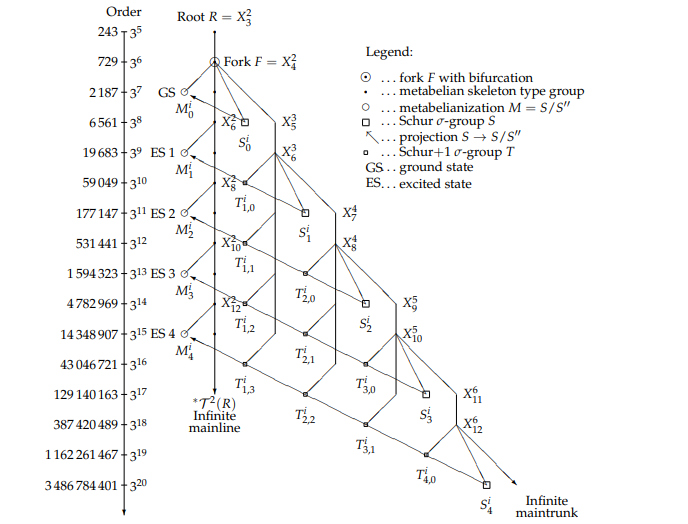
\[\label{eqn:SimplePath} M=M_n^i:=F(-\#1;1-\#1;1)^n\lbrack-\#1;i\rbrack \quad \text{ and } \quad S=S_n^i:=F(-\#2;1-\#1;1)^n\lbrack-\#2;i\rbrack, \tag{12}\] where the parentheses \((\,)\) include vertices of skeleton type and the brackets \(\lbrack\,\rbrack\) include vertices of simple hull type. The final counter \(i=2,3,4\) depends on the capitulation type, E.6 for \(i=2\), E.14 for \(i=3,4\) on the \(Q\)-tree, and E.8 for \(i=2\), E.9 for \(i=3,4\) on the \(U\)-tree. The exponent \(n\) of the skeleton part expresses iteration and is the non-negative integer in the nilpotency class \(\mathrm{cl}(M)=\mathrm{cl}(S)=5+2n\), i.e., the state parameter. Finally, \(F\) is the fork between \(M\) and \(S\). In the case of a real quadratic field \(k\), the metabelian group \(M\) itself and, if \(n\ge 1\) (ES!), additional non-metabelian Schur\(+1\) \(\sigma\)-groups (all of them with relation rank \(d_2=3\)), are admissible for \(S\):
\[\label{eqn:SimplePathReal} S=T_{n,u}^i:=F(-\#2;1-\#1;1)^u(-\#1;1-\#1;1)^{n-u}\lbrack-\#1;i\rbrack \text{ with } 1\le u\le n, \text{ i.e.} \tag{13}\]
Ostensively: if \(v:=n-u\), then the pairs \((u,v)\) satisfy \(u+v=n\) and run through \((1,n-1),\ldots,(n,0)\).
The cover of the second \(3\)-class group \(M_n^i\) with \(i=2,3,4\) becomes bigger when the state parameter \(n\ge 0\) increases. It has \(n+1\) elements, and so it is a singleton in the ground state (GS), \(n=0\):
\[\label{eqn:CovMSimple} \mathrm{cov}(M_n^i)=\lbrace T_{n,u}^i\mid 1\le u\le n\rbrace\cup\lbrace S_n^i\rbrace \quad \text{ and } \quad \mathrm{cov}_\ast(M_n^i)=\lbrace S_n^i\rbrace. \tag{14}\]
As mentioned at the beginning of the previous subsection §7.1, a non-metabelian \(3\)-class field tower has precisely three stages, \(\ell_3(k)=3\), for simple types, whereas the length \(\ell_3(k)\ge 3\) is unbounded for the complex types G.16: \(\varkappa(k)\sim(4231)\), H.4: \(\varkappa(k)\sim(2122)\) [18, pp. 36-38].
Theorem 4. For complex types, the length \(\ell_3(k)\) of the Hilbert \(3\)-class field tower of \(k\) is given as follows. For an imaginary quadratic field \(k\) with \(d<0\), there are always at least three stages, \(\ell_3(k)\ge 3\). For a real quadratic field \(k\) with \(d>0\), the abelian type invariants of second order \(\alpha^{(2)}(k)\) are required for the distinction: for the complex type H.4, we have the following implications:
\(\bullet\) If we have two stages, \(\ell_3(k)=2\), then
\[\label{eqn:TwoOrThreeStagesO} \alpha^{(2)}(k)=(\overbrace{\lbrack(n+3,n+2);\alpha_0,(n+\mathbf{3},n+1,1)^3\rbrack}^{\text{Heterocyclic Polarization}}, \quad\overbrace{\lbrack 1^3;\alpha_0,\mathbf{(1^3)^3},(1^2)^9\rbrack,\quad\lbrack 21;\alpha_0,\mathbf{(21)^3}\rbrack^2}^{\text{Stabilization}}). \tag{15}\]
\(\bullet\) Conversely, if Eq. (15) holds, then we may have two or three stages, \(\ell_3(k)\in\lbrace 2,3\rbrace\).
\(\bullet\) However, if one of the following three conditions holds \[\begin{aligned} \label{eqn:MoreStagesO} \alpha^{(2)}(k) &= (\overbrace{\lbrack(n+3,n+2);\alpha_0,(n+\mathbf{4},n+1,1)^3\rbrack}^{\text{Heterocyclic Polarization}}, \quad\overbrace{\lbrack 1^3;\alpha_0,\mathbf{(1^3)^3},(1^2)^9\rbrack,\quad\lbrack 21;\alpha_0,\mathbf{(21)^3}\rbrack^2}^{\text{Stabilization}}), \text{ or} \notag\\ \alpha^{(2)}(k) &= \left(\lbrack(n+3,n+2);\alpha_0,(n+\mathbf{3},n+1,1)^3\rbrack, \quad\lbrack 1^3;\alpha_0,\mathbf{(21^2)^3},(1^2)^9\rbrack,\quad\lbrack 21;\alpha_0,\mathbf{(31)^3}\rbrack^2\right), \text{ or} \notag\\ \alpha^{(2)}(k) &= \left(\lbrack(n+3,n+2);\alpha_0,(n+\mathbf{4},n+1,1)^3\rbrack, \quad\lbrack 1^3;\alpha_0,\mathbf{(21^2)^3},(1^2)^9\rbrack,\quad\lbrack 21;\alpha_0,\mathbf{(31)^3}\rbrack^2\right), \end{aligned} \tag{16}\] then we certainly have at least three stages, \(\ell_3(k)\ge 3\); for the complex type G.16, we have the following implications:
\(\bullet\) If we have two stages, \(\ell_3(k)=2\), then \[\label{eqn:TwoOrThreeStagesS} \alpha^{(2)}(k)=(\overbrace{\lbrack(n+3,n+2);\alpha_0,(n+\mathbf{3},n+1,1)^3\rbrack}^{\text{Heterocyclic Polarization}}, \quad\overbrace{\lbrack 21;\alpha_0,\mathbf{(21)^3}\rbrack^3}^{\text{Stabilization}}), \tag{17}\]
\(\bullet\) Conversely, if Eq. (17) holds, then we may have two or three stages, \(\ell_3(k)\in\lbrace 2,3\rbrace\).
\(\bullet\) However, if one of the following three conditions holds \[\begin{aligned} \label{eqn:MoreStagesS} \alpha^{(2)}(k) &= (\overbrace{\lbrack(n+3,n+2);\alpha_0,(n+\mathbf{4},n+1,1)^3\rbrack}^{\text{Heterocyclic Polarization}}, \quad\overbrace{\lbrack 21;\alpha_0,\mathbf{(21)^3}\rbrack^3}^{\text{Stabilization}}), \text{ or} \notag\\ \alpha^{(2)}(k) &= \left(\lbrack(n+3,n+2);\alpha_0,(n+\mathbf{3},n+1,1)^3\rbrack, \quad\lbrack 21;\alpha_0,\mathbf{(31)^3}\rbrack^3\right), \text{ or} \\\notag \alpha^{(2)}(k) &= \left(\lbrack(n+3,n+2);\alpha_0,(n+\mathbf{4},n+1,1)^3\rbrack, \quad\lbrack 21;\alpha_0,\mathbf{(31)^3}\rbrack^3\right), \end{aligned} \tag{18}\] then we certainly have at least three stages, \(\ell_3(k)\ge 3\). The claims are proven for bounded state, parametrized by the integer \(n\) (ground state \(n=0\), excited states \(1\le n\le 4\)), but we conjecture they hold for any state \(n\ge 0\). Uniformly, the ATI of the first Hilbert \(3\)-class field \(\mathrm{F}_3^1(k)\) are denoted by \(\alpha_0:=(n+3,n+2,1)\).
Theorem 5. (Structure of \(3\)-class field towers with three or more stages for complex types.) There exists a unique \(\sigma\)-group \(F\), the fork, with nilpotency class \(\mathrm{cl}(B)=4\) and nuclear rank \(\nu(B)=2\), causing bifurcation, such that the path between the metabelian group \(M=S/S^{\prime\prime}\) with relation rank \(d_2(M)=3\) and one of the infinitely many possible non-metabelian Schur \(\sigma\)-groups \(S\) of relation rank \(d_2(M)=2\) in the descendant tree of \(\mathrm{SmallGroup}(9,2)=(\mathbb{Z}/3\mathbb{Z})^2\) is given by the union of the two paths (Figure 2). \[\label{eqn:ComplexPath} \begin{aligned} M=M_n^i &= F(-\#1;1-\#1;1)^n\lbrack-\#1;i-\#1;1\rbrack \quad \text{ and } \quad \\ S=S_{n,t}^i &= F(-\#2;1-\#1;1)^n\lbrack-\#2;i-\#1;1\rbrack\lbrack-\#2;1-\#1;1\rbrack^{t}\lbrack-\#2;2\rbrack \end{aligned} \tag{19}\] where the parentheses \((\,)\) include vertices of skeleton type and the brackets \(\lbrack\,\rbrack\) include vertices of complex hull type. The intermediate counter \(i=5,6\) represents two possible variants, which cannot be distinguished arithmetically. The complex hull type is H.4 on the \(Q\)-tree and G.16 on the \(U\)-tree. The exponent \(n\) of the skeleton part is the non-negative integer in the nilpotency class \(\mathrm{cl}(M)=6+2n\), i.e., the state parameter, and the exponent \(t\) of the complex hull part is the non-negative integer in the nilpotency class \(\mathrm{cl}(S)=7+2t+2n\), i.e., the sub-state parameter. Finally, \(F\) is the fork between \(M\) and \(S\). In the case of a real quadratic field \(k\), additional Schur\(+1\) \(\sigma\)-groups are admissible for \(S\): Firstly, as immediate descendants of \(M\) with child topology,
\[\label{eqn:ComplexPathChild} S=R_{n,j}^i:=M_n^i-\#1;j \quad \text{ with } j=1,2,3 \text{ for type H.4 }, j=1,2 \text{ for type G.16}. \tag{20}\]
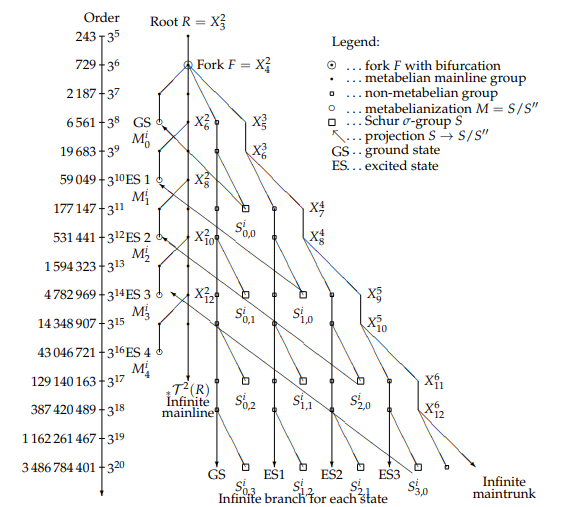
Secondly, via the fork \(F\) with fork topology, if \(n\ge 1\),
\[\label{eqn:ComplexPathFork} S=T_{n,u}^i:=F(-\#2;1-\#1;1)^u(-\#1;1-\#1;1)^{n-u}\lbrack-\#1;i-\#1;1\rbrack \text{ with } 1\le u\le n, \text{ i.e.} \tag{21}\]
Ostensively: if \(v:=n-u\), then the pairs \((u,v)\) satisfy \(u+v=n\) and run through \((1,n-1),\ldots,(n,0)\).
The cover of the second \(3\)-class group \(M_n^i\) with \(i=5,6\) is always infinite, and its components becomes bigger when the state parameter \(n\ge 0\) increases: \[\begin{aligned} \label{eqn:CovMComplex} \mathrm{cov}(M_n^i) = & \lbrace R_{n,j}^i\mid j=1,2(,3)\rbrace\quad\cup \lbrace\mathcal{T}_0(T_{n,u}^i)\mid 1\le u\le n\rbrace\quad\cup\lbrace\mathcal{T}_0(\pi(S_{n,t}^i))\setminus\mathcal{T}_0(\pi(S_{n,t+1}^i))\mid t\ge 0\rbrace \quad \text{ and } \notag\\ \mathrm{cov}_\ast(M_n^i) = & \lbrace S_{n,t}^i\mid t\ge 0\rbrace, \end{aligned} \tag{22}\] where \(\pi\) denotes the parent-operator, and \(\mathcal{T}_0\) is the pruned descendant tree restricted to \(\sigma\)-groups. The \(\mathcal{T}_0(T_{n,u}^i)\) are \(n\) finite saplings whose depth \(\mathrm{dp}=3+2u\) increases with \(u\). The differences \(\mathcal{T}_0(\pi(S_{n,t}^i))\setminus\mathcal{T}_0(\pi(S_{n,t+1}^i))\) are successive finite sections of the infinite branch \(\mathcal{T}_0(\pi(S_{n,0}^i))\), whose depth \(\mathrm{dp}=3+2n\) increases with \(n\). Their vertices conjecturally possess unbounded soluble length. The claims are proved for bounded state, parametrized by the integer \(n\) (ground state \(n=0\), excited states \(1\le n\le 4\)), but we conjecture they hold for any state \(n\ge 0\).
To reduce the complexity of the tree diagram, Schur\(+1\) \(\sigma\)-groups are not drawn in Figure 2. More details are drawn in Figure 3 for the ground state (GS) \(n=0\): the vertices \(R_{0,j}^i\) with child topology \(j=1,2,3\) for type H.4 (drawn), \(j=1,2\) for type G.16, and the finite section \(\mathcal{T}_0(\pi(S_{00}^i))\setminus\mathcal{T}_0(\pi(S_{01}^i))\) with depth \(\mathrm{dp}=3\) of the infinite branch \(\mathcal{T}_0(\pi(S_{00}^i))\) with periodic bifurcations. The vertices \(U_{0j}^i\), \(j=1,\ldots,4\), and \(V_{0}^i\) refer to both complex hull types, for the terminal leaves \(W_{0j}^i\), however, we have \(j=1,2,3\) for type H.4 (drawn), but \(j=1,2\) only for type G.16.
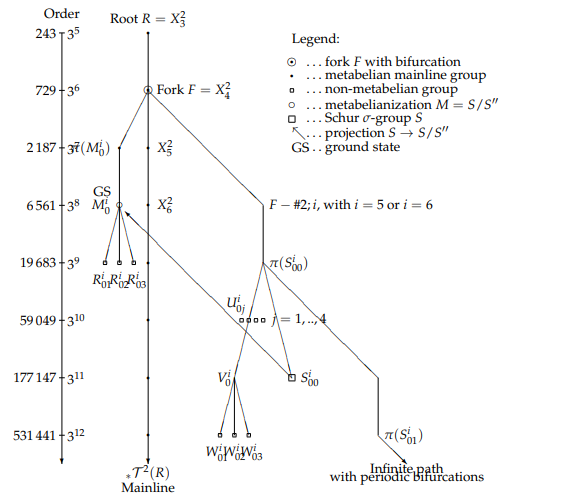
First we show in two Propositions 1 and 2 how the main lines and branches down to depth \(\mathrm{dp}=1\) of both relevant trees, the \(Q\)-tree and the \(U\)-tree, can be given either by parametrized polycyclic pc-presentations or as quotients of infinite limit groups. These propositions concern the metabelianizations \(M\) with coclass \(\mathrm{cc}(M)=2\) of simple and complex types simultaneously.
The reason why only the \(Q\)-tree and the \(U\)-tree are relevant for our assigned six TKTs in Formula (1) is given with the aid of the ‘‘main theorem on class and coclass from IPAD’’ and its corollary [20, §4, Thm 2. and Cor. 1] in § 11.1 : after elimination of the finite \(3\)-groups \(G\) of maximal class, i.e., coclass \(\mathrm{cc}(G)=1\), among all descendants of the elementary bicyclic \(3\)-group \(\mathrm{SmallGroup}(9,2)=(\mathbb{Z}/3\mathbb{Z})^2\), we arrive at the seven groups in Hall’s isoclinism family \(\Phi_6\) by bifurcation from the extra-special \(3\)-group \(\langle 27,3\rangle\). Then the \(\varepsilon\)-invariant of the IPAD and the required shape of the six TKTs eliminates five of these groups, \(\langle 243,i\rangle\) with \(i=3,4,5,7,9\), and only \(\langle 243,6\rangle\), the parent of \(Q=\langle 729,49\rangle\), and \(\langle 243,8\rangle\), the parent of \(U=\langle 729,54\rangle\), remain admissible.
The following result shows that certain \(3\)-groups of class at least \(5\) on the coclass tree \(\mathcal{T}^2(\langle 243,6\rangle)\) belong to \(6+4=10\) periodic coclass sequences (6 odd, 4 even) with period length \(2\).
Proposition 1. For each integer \(c\ge 5\), there are \(6\) metabelian descendants \(G\) of \(\langle 243,6\rangle\), having nilpotency class \(\mathrm{cl}(G)=c\), coclass \(\mathrm{cc}(G)=2\), and order \(\lvert G\rvert=3^{c+2}\), with two generators \(x,y\) and parametrized pc-presentation (where \(t_3\) and \(s_j\) belong to the abelian subgroup \(G^\prime<G\))
\[\label{eqn:QG} \begin{aligned} G = & \langle\ x,y,s_2,t_3,s_3,s_4,\ldots,s_c\ \mid \\ & s_2=\lbrack y,x\rbrack,\ t_3=\lbrack s_2,y\rbrack,\ s_j=\lbrack s_{j-1},x\rbrack \text{ for } 3\le j\le c, \\ & s_j^3=s_{j+2}^2s_{j+3} \text{ for } 2\le j\le c-3,\ s_{c-2}^3=s_c^2,\ t_3^3=1, \\ & R(x)=1,\ R(y)=1\ \rangle, \\ \end{aligned} \tag{23}\] where the relators \(R(x)\) and \(R(y)\) are given by
\[\begin{aligned} \label{eqn:QR} R(x) = & \begin{cases} x^3 & \text{ for } G \text{ of TKT } \mathrm{c}.18 \text{ or } \mathrm{H}.4, \text{ and} \\ x^3s_c^{-1} & \text{ for } G \text{ of TKT } \mathrm{E}.6 \text{ or } \mathrm{E}.14, \end{cases} \notag\\ R(y) = & \begin{cases} y^3s_3^{-2}s_4^{-1} & \text{ for } G \text{ of TKT } \mathrm{c}.18 \text{ or } \mathrm{E}.6, \text{ and either} \\ y^3s_3^{-2}s_4^{-1}s_c^{-1} & \text{ or } \\ y^3s_3^{-2}s_4^{-1}s_c^{-2} & \text{ for } G \text{ of TKT } \mathrm{H}.4 \text{ or } \mathrm{E}.14. \end{cases} \end{aligned} \tag{24}\]
For odd class \(c\ge 5\) the \(6\) groups are pairwise non-isomorphic \(\sigma\)-groups.
For even class \(c\ge 6\), the two pairs of groups sharing the same TKT (\(\mathrm{H}.4\) and \(\mathrm{E}.14\)) are isomorphic, and thus only \(4\) groups are pairwise non-isomorphic, and only the mainline group is a \(\sigma\)-group.
Proof. The claims are a consequence of direct computations of the TKT as kernels of Artin transfers from \(G\) to its four maximal subgroups [3, Alg. 3.3, pp. 104-106], depending on the relators \(R(x)\) and \(R(y)\) but independently of the nilpotency class \(c\). The relators have also been expressed in terms of exponential parameters \(\alpha,\beta\), as used by Blackburn for \(3\)-groups of maximal class, in [3, Formula 13-14, p. 107]. Skeleton type is \((0122)\). ◻
The following result shows that certain \(3\)-groups of class at least \(5\) on the coclass tree \(\mathcal{T}^2(\langle 243,8\rangle)\) belong to \(6+4=10\) periodic coclass sequences (6 odd, 4 even) with period length \(2\).
Proposition 2. For each integer \(c\ge 5\), there are \(6\) metabelian descendants \(G\) of \(\langle 243,8\rangle\), having nilpotency class \(\mathrm{cl}(G)=c\), coclass \(\mathrm{cc}(G)=2\), and order \(\lvert G\rvert=3^{c+2}\), with two generators \(x,y\) and parametrized pc-presentation (where \(s_3\) and \(t_j\) belong to the abelian subgroup \(G^\prime<G\))
\[\label{eqn:UG} \begin{aligned} G = & \langle\ x,y,t_2,s_3,t_3,t_4,\ldots,t_c\ \mid \\ & t_2=\lbrack y,x\rbrack,\ s_3=\lbrack t_2,x\rbrack,\ t_j=\lbrack t_{j-1},y\rbrack \text{ for } 3\le j\le c, \\ & t_j^3=t_{j+2}^2t_{j+3} \text{ for } 2\le j\le c-3,\ t_{c-2}^3=t_c^2,\ s_3^3=1, \\ & R(y)=1,\ R(x)=1\ \rangle, \\ \end{aligned} \tag{25}\] where the relators \(R(y)\) and \(R(x)\) are given by \[\begin{aligned} \label{eqn:UR} R(y) = & \begin{cases} y^3s_3^{-1} & \text{ for } G \text{ of TKT } \mathrm{c}.21 \text{ or } \mathrm{G}.16, \text{ and} \\ y^3s_3^{-1}t_c^{-1} & \text{ for } G \text{ of TKT } \mathrm{E}.8 \text{ or } \mathrm{E}.9, \end{cases} \notag\\ R(x) = & \begin{cases} x^3t_3^{-1}t_4^{-2}t_5^{-1} & \text{ for } G \text{ of TKT } \mathrm{c}.21 \text{ or } \mathrm{E}.8, \text{ and either} \\ x^3t_3^{-1}t_4^{-2}t_5^{-1}t_c^{-1} & \text{ or } \\ x^3t_3^{-1}t_4^{-2}t_5^{-1}t_c^{-2} & \text{ for } G \text{ of TKT } \mathrm{G}.16 \text{ or } \mathrm{E}.9. \end{cases} \end{aligned} \tag{26}\]
For odd class \(c\ge 5\) the \(6\) groups are pairwise non-isomorphic \(\sigma\)-groups.
For even class \(c\ge 6\), the two pairs of groups sharing the same TKT (\(\mathrm{G}.16\) and \(\mathrm{E}.9\)) are isomorphic, and thus only \(4\) groups are pairwise non-isomorphic, and only the mainline group is a \(\sigma\)-group.
Proof. The claims are a consequence of direct computations of the TKT as kernels of Artin transfers from \(G\) to its four maximal subgroups, depending on the relators \(R(y)\) and \(R(x)\) but independently of the nilpotency class \(c\). Here, the equivalent skeleton type is \((0134)\sim (0231)\). ◻
For the special case of the \(Q\)-tree and the \(U\)-tree, the two Propositions 1 and 2 provide an explicit proof of the periodicity of tree branches, proven generally and independently in [21– 25]. The finitely many pre-periodic instances down to class \(c=3,4\) have similar pc-presentations with slight degenerations, due to the low values of \(c\). However, our metabelianizations \(M\) in Theorem 3 and 5 have odd nilpotency class \(\mathrm{cl}(M)=2n+5\ge 5\), for each state \(n\ge 0\).
Corollary 2. For simple types, the metabelian second \(3\)-class group \(M=\mathrm{Gal}(\mathrm{F}_3^2(k)/k)\) of the state with parameter \(n\ge 0\) is given by \(M=M_n^i:=F(-\#1;1-\#1;1)^n\lbrack-\#1;i\rbrack\), as a relative identifier with respect to the fork \(F=Q\) or \(F=U\). The final counter \(2\le i\le 4\) depends on the TKT, E.6 for \(i=2\), E.14 for \(i=3,4\) on the \(Q\)-tree, E.8 for \(i=2\), E.9 for \(i=3,4\) on the \(U\)-tree.
Proof. In a coclass tree, all edges have step size \(s=1\). All metabelianizations \(M=M_n^i\) in the Formula (12) of Theorem 3 have odd nilpotency class \(c=\mathrm{cl}=2n+5\), fixed coclass \(r=\mathrm{cc}=2\), and thus odd logarithmic order \(\mathrm{lo}=2n+7\). Thus they belong to the \(6\) odd periodic coclass sequences. They are terminal leaves with depth \(\mathrm{dp}=1\) away from the mainline of the pruned coclass tree \({}^\ast\mathcal{T}^2(F)\) in Figure 1. Corresponding to the group \(G\) in Proposition 1, respectively 2, with odd class \(c=2n+5\), their relative identifiers are of the shape \(M=M_n^i:=F(-\#1;1-\#1;1)^n\lbrack-\#1;i\rbrack\) with state parameter \(n\ge 0\) and counter \(i=2,3,4\) specifying the TKT, as given in the theorem. We add that the meaning of the counter \(i=1\) is the mainline vertex \(X_c^r\) with \(r=2\), Eqn. (29). ◻
The complete theory of the mainlines with vertices of skeleton type, c.18, \(\varkappa\sim (0122)\), on the \(Q\)-tree, respectively c.21, \(\varkappa\sim (0231)\), on the \(U\)-tree, of the descendant tree \(\mathcal{T}(R)\) with root \(R\), containing an infinite main trunk of alternating step sizes \(s=2\) and \(s=1\), is based on the following infinite limit groups, due to Mike F. Newman.
Definition 11. The skeleton group with sign \(-1\) for the \(Q\)-tree and sign \(+1\) for the \(U\)-tree is
\[\label{eqn:ProfiniteGroup} \mathcal{L}_{\mp 1}:=\langle\ a,t\ \mid\ (at)^3=a^3,\ \lbrack\lbrack t,a\rbrack,t\rbrack=a^{\mp 3}\ \rangle. \tag{27}\]
For each coclass \(r\ge 2\), the mainline-\(r\) limit is defined as a quotient of \(\mathcal{L}_{\mp 1}\):
\[\label{eqn:MainlineLimits} \mathcal{L}_{\mp 1}^{r}:=\mathcal{L}_{\mp 1}\ /\ \langle\ a^{3^r}\ \rangle. \tag{28}\]
Finally, for each coclass \(r\ge 2\), and for each nilpotency class \(c\ge 2r-1\), the mainline-\(r\) vertex of class \(c\) on the coclass-\(r\) tree \(\mathcal{T}^r(X_{2r-1}^r)\) is defined as a quotient of \(\mathcal{L}_{\mp 1}^{(r)}\):
\[\label{eqn:MainlineVertices} X_c^r:= \begin{cases} \mathcal{L}_{\mp 1}^{r}\ /\ \langle\ \lbrack t,a\rbrack^{3^j}\ \rangle & \text{ if }\ c=2j+1\ \text{ is odd with }\ j\ge r-1, \\ \mathcal{L}_{\mp 1}^{r}\ /\ \langle\ t^{3^j}\ \rangle & \text{ if }\ c=2j\ \text{ is even with }\ j\ge r. \end{cases} \tag{29}\]
Theorem 6. (Mainline vertices as quotients of the limit group \(\mathcal{L}_{\mp}\).)
1. For each coclass \(r\ge 2\), and for each class \(c\ge 2r-1\), the mainline vertex of coclass \(r\) and nilpotency class \(c\) in the tree \(\mathcal{T}(R)\) is isomorphic to \(X_c^r\).
2. For each coclass \(r\ge 2\), the projective limit of the mainline \(\left(X_c^r\right)_{c\ge 2r-1}\) with vertices of coclass \(r\) in the tree \(\mathcal{T}(R)\) is isomorphic to \(\mathcal{L}_{\mp}^{(r)}\).
3. \(\mathcal{L}_{\mp}\) is an infinite non-nilpotent profinite limit group.
Proof. In [3, Alg. 3.1, Rmk. 3.1-2, Thm. 3.3, Cnj. 3.2, pp. 93-96], item (3) was proved generally. By means of top-down techniques, item (2) was proved for bounded coclass \(2\le r\le 8\), and item (1) for bounded coclass \(2\le r\le 8\) and bounded class \(2r-1\le c\le 35\). Since bottom-up techniques admit much bigger bounds \(r\le 32\) and \(c\le 63\), that is a logarithmic order of \(c+r=95\), items (1) and (2) were conjectured to hold for any coclass \(r\), and item (1) for any class \(c\). However, the Formulas (27), (28), and (29) comprise parametrized formation laws with two unbounded parameters \(r\) and \(c\). Therefore, they hold generally, since they are independent of verifications with the aid of necessarily limited information technology in the form of the indicated version V2.22-7 of the computational algebra system Magma [14]. ◻
Definition 12. For \(e\in\lbrace 0,1\rbrace\) (\(e=0\) for the \(Q\)-tree and \(e=1\) for the \(U\)-tree), we define the cover limit (according to Mike F. Newman) to be the infinite limit group \[\label{eqn:CoverLimit} \begin{aligned} \mathcal{C}^{(e)} := \langle&\ a,t,u,y,z\ \mid\ t^a=u,\ u^atuy=\lbrack u,t\rbrack^e,\ a^3\lbrack t,a,t\rbrack=z,\ \lbrack u,t,t\rbrack=\lbrack u,t,u\rbrack=1, \\ &\ y^3=1,\ \lbrack a,y\rbrack=\lbrack t,y\rbrack=\lbrack u,y\rbrack=\lbrack z,y\rbrack=1,\ z^3 =1,\ \lbrack t,z\rbrack=\lbrack u,z\rbrack=1\ \rangle. \end{aligned} \tag{30}\] which is related to a group in [23]. For each \(\ell\in\lbrace -1,0,1\rbrace\) and for each integer \(c\ge 4\), let \[\label{eqn:Quotient} \mathcal{Q}_c^{(e,\ell)}:=\mathcal{C}^{(e)}\ /\ \langle\ yw_c^\ell v_c,\ zw_c\ \rangle, \tag{31}\] be the class-\(c\) quotient with parameter \(\ell\) of \(\mathcal{C}^{(e)}\), where \(w_c:=\lbrack t,\overbrace{a,\ldots,a}^{(c-1) \text{ times}}\rbrack\) and \(v_c:=\lbrack w_{c-2},\lbrack t,a\rbrack\rbrack\).
The next theorem is a second crucial ingredient of this proof section, establishing the finiteness and structure of the cover for each metabelian \(3\)-group \(M\) with transfer kernel type in section \(\mathrm{E}\).
Theorem 7. (Explicit covers of metabelian \(3\)-groups.) Let \(M_n^i\) in the coclass-\(2\) tree \(\mathcal{T}^{2}\left(X_{3}^{2}\right)\) be the metabelianization of odd nilpotency class \(c=2n+5\ge 5\), \(n\ge 0\), with simple TKT
\[\varkappa(k)= \begin{cases} (1122),\ \mathrm{E}.6, \text{ resp. } (1231),\ \mathrm{E}.8 & \text{ if } i=2, \\ (3122),\ \mathrm{E}.14, \text{ resp. } (2231),\ \mathrm{E}.9 & \text{ if } i=3 \text{ or } i=4. \end{cases}\]
1. The cover of \(M_n^i\) is given by \[\label{eqn:CovSecE} \mathrm{cov}\left(M_n^i\right)= \left\lbrace T_{n,1}^i,\ldots,T_{n,n}^i,S_n^i\right\rbrace, \quad \text{ for } n\ge 0,\ 2\le i\le 4. \tag{32}\]
In particular, the cover is a finite set with \(n+1\) elements which are \(\sigma\)-groups.
2. The Shafarevich cover of \(M_n^i\) with respect to imaginary quadratic fields \(k\) is given by \[\label{eqn:ShafarevichCovSecE} \mathrm{cov}_\ast\left(M_n^i\right)= \left\lbrace S_n^i\right\rbrace, \quad \text{ for } n\ge 0,\ 2\le i\le 4. \tag{33}\]
In particular, the Shafarevich cover contains a unique non-metabelian Schur \(\sigma\)-group.
3. The class-\(c\) quotient with parameter \(\ell\) of the cover limit \(\mathcal{C}^{(e)}\) is isomorphic to the Schur \(\sigma\)-group \(S_{n}^{i}\simeq\mathcal{Q}^{(e,\ell)}_c\), for odd class \(c=2n+5\), \(n\ge 0\). The precise correspondence between the parameters \(\ell\) and \(i\) is given in the following way: \[\begin{aligned} \label{eqn:IsomCovSecE} \text{simple type }\mathrm{E}.6:\ &\mathcal{Q}^{(0,0)}_c \simeq S_{n}^{2}\in\mathcal{T}(Q), \ell=0 \text{ corresponds to } i=2, \notag\\ \text{simple type }\mathrm{E}.8:\ &\mathcal{Q}^{(1,0)}_c \simeq S_{n}^{2}\in\mathcal{T}(U), \ell=0 \text{ corresponds to } i=2, \notag\\ \text{simple type }\mathrm{E}.14:\ &\mathcal{Q}^{(0,-1)}_c\simeq S_{n}^{3}\in\mathcal{T}(Q) \ell=-1 \text{ corresponds to } i=3, \\ \text{simple type }\mathrm{E}.9:\ &\mathcal{Q}^{(1,-1)}_c \simeq S_{n}^{3}\in\mathcal{T}(U), \ell=-1 \text{ corresponds to } i=3, \notag\\ \text{simple type }\mathrm{E}.9:\ &\mathcal{Q}^{(1,+1)}_c \simeq S_{n}^{4}\in\mathcal{T}(U), \ell=+1 \text{ corresponds to } i=4.\notag \end{aligned} \tag{34}\]
The variant \(e=0\), respectively \(e=1\), is associated to the root \(R=\langle 243,6\rangle\), respectively \(R=\langle 243,8\rangle\).
4. A parametrized family of fork topologies for second \(3\)-class groups \(M=\mathrm{Gal}\left(F_3^{2}(k)/k\right)\) of imaginary quadratic fields \(k\) is given uniformly for the states \(n\ge 0\) (ground state, GS, for \(n=0\), excited state, ES \(n\), for \(n\ge 1\)) of simple transfer kernel types in section \(\mathrm{E}\) by the following symmetric topology symbol for the connecting path \(P\),
\[\label{eqn:ForkSecE} P= \overbrace{\mathrm{E}\stackrel{1}{\rightarrow}}^{\text{Leaf}}\quad \overbrace{\left\lbrace\mathrm{c}\stackrel{1}{\rightarrow}\mathrm{c}\stackrel{1}{\rightarrow}\right\rbrace^{n}\ }^{\text{Mainline}}\quad \overbrace{\mathrm{c}}^{\text{Fork}}\quad \overbrace{\left\lbrace\stackrel{2}{\leftarrow}\mathrm{c}\stackrel{1}{\leftarrow}\mathrm{c}\right\rbrace^{n}\ }^{\text{Maintrunk}}\quad \overbrace{\stackrel{2}{\leftarrow}\mathrm{E}}^{\text{Leaf}}, \tag{35}\] with skeleton type \(\mathrm{c}\) and the following invariants: distance \(d=(2n+1)+(2n+1)=4n+2\), weighted distance \(w=(2n+1)+(3n+2)=5n+3\), class increment \(\Delta\mathrm{cl}=(2n+5)-(2n+5)=0\), coclass increment \(\Delta\mathrm{cc}=(n+3)-2=n+1\), logarithmic order increment \(\Delta\mathrm{lo}=(3n+8)-(2n+7)=n+1\).
Proof. We compare the uniform generator rank \(d_1=2\) of all involved groups \(M_n^i\) and \(S_{n}^{i}\) with odd class \(c=2n+5\ge 5\), coclass \(r\ge 2\), and counter \(2\le i\le 4\) specifying the simple TKT, with their relation rank \(d_2\). Since \(d_2=\mu\) and the \(3\)-multiplicator rank is \(\mu=2\) for \(S_{n}^{i}\) with odd class \(c=2n+5\ge 5\) and coclass \(r=n+3\ge 3\), but \(\mu=3\) for \(M_n^i\) with \(r=2\), only the groups \(S_{n}^{i}\) are Schur \(\sigma\)-groups with balanced presentation \(d_2=2=d_1\), and are therefore admissible as \(3\)-class field tower groups \(S\) of imaginary quadratic fields \(k\), according to our corrected version, Theorem 1, of the Shafarevich Theorem and Corollary 1. Finally we remark that the nuclear rank is \(\nu=0\) for \(M_n^i\) with odd class \(c=2n+5\), i.e., the metabelianizations \(M=M_n^i\) are terminal leaves.
Since the finite class-\(c\) quotients \(\mathcal{Q}^{(e,k)}_c\) with odd \(c\ge 5\) and parameter \(\ell=-1,0,+1\) of the infinite cover limit \(\mathcal{C}^{(e)}\), \(e=0,1\), contain the unlimited nilpotency class \(c\), Theorem 7 can be stated without bounds, in contrast to the careful formulation of [3, Thm. 3.5 and Cnj. 3.3, pp. 98-100] with bound \(n\le 8\) for the state parameter \(n\).
We remark that the execution of Algorithm 3.2 in [3, pp. 97-98] experimentally proves the isomorphisms \(\mathcal{Q}^{(e,\ell)}_c\simeq S_{n}^{i}\), with odd class \(c=2n+5\) and suitably corresponding parameters \(\ell\) and \(i\), for \(5\le c\le 21\), that is, \(0\le n\le 8\). The algorithm is initialized by the starting group \(R=X_3^{2}\) of coclass \(2\), and navigates through the mainline vertices \(X_{c}^{2}\), \(c\ge 3\), of the coclass tree \(\mathcal{T}^{2}\left(X_{3}^{2}\right)\). A subroutine tests the transfer kernel type TKT of all descendants and selects either the unique capable descendant with skeleton type \(\mathrm{c}.18\), respectively \(\mathrm{c}.21\), or the unique descendant with simple hull type \(\mathrm{E}.6\), respectively \(\mathrm{E}.8\), or the first or second descendant with simple hull type \(\mathrm{E}.14\), respectively \(\mathrm{E}.9\). The selected non-mainline vertex is always checked for isomorphism to the metabelianization of the appropriate quotient \(\mathcal{Q}^{(e,\ell)}_c\). However, the bound \(n\le 8\), is only due to the unavoidable limitations of the computational algebra system Magma [14], and does not restrict the generality of the infinite cover limit \(\mathcal{C}^{(e)}\) and its quotients \(\mathcal{Q}^{(e,\ell)}_c\). ◻
A pure bottom up approach without top down constructions, instead of using Algorithm 3.2 in [3, pp. 97-98], is able to reach coclass \(r=32\), nilpotency class \(c=63\), and logarithmic order \(r+c=95\), without surpassing internal limits of Magma, and thus provides even stronger support for Theorem 7, from the experimental point of view.
Currently, a drawback of the quotients \(\mathcal{Q}^{(0,+1)}_c\) with \(e=0\), \(\ell=+1\), \(c\ge 5\), which lead into a completely different realm, namely the complicated brushwood of the complex transfer kernel type \(\mathrm{H}.4\), is that they cannot be interpretated as covers of metabelianizations \(M_n^i\).
A common feature of all Theorems 2–5 together are certain general requirements for Galois groups \(\mathrm{Gal}(\mathrm{F}_p^q(k)/k)\), with a positive integer \(q\), of the stages of the \(p\)-class field tower with an odd prime \(p\), of quadratic number fields \(k=\mathbb{Q}(\sqrt{d})\).
Generally, any Galois group \(G=\mathrm{Gal}(\mathrm{F}_3^q(k)/k)\), with a positive integer \(q\), must be a \(\sigma\)-group, possessing an automorphism which acts as inversion on both cohomology groups \(H^i(G,\mathbb{F}_3)\), with \(i=1,2\), and the \(3\)-class field tower group \(S=\mathrm{Gal}(\mathrm{F}_3^\infty(k)/k)\) additionally must satisfy the Shafarevich bound for the relation rank, \(2\le d_2(S)\le d_{2,\mathrm{max}}\) with \(d_{2,\mathrm{max}}=2\) for imaginary \(k\), enforcing a Schur \(\sigma\)-group, and \(d_{2,\mathrm{max}}=3\) for real \(k\), admitting also a Schur\(+1\) \(\sigma\)-group [6, 13].
For each simple type in section E [18, p. 36], and separately for each complex type in the sections G and H [18, pp. 36-38], the candidates for the metabelianization \(M=S/S^{\prime\prime}=\mathrm{Gal}(\mathrm{F}_3^2(k)/k)\) and for the \(3\)-class field tower group \(S=\mathrm{Gal}(\mathrm{F}_3^\infty(k)/k)\) itself are identified by a search along the descendant tree of either the root \(Q=\langle 729,49\rangle\) or \(U=\langle 729,54\rangle\) [4, 5], constructed with the \(p\)-group generation algorithm by Newman [16, 26] and O’Brien [15, 17]. The claims for the ground state \(n=0\) and the lower excited states \(n=1,2,3,4\) are covered by initial computations with Magma [14, 27– 29], and evidence of statements for higher excited states \(n\ge 5\) is provided for the metabelianizations \(M_n^i\) either by Corollary 2 or by the periodicity of tree branches, which was proven independently in [21– 25].
In the notation with relative identifiers [19], and starting from one of the forks with bifurcation \(F\in\lbrace Q,U\rbrace\) as roots, for simple types, the metabelianizations turn out to be of the shape \(M=F(-\#1;1-\#1;1)^n\lbrack-\#1;i\rbrack\), and \(M=F(-\#1;1-\#1;1)^n\lbrack-\#1;i-\#1;1\rbrack\) for complex types, since, in the latter situation, for \(G=\pi(M)=F(-\#1;1-\#1;1)^n\lbrack-\#1;i\rbrack\), an automorphism acts as inversion on \(H^1(G,\mathbb{F}_3)\) only but not on \(H^2(G,\mathbb{F}_3)\). So the group \(M\) is still a vertex of the coclass tree \(\mathcal{T}^2(F)\) with exclusive step size \(s=1\) and thus with fixed coclass \(2\). It has depth \(\mathrm{dp}=1\) for simple types and \(\mathrm{dp}=2\) for complex types.
However, periodic bifurcations must actually be exploited for \(S=F(-\#2;1-\#1;1)^n\lbrack-\#2;i\rbrack\), if the type is simple, and for \(S=F(-\#2;1-\#1;1)^n\lbrack-\#2;i-\#1;1\rbrack\lbrack-\#2;1-\#1;1\rbrack^{t}\lbrack-\#2;2\rbrack\), when the type is complex, due to infinite branches with infinitely many candidates for each state \(n\ge 0\), expressed by the second parameter \(t\ge 0\).
Proof. We prove Theorems 2 and 3 together. The group theoretic invariants of the metabelianizations \(M_n^i\) and the Schur \(\sigma\)-groups \(S_n^i\) for any state \(n\ge 0\) and counters \(2\le i\le 4\) are: logarithmic order, \(\mathrm{lo}(M_n^i)=\mathrm{lo}(F)+2n+1=2n+7\), \(\mathrm{lo}(S_n^i)=\mathrm{lo}(F)+3n+2=3n+8\), nilpotency class, \(\mathrm{cl}(M_n^i)=\mathrm{cl}(F)+2n+1=2n+5\), \(\mathrm{cl}(S_n^i)=\mathrm{cl}(F)+2n+1=2n+5\), and coclass, \(\mathrm{cc}(M_n^i)=\mathrm{cc}(F)+0=2\), \(\mathrm{cc}(S_n^i)=\mathrm{cc}(F)+n+1=n+3\), since the fork possesses the invariants \(\mathrm{lo}(F)=6\), \(\mathrm{cl}(F)=4\), \(\mathrm{cc}(F)=2\).
The invariants of the Schur\(+1\) \(\sigma\)-groups \(T_{n,u}^i\) for excited states \(n\ge 1\), \(1\le u\le n\) and counters \(2\le i\le 4\) are: logarithmic order, \(\mathrm{lo}(T_{n,u}^i)=\mathrm{lo}(F)+3u+2(n-u)+1=2n+2u+7\), nilpotency class, \(\mathrm{cl}(T_{n,u}^i)=\mathrm{cl}(F)+2u+2(n-u)+1=2n+5\), and coclass, \(\mathrm{cc}(T_{n,u}^i)=\mathrm{cc}(F)+u=u+2\).
In [3, Dfn. 3.3, Eqn. 6-7, p. 97], an infinite cover limit group \(\mathcal{C}^{(e)}\), due to M. F. Newman, is defined for two parameter values \(e=0,1\), together with class-\(c\) quotients \(\mathcal{Q}^{(e,k)}_c\) of \(\mathcal{C}^{(e)}\) with parameter \(k=-1,0,+1\) and nilpotency class \(c\ge 4\). In [3, Thm. 3.5, Eqn. 8–12, pp. 98–100], it is shown that, for odd nilpotency class \(c=2n+5\ge 5\), \(\mathcal{Q}^{(0,0)}_c\simeq S_n^2\), \(\mathcal{Q}^{(0,-1)}_c\simeq S_n^4\) on the \(Q\)-tree, and \(\mathcal{Q}^{(1,0)}_c\simeq S_n^2\), \(\mathcal{Q}^{(1,-1)}_c\simeq S_n^3\), \(\mathcal{Q}^{(1,+1)}_c\simeq S_n^4\) on the \(U\)-tree. Note that in [3], the Schur \(\sigma\)-group \(S_n^i\) is denoted by \(S_{2n+5,i-1}^{(n+3)}\) for \(2\le i\le 4\), emphasizing the nilpotency class \(c=2n+5\) and the coclass \(r=n+3\), for each state \(n\ge 0\). The results are translated to the present notation in Theorem 7 (with \(k\) replaced by \(\ell\)).
Theorem 3 is now an immediate consequence of the parametrized polycyclic pc-presentations in Proposition 1–2 and the relative identifiers in Corollary 1, which give the shape of \(M_n^i\), the quotients of the mainline-\(r\) limit groups \(\mathcal{L}_{\mp 1}^{r}\) in Theorem 6, which give the complete skeleton, and the quotients of the cover limit group \(\mathcal{C}^{(e)}\) in Theorem 7, which give the covers \(S_n^i\).
Theorem 2 follows by computation of the abelian type invariants of second order, \(\alpha^{(2)}(k)\), of all groups \(M_n^i\), \(S_n^i\), \(T_{n,u}^i\). ◻
Proof. We prove Theorems 4 and 5 together. So far we have only paid attention to the Schur \(\sigma\)-groups among the candidates for \(S\). For imaginary \(k\), these are the only non-metabelian candidates. For real \(k\) with simple types, the non-metabelian Schur\(+1\) \(\sigma\)-groups \(T_{n,u}^i\) arise as additional candidates for \(S\). For real \(k\) with complex types, however, various further non-metabelian Schur\(+1\) \(\sigma\)-groups are also admissible. They all share a common metabelianization \(M=S/S^{\prime\prime}\).
At this point, the (logarithmic) abelian type invariants of the second order \(\alpha^{(2)}(k)\) come into the play. For simple types, the metabelianization \(M\) is a terminal vertex of its descendant tree, and we obtain sharp necessary and sufficient criteria, since the regular components of the stabilization are tame, \(\lbrack 21;\alpha_0,\mathbf{(21)^3}\rbrack\), in the case \(S=M\) of a tower with two stages, and wild, \(\lbrack 21;\alpha_0,\mathbf{(31)^3}\rbrack\), when the tower has precisely three stages. On the tree with root \(Q\), the singular component of the stabilization admits an additional decision, it is tame, \(\lbrack 1^3;\alpha_0,\mathbf{(1^3)^3},(1^2)^9\rbrack\), when \(\ell_3(k)=2\), i.e. \(S=M\) is a metabelian Schur\(+1\) \(\sigma\)-group, and wild, \(\lbrack 1^3;\alpha_0,\mathbf{(21^2)^3},(1^2)^9\rbrack\), when \(\ell_3(k)=3\), i.e. \(S\ne M\) is a non-metabelian Schur \(\sigma\)-group \(S_n^i\) or Schur\(+1\) \(\sigma\)-group \(T_{n,u}^i\). Here the heterocyclic polarization \(\lbrack(n+3,n+2);\alpha_0,(n+\mathbf{3},n+1,1)^3\rbrack\) is always tame and does not enable a decision. See [20, § 4, Thm. 2] for this terminology concerning the first order ATI. The Schur \(\sigma\)-groups \(S\) are drawn in Figure 2 for simple types, and in Figure 2 for complex types. The path between \(S\) and \(M\) always represents a so-called fork topology with respect to the first bifurcation \(F\) in the skeleton.
For real \(k\) and complex types, there arise additional possibilities of Schur\(+1\) \(\sigma\)-groups, besides the Schur \(\sigma\)-groups described for imaginary \(k\). These additional candidates for complex types are not drawn in Figure 2 in order to avoid too complicated tree structures. For the GS, they are drawn in Figure 3.
Firstly, a so-called child topology for the path between \(S\) and \(M\) can be realized by one of the immediate non-metabelian descendants \(R_{0j}^i=M-\#1;j\), \(j=1,2,3\) for type H.4, \(j=1,2\) for type G.16, of the non-terminal metabelianization \(M=M_n^i=F(-\#1;1-\#1;1)^n\lbrack-\#1;i-\#1;1\rbrack\). They share a common tame stabilization. The polarization \(\lbrack(n+3,n+2);\alpha_0,(n+\mathbf{4},n+1,1)^3\rbrack\) is wild when \(j=1,2\) for type H.4 and \(j=1\) for type G.16. These are the only cases where the tower even has precisely three stages. The crux concerning two stage towers is that \(j=3\) for type H.4 and \(j=2\) for type G.16 shows a tame polarization \(\lbrack(n+3,n+2);\alpha_0,(n+\mathbf{3},n+1,1)^3\rbrack\) and thus cannot be distinguished from a metabelian tower.
Secondly, further fork topologies for the path between \(S\) and \(M\) can be due to immediate descendants \(G\lbrack-\#1;j\rbrack\) with step size \(s=1\) of \(G=\pi(S_{n,t}^i)=F(-\#2;1-\#1;1)^n\lbrack-\#2;i-\#1;1\rbrack\lbrack-\#2;1-\#1;1\rbrack^{t}\) with \(i=5,6\). They share a common wild stabilization. The polarization \(\lbrack(n+3,n+2);\alpha_0,(n+\mathbf{4},n+1,1)^3\rbrack\) is wild when \(j=3\) for type H.4 and \(j=1\) for type G.16. The polarization \(\lbrack(n+3,n+2);\alpha_0,(n+\mathbf{3},n+1,1)^3\rbrack\) is tame when \(j=1,4\) for type H.4 and \(j=3,4\) for type G.16. For both types, \(j=2\) gives rise to a finite sapling with depth \(2n\) sharing a common wild polarization. See Figure 3, for the ground state GS \(n=0\).
In Theorem 5, the modified shape of \(M_n^i=F(-\#1;1-\#1;1)^n\lbrack-\#1;i-\#1;1\rbrack\) is even proven for unbounded states \(n\ge 0\), due to the parametrized polycyclic pc-presentations in Proposition 1–2 and an easy generalization of the relative identifiers in Corollary 1. The shape of the covers \(S_{n,t}^i\) is investigated experimentally for bounded states \(0\le n\le 4\) only.
Theorem 4 follows by computation of the abelian type invariants of second order, \(\alpha^{(2)}(k)\), of all involved groups. ◻
Suppose \(p\) is an odd prime number. Let \(k=\mathbb{Q}(\sqrt{d})\), with fundamental discriminant \(d<0\), be an imaginary quadratic number field possessing an elementary bicyclic \(p\)-class group \(\mathrm{Cl}_p(k)=(\mathbb{Z}/p\mathbb{Z})^2\). Then the Galois group \(S=\mathrm{Gal}(\mathrm{F}_p^\infty(k)/k)\) of the maximal unramified pro-\(p\)-extension of \(k\) is a non-abelian Schur \(\sigma\)-group [7] with balanced presentation and a generator and relator inverting automorphism \(\sigma\) of order \(2\) [30]. The second derived quotient \(S/S^{\prime\prime}\) of \(S\) is isomorphic to the Galois group \(M=\mathrm{Gal}(\mathrm{F}_p^2(k)/k)\) of the maximal metabelian unramified \(p\)-extension of \(k\).
For \(p=3\), we recall the well-known facts concerning the ground state (GS) and the excited states (ES) of \(3\)-tower groups \(S\) of \(k\) with capitulation type \(\varkappa(k)\) in section E of Scholz and Taussky [18]:
Theorem 8. Let the (logarithmic) abelian type invariants (ATI) of the \(4\) unramified cyclic cubic extensions \(E_1,\ldots,E_4\) of \(k\) be assigned by either \(\alpha(k)=\lbrack 32,111,21,21\rbrack\) or \(\alpha(k)=\lbrack 32,21,21,21\rbrack\). In this context, we speak about the ground state of the groups \(M\) and \(S\) with heterocyclic polarization \((32)\), characterized by the nilpotency class \(\mathrm{cl}(M)=3+2=5\) of \(M\). In terms of the identifiers \(\langle\mathrm{ord},\mathrm{id}\rangle\) in the SmallGroups database [4] of the computer algebra system Magma [14, 29], the groups \(M\) and \(S\) are given as follows in dependence of the capitulation type:
1. if \(\varkappa(k)\sim (1122)\), type E.6, then \(M=\langle 2187,288\rangle\) and \(S=\langle 6561,616\rangle\);
2. if \(\varkappa(k)\sim (3122)\), type E.14, then either \(M=\langle 2187,289\rangle\) and \(S=\langle 6561,617\rangle\) or \(M=\langle 2187,290\rangle\) and \(S=\langle 6561,618\rangle\);
3. if \(\varkappa(k)\sim (1231)\), type E.8, then \(M=\langle 2187,304\rangle\) and \(S=\langle 6561,622\rangle\);
4. if \(\varkappa(k)\sim (2231)\), type E.9, then either \(M=\langle 2187,302\rangle\) and \(S=\langle 6561,620\rangle\) or \(M=\langle 2187,306\rangle\) and \(S=\langle 6561,624\rangle\). The path between \(M\) and \(S\) is drawn in Figure 1, starting at the symbol GS. For the types E.6 and E.14, the root is \(R=\langle 243,6\rangle\), and for the types E.8 and E.9, the root is \(R=\langle 243,8\rangle\).
Proof. For \(\varkappa(k)\sim (2231)\), type E.9, the statement was proved in [10, Cor. 4.1.1, p. 775]. For the other types, the proof was given in [31] and [32]. The trees with minimal discriminants \(d\) of prototypes are drawn in [6, Figure 1-2, pp. 24-25]. ◻
Remark 1. The four capitulation types in section E can be distinguished by the number of fixed points (FP): type E.14, \(\varkappa(k)\sim (3122)\), has \(0\) FP, type E.6, \(\varkappa(k)\sim (1122)\), has \(1\) FP, type E.9, \(\varkappa(k)\sim (2231)\), has \(2\) FP, and type E.8, \(\varkappa(k)\sim (1231)\), has \(3\) FP. They are simple types.
Theorem 9. With an integer \(n\ge 1\), let the (logarithmic) abelian type invariants (ATI) of the \(4\) unramified cyclic cubic extensions \(E_1,\ldots,E_4\) of \(k\) be fixed by either \(\alpha(k)=\lbrack (n+3,n+2),111,21,21\rbrack\) or \(\alpha(k)=\lbrack (n+3,n+2),21,21,21\rbrack\). In this context, we speak about the \(n\)-th excited state of the groups \(M\) and \(S\), characterized by the nilpotency class \(\mathrm{cl}(M)=n+3+n+2=2n+5\) of \(M\). Then the groups \(M\) and \(S\) with heterocyclic polarization \((n+3,n+2)\), are given by the following paths: \[\label{eqn:Structure} \begin{aligned} M &= R(-\#1;1)(-\#1;1-\#1;1)^n\lbrack-\#1;i\rbrack \text{ and } \\ S &= R(-\#1;1)(-\#2;1-\#1;1)^n\lbrack-\#2;i\rbrack, \end{aligned} \tag{36}\] in terms of relative ANUPQ-identifiers [19]. The dependency of the capitulation type is expressed by \(2\le i\le 4\). For \(1\le n\le 4\), the path between \(M\) and \(S\) is drawn in Figure 1, starting at the symbol ES \(n\). For the types E.6 and E.14, the root is \(R=\langle 243,6\rangle\), and for the types E.8 and E.9, the root is \(R=\langle 243,8\rangle\).
Proof. The proof was given in [31] and [32]. Note that \(R(-\#1;1)=\langle 729,49\rangle\) for \(R=\langle 243,6\rangle\), and \(R(-\#1;1)=\langle 729,54\rangle\) for \(R=\langle 243,8\rangle\), is the first tree vertex with bifurcation (\(1\le s\le 2\)). ◻
Example 1. For the type E.9, \(\varkappa(k)\sim (2231)\), the minimal discriminants of prototypes for the states are given by \(d=-9\,748\) for GS, \(d=-297\,079\) for ES 1, \(d=-1\,088\,808\) for ES 2, \(d=-11\,091\,140\) for ES 3, and \(d=-94\,880\,548\) for ES 4, computed with Magma [14] using [15].
In both tree diagrams of Figure 1 and 2, there are two possible realizations of the root \(R\) on the top of the tree diagram. Both of these finite \(3\)-groups have nilpotency class \(\mathrm{cl}(R)=3\) and coclass \(\mathrm{cc}(R)=2\). In both cases, \(R\) belongs to Hall’s isoclinism family \(\Phi_6\) [33, p. 139]. On The \(Q\)-tree, the root is \(R=\langle 243,6\rangle\) with skeleton type c.18, \(\varkappa(k)\sim(0122)\). On The \(U\)-tree, the root is \(R=\langle 243,8\rangle\) with skeleton type c.21, \(\varkappa(k)\sim(0231)\).
Remarks concerning Figure 1. The figure is restricted to the root region up to logarithmic order \(\mathrm{lo}=20\), and to the pruned subtree \({}^\ast\mathcal{T}(R)<\mathcal{T}(R)\) of the complete descendant tree of the root \(R\), where the complex types are eliminated, and only simple types in section E of Scholz and Taussky [18] remain as terminal leaves, connected by mainline vertices of skeleton type. By \({}^\ast\mathcal{T}^2(R)\), we denote the pruned subtree of \({}^\ast\mathcal{T}(R)\) with fixed coclass \(\mathrm{cc}=2\), a so-called coclass tree. In terms of relative ANUPQ-identifiers [19], the Schur \(\sigma\)-groups [34] with simple types are given by periodic bifurcations as in Formula (12), \[S=S_n^i:=R(-\#1;1)(-\#2;1-\#1;1)^n\lbrack -\#2;i\rbrack,\ 2\le i\le 4,\] a unique Schur \(\sigma\)-group for each state \(n\ge 0\). Parentheses enclose vertices with skeleton type, and brackets surround vertices with simple types. The situation is unproblematic with respect to ambiguities, since the Schur \(\sigma\)-group \(S\) with \(M=S/S^{\prime\prime}\) is unique, but Schur\(+1\) \(\sigma\)-groups [35] with simple types also exist. The metabelianizations are given as second derived quotients as in Formula (12), \[M=M_n^i:=S/S^{\prime\prime}=R(-\#1;1)(-\#1;1-\#1;1)^n\lbrack -\#1;i\rbrack,\ 2\le i\le 4,\] on the pruned coclass subtree \({}^\ast\mathcal{T}^2(R)\).
The differences between the two possible realizations can be summarized as follows:
\(\bullet\) The \(Q\)-tree: It is pruned from the complex type H.4, \(\varkappa(k)\sim(2122)\), and the skeleton type of the mainline is c.18, \(\varkappa(k)\sim(0122)\). In particular, the root \(R=\langle 243,6\rangle\) and its immediate descendant, the fork \(Q=\langle 729,49\rangle=\langle 243,6\rangle(-\#1;1)\), are of skeleton type. The fork \(F=Q\) has a bifurcation, due to nuclear rank \(\nu=2\). The type of the terminal leaves is E.6, \(\varkappa(k)\sim(1122)\), for \(i=2\), and E.14, \(\varkappa(k)\sim(3122)\), for \(i=3,4\).
\(\bullet\) The \(U\)-tree: It is pruned from the complex type G.16, \(\varkappa(k)\sim(4231)\), and the skeleton type of the mainline is c.21, \(\varkappa(k)\sim(0231)\). In particular, the root \(R=\langle 243,8\rangle\) and its immediate descendant, the fork \(U=\langle 729,54\rangle=\langle 243,8\rangle(-\#1;1)\), possess the skeleton type. The fork \(F=U\) has a bifurcation to different step sizes \(s=1\) and \(s=2\). The type of the terminal leaves is E.8, \(\varkappa(k)\sim(1231)\), for \(i=2\), and E.9, \(\varkappa(k)\sim(2231)\), for \(i=3,4\).
Remarks concerning Figure 2. The figure is restricted to the root region up to logarithmic order \(\mathrm{lo}=20\), and to the pruned subtree \({}_\ast\mathcal{T}(R)<\mathcal{T}(R)\) of the complete descendant tree of the root \(R\), where the simple types in section E of Scholz and Taussky [18] are eliminated, and only complex types remain as finite or infinite branches, connected by mainline vertices of skeleton type. By \({}_\ast\mathcal{T}^2(R)\), we denote the pruned subtree of \({}_\ast\mathcal{T}(R)\) with fixed coclass \(\mathrm{cc}=2\), a so-called coclass tree.
The differences between the two possible realizations can be summarized as follows:
\(\bullet\) The \(Q\)-tree: It is pruned from the simple types, E.6, \(\varkappa(k)\sim(1122)\), and E.14, \(\varkappa(k)\sim(3122)\). The skeleton type of the mainline is c.18, \(\varkappa(k)\sim(0122)\). In particular, the root \(R=\langle 243,6\rangle\) and its immediate descendant, the fork \(Q=\langle 729,49\rangle=\langle 243,6\rangle(-\#1;1)\), are of skeleton type. The fork \(F=Q\) has a bifurcation, due to nuclear rank \(\nu=2\). The type of the infinite branches is the complex hull type H.4, \(\varkappa(k)\sim(2122)\).
\(\bullet\) The \(U\)-tree: It is pruned from the simple types, E.8, \(\varkappa(k)\sim(1231)\), and E.9, \(\varkappa(k)\sim(2231)\). The skeleton type of the mainline is c.21, \(\varkappa(k)\sim(0231)\). In particular, the root \(R=\langle 243,8\rangle\) and its immediate descendant, the fork \(U=\langle 729,54\rangle=\langle 243,8\rangle(-\#1;1)\), possess the skeleton type. The fork \(F=U\) has a bifurcation to different step sizes \(s=1\) and \(s=2\). The type of the infinite branches is the complex hull type G.16, \(\varkappa(k)\sim(4231)\).
Remarks concerning Figure 3. A detailed tree diagram for the ground state (GS) of complex types is drawn in Figure 3. It is pruned from simple types, and restricted to skeleton types and complex types. Four different scenarios can be realized by the same diagram: the two trees with fork \(F\) equal to \(Q=\langle 729,49\rangle\) or \(U=\langle 729,54\rangle\), and each of them with two possible selections of the metabelianization \(M_0^i\), sharing the same complex type in the GS.
\(\bullet\) The \(Q\)-tree: Skeleton type is c.18, \((0122)\), which forms the infinite mainline of the tree \(\mathcal{T}^2(R)\) with fixed coclass \(2\), starting at the root \(R=\langle 243,6\rangle\), passing the fork \(F=Q=\langle 729,49\rangle\) with nuclear rank \(\nu=2\) and bifurcation, on the one hand with permanent step size \(s=1\) to \(X_5^2=\langle 2187,285\rangle\), \(X_6^2=\langle 6561,2024\rangle\), etc. [36, Figure 3, p. 151], and on the other hand with alternating step sizes \(s=2\) and \(s=1\) on an infinite path with complex type H.4, \((2122)\), and with periodic bifurcations, giving rise to unboundedly increasing coclass. We are interested in two siblings of \(\langle 2187,285\rangle\) rather than in the mainline. They lead to two arithmetically indistinguishable candidates for the metabelianization \(M=\mathrm{Gal}(\mathrm{F}_3^2(K)/K)\) of the \(3\)-class field tower group.
Either via the sibling \(\langle 2187,286\rangle\), which is forbidden as \(M\) due to the lack of a proper \(\sigma\)-automorphism, to \(M=M_0^5=\langle 6561,2030\rangle\).
Or via the sibling \(\langle 2187,287\rangle\) which is forbidden as \(M\) due to the lack of a proper \(\sigma\)-automorphism, to \(M=M_0^6=\langle 6561,2035\rangle\).
In both cases, several configurations of \(3\)-class field tower groups \(S\) are possible. For real quadratic base fields \(K\), three terminal immediate non-metabelian descendants \(R_{0j}^i=M_0^i-\#1;j\), \(j=1,2,3\), provide the option of a Schur\(+1\) \(\sigma\)-group \(S\) with child topology.
Similarly, we are interested in two siblings, \(F-\#2;5=\langle 6561,614\rangle\) and \(F-\#2;6=\langle 6561,615\rangle\), of \(F-\#2;1=\langle 6561,613\rangle\) rather than in the skeleton type itself.
| Stabilization | ||||
|---|---|---|---|---|
| lo | id | Polarization | Singular | Regular |
| 8 | \(2030\vert 2035\) | \(32,(311)^3\) | \(111;(11)^9,(111)^3\) | \(\lbrack 21;(21)^3\rbrack^2\) |
| 9 | \(M_0^i-\#1;1\vert 2\) | \(32,(411)^3\) | \(111;(11)^9,(111)^3\) | \(\lbrack 21;(21)^3\rbrack^2\) |
| 9 | \(M_0^i-\#1;3\) | \(32,(311)^3\) | \(111;(11)^9,(111)^3\) | \(\lbrack 21;(21)^3\rbrack^2\) |
\(\bullet\) The \(U\)-tree: Skeleton type is c.21, \((0231)\), which forms the infinite mainline of the tree \(\mathcal{T}^2(R)\) with fixed coclass \(2\), starting at the root \(R=\langle 243,8\rangle\), passing the fork \(F=Q=\langle 729,54\rangle\) with nuclear rank \(\nu=2\) and bifurcation, on the one hand with permanent step size \(s=1\) to \(X_5^2=\langle 2187,303\rangle\), \(X_6^2=\langle 6561,2050\rangle\), etc. [36, Figure 4, p. 152], and on the other hand with alternating step sizes \(s=2\) and \(s=1\) on an infinite path with complex type G.16, \((4231)\), and with periodic bifurcations, causing unboundedly increasing coclass. We are interested in two siblings of \(\langle 2187,303\rangle\) rather than in the mainline. They lead to two arithmetically indistinguishable candidates for the metabelianization \(M=\mathrm{Gal}(\mathrm{F}_3^2(K)/K)\) of the \(3\)-class field tower group.
Either via the sibling \(\langle 2187,301\rangle\), which is forbidden as \(M\) due to the lack of a proper \(\sigma\)-automorphism, to \(M=M_0^5=\langle 6561,2048\rangle\).
Or via the sibling \(\langle 2187,305\rangle\) which is forbidden as \(M\) due to the lack of a proper \(\sigma\)-automorphism, to \(M=M_0^6=\langle 6561,2058\rangle\).
In both cases, several configurations of \(3\)-class field tower groups \(S\) are possible. For real quadratic base fields \(K\), two terminal immediate non-metabelian descendants \(R_{0j}^i=M_0^i-\#1;j\), \(j=1,2\), provide the option of a Schur\(+1\) \(\sigma\)-group \(S\) with child topology.
Similarly, we are interested in two siblings, \(F-\#2;5=\langle 6561,619\rangle\) and \(F-\#2;6=\langle 6561,623\rangle\), of \(F-\#2;1=\langle 6561,621\rangle\) rather than in the skeleton type itself.
| lo | id | Polarization | Stabilization |
|---|---|---|---|
| 8 | \(2048\vert 2058\) | \(32,(311)^3\) | \(\lbrack 21;(21)^3\rbrack^3\) |
| 9 | \(M_0^i-\#1;1\) | \(32,(411)^3\) | \(\lbrack 21;(21)^3\rbrack^3\) |
| 9 | \(M_0^i-\#1;2\) | \(32,(311)^3\) | \(\lbrack 21;(21)^3\rbrack^3\) |
On 11 July 2015, M. R. Bush kindly shared an extensive database with
us, in private communication. This information was the computational
background for the article [35], and extended the range of our own tables
in [11, 37] by a
factor of \(100\). It was created in
several months of CPU time on a cluster of parallel supercomputers, and
so it would have been impossible for us to reconstruct this numerical
data. The associated README_real.txt file explains the
contents of the database:
‘‘The Magma file ipad_freq_real.m contains two lists
called disclist and ipadlist. Each list
contains \(185\) entries.
Each entry in ipadlist is the IPAD, for \(p = 3\), of a real quadratic field
\(K\) with \(3\)-class group of rank \(2\) and discriminant \(d_K < 10^9\). The IPAD of such a field
\(K\) is a \(5\)-tuple in which the first entry is the
\(3\)-class group of \(K\) and the remaining four entries are the
\(3\)-class groups of the four
unramified cyclic cubic extensions of \(K\).
The \(i\)-th entry in
disclist is the complete list of discriminants \(d_K\) of real quadratic fields with \(3\)-class group of rank \(2\), \(d_K <
10^9\) and whose IPAD appears as the \(i\)-th entry in ipadlist.
All class groups have been computed using Magma
V2.19-5.
Note. Taken together, the discriminants appearing in
disclist form a complete list of discriminants for real
quadratic fields \(K\) with \(3\)-class group of rank \(2\) and \(d_K
< 10^9\). There are \(481\,756\) such fields.
Using a Magma program script SiftRealIPADs.m, we
retrieved the following statistics of IPADs in Table 4, for the upper
bound \(d_K < 10^9\), restricted to
the elementary bicyclic first IPAD component \([ 3, 3 ]\): ‘‘Rel’’ denotes the relative
counter of the \(35\) sifted IPADs, as
opposed to the absolute counter ‘‘Abs’’ among all \(185\) IPADs. ‘‘NumDisc’’ is the number of
discriminants with given IPAD. ‘‘MinDisc’’ is the minimal discriminant
with assigned IPAD. Since the first component \([ 3, 3 ]\) is fixed, only the last four
components of the IPAD are given. Boldface IPADs are
crucial. Number of all IPADs: \(185\),
Number of sifted IPADs: \(35\), Total
number of discriminants: \(415\,698\).
| Rel | Abs | NumDisc | MinDisc | IPAD (last four components) | State |
| 1 | 1 | 208236 | \(32\,009\) | ( [ 3, 3 ], [ 3, 3 ], [ 3, 3 ], [ 3, 9 ] ) | |
| 2 | 2 | 122955 | \(142\,097\) | ( [ 3, 3 ], [ 3, 3 ], [ 3, 3 ], [ 3, 3, 3 ] ) | |
| 3 | 4 | 26678 | \(62\,501\) | ( [ 3, 3 ], [ 3, 3 ], [ 3, 3 ], [ 9, 9 ] ) | |
| 4 | 5 | 13712 | \(422\,573\) | ( [ 3, 3, 3 ], [ 3, 9 ], [ 3, 9 ], [ 3, 9 ] ) | |
| 5 | 6 | 11780 | \(494\,236\) | ( [ 3, 3 ], [ 3, 3 ], [ 3, 3 ], [ 9, 27 ] ) | |
| 6 | 9 | 6691 | \(631\,769\) | ( [ 3, 3, 3 ], [ 3, 3, 3 ], [ 3, 9 ], [ 3, 9 ] ) | |
| 7 | 10 | 6583 | \(957\,013\) | ( [ 3, 3, 3 ], [ 3, 3, 3 ], [ 3, 3, 3 ], [ 3, 9 ] ) | |
| 8 | 11 | 4377 | \(540\,365\) | ( [ 3, 9 ], [ 3, 9 ], [ 3, 9 ], [ 9, 9 ] ) | |
| 9 | 12 | 4318 | \(534\,824\) | ( [ 3, 3, 3 ], [ 3, 9 ], [ 3, 9 ], [ 9, 9 ] ) | |
| 10 | 16 | 1958 | \(342\,664\) | \(\mathbf{( [ 3, 9 ], [ 3, 9 ], [ 3, 9 ], [ 9, 27 ] )}\)) | GS |
| 11 | 17 | 1880 | \(1\,162\,949\) | \(\mathbf{( [ 3, 3, 3 ], [ 3, 9 ], [ 3, 9 ], [ 9, 27 ] )}\)) | GS |
| 12 | 18 | 1636 | \(214\,712\) | ( [ 3, 9 ], [ 3, 9 ], [ 3, 9 ], [ 3, 9 ] ) | |
| 13 | 19 | 1410 | \(710\,652\) | ( [ 3, 3, 3 ], [ 3, 3, 3 ], [ 9, 9 ], [ 9, 9 ] ) | |
| 14 | 21 | 1251 | \(1\,535\,117\) | ( [ 3, 3, 3 ], [ 3, 3, 3 ], [ 9, 9 ], [ 9, 27 ] ) | |
| 15 | 25 | 921 | \(2\,905\,160\) | ( [ 3, 3 ], [ 3, 3 ], [ 3, 3 ], [ 27, 27 ] ) | |
| 16 | 32 | 391 | \(10\,200\,108\) | ( [ 3, 3 ], [ 3, 3 ], [ 3, 3 ], [ 27, 81 ] ) | |
| 17 | 38 | 234 | \(8\,321\,505\) | ( [ 3, 3, 3 ], [ 3, 3, 3 ], [ 9, 27 ], [ 9, 27 ] ) | |
| 18 | 43 | 146 | \(1\,001\,957\) | ( [ 3, 9 ], [ 3, 9 ], [ 3, 9 ], [ 27, 27 ] ) | |
| 19 | 45 | 138 | \(13\,714\,789\) | ( [ 3, 3, 3 ], [ 3, 9 ], [ 3, 9 ], [ 27, 27 ] ) | |
| 20 | 48 | 101 | \(17\,802\,872\) | ( [ 3, 3, 3 ], [ 3, 3, 3 ], [ 9, 9 ], [ 27, 27 ] ) | |
| 21 | 55 | 81 | \(26\,889\,637\) | \(\mathbf{( [ 3, 9 ], [ 3, 9 ], [ 3, 9 ], [ 27, 81 ] )}\)) | ES1 |
| 22 | 59 | 66 | \(70\,539\,596\) | \(\mathbf{( [ 3, 3, 3 ], [ 3, 9 ], [ 3, 9 ], [ 27, 81 ] )}\)) | ES1 |
| 23 | 66 | 40 | \(8\,491\,713\) | ( [ 3, 3, 3 ], [ 3, 3, 3 ], [ 9, 27 ], [ 27, 27 ] ) | |
| 24 | 70 | 31 | \(27\,970\,737\) | ( [ 3, 3, 3 ], [ 3, 3, 3 ], [ 9, 9 ], [ 27, 81 ] ) | |
| 25 | 74 | 25 | \(40\,980\,808\) | ( [ 3, 3 ], [ 3, 3 ], [ 3, 3 ], [ 81, 81 ] ) | |
| 26 | 76 | 23 | \(8\,127\,208\) | ( [ 3, 3, 3 ], [ 3, 3, 3 ], [ 9, 27 ], [ 27, 81 ] ) | |
| 27 | 86 | 12 | \(37\,304\,664\) | ( [ 3, 3 ], [ 3, 3 ], [ 3, 3 ], [ 81, 243 ] ) | |
| 28 | 114 | 5 | \(174\,458\,681\) | ( [ 3, 3, 3 ], [ 3, 9 ], [ 3, 9 ], [ 81, 81 ] ) | |
| 29 | 115 | 5 | \(116\,043\,324\) | ( [ 3, 9 ], [ 3, 9 ], [ 3, 9 ], [ 81, 81 ] ) | |
| 30 | 116 | 4 | \(131\,279\,821\) | ( [ 3, 3, 3 ], [ 3, 3, 3 ], [ 9, 9 ], [ 81, 243 ] ) | |
| 31 | 129 | 3 | \(343\,438\,961\) | ( [ 3, 3, 3 ], [ 3, 3, 3 ], [ 9, 9 ], [ 81, 81 ] ) | |
| 32 | 130 | 3 | \(124\,813\,084\) | \(\mathbf{( [ 3, 9 ], [ 3, 9 ], [ 3, 9 ], [ 81, 243 ] )}\)) | ES2 |
| 33 | 151 | 2 | \(180\,527\,768\) | ( [ 3, 3, 3 ], [ 3, 3, 3 ], [ 27, 27 ], [ 27, 27 ] ) | |
| 34 | 165 | 1 | \(336\,698\,284\) | \(\mathbf{( [ 3, 3, 3 ], [ 3, 9 ], [ 3, 9 ], [ 81, 243 ] )}\)) | ES2 |
| 35 | 170 | 1 | \(705\,576\,037\) | \(\mathbf{( [ 3, 3, 3 ], [ 3, 9 ], [ 3, 9 ], [ 243, 729 ] )}\)) | ES3 |
In order to identify the relevant IPADs of vertices on the Q-tree and U-tree, corresponding to the six transfer kernel types under investigation (Formula 1), we define: Let \(\varepsilon\) be the number of elementary tricyclic components \([ 3, 3, 3 ]\) of an IPAD. By the ‘‘main theorem on class and coclass from IPAD’’ and its corollary in [20], it is well known that
an IPAD with (at least) three elementary bicyclic components \([ 3, 3 ]\) is due to a group of maximal class, \(\mathrm{cc}=1\) (Abs = 1,2,4,6,25,32,74,86),
an IPAD with \(\varepsilon=3\) is due to the sporadic group \(\langle 243,4\rangle\) and its descendants (Abs = 10),
an IPAD with \(\varepsilon=2\) is either due to the sporadic Schur \(\sigma\)-group \(\langle 243,7\rangle\) (Abs = 9) or to the group \(\langle 243,3\rangle\) and its descendants, in particular to all groups with \(\mathrm{cc}\ge 3\) (Abs = 19,21,38,48,66,70,76,116,129,151),
among the remaining IPADs with \(\varepsilon=1\), Abs = 5 is due to the sporadic Schur \(\sigma\)-group \(\langle 243,5\rangle\), the polarization of Abs = 12,45,114 is homocyclic, and only Abs = 17,59,165,170 belong to vertices with heterocyclic polarization on the Q-tree,
among the remaining IPADs with \(\varepsilon=0\), Abs = 18 is due to the sporadic group \(\langle 243,9\rangle\) and its descendants, the polarization of Abs = 11,43,115 is homocyclic, and only Abs = 16,55,130 belong to vertices with heterocyclic polarization on the U-tree.
By means of GetDiscsForFixedIPAD.m, a Magma program
script, we retrieved the discriminants in ascending order for the IPADs
\[\textbf{Abs =
16,17,55,59,130,165,170}.\]
The TKT was computed with RQGroundDisc.m, the ATI2 and
Length with SecondATIExtended.m.
In Table 5, the initial 15 discriminants with IPAD Abs = 16 \(( [ 3, 9 ], [ 3, 9 ], [ 3, 9 ], [ 9, 27 ] )\) are classified according to their transfer kernel type TKT E.8 or E.9 or G.16, in the ground state GS, \(n = 0\). The corresponding metabelianizations \(M\) are vertices on the U-tree.
| No | Disc | Factors | TKT | Length |
|---|---|---|---|---|
| 1 | \(\mathbf{342\,664}\) | \(2^3\cdot 7\cdot 29\cdot 211\) | E.9 | 3 |
| 2 | \(1\,452\,185\) | \(5\cdot 7\cdot 41491\) | E.9 | 3 |
| 3 | \(1\,787\,945\) | \(5\cdot 353\cdot 1013\) | E.9 | 3 |
| 4 | \(\mathbf{4\,760\,877}\) | \(3\cdot 11\cdot 89\cdot 1621\) | E.9 | 2 |
| 5 | \(4\,861\,720\) | \(2^3\cdot 5\cdot 19\cdot 6397\) | E.9 | 3 |
| 6 | \(5\,976\,988\) | \(2^2\cdot 1494247\) | E.9 | 3 |
| 7 | \(\mathbf{6\,098\,360}\) | \(2^3\cdot 5\cdot 152459\) | E.8 | 3 |
| 8 | \(6\,652\,929\) | \(3\cdot 2217643\) | E.9 | 2 |
| 9 | \(7\,100\,889\) | \(3\cdot 19\cdot 124577\) | E.8 | 3 |
| 10 | \(7\,358\,937\) | \(3\cdot 71\cdot 34549\) | E.9 | 2 |
| 11 | \(8\,079\,101\) | prime | E.9 | 3 |
| 12 | \(\mathbf{8\,632\,716}\) | \(2^2\cdot 3\cdot 719393\) | E.8 | 2 |
| 13 | \(\mathbf{8\,711\,453}\) | \(947\cdot 9199\) | G.16 | 3 |
| 14 | \(9\,129\,480\) | \(2^3\cdot 3\cdot 5\cdot 76079\) | E.9 | 2 |
| 15 | \(\mathbf{9\,448\,265}\) | \(5\cdot 1889653\) | G.16 | 2 or 3 |
In Table 6, the initial 10 discriminants with IPAD Abs = 17 \(( [ 3, 3, 3 ], [ 3, 9 ], [ 3, 9 ], [ 9, 27 ] )\) are classified according to their transfer kernel type TKT E.6 or E.14 or H.4, in the ground state GS, \(n = 0\). The corresponding metabelianizations \(M\) are vertices on the Q-tree.
| No | Disc | Factors | TKT | Length |
|---|---|---|---|---|
| 1 | \(\mathbf{1\,162\,949}\) | \(23\cdot 59\cdot 857\) | H.4 | 2 or 3 |
| 2 | \(\mathbf{2\,747\,001}\) | \(3\cdot 19\cdot 48193\) | H.4 | 3 |
| 3 | \(3\,122\,232\) | \(2^3\cdot 3\cdot 19\cdot 41\cdot 167\) | H.4 | 2 or 3 |
| 4 | \(\mathbf{3\,918\,837}\) | \(3\cdot 13\cdot 100483\) | E.14 | 2 |
| 5 | \(4\,074\,493\) | \(19\cdot 131\cdot 1637\) | H.4 | 2 or 3 |
| 6 | \(\mathbf{5\,264\,069}\) | \(139\cdot 37871\) | E.6 | 3 |
| 7 | \(6\,946\,573\) | \(29\cdot 31\cdot 7727\) | E.6 | 3 |
| 8 | \(\mathbf{7\,153\,097}\) | \(7\cdot 613\cdot 1667\) | E.6 | 2 |
| 9 | \(8\,897\,192\) | \(2^3\cdot 163\cdot 6823\) | E.14 | 2 |
| 10 | \(\mathbf{9\,433\,849}\) | \(2549\cdot 3701\) | E.14 | 3 |
In Table 7, the initial 18 discriminants with IPAD Abs = 55 \(( [ 3, 9 ], [ 3, 9 ], [ 3, 9 ], [ 27, 81 ] )\) are classified according to their transfer kernel type TKT E.8 or E.9 or G.16, in the first excited state ES 1, \(n = 1\). The corresponding metabelianizations \(M\) are vertices on the U-tree.
| No | Disc | Factors | TKT | Length |
|---|---|---|---|---|
| 1 | \(\mathbf{26\,889\,637}\) | prime | E.8 | 2 |
| 2 | \(\mathbf{59\,479\,964}\) | \(2^2\cdot 347\cdot 42853\) | G.16 | 2 or 3 |
| 3 | \(\mathbf{79\,043\,324}\) | \(2^2\cdot 19760831\) | E.9 | 2 |
| 4 | \(98\,755\,469\) | \(29\cdot 139\cdot 24499\) | E.8 | 2 |
| 5 | \(111\,121\,161\) | \(3\cdot 1163\cdot 31849\) | E.9 | 2 |
| 6 | \(135\,445\,241\) | prime | E.9 | 2 |
| 7 | \(147\,910\,989\) | \(3\cdot 79\cdot 624097\) | E.8 | 2 |
| 8 | \(155\,191\,657\) | \(17\cdot 83\cdot 109987\) | E.9 | 2 |
| 9 | \(157\,423\,029\) | \(3\cdot 83\cdot 632221\) | G.16 | 2 or 3 |
| 10 | \(\mathbf{178\,243\,036}\) | \(2^2\cdot 113\cdot 139\cdot 2837\) | E.9 | 3 |
| 11 | \(188\,823\,317\) | \(8293\cdot 22769\) | E.8 | 2 |
| 12 | \(\mathbf{209\,483\,033}\) | prime | G.16 | \(\mathbf{\ge 3}\) |
| 13 | \(227\,396\,348\) | \(2^2\cdot 56849087\) | G.16 | 2 or 3 |
| 14 | \(230\,668\,493\) | \(11\cdot19\cdot 619\cdot 1783\) | E.9 | |
| 15 | \(248\,917\,036\) | \(2^2\cdot 887\cdot 70157\) | E.9 | |
| 16 | \(249\,304\,648\) | \(2^3\cdot 29\cdot 613\cdot 1753\) | E.9 | |
| 17 | \(264\,062\,393\) | \(7\cdot 37723199\) | E.9 | |
| 18 | \(\mathbf{292\,399\,937}\) | \(37\cdot 7902701\) | E.8 | 3 |
In Table 8, the initial 7 discriminants with IPAD Abs = 59 \(( [ 3, 3, 3 ], [ 3, 9 ], [ 3, 9 ], [ 27, 81 ] )\) are classified according to their transfer kernel type TKT E.6 or E.14 or H.4, in the first excited state ES 1, \(n = 1\). The corresponding metabelianizations \(M\) are vertices on the Q-tree.
| No | Disc | Factors | TKT | Length |
|---|---|---|---|---|
| 1 | \(\mathbf{70\,539\,596}\) | \(2^2\cdot 17\cdot 1037347\) | E.14 | 3 |
| 2 | \(\mathbf{75\,393\,861}\) | \(3\cdot 17\cdot 941\cdot 1571\) | E.6 | 3 |
| 3 | \(\mathbf{111\,046\,577}\) | \(181\cdot 199\cdot 3083\) | E.6 | 2 |
| 4 | \(\mathbf{113\,284\,396}\) | \(2^2\cdot 17\cdot 347\cdot 4801\) | E.14 | 2 |
| 5 | \(\mathbf{126\,691\,957}\) | \(7\cdot 103\cdot 199\cdot 883\) | H.4 | 3 |
| 6 | \(136\,970\,636\) | \(2^2\cdot 11\cdot 103\cdot 30223\) | E.14 | 2 |
| 7 | \(\mathbf{170\,356\,565}\) | \(5\cdot 19\cdot 1793227\) | H.4 | 2 or 3 |
For each assigned transfer kernel type \(\varkappa(k)\in\lbrace (1122), (2122), (3122), (1231), (2231), (4231)\rbrace\) and each foregiven excited state of (logarithmic) abelian type invariants (ATI), or transfer target type (TTT), \(\alpha(k)\in\lbrace \lbrack(n+3,n+2),111,21,21\rbrack; \lbrack(n+3,n+2),21,21,21\rbrace\) with non-negative integers \(n\ge 0\), the prototype is the minimal positive quadratic fundamental discriminant \(d\) such that the real quadratic field \(k=\mathbb{Q}(\sqrt{d})\) has TKT \(\varkappa(k)\) and TTT \(\alpha(k)\).
The Ground State is characterized by the polarization \((32)\) in the ATI of the first order \[\label{eqn:Ground} \alpha(k)=\lbrack 32,111,21,21\rbrack, \text{ respectively } \lbrack 32,21,21,21\rbrack, \text{ see Table } 9\text{ under the GRH}, \tag{37}\] whereas the stabilization \((111,21,21)\), respectively \((21,21,21)\), remains the same for all states.
| No. | \(d\) | TKT | \(\ell_3(k)\) | Reference |
|---|---|---|---|---|
| 6 | \(5\,264\,069\) | E.6 | \(3\) | Tbl. 6 |
| 8 | \(7\,153\,097\) | E.6 | \(2\) | Tbl. 6 |
| 4 | \(3\,918\,837\) | E.14 | \(2\) | Tbl. 6 |
| 10 | \(9\,433\,849\) | E.14 | \(3\) | Tbl. 6 |
| 1 | \(1\,162\,949\) | H.4 | \(2\) or \(3\) | Tbl. 6 |
| 2 | \(2\,747\,001\) | H.4 | \(3\) | Tbl. 6 |
| 25 | \(23\,064\,965\) | H.4 | \(\ge 3\) | Extension |
| 30 | \(30\,118\,269\) | H.4 | Schur \(\ge 3\) | Extension |
| 7 | \(6\,098\,360\) | E.8 | \(3\) | Tbl. 5 |
| 12 | \(8\,632\,716\) | E.8 | \(2\) | Tbl. 5 |
| 1 | \(342\,664\) | E.9 | \(3\) | Tbl. 5 |
| 4 | \(4\,760\,877\) | E.9 | \(2\) | Tbl. 5 |
| 13 | \(8\,711\,453\) | G.16 | \(3\) | Tbl. 5 |
| 15 | \(9\,448\,265\) | G.16 | \(2\) or \(3\) | Tbl. 5 |
The First Excited State is characterized by the polarization \((43)\) in the ATI of the first order
\[\label{eqn:Excited} \alpha(k)=\lbrack 43,111,21,21\rbrack \text{ respectively } \lbrack 43,21,21,21\rbrack, \text{ see Table }10\text{ under the GRH}. \tag{38}\]
| No. | \(d\) | TKT | \(\ell_3(k)\) | Reference |
|---|---|---|---|---|
| 2 | \(75\,393\,861\) | E.6 | \(3\) | Tbl. 8 |
| 3 | \(111\,046\,577\) | E.6 | \(2\) | Tbl. 8 |
| 1 | \(70\,539\,596\) | E.14 | \(3\) | Tbl. 8 |
| 4 | \(113\,284\,396\) | E.14 | \(2\) | Tbl. 8 |
| 5 | \(126\,691\,957\) | H.4 | \(3\) | Tbl. 8 |
| 7 | \(170\,356\,565\) | H.4 | \(2\) or \(3\) | Tbl. 8 |
| 14 | \(216\,353\,320\) | H.4 | \(\ge 3\) | Extension |
| 1 | \(26\,889\,637\) | E.8 | \(2\) | Tbl. 7 |
| 18 | \(292\,399\,937\) | E.8 | \(3\) | Tbl. 7 |
| 3 | \(79\,043\,324\) | E.9 | \(2\) | Tbl. 7 |
| 10 | \(178\,243\,036\) | E.9 | \(3\) | Tbl. 7 |
| 2 | \(59\,479\,964\) | G.16 | \(2\) or \(3\) | Tbl. 7 |
| 12 | \(209\,483\,033\) | G.16 | \(\ge 3\) | Tbl. 7 |
The root region up to the logarithmic order \(\mathrm{lo}=20\) of two infinite descendant trees [16, 17, 26] is drawn in Figure 1 for the pruned tree \({}^\ast\mathcal{T}(R)\), which is restricted to the skeleton type and simple types, and in Figure 2 for the pruned tree \({}_\ast\mathcal{T}(R)\), which is restricted to the skeleton type and the complex type. For the types E.6, E.14 and H.4, the root is \(R=\langle 243,6\rangle\) with type c.18, and for the types E.8, E.9 and G.16, the root is \(R=\langle 243,8\rangle\) with type c.21.
The investigation of non-metabelian \(3\)-class field towers with length \(\ell_3(k)=3\) started in 2012 in cooperation with M. R. Bush [10, Thm. 4.1 and Cor. 4.1.1, pp. 774-775], where the erroneous claim \(\ell_3(k)=2\) for the imaginary quadratic field \(k=\mathbb{Q}(\sqrt{-9748})\) with TKT E.9 in the GS \(n=0\) in [18, p. 41] was disproved by the rigorous verification that either \(S=S_0^3\) or \(S=S_0^4\), rather than \(S=M\), presented at the West Coast Number Theory Conference (WCNT) in Asilomar, December 2013.
In 2015, [31, pp. 184-193] we extended the proof for \(\ell_3(k)=3\) of 2012 to all four simple TKTs, E.6, E.8, E.9, E.14, of imaginary quadratic fields, up to ES \(n\le 7\), i.e. \(\mathrm{cl}\le 19\), \(\mathrm{cc}\le 10\), \(\mathrm{lo}\le 29\), introducing the cover \(\mathrm{cov}(M)\), presented at the 29th Journées Arithmétiques (JA) in Debrecen, July 2015. We also drew a more detailed version of the present Figure 1 (bounded by \(\mathrm{lo}=20\)) in the Figures 8–9 on pp. 188–189 (bounded by \(\mathrm{lo}=14\)), and we studied the normal lattice of the Schur \(\sigma\)-groups \(S_0^i\) and \(S_1^i\) in the Figures 10–11 on pp. 191–192.
Arithmetical prototypes up to ES \(n\le 4\) for all imaginary quadratic fields \(k=\mathbb{Q}(\sqrt{d})\), \(-10^8<d<0\), were computed for the Figures 3–4 on pp. 754–755 in [32], presented at the 1st International Conference on Goups and Algebras (ICGA) in Shanghai, July 2015. See also the Figures 1–2 on pp. 24–25 in [6].
It should be pointed out that the present Theorem 2 on the length \(\ell_3(k)\) of real quadratic fields with simple TKT was proved on 5 Oct 2025 for all excited states (ES \(n\)) with \(n\ge 1\), whereas it was known for the ground state (GS) with \(n=0\) already in [39, Thm. 6.3, pp. 298–299] for the \(U\)-tree alone, in [36, Thm. 7.5–7.12, pp. 159–166] for both, the \(Q\)-tree and the \(U\)-tree, and the trees with minimal positive discriminants \(d>0\) of prototypes were drawn in [36, Figure 3–4, pp. 151–152].
Due to the highly confusing branches of complex TKTs, Theorem 4 was proved on 15 Oct 2025 for bounded state parameter \(0\le n\le 4\) only. With second order ATIs, only implications can be proven rather than equivalences. TODO: For an extension to \(n\ge 5\), modified infinite limit groups would be required, maybe \(3\)-adic Lie groups like \(\mathrm{SL}_2(\mathbb{Z}_3)\).
It was possible to prove necessary and sufficient criteria for all excited states (ES) parametrized with state parameter \(n\ge 0\). Figure 1 ostensively reveals that, in the case of non-coincidence, \(S\ne M\), the connecting path between \(M\) and \(S\) consists of an ascending part with exclusive step size \(s=1\) from the metabelianization \(M=S/S^{\prime\prime}\) to the fork \(F=R(-\#1;1)\), and a descending part with alternating step sizes \(s=2\) and \(s=1\), the so-called structure elements (SE), from the fork \(F\) to the Schur \(\sigma\)-group \(S\). The ground state (GS) gives rise to logarithmic order \(\mathrm{lo}(S)=8\) without SE, and the \(n\)-th excited state (ES \(n\)) requires exactly \(n\) SE and leads to logarithmic order \(\mathrm{lo}(S)=8+3n\).
Examples for the distinction between the two possible tower lengths \(\ell_3(k)\in\lbrace 2,3\rbrace\) for real quadratic base fields \(k\) are given for the ground state (GS) in [36, Thm. 7.8, pp. 162–163, and Thm. 7.12, pp. 165–166]. For the first excited state (ES \(1\)), we have for instance three stages for \(d=70\,539\,596\) of type E.14, and for \(d=75\,393\,861\) of type E.6, but only two stages for \(d=26\,889\,637\) of type E.8. For the second excited state (ES \(2\)), we have only two stages for \(d=336\,698\,284\) of type E.14 (ES 2 is not contained in our tables).
The tree structure in Figure 2 is more complicated, due to infinite branches. In contrast to the simple types in section E of Scholz and Taussky, where a real quadratic field \(k=\mathbb{Q}(\sqrt{d})\) with tower length \(\ell_3(k)=3\) has a Schur or Schur\(+1\) \(\sigma\)-group \(S=\mathrm{Gal}(\mathrm{F}_3^\infty(k)/k)\) as the Galois group of its maximal unramified pro-\(3\)-extension and the path between \(S\) and \(M=S/S^{\prime\prime}\) is a fork topology as described above, the complex types in the sections G and H of Scholz and Taussky admit a variety of different scenarios, most frequently a child topology with an immediate (Schur+1)-descendant \(S=M-\#1\) of \(M\) and thus necessarily precise length \(\ell_3(k)=3\), for instance \(d=2\,747\,001\) and \(d=126\,691\,957\) of type H.4, and \(d=8\,711\,453\) of type G.16, or less frequently a fork topology with either a (Schur+1) \(\sigma\)-group \(S\), such as \(d=23\,064\,965\) and \(d=216\,353\,320\) of type H.4, and \(d=209\,483\,033\) of type G.16, or quite sparsely with a Schur \(\sigma\)-group \(S\), e.g. \(d=30\,118\,269\) of type H.4. All the latter are located on infinite branches with presumably unbounded \(\ell_3(k)\ge 3\).
In [40], a sporadic variant of the TKT H.4, \(\varkappa=(4111)\sim (2122)\), with stable ATI \(\alpha=\lbrack (1^3)^3,21\rbrack\) is analyzed with the aid of the special linear group of dimension \(2\) over the \(3\)-adic integers, \(\mathrm{SL}_2(\mathbb{Z}_3)\). It is the \(3\)-principalization type of all members of the infinite descendant tree of the root \(\langle 243,4\rangle\), whose unique immediate \(\sigma\)-descendant is Ascione’s group \(N=\langle 729,45\rangle\) [5]. The pruned subtree \(\mathcal{T}_\sigma(N)\) of all \(\sigma\)-descendants of \(N\) contains an infinite sequence \((G_m)_{m\ge 2}\) of non-metabelian Schur \(\sigma\)-groups possessing an unbounded soluble length \(\mathrm{sl}(G_m)=\lfloor\log_2(3m+3)\rfloor\) [40, Thm. 2.1, p. 160].
The location of these groups in the tree is given by the parametrized relative identifier \[\label{eqn:BaBu} N(-\#2;1-\#1;1)^{m-2}-\#2;2, \qquad m\ge 2. \tag{39}\]
TODO: It seems plausible that other \(3\)-adic Lie groups can be used to investigate the Schur \(\sigma\)-groups \(S_{n,t}^i\) with the periodic variant of the TKT H.4, \(\varkappa=(2122)\), and with variable ATI depending on the order \(n\ge 0\) of the excited state (ES \(n\)): \(\alpha=\lbrack (n+3,n+2),1^3,(21)^2\rbrack\) with heterocyclic polarization \((n+3,n+2)\).
In Table 11, we compare the logarithmic order lo, nilpotency class cl, coclass cc, soluble length sl, and the \(3\)-valuation \(a:=v_3(A_m)\) of the order of the automorphism group \(A_m:=\mathrm{ord}(G_m)\) with the corresponding values of the ground state (GS) and the first three excited states (ES) of the Schur \(\sigma\)-groups \(S_{n,t}^i\). TODO: Deterministic laws for their soluble length seem plausible.
| Periodic | ||||||||||||
|---|---|---|---|---|---|---|---|---|---|---|---|---|
| Sporadic | GS | ES1 | ES2 | ES3 | ||||||||
| lo | cl | cc | sl | \(a\) | sl | \(a\) | sl | \(a\) | sl | \(a\) | sl | \(a\) |
| 8 | 5 | 3 | 3 | 9 | ||||||||
| 11 | 7 | 4 | 3 | 12 | 3 | 13 | ||||||
| 14 | 9 | 5 | 3 | 15 | 3 | 16 | 3 | 17 | ||||
| 17 | 11 | 6 | 4 | 18 | 3 | 19 | 3 | 20 | 3 | 21 | ||
| 20 | 13 | 7 | 4 | 21 | 3 | 22 | 3 | 23 | 3 | 24 | 3 | 25 |
| 23 | 15 | 8 | 4 | 24 | 4 | 25 | 3 | 26 | 3 | 27 | 3 | 28 |
| 26 | 17 | 9 | 4 | 27 | 4 | 28 | 3 | 29 | 3 | 30 | 3 | 31 |
| 29 | 19 | 10 | 4 | 30 | 4 | 31 | 4 | 32 | 3 | 33 | 3 | 34 |
| 32 | 21 | 11 | 5 | 33 | 4 | 34 | 4 | 35 | 3 | 36 | 3 | 37 |
| 35 | 23 | 12 | 5 | 36 | 4 | 37 | 4 | 38 | 4 | 39 | 3 | 40 |
| 38 | 25 | 13 | 5 | 39 | 4 | 40 | 4 | 41 | 4 | 42 | 3 | 43 |
| 41 | 27 | 14 | 5 | 42 | 4 | 43 | 4 | 44 | 4 | 45 | 4 | 46 |
| 44 | 29 | 15 | 5 | 45 | 5 | 46 | 4 | 47 | 4 | 48 | 4 | 49 |
| 47 | 31 | 16 | 5 | 48 | 5 | 49 | 4 | 50 | 4 | 51 | 4 | 52 |
| 50 | 33 | 17 | 5 | 51 | 5 | 52 | 4 | 53 | 4 | 54 | 4 | 55 |
| 53 | 35 | 18 | 5 | 54 | 5 | 55 | 4 | 56 | 4 | 57 | 4 | 58 |
| 56 | 37 | 19 | 5 | 57 | 5 | 58 | 5 | 59 | 4 | 60 | 4 | 61 |
| 59 | 39 | 20 | 5 | 60 | 5 | 61 | 5 | 62 | 4 | 63 | 4 | 64 |
| 62 | 41 | 21 | 5 | 63 | 5 | 64 | 5 | 65 | 4 | 66 | 4 | 67 |
| 65 | 43 | 22 | 6 | 66 | 5 | 67 | 5 | 68 | 4 | 69 | 4 | 70 |
We are indebted to Michael Raymond Bush at the Washington and Lee University (WLU) in Lexington, Virginia, USA, for making available an extensive database of quadratic fundamental discriminants with assigned abelian type invariants of the first order. Sincere thanks are given to Mike F. Newman at the Australian National University (ANU) in Canberra, Capital Territory, Australia, for the infinite limit groups which are crucial in the proofs of the main theorems. We thank Bill Allombert at the University of Bordeaux, Aquitaine, France, for computational aid in determining decisive abelian type invariants of the second order with PARI/GP for Table 10. The authors are deeply indebted to the anonymous referee for his expertise and helpful suggestions concerning the entire exposition.
The second author gratefully acknowledges financial support by the Austrian Science Fund (FWF): projects J0497-PHY, P26008-N25, and by the Research Executive Agency of the European Union (EUREA): project Horizon Europe 2021–2027.
The authors declare that no conflict of interests arises from this article.
Magma program scripts and output may be requested from the second author via email.