
Quantum calculus also called calculus without limits, play very important role in different fields of studies, for instance it has applications in geometric function theory, mechanics, physics, theory of finite differences and analytical number theory. Initially it was dealt by \(q\)-derivatives/integrals and \(h\)-derivatives/integrals, but now almost all kinds of special functions, integral transforms, and integral operators have their \(q\)-analogues which possess interesting and innovative properties as compared to classical concepts.
From two recent past decades, applying \(q\)-derivatives/integrals a lot of classical inequalities (such as \(\mathcal{H}-\mathcal{H}\), Ostrowski, Grüss and Chebyshev inequalities etc.) have been generalized. For example, Tariboon and Ntouyas [1] gave some inequalities by using \(q\)-derivatives and \(q\)-integrals on finite intervals. Jhanthanam et al. [2] utilized the concept of differentiable convex function and \(q\)-integrals to derive the \(q\)–\(\mathcal{H}-\mathcal{H}\) type inequalities. Gulshan et al. [3] utilized the definition of \(s\)-convexity and \(T_q\) integrals to establish the quantum \(\mathcal{H}-\mathcal{H}\) type inequalities. Alp et al. [4] used the definitions of convex function, quasi-convex function and \(q\)-integrals to obtain the \(q\)–\(\mathcal{H}-\mathcal{H}\) and midpoint type inequalities. Noor et al. [5] used the definition of \(q\)-integrals to obtain the \(q\)-Ostrowski type inequalities.
The notions of \(q\)-derivatives and
\(q\)-integrals were also generalized
in the form of \((p,q)\)-derivatives
and \((p,q)\)-integrals. Chakrabarti
and Jagannathan [6]
introduced the concept of post quantum calculus or \((p,q)\)-calculus which based on the
generalization of \(q\)-derivatives and
\(q\)-integrals. Tunç and Göv [7] introduced the concept of
\((p,q)\)-derivatives and \((p,q)\)-integrals on finite intervals.
Also, they derived the Minkowski and Hölder type inequalities for \((p,q)\)-integral. Kunt et al. [8] used the definitions of convex
function, quasi-convex function and \((p,q)\)-integrals to obtain the \((p,q)\)–\(\mathcal{H}-\mathcal{H}\) and midpoint type
inequalities. Tunç and Göv [9] utilized \((p,q)\)-integral to derive Ostrowski,
Grüss, Grüss-Chebyshev, Hölder, Cauchy-Bunyakovsky-Schwarz and trapezoid
type inequalities.
Shi et. al in [10] introduced
the \(q-h\)-derivative and the \(q-h\)-integral and also proved some
inequalities in implicit form of \(q\)–
and \(h\)-integrals. Chen et. al in
[11] proved \(\mathcal{H}-\mathcal{H}\) inequalities for
\(q-h\)-integrals by using convex
function’s properties.
Recently, Liu et al. [12] gave the generalization of \(q\)-derivative, \(h\)-derivative, \(q\)-integral and \(h\)-integral by defining \((q,h)\)-derivatives and \((q,h)\)-integrals on finite intervals. Further, they derived \(q\)–\(\mathcal{H}-\mathcal{H}\) type inequalities for differentiable convex function via \(q-h\)-integrals. All the aforementioned inequalities are also very frequently analyzed for fractional integral operators, we refer the readers to [13– 16].
Our aim in this paper is to define \((p,q)-h\)-derivatives and \((p,q)-h\)-integrals on finite intervals. By applying the notion of \((p,q)-h\)-integral, we derive the \(\mathcal{H}-\mathcal{H}\) type inequalities for convex and differentiable function. The presented results lead to published results in [4, 8, 12, 17], under certain assumptions.
Next, we give the definition of convex function and the well known \(\mathcal{H}-\mathcal{H}\) inequality as follows:
Definition 1. Let \(f:[a,b]\rightarrow\mathbb{R}\) be a real function. The function \(f\) is said to be convex, if \[f(t u+(1-t)v)\leq t f(u)+(1-t)f(v),\] valid for \(t\in[0,1],\,u,\,v\in [a,b]\).
The classical \(\mathcal{H}-\mathcal{H}\) inequality for convex function is stated below [18]:
Theorem 1. Let \(f:[a,b]\rightarrow\mathbb{R}\) be a convex function. Then for \(u,\,v\in [a,b],\,u<v\), we have: \[\label{003} f\left(\frac{u+v}{2}\right)\leq\frac{1}{v-u}\int_{u}^{v}f(t)dt\leq\frac{f(u)+f(v)}{2}. \tag{1}\]
The inequality (1) has attracted several researchers working in the field of fractional calculus and quantum calculus. This inequality has been extended and generalized for different types of functions and integrals. For more details related to the inequality (1), see [16, 18] and references therein. In the upcoming section, we give some basic definitions related to \(q\)-calculus, \((p,q)\)-calculus and \((q,h)\)-calculus.
First, we define \(q\)-derivative, \(h\)-derivative, \((p,q)\)-derivative and \((q,h)\)-derivative as follows:
Definition 2. Let \(f\) be a continuous function defined on an interval \(I\) of real line \(\mathbb{R}\). Then for \(0<q<1\), the following expression [19]: \[\label{21} \mathcal{D}_{q}f(t)=\frac{f(qt)-f(t)}{(q-1)t}, \tag{2}\] is called \(q\)-derivative of the function \(f(t)\). For \(h \in \mathbb{R}\), the following expression [19]: \[\label{23} \mathcal{D}_{h}f(t)=\frac{f(t+h)-f(t)}{h}, \tag{3}\] is called \(q\)-derivative of the function \(f(t)\). For \(0<q<1\) and \(p\leq1\), the following expression [6]: \[\label{25} \mathcal{D}^{p}_{q}f(t)=\frac{f(qt)-f(pt)}{(q-p)t}, \tag{4}\] is called \((p,q)\)-derivative of the function \(f(t)\). For \(0<q<1\) and \(h \in \mathbb{R}\), the following expression [12]: \[\label{24} \mathcal{D}^{q}_{h}f(t)=\frac{f(q(t+h))-f(t)}{(q-1)t+qh}, \tag{5}\] is called \((q,h)\)-derivative of the function \(f(t)\).
Next, we give the definitions of \(q\)-derivatives and \(q\)-integrals on finite interval \([u,v]\).
Definition 3. [1, 17] Consider a continuous function \(f:I\subset[u,v]\rightarrow\mathbb{R}\). Then for \(0<q<1\) and \(t\in[u,v]\), the following expressions: \[\label{qi} _{u}\mathcal{D}_{q}f(t)=\frac{f(qt+(1-q)u)-f(t)}{(q-1)(t-u)}, \ t \neq u, \tag{6}\] \[\label{qj} ^{v}\mathcal{D}_{q}f(t)=\frac{f(qt+(1-q)v)-f(t)}{(q-1)(t-v)},\ t \neq v, \tag{7}\] are called \(q^u\)-derivative and \(q^v\)-derivative of the function \(f(t)\).
In above definition, for \(t=u\) we have \(^{u}\mathcal{D}_{q}f(u)=\lim\limits_{t\longrightarrow u}\ ^{u}\mathcal{D}_{q}f(t)\) and for \(t=v\) we have \(^{v}\mathcal{D}_{q}f(v)=\lim\limits_{t\longrightarrow v}\ ^{v}\mathcal{D}_{q}f(t)\). Also, for \(u=v=0\), the expression of \(q\)-derivative (2) is obtained. The definite \(q\)-integrals are defined as follows:
Definition 4. [1, 17] Consider a continuous function \(f:I\subset[u,v]\rightarrow\mathbb{R}\). Then for \(0<q<1\) and \(t\in[u,v]\), the \(q^{u}\)-integral and \(q^{v}\)-integral are defined by: \[\label{q1} \int_{u}^{t}f(t)^{u}d_{q}t =(1-q)(t-u)\sum_{\eta=0}^{\infty}q^{\eta}f(q^{\eta}t+(1-q^{\eta})u) , \tag{8}\] \[\label{q2} \int_{t}^{v}f(t)^{v}d_{q}t =(1-q)(v-t)\sum_{\eta=0}^{\infty}q^{\eta}f(q^{\eta}t+(1-q^{\eta})v). \tag{9}\]
Next, we give the definitions of \((p,q)\)-derivatives and \((p,q)\)-integrals on finite interval \([u,v]\).
Definition 5. [7, 20] Consider a continuous function \(f:I\subset[u,v]\rightarrow\mathbb{R}\). Then for \(0<q<p\leq1\) and \(t\in[u,v]\), the following expressions \[\label{pqi} ^{u}\mathcal{D}^{p}_{q}f(t)=\frac{f(qt+(1-q)u)-f(pt+(1-p)u)}{(q-p)(t-u)}, \ t \neq u, \tag{10}\] and \[\label{pqj} ^{v}\mathcal{D}^{p}_{q}f(t)=\frac{f(qt+(1-q)v)-f(pt+(1-p)v)}{(q-p)(t-v)},\ t \neq v, \tag{11}\] are called \(q_{p}^u\)-derivative and \(q_{p}^v\)-derivative of the function \(f(t)\).
In above definition, for \(t=u\) we have \(^{u}\mathcal{D}^{p}_{q}f(u)=\lim_{t\longrightarrow u}\ ^{u}\mathcal{D}^{p}_{q}f(t)\) and for \(t=v\) we have \(^{v}\mathcal{D}^{p}_{q}f(v)=\lim_{t\longrightarrow v}\ ^{v}\mathcal{D}^{p}_{q}f(t)\). Also, for \(u=v=0\), the expression of \((p,q)\)-derivative (4) is obtained, for \(u=v=0\) and \(p=1\), the expression of \(q\)-derivative (2) is obtained.
Definition 6. [7, 20] Consider a continuous function \(f:I\subset[u,v]\rightarrow\mathbb{R}\). Then for \(0<q<p\leq1\) and \(t\in[u,v]\), the \(q_{p}^{u}\)-integral and \(q_{p}^{v}\)-integral are defined by: \[\label{pq1} \int_{u}^{t}f(t)^{u}d^{p}_{q}t =(p-q)(t-u)\sum_{\eta=0}^{\infty}\frac{q^{\eta}}{p^{\eta+1}}f\bigg(\frac{q^{\eta}}{p^{\eta+1}}t+\left(1-\frac{q^{\eta}}{p^{\eta+1}}\right)u\bigg) , \tag{12}\] \[\label{pq2} \int_{t}^{v}f(t)^{v}d^{p}_{q}t =(p-q)(v-t)\sum_{\eta=0}^{\infty}\frac{q^{\eta}}{p^{\eta+1}}f\bigg(\frac{q^{\eta}}{p^{\eta+1}}t+\left(1-\frac{q^{\eta}}{p^{\eta+1}}\right)v\bigg). \tag{13}\]
For \(p=1\), \((p,q)\)-integrals (12) and (13)
reduce to \(q\)-integrals (8) and
(9)
respectively.
Recently, Liu et al. [12]
gave the definitions of \((q,h)\)-derivatives and \((q,h)\)-integrals on finite interval \([u,v]\).
Definition 7. Consider a continuous function \(f:I\subset[u,v]\rightarrow\mathbb{R}\). Then for \(0<q<1\), \(h \in \mathbb{R}\) and \(t\in[u,v]\), the following expressions \[\label{qhi} ^{u}_{h}\mathcal{D}_{q}f(t)=\frac{f(qt+(1-q)u+qh)-f(t)}{(q-1)(t-u)+qh}, \ t \neq u, \tag{14}\] and \[\label{qhj} ^{v}_{h}\mathcal{D}_{q}f(t)=\frac{f(qt+(1-q)v+qh)-f(t)}{(q-1)(t-v)+qh},\ t \neq v, \tag{15}\] are called \(q_{h}^u\)-derivative and \(q_{h}^v\)-derivative of the function \(f(t)\).
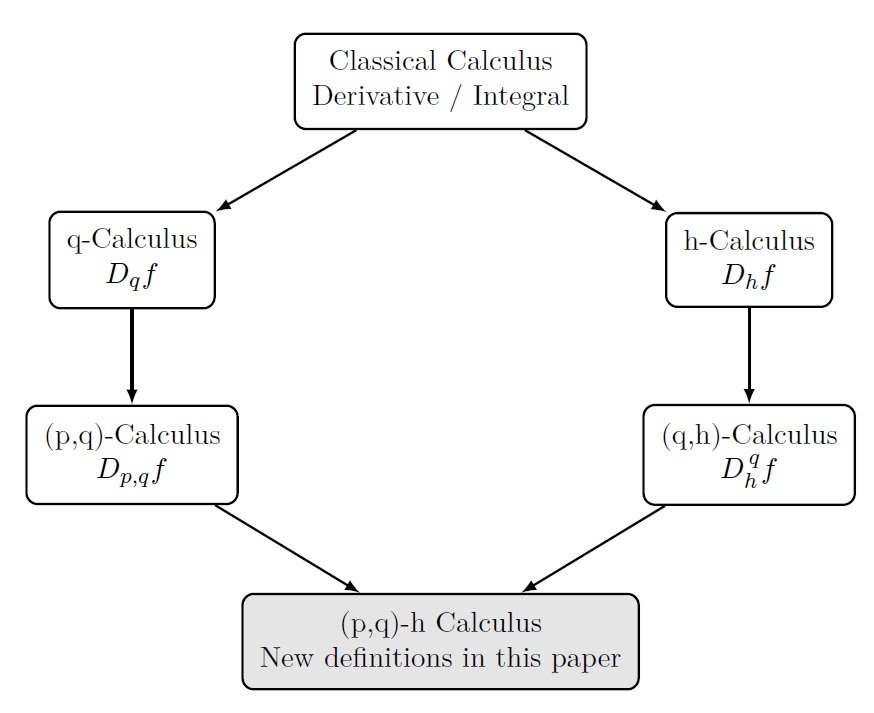
In above definition, for \(t=u\) we have \(^{u}_{h}\mathcal{D}_{q}f(u)=\lim\limits_{t\longrightarrow u}\ ^{u}_{h}\mathcal{D}_{q}f(t)\) and for \(t=v\) we have \(^{v}_{h}\mathcal{D}_{q}f(v)=\lim\limits_{t\longrightarrow v}\ ^{v}_{h}\mathcal{D}_{q}f(t)\). Also, for \(u=v=0\), the expression of \((q,h)\)-derivative (5) is obtained, for \(u=v=0\) and \(q\longrightarrow 1\), the expression of \(h\)-derivative (3) is obtained, for \(u=v=0\) and \(h=1\), the expression of \(q\)-derivative (2) is obtained. The definite \((q,h)\)-integrals are defined as follows:
Definition 8. [12] Consider a continuous function \(f:I\subset[u,v]\rightarrow\mathbb{R}\). Then for \(0<q<1\), \(h \in \mathbb{R}\) and \(t\in[u,v]\), the \(q_{h}^{u}\)-integral and \(q_{h}^{v}\)-integral are defined by: \[\label{qh1} ^{u}_{h}\mathcal{I}_{q}f(t):=\int_{u}^{t}f(t)^{u}_{h}d_{q}t =\big((1-q)(t-u)+qh\big)\sum_{\eta=0}^{\infty}q^{\eta}f(q^{\eta}t+(1-q^{\eta})u+\eta q^\eta h) , \tag{16}\] \[\label{qh2} ^{v}_{h}\mathcal{I}_{q}f(t):=\int_{t}^{v}f(t)^{v}_{h}d_{q}t =\big((1-q)(v-t)+qh\big)\sum_{\eta=0}^{\infty}q^{\eta}f(q^{\eta}t+(1-q^{\eta})v+\eta q^\eta h). \tag{17}\]
For \(h=1\), \((q,h)\)-integrals (16) and (17) reduce to \(q\)-integrals (8) and (9) respectively.
In next section, first we define \((p,q)-h\)-derivatives and \((p,q)-h\)-integrals on finite interval \([u,v]\). Then the \(\mathcal{H}-\mathcal{H}\) type inequalities for convex and differentiable functions via \(q^{u}_{p-h}\)-integrals are established. In 4, we establish the \(\mathcal{H}-\mathcal{H}\) type inequalities for convex and differentiable functions via \(q^{v}_{p-h}\)-integrals. The special cases of the presented results are also given.
First, we define \((p,q)-h\)-derivatives and \((p,q)-h\)-integrals on finite interval \([u,v]\), as follows:
Definition 9. Consider a continuous function \(f:I\subset[u,v]\rightarrow\mathbb{R}\). Then for \(0<q<p\leq1\), \(h \in \mathbb{R}\) and \(t\in[u,v]\), the following expressions: \[^{u}_{h}\mathcal{D}^{p}_{q}f(t)=\frac{f(qt+(1-q)u+qh)-f(pt+(1-p)u)}{(q-p)(t-u)+qh}, \ t \neq u, \tag{18}\] \[^{v}_{h}\mathcal{D}^{p}_{q}f(t)=\frac{f(qt+(1-q)v+qh)-f(pt+(1-p)v)}{(q-p)(t-v)+qh},\ t \neq v, \tag{19}\] will be called \(q_{p-h}^u\)-derivative and \(q_{p-h}^v\)-derivative of the function \(f(t)\).
In above definition, for \(t=u\) we have \(^{u}_{h}\mathcal{D}^{p}_{q}f(u)=\lim\limits_{t\longrightarrow u}\ ^{u}_{h}\mathcal{D}^{p}_{q}f(t)\) and for \(t=v\) we have \(^{v}_{h}\mathcal{D}^{p}_{q}f(v)=\lim\limits_{t\longrightarrow v}\ ^{v}_{h}\mathcal{D}^{p}_{q}f(t)\). Also, for \(p=1\), the expressions of \((q,h)\)-derivatives on finite interval (14) and (15) are obtained, for \(h=0\), the expressions of \((p,q)\)-derivatives on finite interval (10) and (11) are obtained, for \(p=1\) and \(h=0\), the expressions of \(q\)-derivatives on finite interval (6) and (7) are obtained, for \(u=v=0\) and \(p=1\), the expression of \((q,h)\)-derivative (5) is obtained, for \(u=v=h=0\), the expression of \((p,q)\)-derivative (4) is obtained, for \(u=v=0\), \(p=1\) and \(q\longrightarrow 1\), the expression of \(h\)-derivative (3) is obtained, for \(u=v=0\) and \(p=h=1\), the expression of \(q\)-derivative (2) is obtained.
Definition 10. Consider a continuous function \(f:I\subset[u,v]\rightarrow\mathbb{R}\). Then for \(0<q<p\leq1\), \(h \in \mathbb{R}\) and \(t\in[u,v]\), the \(q_{p-h}^{u}\)– and \(q_{p-h}^{v}\)-integrals denoted by \(^{u}_{h}\mathcal{J}^{p}_{q}f\) and \(^{v}_{h}\mathcal{J}^{p}_{q}f\) respectively, are defined by: \[\begin{aligned} \label{pqh1} ^{u}_{h}\mathcal{J}^{p}_{q}f(t):=\int_{u}^{t}f(t)\,^{u}_{h}d^{p}_{q}t =\big((p-q)(t-u)+qh\big)\sum_{\eta=0}^{\infty}\frac{q^{\eta}}{p^{\eta+1}}f\bigg(\frac{q^{\eta}}{p^{\eta+1}}t+\left(1-\frac{q^{\eta}}{p^{\eta+1}}\right)u+\eta\frac{q^\eta h}{p^{\eta+1}}\bigg) , \end{aligned} \tag{20}\] and \[\begin{aligned} \label{pqh2} ^{v}_{h}\mathcal{J}^{p}_{q}f(t):=\int_{t}^{v}f(t)^{v}_{h}d^{p}_{q}t =\big((p-q)(v-t)+qh\big)\sum_{\eta=0}^{\infty}\frac{q^{\eta}}{p^{\eta+1}}f\bigg(\frac{q^{\eta}}{p^{\eta+1}}t+\left(1-\frac{q^{\eta}}{p^{\eta+1}}\right)v+\eta\frac{q^\eta h}{p^{\eta+1}}\bigg). \end{aligned} \tag{21}\]
In above definition, for \(p=1\), the \((p,q)-h\)-integrals reduce to \((q,h)\)-integrals (16) and (17) respectively. For \(h=0\), the \((p,q)-h\)-integrals reduce to \((p,q)\)-integrals (12) and (13) respectively. For \(p=1\) and \(h=0\), the \((p,q)-h\)-integrals reduce to \(q\)-integrals (8) and (9) respectively.
Example 1. Let \(0<q<p\leq1\), \(h \in \mathbb{R}\) and \(f(t)=t\). Then we have: \[\begin{aligned} \label{i1} ^{u}_{h}\mathcal{J}^{p}_{q}f(t):=\int_{u}^{pv+(1-p)u}t\,\,^{u}_{h}d^{p}_{q}t =\big(p(p-q)(v-u)+qh\big)\bigg(\frac{pv+u q}{p^2-q^2}+\frac{h}{p^2}\sum_{\eta=0}^{\infty}\eta\left(\frac{q}{p}\right)^{2\eta}\bigg), \end{aligned} \tag{22}\] and \[\begin{aligned} \label{i2} &^{v}_{h}\mathcal{J}^{p}_{q}f(t):=\int_{pu+(1-p)v}^{v}t\,\,^{v}_{h}d^{p}_{q}t =\big(p(p-q)(v-u)+qh\big)\bigg(\frac{pu+v q}{p^2-q^2}+\frac{h}{p^2}\sum_{\eta=0}^{\infty}\eta\left(\frac{q}{p}\right)^{2\eta}\bigg). \end{aligned} \tag{23}\]
Now, by utilizing \(q^{u}_{p-h}\)-integral, we prove three versions of the \(\mathcal{H}-\mathcal{H}\) inequality for convex and differentiable functions. In whole results, we assume the sum of the series \(\sum_{\eta=0}^{\infty}\eta\left(\frac{q}{p}\right)^{2\eta}\) equal to \(\zeta\).
Theorem 2. Let \(f:[u,v] \rightarrow\mathbb{R}\) be a convex function on \((u,v)\) such that \(0\leq u<v\). Then for \(0<q<p\leq1\), and \(q^{u}_{p-h}\)-integral, we have \[\begin{aligned} \label{1t} f\left(\frac{qu+pv}{p+q}\right)\bigg(\frac{1}{p-q}\bigg)+\frac{mh\zeta}{p^2}&\leq\frac{1}{\big(p(p-q)(v-u)+qh\big)}\int_{u}^{pv+(1-p)u}f(t)\,_{h}^{u}d_{q}^{p}t\nonumber\\&\leq\frac{qf(u)+pf(v)}{p^2-q^2}+\frac{f(v)-f(u)}{v-u}\frac{h\zeta}{p^2}. \end{aligned} \tag{24}\]
Proof. Since, \(f\) is convex function it has at least one line of support at each \(t_o=\frac{qu+pv}{p+q}\) in \((u,v)\). The lines of support for \(f\) are denoted by \(\mathcal{Q}\) and defined as follows: \[\mathcal{Q}(t)=f\left(\frac{qu+pv}{p+q}\right)+m\left(t-\frac{qu+pv}{p+q}\right), \quad m\in \bigg[f'_{-}\left(\frac{qu+pv}{p+q}\right),f'_{+}\left(\frac{qu+pv}{p+q}\right)\bigg].\] As line of supports are always lie below the graph of a convex function, therefore we have \[\label{1} f\left(\frac{qu+pv}{p+q}\right)+m\left(t-\frac{qu+pv}{p+q}\right)\leq f(t),\quad\forall\,\,\, t \in [u,v]. \tag{25}\]
By applying on both sides of (25), \(q^{u}_{p-h}\)-integral, we have \[\label{2} \int_{u}^{pv+(1-p)u}\left(f\left(\frac{qu+pv}{p+q}\right)+m\left(t-\frac{qu+pv}{p+q}\right)\right)\ _{h}^{u}d_{q}^{p}t\leq \int_{u}^{pv+(1-p)u}f(t)_{h}^{u}d_{q}^{p}t. \tag{26}\]
The above inequality (26), can be written as follows: \[\begin{aligned} \label{3} &f\left(\frac{qu+pv}{p+q}\right)\int_{u}^{pv+(1-p)u}\ _{h}^{u}d_{q}^{p}t+m\left(\int_{u}^{pv+(1-p)u}t\ _{h}^{u}d_{q}^{p}t-\left(\frac{qu+pv}{p+q}\right)\int_{u}^{pv+(1-p)u}\ _{h}^{u}d_{q}^{p}t\right)\notag\\&\qquad\qquad\qquad\leq \int_{u}^{pv+(1-p)u}f(t)_{h}^{u}d_{q}^{p}t. \end{aligned} \tag{27}\]
For \(f(t)=1\) in (22), we have the following identity: \[\label{5} \int_{u}^{pv+(1-p)u}\ _{h}^{u}d_{q}^{p}t=\frac{p(p-q)(v-u)+qh}{p-q}. \tag{28}\]
By using (22) and (28) in (27), then after simplification, the first inequality of (24) is obtained. Now, on the other hand, let \(\mathcal{K}\) be a function which expressing the line connecting points \((u,f(u))\) and \((v,f(v))\) as follows: \[\mathcal{K}(t)=f(u)+\frac{f(v)-f(u)}{v-u}(t-u).\]
As we know that \(f\) is a convex function on \([u,v]\) and for this the inequality \(f(t)\leq\mathcal{K}(t)\) holds true. Therefore, the following inequality holds: \[\label{1*} f(t)\leq f(u)+\frac{f(v)-f(u)}{v-u}(t-u),\quad\forall \,\,\, t \in [u,v]. \tag{29}\]
By applying both sides of (29), \(q^{u}_{p-h}\)-integral, we have \[\label{2*} \int_{u}^{pv+(1-p)u}f(t)\ _{h}^{u}d_{q}^{p}t\leq\int_{u}^{pv+(1-p)u}\bigg(f(u)+\frac{f(v)-f(u)}{v-u}(t-u)\bigg)\ _{h}^{u}d_{q}^{p}t. \tag{30}\]
The above inequality (30), can be written as follows: \[\begin{aligned} \label{2**} \int_{u}^{pv+(1-p)u}f(t)\ _{h}^{u}d_{q}^{p}t\leq f(u)\int_{u}^{pv+(1-p)u}\ _{h}^{u}d_{q}^{p}t+\frac{f(v)-f(u)}{v-u}\bigg(\int_{u}^{pv+(1-p)u}t\ _{h}^{u}d_{q}^{p}t-u\int_{u}^{pv+(1-p)u}\ _{h}^{u}d_{q}^{p}t\bigg). \end{aligned} \tag{31}\]
By using (22) and (28) in (31), then after simplification, the second inequality of (24) is obtained. ◻
Corollary 1. Let \(f\) be differentiable. Then (24) reduces to the following inequality: \[\begin{aligned} \label{1t*} f\left(\frac{qu+pv}{p+q}\right)\bigg(\frac{1}{p-q}\bigg)+f'\left(\frac{qu+pv}{p+q}\right)\frac{h\zeta}{p^2}&\leq\frac{1}{\big(p(p-q)(v-u)+qh\big)}\int_{u}^{pv+(1-p)u}f(t)_{h}^{u}d_{q}^{p}t\notag\\ &\leq\frac{qf(u)+pf(v)}{p^2-q^2}+\frac{f(v)-f(u)}{v-u}\frac{h\zeta}{p^2}. \end{aligned} \tag{32}\]
Proof. At point \(\frac{qu+pv}{p+q}\) we have unique line of support with \(m=f'\left(\frac{qu+pv}{p+q}\right)\). By using this value of \(m\) in (24), the inequality (32) is achieved. ◻
Corollary 2. For \(h=0\) in (24), the following inequality holds [8, Theorem 3]: \[\begin{aligned} f\left(\frac{qu+pv}{p+q}\right)\leq\frac{1}{p(v-u)}\int_{u}^{pv+(1-p)u}f(t)_{0}^{u}d_{q}^{p}t\leq\frac{qf(u)+pf(v)}{p+q}. \end{aligned} \tag{33}\]
Corollary 3. For \(p=1\) in (24), the following inequality holds: \[\begin{aligned} f\left(\frac{qu+v}{1+q}\right)\bigg(\frac{1}{1-q}\bigg)+m{h\zeta}&\leq\frac{1}{\big((1-q)(v-u)+qh\big)}\int_{u}^{v}f(t)_{h}^{u}d_{q}^{1}t\notag\\ &\leq\frac{qf(u)+f(v)}{1-q^2}+\frac{f(v)-f(u)}{v-u}{h\zeta}. \end{aligned} \tag{34}\]
Corollary 4. For \(h=0\) and \(p=1\) in (24), the following inequality holds [4, Theorem 6]: \[\begin{aligned} &f\left(\frac{qu+v}{1+q}\right)\leq\frac{1}{(v-u)}\int_{u}^{v}f(t)_{0}^{u}d_{q}^{1}t\leq\frac{qf(u)+f(v)}{1+q}. \end{aligned} \tag{35}\]
Remark 1. 1. For \(p=1\) in (32), the \(\mathcal{H}-\mathcal{H}\) type inequality
for \((q,h)\)-integral given in [12, Theorem 3] is obtained.
2. For \(p=1\), \(h=0\) and \(q\rightarrow1\) in (32), the classical
\(\mathcal{H}-\mathcal{H}\) inequality
is obtained.
Theorem 3. With the same conditions of Theorem 2, the following inequality holds: \[\begin{aligned} \label{2t} f\left(\frac{pu+qv}{p+q}\right)\bigg(\frac{1}{p-q}\bigg)+m\left(\frac{(p-q)(v-u)}{p^2-q^2}+\frac{h}{p^2}\zeta\right)&\leq\frac{1}{p(p-q)(v-u)+qh}\int_{u}^{pv+(1-p)u}f(t)\,_{h}^{u}d_{q}^{p}t\notag\\ &\leq\frac{qf(u)+pf(v)}{p^2-q^2}+\frac{f(v)-f(u)}{v-u}\frac{h\zeta}{p^2}. \end{aligned} \tag{36}\]
Proof. Because \(f\) is convex function, for \(t_o=\frac{pu+qv}{p+q}\) in \((u,v)\) it must has at least one line of support. Let we represent it with \(\mathcal{Q}_1\), that is \[\mathcal{Q}_1(t)=f\left(\frac{pu+qv}{p+q}\right)+m\left(t-\frac{pu+qv}{p+q}\right), \quad m\in \bigg[f'_{-}\left(\frac{pu+qv}{p+q}\right),f'_{+}\left(\frac{pu+qv}{p+q}\right)\bigg].\] A line of support lies below the graph of a convex function, hence in terms of inequality one have \[\label{12} f\left(\frac{pu+qv}{p+q}\right)+m\left(t-\frac{pu+qv}{p+q}\right)\leq f(t),\quad\forall \,\,\, t \in [u,v]. \tag{37}\] By applying both sides of (37), \(q^{u}_{p-h}\)-integral, we have \[\label{22} \int_{u}^{pv+(1-p)u}\left(f\left(\frac{pu+qv}{p+q}\right)+m\left(t-\frac{pu+qv}{p+q}\right)\right)\ _{h}^{u}d_{q}^{p}t\leq \int_{u}^{pv+(1-p)u}f(t)\,_{h}^{u}d_{q}^{p}t. \tag{38}\] The inequality (38), takes the following form: \[\begin{aligned} \label{32} &f\left(\frac{pu+qv}{p+q}\right)\int_{u}^{pv+(1-p)u}\ _{h}^{u}d_{q}^{p}t+m\bigg(\int_{u}^{pv+(1-p)u}t\ _{h}^{u}d_{q}^{p}t-\left(\frac{pu+qv}{p+q}\right)\int_{u}^{pv+(1-p)u}\ _{h}^{u}d_{q}^{p}t\bigg)\notag\\ &\qquad\qquad\qquad\leq \int_{u}^{pv+(1-p)u}f(t)_{h}^{u}d_{q}^{p}t. \end{aligned} \tag{39}\] By using (22) and (28) in (39), and simplifying one can get the first inequality of (36). The proof of second inequality, we left for the reader. ◻
Corollary 5. Let \(f\) is differentiable. Then (36) reduces to the following inequality: \[\begin{aligned} \label{2t*} &f\left(\frac{pu+qv}{p+q}\right)\bigg(\frac{1}{p-q}\bigg)+f'\left(\frac{pu+qv}{p+q}\right)\left(\frac{(p-q)(v-u)}{p^2-q^2}+\frac{h}{p^2}\zeta\right)\notag\\ &\qquad\qquad\leq\frac{1}{\big(p(p-q)(v-u)+qh\big)}\int_{u}^{pv+(1-p)u}f(t)_{h}^{u}d_{q}^{p}t\notag\\ &\qquad\qquad\leq\frac{qf(u)+pf(v)}{p^2-q^2}+\frac{f(v)-f(u)}{v-u}\frac{h\zeta}{p^2}. \end{aligned} \tag{40}\]
Proof. At point \(\frac{pu+qv}{p+q}\) line of support will be unique and \(m=f'\left(\frac{pu+qv}{p+q}\right)\). By using this value of \(m\) in (36), one can get the required inequality (40). ◻
Corollary 6. For \(h=0\) in (36), we have: \[\begin{aligned} &f\!\left(\frac{pu+qv}{p+q}\!\right)\!+\!m\frac{(p-q)(v-u)}{(p+q)}\!\leq\frac{1}{p(v-u)}\!\int_{u}^{pv+(1-p)u}\!\!\!f(t)_{0}^{u}d_{q}^{p}t\!\leq\frac{qf(u)+pf(v)}{p+q}. \end{aligned} \tag{41}\]
Corollary 7. For \(p=1\) in (36), we have: \[\begin{aligned} f\left(\frac{u+qv}{1+q}\right)\bigg(\frac{1}{1-q}\bigg)+m\left(\frac{v-u}{1+q}+{h}\zeta\right)&\leq\frac{1}{\big((1-q)(v-u)+qh\big)}\int_{u}^{v}f(t)_{h}^{u}d_{q}^{1}t\notag\\ &\leq\frac{qf(u)+f(v)}{1-q^2}+\frac{f(v)-f(u)}{v-u}{h\zeta}. \end{aligned} \tag{42}\]
Corollary 8. For \(h=0\) and \(p=1\) in (36), the following inequality holds: \[\begin{aligned} &f\!\left(\frac{u+qv}{1+q}\!\right)\!+\!m\frac{(1-q)(v-u)}{(1+q)}\!\leq\frac{1}{(v-u)}\!\int_{u}^{v}\!\!\!f(t)_{0}^{u}d_{q}^{1}t\!\leq\frac{qf(u)+f(v)}{1+q}. \end{aligned} \tag{43}\]
Remark 2. 1. For \(p=1\) and \(h=0\) in (40), the \(\mathcal{H}-\mathcal{H}\) type inequality
for \(q\)-integral given in [4, Theorem 8] is obtained.
2. For \(h=0\) in (40), the \(\mathcal{H}-\mathcal{H}\) type inequality
for \((p,q)\)-integral given in [8, Theorem 4] is obtained.
3. For \(p=1\), \(h=0\) and \(q\rightarrow1\) in (40), the classical
\(\mathcal{H}-\mathcal{H}\) inequality
is obtained.
Theorem 4. With the same conditions of Theorem 2, the following inequalities are valid: \[\begin{aligned} \label{4t} f\left(\frac{u+v}{2}\right)\bigg(\frac{1}{p-q}\bigg)+m\left(\frac{(p-q)(v-u)}{2(p^2-q^2)}+\frac{h}{p^2}\zeta\right)&\leq\frac{1}{p(p-q)(v-u)+qh}\times\int_{u}^{pv+(1-p)u}f(t)\,_{h}^{u}d_{q}^{p}t\notag\\ &\leq\frac{qf(u)+pf(v)}{p^2-q^2}+\frac{f(v)-f(u)}{v-u}\frac{h\zeta}{p^2}. \end{aligned} \tag{44}\]
Proof. Because \(f\) is convex function, for \(t_o=\frac{u+v}{2}\) in \((u,v)\) it must has at least one line of support. Let we represent it with \(\mathcal{Q}_2\), that is \[\mathcal{Q}_2(t)=f\left(\frac{u+v}{2}\right)+m\left(t-\frac{u+v}{2}\right), \quad m\in \bigg[f'_{-}\left(\frac{u+v}{2}\right),f'_{+}\left(\frac{u+v}{2}\right)\bigg].\] A line of support lies below the graph of a convex function, hence in terms of inequality one have \[\label{124} f\left(\frac{u+v}{2}\right)+m\left(t-\frac{u+v}{2}\right)\leq f(t),\quad\forall \,\,\, t \in [u,v]. \tag{45}\]
By applying both sides of (45), \(q^{u}_{p-h}\)-integral, we have \[\label{224} \int_{u}^{pv+(1-p)u}\left(f\left(\frac{u+v}{2}\right)+m\left(t-\frac{u+v}{2}\right)\right)\ _{h}^{u}d_{q}^{p}t\leq \int_{u}^{pv+(1-p)u}f(t)_{h}^{u}d_{q}^{p}t. \tag{46}\]
The inequality (46), takes the following form:
\[\begin{aligned} \label{324} f\left(\frac{u+v}{2}\right)\int_{u}^{pv+(1-p)u}\ _{h}^{u}d_{q}^{p}t+m\bigg(\int_{u}^{pv+(1-p)u}t\ _{h}^{u}d_{q}^{p}t-\left(\frac{u+v}{2}\right)\int_{u}^{pv+(1-p)u}\ _{h}^{u}d_{q}^{p}t\bigg)\leq \int_{u}^{pv+(1-p)u}f(t)_{h}^{u}d_{q}^{p}t. \end{aligned} \tag{47}\]
By using (22) and (28) in (47), and simplifying one can get the first inequality of (44). The proof of second inequality, we left for reader. ◻
Corollary 9. Let \(f\) be differentiable. Then (44) reduces to the following inequality: \[\begin{aligned} \label{4t*} f\left(\frac{u+v}{2}\right)\bigg(\frac{1}{p-q}\bigg)+f'\left(\frac{u+v}{2}\right)\left(\frac{(p-q)(v-u)}{2(p^2-q^2)}+\frac{h}{p^2}\zeta\right)&\leq\frac{1}{\big(p(p-q)(v-u)+qh\big)}\int_{u}^{pv+(1-p)u}f(t)_{h}^{u}d_{q}^{p}t\nonumber\\&\leq\frac{qf(u)+pf(v)}{p^2-q^2}+\frac{f(v)-f(u)}{v-u}\frac{h\zeta}{p^2}. \end{aligned} \tag{48}\]
Proof. At point \(\frac{u+v}{2}\) line of support will be unique and \(m=f'\left(\frac{u+v}{2}\right)\). By using this value of \(m\) in (44), one can get the required inequality (48). ◻
Corollary 10. For \(h=0\) in (44), we have \[\begin{aligned} &f\left(\frac{u+v}{2}\right)+m\frac{(p-q)(v-u)}{2(p+q)}\leq\frac{1}{p(v-u)}\int_{u}^{pv+(1-p)u}f(t)_{0}^{u}d_{q}^{p}t\leq\frac{qf(u)+pf(v)}{p+q}. \end{aligned} \tag{49}\]
Corollary 11. For \(p=1\) in (44), the following inequality holds: \[\begin{aligned} f\left(\frac{u+v}{2}\right)\bigg(\frac{1}{1-q}\bigg)+m\left(\frac{v-u}{2(1+q)}+{h}\zeta\right)&\leq\frac{1}{\big((1-q)(v-u)+qh\big)}\int_{u}^{v}f(t)_{h}^{u}d_{q}^{1}t\nonumber\\& \leq\frac{qf(u)+f(v)}{1-q^2}+\frac{f(v)-f(u)}{v-u}{h\zeta}. \end{aligned} \tag{50}\]
Corollary 12. For \(h=0\) and \(p=1\) in (44), the following inequality holds: \[\begin{aligned} &f\left(\frac{u+v}{2}\right)+m\frac{(1-q)(v-u)}{2(1+q)}\leq\frac{1}{(v-u)}\int_{u}^{v}f(t)_{0}^{u}d_{q}^{1}t\leq\frac{qf(u)+f(v)}{1+q}. \end{aligned} \tag{51}\]
Remark 3. 1. For \(p=1\) and \(h=0\) in (48), the \(\mathcal{H}-\mathcal{H}\) type inequality
for \(q\)-integral given in [4, Theorem 9] is obtained.
2. For \(h=0\) in (48), the \(\mathcal{H}-\mathcal{H}\) type inequality
for \((p,q)\)-integral given in [8, Theorem 5] is obtained.
3. For \(p=1\) in (48), the \(\mathcal{H}-\mathcal{H}\) type inequality
for \((q,h)\)-integral given in [12, Theorem 5] is obtained.
4. For \(p=1\), \(h=0\) and \(q\rightarrow1\) in (48), the classical
\(\mathcal{H}-\mathcal{H}\) inequality
is obtained.
In this section, we prove the three versions of the \((p,q)-h\)–\(\mathcal{H}-\mathcal{H}\) inequalities for convex function via \(q^{v}_{p-h}\)-integral. Also, for differentiable function these versions are given.
Theorem 5. Let \(f:[u,v] \rightarrow\mathbb{R}\) be a convex function on \((u,v)\) such that \(0\leq u<v\). Then for \(0<q<p\leq1\), and \(q^{v}_{p-h}\)-integral, we have \[\begin{aligned} \label{5t} f\left(\frac{qu+pv}{p+q}\right)\bigg(\frac{1}{p-q}\bigg)+m\bigg(\frac{h\zeta}{p^2}-\frac{v-u}{p+q}\bigg)&\leq\frac{1}{p(p-q)(v-u)+qh}\times\int_{pu+(1-p)v}^{v}f(t)\,_{h}^{v}d_{q}^{p}t\notag\\ &\leq\frac{pf(u)+qf(v)}{p^2-q^2}+\frac{f(v)-f(u)}{v-u}\frac{h\zeta}{p^2}. \end{aligned} \tag{52}\]
Proof. By applying both sides of (25), \(q^{v}_{p-h}\)-integral, we have \[\label{42} \int_{pu+(1-p)v}^{v}\left(f\left(\frac{qu+pv}{p+q}\right)+m\left(t-\frac{qu+pv}{p+q}\right)\right)\ _{h}^{v}d_{q}^{p}t\leq \int_{pu+(1-p)v}^{v}f(t)\,_{h}^{v}d_{q}^{p}t. \tag{53}\]
For \(f(t)=1\) in (23), one can get the upcoming identity: \[\label{45} \int_{pu+(1-p)v}^{v}\ _{h}^{v}d_{q}^{p}t=\frac{p(p-q)(v-u)+qh}{p-q}. \tag{54}\]
By using (23) and (54) in (53), then after simplification, the first inequality of (52) is obtained. Now, for the second inequality, applying both sides of (29), \(q^{v}_{p-h}\)-integral, we have \[\label{42*} \int_{pu+(1-p)v}^{v}f(t)\ _{h}^{v}d_{q}^{p}t\leq\int_{pu+(1-p)v}^{v}\bigg(f(u)+\frac{f(v)-f(u)}{v-u}(t-u)\bigg)\ _{h}^{v}d_{q}^{p}t. \tag{55}\]
By using (23) and (54) in (55), then after simplification, the second inequality of (52) is obtained. ◻
Corollary 13. Let \(f\) be differentiable. Then (52) reduces to the following inequality: \[\begin{aligned} \label{21t*} f\left(\frac{qu+pv}{p+q}\right)\bigg(\frac{1}{p-q}\bigg)+f'\left(\frac{qu+pv}{p+q}\right)\bigg(\frac{h\zeta}{p^2}-\frac{v-u}{p+q}\bigg)&\leq\frac{1}{p(p-q)(v-u)+qh}\times\int_{pu+(1-p)v}^{v}f(t)_{h}^{v}d_{q}^{p}t\notag\\ &\leq\frac{pf(u)+qf(v)}{p^2-q^2}+\frac{f(v)-f(u)}{v-u}\frac{h\zeta}{p^2}. \end{aligned} \tag{56}\]
Proof. At point \(\frac{qu+pv}{p+q}\) line of support will be unique and \(m=f'\left(\frac{qu+pv}{p+q}\right)\). By using this value of \(m\) in (52), one can get the required inequality (56). ◻
Theorem 6. With the same conditions of Theorem 5, the following inequality is valid: \[\begin{aligned} \label{52t} f\left(\frac{pu+qv}{p+q}\right)\bigg(\frac{1}{p-q}\bigg)+\frac{mh\zeta}{p^2}&\leq\frac{1}{p(p-q)(v-u)+qh}\times\int_{pu+(1-p)v}^{v}f(t)\,_{h}^{v}d_{q}^{p}t\notag\\ &\leq\frac{pf(u)+qf(v)}{p^2-q^2}+\frac{f(v)-f(u)}{v-u}\frac{h\zeta}{p^2}. \end{aligned} \tag{57}\]
Proof. By applying both sides of (37), \(q^{v}_{p-h}\)-integral, we have \[\label{422} \int_{pu+(1-p)v}^{v}\left(f\left(\frac{pu+qv}{p+q}\right)+m\left(t-\frac{pu+qv}{p+q}\right)\right)\ _{h}^{v}d_{q}^{p}t\leq \int_{pu+(1-p)v}^{v}f(t)\,_{h}^{v}d_{q}^{p}t. \tag{58}\]
By using (23) and (54) in (58), then after simplification, the first inequality of (57) is obtained. The proof of second inequality is left for reader. ◻
Corollary 14. Let \(f\) be differentiable. Then (57) reduces to the following inequality: \[\begin{aligned} \label{231t*} f\left(\frac{pu+qv}{p+q}\right)\bigg(\frac{1}{p-q}\bigg)+f'\left(\frac{pu+qv}{p+q}\right)\frac{h\zeta}{p^2}&\leq\frac{1}{p(p-q)(v-u)+qh}\times\int_{pu+(1-p)v}^{v}f(t)\,_{h}^{v}d_{q}^{p}t\notag\\ &\leq\frac{pf(u)+qf(v)}{p^2-q^2}+\frac{f(v)-f(u)}{v-u}\frac{h\zeta}{p^2}. \end{aligned} \tag{59}\]
Proof. At point \(\frac{pu+qv}{p+q}\) line of support will be unique and \(m=f'\left(\frac{pu+qv}{p+q}\right)\). By using this value of \(m\) in (57), one can get the required inequality (59). ◻
Remark 4. 1. For \(p=1\) in (59), the \(\mathcal{H}-\mathcal{H}\) type inequality
for \((q,h)\)-integral given in [12, Theorem 4] is obtained.
2. For \(h=0\) and \(p=1\) in (59), the \(\mathcal{H}-\mathcal{H}\) type inequality
for \(q\)-integral given in [17, Theorem 12] is obtained.
Theorem 7. With the same conditions of Theorem 5, the following inequality is valid: \[\begin{aligned} \label{53t} f\left(\frac{u+v}{2}\right)\bigg(\frac{1}{p-q}\bigg)+m\bigg(\frac{h\zeta}{p^2}-\frac{v-u}{2(p+q)}\bigg)&\leq\frac{1}{p(p-q)(v-u)+qh}\times\int_{pu+(1-p)v}^{v}f(t)\,_{h}^{v}d_{q}^{p}t\notag\\ &\leq\frac{pf(u)+qf(v)}{p^2-q^2}+\frac{f(v)-f(u)}{v-u}\frac{h\zeta}{p^2}. \end{aligned} \tag{60}\]
Proof. By applying both sides of (45), \(q^{v}_{p-h}\)-integral, we have \[\label{432} \int_{pu+(1-p)v}^{v}\left(f\left(\frac{u+v}{2}\right)+m\left(t-\frac{u+v}{2}\right)\right)\ _{h}^{v}d_{q}^{p}t\leq \int_{pu+(1-p)v}^{v}f(t)\,_{h}^{v}d_{q}^{p}t. \tag{61}\] By using (23) and (54) in (61), then after simplification, the first inequality of (60) is obtained. The proof of second inequality is left for reader. ◻
Corollary 15. Let \(f\) be differentiable. Then (60) reduces to the following inequality: \[\begin{aligned} \label{54t*} f\left(\frac{u+v}{2}\right)\bigg(\frac{1}{p-q}\bigg)+f'\left(\frac{u+v}{2}\right)\bigg(\frac{h\zeta}{p^2}-\frac{v-u}{2(p+q)}\bigg)&\leq\frac{1}{p(p-q)(v-u)+qh}\times\int_{pu+(1-p)v}^{v}f(t)_{h}^{v}d_{q}^{p}t\notag\\ &\leq\frac{pf(u)+qf(v)}{p^2-q^2}+\frac{f(v)-f(u)}{v-u}\frac{h\zeta}{p^2}. \end{aligned} \tag{62}\]
Proof. At point \(\frac{u+v}{2}\) line of support will be unique and \(m=f'\left(\frac{u+v}{2}\right)\). By using this value of \(m\) in (60), one can get the required inequality (62). ◻
Remark 5. For \(p=1\) in (62), the \(\mathcal{H}-\mathcal{H}\) type inequality for \((q,h)\)-integral given in [12, Theorem 6] is obtained.
This paper has presented new Hermite-Hadamard type inequalities in the framework of \((p,q)\!-\!h\) calculus for convex and differentiable functions. The results unify and extend several earlier inequalities, showing that the \((p,q)\!-\!h\) setting is a versatile tool that naturally recovers known cases such as \(q\)-, \((p,q)\)-, and \((q,h)\)-integrals. These findings strengthen the role of generalized convexity in quantum analysis and provide a basis for applications in optimization, approximation theory, and numerical methods. Future research may extend these inequalities to broader classes of functions and explore their utility in applied sciences and engineering.